
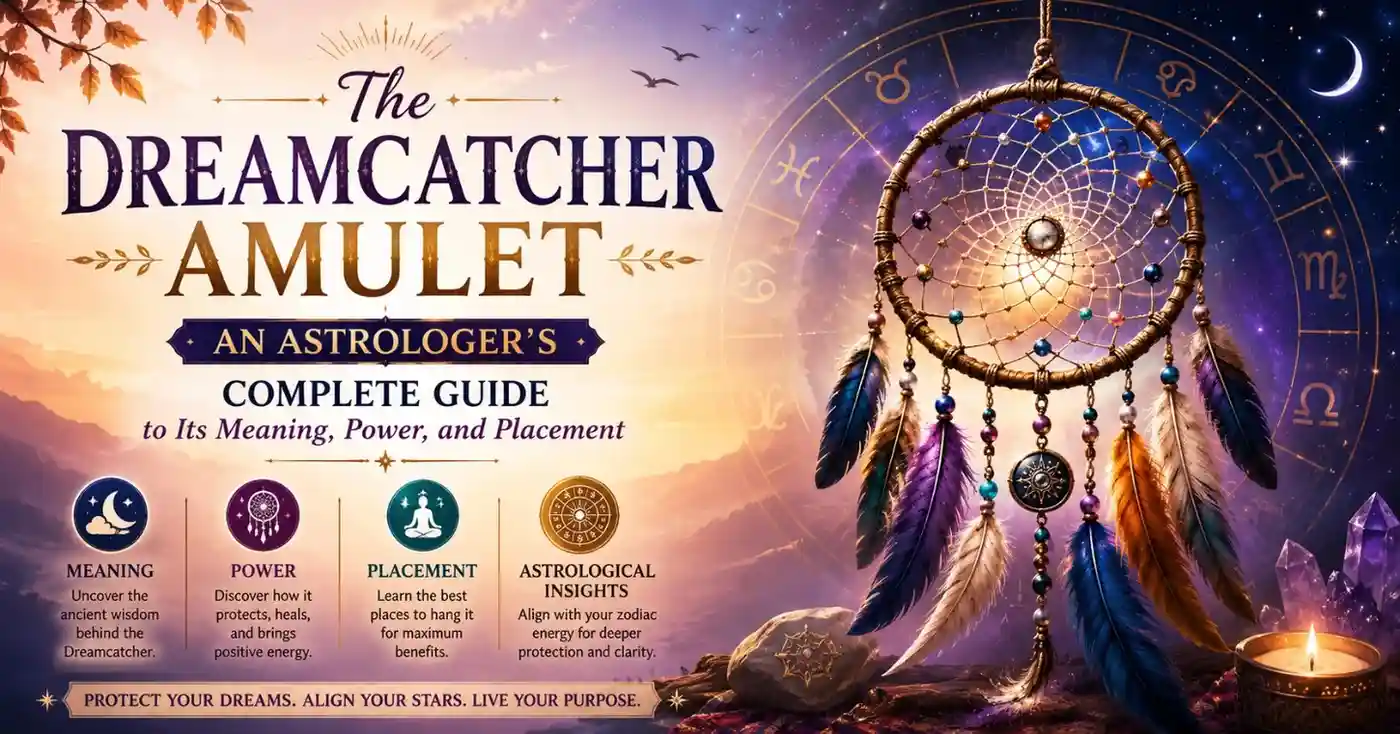
In more than two decades of reading charts and helping clients understand the unseen forces shaping their sleep, their dreams, and their energy, I have watched one object come up again and again in consultations: the dreamcatcher amulet. People bring it up almost sheepishly, as if it’s “just decoration,” and then admit that ever since they hung one above their bed, something in their nights has shifted. As an astrologer, I don’t see that as coincidence. I see it as the meeting point of ancient symbolism, planetary energy, and the oldest human need there is — to feel safe while we sleep.
This guide draws together the traditional meaning of the dreamcatcher amulet, the astrological logic behind why it seems to “work” for so many people, and the practical, experience-based advice I give my own clients about choosing, placing, and caring for one. Whether you’re drawn to a dreamcatcher for its beauty, its protective symbolism, or its connection to your zodiac sign, this article will help you understand exactly what you’re bringing into your home — and how to use it with intention.
What Is a Dreamcatcher Amulet?
A dreamcatcher amulet is a handwoven talisman, traditionally built from a circular hoop, an inner web, and hanging feathers and beads, designed to filter the energy that moves through a sleeper’s mind at night. Rooted in the cultural tapestry of the Ojibwe (Chippewa) Nation, this iconic object carries deep spiritual significance and is believed to guard against nightmares while acting as a conduit for positive dreams. In practical terms, the belief is simple and elegant: good dreams know how to move gently through the web and slide down the feathers to the sleeper, while nightmares and heavy energy get caught in the weave and burn away with the morning sun.
From an astrological standpoint, I think of the dreamcatcher as a kind of energetic filter that works the same way a natal chart filters raw planetary energy into personality — it doesn’t create the energy, it shapes how it reaches you. That’s precisely why the amulet has found such a natural home within modern astrology and crystal-healing practices, where each element of the dreamcatcher — hoop, web, feather, bead, and stone — can be matched to a person’s sign, ruling planet, or elemental energy for a more personalized protective effect.
The Ancestral Origins and Legend of the Dreamcatcher
To understand why this amulet carries so much symbolic weight, it helps to know where it comes from. The meaning of a dreamcatcher is rooted in a beautiful balance of protection, tradition, and spirituality, originally crafted by the Indigenous peoples of North America as a filter for the spirit world. These sacred hoops were designed to trap nightmares in their intricate webs while allowing peaceful dreams to slide down their feathers to the sleeper below.
The Ojibwe Legend of Asibikaashi, the Spider Woman
The history of the dreamcatcher is primarily defined by two oral traditions, the first of which centers on Asibikaashi, the Ojibwe Spider Woman. As the story is told, Asibikaashi cared for the children and people of her nation, spinning her web across the doorway of the dwelling each night to catch anything harmful before it reached the sleepers inside. As the Ojibwe nation expanded and it became harder for Asibikaashi to reach every child, mothers and grandmothers began weaving miniature spider webs from willow hoops and sinew, so that every family could carry her protection with them.
The Lakota Legend of Iktomi the Spider Spirit
There’s a second, equally powerful origin story from the Lakota tradition. According to this legend, a leader of the tribe had a vision of Iktomi, a spiritual guide who delighted in transformations and sleight of hand, and who appeared in the dream in the form of a spider. Iktomi took a willow hoop — the same sacred plant used for arrows and ceremonial ornaments — and began to weave a web across it while speaking of the cycles of life: how we begin as infants, grow through childhood, become adults, and eventually return to a state of dependence in old age. The web itself became a teaching tool, a symbol of both protection and the interconnected nature of every stage of life.
Historians note the dreamcatcher was likely invented by the Ojibwe tribe and passed to the Lakota through relations between the two nations, though the Lakota claim its creation as their own — and, in truth, we will probably never know with certainty who wove the very first one. What both legends agree on, however, is the amulet’s core purpose: to filter what reaches us while we are at our most vulnerable, unconscious and unguarded.
The Spiritual and Astrological Symbolism of Each Element
Every part of a dreamcatcher carries meaning, and as an astrologer, I find it fascinating how neatly each component maps onto astrological concepts you’ll already recognize from your natal chart. Understanding this symbolism is the key to choosing — or building — a dreamcatcher that actually resonates with your energy.
The Hoop: The Wheel of Life and the Cosmic Cycle
Dreamcatchers, often in the form of a circle, are seen as symbols for peace and harmony, with the hoop representing healing energy through its symbol of an eternal cycle. In astrology, this circular shape mirrors the zodiac wheel itself — the same wheel your birth chart is drawn on, with its twelve houses and twelve signs representing a complete cycle of experience. When you hang a dreamcatcher, you are, in effect, hanging a miniature cosmos above your head: a closed loop of protection with no beginning and no end for negative energy to slip through.
The Web: An Energetic Filter for the Subconscious Mind
The woven web acts as an energy filter that retains negativity and allows positivity to flow freely, while the circular hoop represents the cycle of life and the connection with Mother Earth. Astrologically, I associate the web with the Moon — the planet that governs our subconscious, our emotional undercurrents, and our dream life. A dreamcatcher’s web is essentially a physical stand-in for the lunar function in your chart: sorting emotional debris from genuine intuitive insight while you sleep.
Feathers: Air, Breath, and Messages from Spirit
Dreamcatchers often featured at least one feather from a bird of prey — most prized were those from owls and eagles — chosen by the owner to hold special personal meaning. In elemental astrology, feathers correspond directly to the Air element (Gemini, Libra, Aquarius), representing breath, thought, and the movement of spirit through the physical world. This is also why feathers are considered the final stage of a good dream’s journey — nightmares were caught in the web and vanished with the morning light, while good dreams slid down the feathers to the sleepers below. Air carries; feathers deliver.
Beads and Gemstones: Fixed Prayers and Planetary Anchors
In tribes, shamans crafted the dreamcatcher while the owner added personal adornments like stones, shells, pearls, or beads that held special meaning, with the rarest minerals used by Native Americans including magnesite and crystal. A single bead is traditionally thought to represent the spider that spun the original web, while a cluster of beads represents the dreams that made it through — the memorable, meaningful dreams of a lifetime. In modern astrological practice, gemstones are frequently added to dreamcatchers specifically to reinforce planetary rulerships: rose quartz for Venus-ruled Taurus and Libra, carnelian for fiery Mars energy, moonstone for the Moon and Cancer, and clear quartz as an amplifier for any intention at all.
How the Dreamcatcher Amulet Connects to Astrology and the Zodiac
Modern astrologers have increasingly paired the dreamcatcher’s ancestral symbolism with zodiac energy, and honestly, it’s a natural fit. Astrologers believe the circular shape represents the continuous cycle of the zodiac, while the web inside mirrors the cosmic web connecting all twelve signs. Below is how I typically guide clients toward a dreamcatcher that complements their elemental makeup.
Fire Signs: Aries, Leo, Sagittarius
Fire signs run hot — mentally active, restless, prone to vivid or anxious dreaming when overstimulated. For fiery Aries energy, a red dream catcher can help channel that ram-like enthusiasm into productive dreams rather than midnight anxiety spirals. Leo’s cosmic connection to dream catchers is about amplifying star-quality dreams, with a golden or sun-themed dream catcher placed in the east said to boost confidence-building dreams while filtering out anxious ones. I generally recommend citrine, carnelian, or garnet accents for fire signs — stones that support rather than overstimulate an already energetic mind.
Earth Signs: Taurus, Virgo, Capricorn
Earth signs benefit from dreamcatchers built with natural, grounding materials — wood, unbleached cotton, and stones like moss agate, tiger’s eye, or smoky quartz. These signs tend to carry practical daily stress into their sleep, and a heavier, more textured dreamcatcher (rather than a delicate, airy one) tends to feel more resonant for their steady, tactile energy.
Air Signs: Gemini, Libra, Aquarius
Air signs are naturally aligned with the feather symbolism of the dreamcatcher, since the woven web design allows positive dreams to pass while preventing nightmares and bad dreams from reaching the sleeper, with the hole in the center symbolizing how the soul can soar out into the universe. Air-sign sleepers often report overactive, chattering minds at bedtime, and a lighter dreamcatcher with plentiful feathers, hung where it can move gently in a breeze, tends to suit their need for mental release.
Water Signs: Cancer, Scorpio, Pisces
Sensitive Cancers, ruled by the Moon, can treat dream catchers as moon energy in physical form — a silver or pearl-embellished piece placed near the bed creates what astrologers call an “emotional filtration system,” keeping weepy, emotional nightmares at bay while letting in nourishing dreams. Scorpio and Pisces, both deeply intuitive and dream-heavy signs, tend to do beautifully with moonstone, amethyst, or labradorite dreamcatchers — stones long associated with psychic sensitivity and emotional protection.
The Astrological Benefits of Hanging a Dreamcatcher
Clients often ask me directly: does it actually do anything? My honest astrological answer is that the dreamcatcher works on three levels simultaneously — symbolic, psychological, and energetic — and all three reinforce each other.
- Energetic filtration. This amulet is attributed with properties such as energetic protection and a connection to the spiritual and nature, acting as a bridge between the physical world, dreams, and the spiritual.
- Emotional grounding. For those who fear negative energies, spirits, or witchcraft, dreamcatchers act as spiritual guardians, and hanging one in your home or workspace can create an energetic barrier that filters negative influences.
- Improved rest. Many people report that dreamcatchers help combat nightmares and feelings of fear or vulnerability, and hanging one above the bed can improve the quality of sleep by filtering disturbing energies.
- A daily ritual anchor. Simply having a meaningful object above your bed encourages a small nightly ritual of intention-setting — and in astrology, ritual and repetition are two of the most powerful tools we have for shifting subconscious patterns.
I want to be transparent here, as any responsible astrologer should be: a dreamcatcher is a symbolic and energetic tool, not a scientifically proven medical treatment for insomnia, anxiety, or trauma-related nightmares. If sleep disturbances are severe or persistent, please also speak with a doctor or therapist — the amulet works best as a complement to, not a replacement for, proper care.
Choosing the Right Dreamcatcher Amulet for Your Energy
Not every dreamcatcher is created equal, and choosing one intentionally makes a real difference in how it “feels” in your space.
By Color
Dream catchers in a multitude of colors offer an energetic and distinctive aesthetic, combining energies from various hues — red for power, blue for serenity, yellow for joy, and green symbolizing regeneration. The black dream catcher is considered one of the rarest types, often made entirely of glass or crystal beads and traditionally used by shamans, healers, and in sweatlodge ceremonies. As a general astrological rule: choose warm tones (red, orange, gold) if you want to energize and motivate your dream life, and cool tones (blue, silver, white) if your goal is calm, restful, undisturbed sleep.
By Gemstone
Semi-precious stones such as tourmaline, tiger’s eye, citrine, and amethyst are often used to amplify a dreamcatcher’s protective effect, with tourmaline especially known for its ability to absorb and repel negative energy and provide an energetic shield. When in doubt, amethyst is the single most universally compatible stone across all twelve signs, thanks to its association with spiritual clarity and restful sleep.
By Zodiac Sign
Many artisans now weave dreamcatchers specifically tied to birth charts — a lovely, highly personal option. One astrologer describes her own dreamcatcher-based astrology charts as using the twelve Native American zodiac animals corresponding to the twelve western zodiac signs, tied to the idea of a medicine wheel. If you’re choosing a zodiac dreamcatcher as a gift, look for one that pairs your recipient’s sun sign with stones and colors that match their elemental family, rather than picking based on appearance alone — the symbolic alignment is what gives the piece its real resonance.
By Design Style
One intriguing version, known as the Fusion of Souls Amulet, consists of two hoops intersecting with webs crossing through their sections while hosting one bead-shaped amulet at each end, signifying protection for relationships and safe dreams for those who love each other. Heart-shaped dream catchers, meanwhile, carry powerful symbolism of joy, love, and emotional healing, making them a meaningful gift for someone special and a reminder to focus on the relationships that matter. If your intention is romantic protection or relationship harmony, these design variants are worth seeking out over the traditional single-hoop style.
Where and How to Place Your Dreamcatcher for Maximum Protection
Placement matters just as much as the object itself. Here is the guidance I give every client, drawn from both traditional teaching and practical astrological logic.
Above the Bed
The placement of a dreamcatcher depends on what you want from it — if you wish for restful sleep and to prevent nightmares, hang the dreamcatcher directly above your bed. According to indigenous belief, the dreamcatcher should be hung in a spot where the sun shines at least once a day, so that the sun can “purify” the net each morning, removing the negative energies trapped there overnight and preparing it for the next night.
Near the Entrance of Your Home
The entrance of a house is a key energy point, and a dreamcatcher there can symbolize general protection and cleansing of negative energies before they enter your personal space, fostering a harmonious, balanced environment. This is one of my favorite placements for clients dealing with a chaotic household or frequent visitors, since it acts as an energetic checkpoint before anything crosses your threshold.
In a Meditation or Yoga Space
Placing the dreamcatcher where you practice meditation, yoga, or introspection can help enhance your spiritual connection, mental clarity, and inner calm, facilitating openness to intuition and positive thought.
On a Window, Above a TV, or in a Child’s Room
If hung on a window, a dreamcatcher is believed to block bad energy, while one placed above a TV or computer is thought to filter the negative energy emitted by these devices. Traditionally, dreamcatchers were hung above the crib or bed of young children, with the belief that positive dreams pass through the center of the net while nightmares are trapped in the mesh.
How to Cleanse and Charge Your Dreamcatcher Amulet
A dreamcatcher isn’t a “set it and forget it” object — like any amulet, it accumulates energy over time and needs periodic renewal.
- Sunlight cleansing. According to some contemporary traditions, placing the dreamcatcher where it receives sunlight intensifies its symbolic power, as sunlight is believed to dissolve the energies trapped in the web, continuously purifying the environment.
- Smoke cleansing. If you use the dreamcatcher for spiritual purposes, energetically cleansing it with herbal smoke, such as sage, can help revitalize its power.
- Set your intention. Before installing it, take a few seconds to visualize your purpose for it — protection, calm, or positive dreams — so that your intention becomes woven into the object itself.
- Physical care. To keep a dreamcatcher in good condition, clean any metal or plastic parts regularly with mild detergent on a soft cloth, and hand-wash fabric components carefully to avoid damage.
I recommend a full moon or new moon cleanse as the ideal astrological timing — full moons for releasing built-up negativity, new moons for setting fresh protective intentions.
Common Myths and Misconceptions About the Dreamcatcher Amulet
There’s a lot of noise online about dreamcatchers, so let’s clear up a few things.
Myth: It’s purely decorative and has no real tradition behind it. While a dreamcatcher is, first and foremost, a timeless decoration that fits into any home, it is also, above all, a significant talisman that has become popular in many households due to its perceived effects on individuals.
Myth: Any dreamcatcher works the same way. Different types of dream catchers carry different meanings depending on their design, color, and materials — understanding these symbols and traditions helps you pick the piece that will suit your needs best.
Myth: The design and materials don’t matter. Choosing dreamcatchers made with natural materials — wood, real feathers, string — can reinforce their original and spiritual meaning far more effectively than mass-produced synthetic versions.
Respecting the Cultural Origins of the Dreamcatcher
As an astrologer who works across many traditions, I feel strongly that this section belongs in any honest guide to the dreamcatcher amulet. The commercialization of dreamcatchers has saturated the market with mass-produced versions that completely sever the item from its Indigenous history, and true cultural appreciation requires taking the time to learn that history and respect the spiritual intent behind it. Appropriation occurs when the symbol is treated purely as a superficial fashion trend or cheap aesthetic accessory, without acknowledging or supporting the people who carried the tradition through generations.
Wherever possible, I encourage clients to purchase directly from Native American craftsmen, which helps preserve a living tradition and ensures that centuries-old spiritual meanings and sacred weaving techniques remain intact rather than diluted. Using a dreamcatcher as a spiritual or astrological tool can absolutely coexist with cultural respect — the two are not in conflict, as long as we approach the object with genuine reverence rather than treating it as a disposable trend.
Frequently Asked Questions About the Dreamcatcher Amulet
Does a dreamcatcher really stop nightmares?
Symbolically and energetically, that is its entire purpose. A dreamcatcher is considered a protective talisman with magical power meant to guard against nightmares, bringing peaceful sleep and happiness. There’s no scientific mechanism proven behind this, but the ritual of hanging one, combined with the calming visual presence of the object, genuinely helps many people relax into sleep with greater ease.
How often should I cleanse my dreamcatcher?
Once a month, ideally timed to the full or new moon, is a good rhythm for most people. If you’ve been through an especially stressful period, an extra sunlight or smoke cleanse is never a bad idea.
Can I hang more than one dreamcatcher in my home?
Yes. Many of my clients hang one over the bed for sleep protection, a second near the entryway for general household protection, and a third in a meditation corner — each serving a distinct energetic purpose.
What’s the difference between a decorative dreamcatcher and a spiritual one?
Mainly intention and materials. Dreamcatchers made from natural materials serve as a bridge between the physical and spiritual worlds, allowing for greater harmonization and alignment with natural forces — something a purely ornamental, synthetic piece typically doesn’t offer in the same way.
Is it disrespectful to use a dreamcatcher if I’m not Native American?
Not inherently — but it should be done thoughtfully. Appreciation means learning the history, respecting the spiritual intent, and recognizing the dreamcatcher as a living piece of Native American heritage, ideally by supporting Indigenous artisans directly rather than mass-market imitations.
Signs You May Be Ready for a Dreamcatcher Amulet
In my practice, certain patterns tend to show up right before someone finally decides to bring a dreamcatcher into their home. You might be needing a dreamcatcher if lately you’ve noticed disrupted sleep, a heavier emotional load, or a general sense that your space needs re-anchoring. A few more specific signs I watch for in consultations:
- You wake up feeling more tired than when you went to sleep, even after a full night’s rest.
- You’ve moved into a new home or room and haven’t yet “claimed” the space energetically.
- You’re going through a period of grief, transition, or heightened anxiety that seems to follow you into your dreams.
- You’ve been having repetitive or unusually vivid nightmares with no clear physical cause.
- You feel drawn, almost inexplicably, to the image of a dreamcatcher whenever you see one — which, in my experience, is often the clearest sign of all. Symbolic pull is rarely random.
If several of these resonate, it may be worth treating the dreamcatcher not as a passing purchase but as a considered ritual object — chosen deliberately, placed with intention, and cared for over time.
Types of Dreamcatchers and What They’re Best Suited For
Beyond zodiac-specific designs, it helps to understand the broader categories of dreamcatchers available today, since each is built with a slightly different purpose in mind.
Traditional single-hoop dreamcatchers remain the most versatile choice and the closest to the original Ojibwe design — a good starting point for anyone new to working with the amulet.
Multi-hoop and nested designs, such as the double-ring “Fusion” style mentioned earlier, are best suited to shared spaces: bedrooms shared by partners, family homes, or nurseries where more than one person’s energy needs filtering.
Crystal-heavy dreamcatchers, often built with combinations of stones like hematite, garnet, quartz, rhodonite, rose quartz, and iolite, are ideal for anyone doing active shadow work, therapy, or inner healing, since the added mineral energy is thought to intensify the amulet’s filtering effect.
Minimalist or feather-free suncatcher styles work well for people who want the aesthetic and symbolic benefit of the dreamcatcher without a heavy visual presence — a good option for small apartments, shared walls, or minimalist interiors.
Miniature travel dreamcatchers, small enough to clip to a bag or hang from a car mirror, are increasingly popular for people who feel their protective needs extend beyond the bedroom into daily movement through the world — commutes, travel, and time spent away from home.
Matching the type to your actual lifestyle, not just your sign, will always give you a more satisfying result than choosing on looks alone.
Final Thoughts: Weaving Protection Into Your Nights
Whether you come to the dreamcatcher amulet through astrology, curiosity, or simple aesthetic pull, its enduring popularity tells us something important: humans have always needed a way to feel protected while their conscious mind rests. Its purpose is to filter energy during the night — allowing healing dreams to pass gently through the web while catching nightmares and heavy vibrations until they dissolve with the morning light.
As an astrologer, my closing advice is always the same: choose your dreamcatcher the way you’d choose any meaningful talisman — with attention to its materials, its origin, and the intention you set the moment you hang it. Pair it thoughtfully with your zodiac energy, place it where morning light can reach it, cleanse it with the rhythm of the moon, and let it do what it has done for generations before you: stand quiet guard over your dreams while you sleep.
My Today’s Horoscope is filled with carefully researched articles, daily horoscopes, spiritual guidance, zodiac compatibility insights, numerology meanings, tarot interpretations, and astrology tools for readers of every experience level — from curious beginners to advanced astrology enthusiasts. (See our Site Index to quickly find what we have to offer)