
Psalm 91 is one of the most quoted chapters in the entire Bible. Soldiers carry it into battle. Caregivers whisper it at hospital bedsides. Believers recite it during storms, surgeries, and sleepless nights. Few passages in Scripture combine such vivid imagery with such bold promises.
This guide walks through Psalm 91 in full. It covers authorship, structure, Hebrew word meanings, verse-by-verse commentary, historical background, and the hard theological questions the psalm raises. It also answers the questions people ask most often about this chapter. The goal is simple: help you understand Psalm 91 completely, in plain English, without losing any of its depth.
What Is Psalm 91 About?
Psalm 91 is a song of trust. It describes the safety that belongs to anyone who takes shelter in God. The psalm pictures God as a fortress, a shield, and a mother bird who shelters her young under her wings. It promises protection from hidden traps, disease, nighttime terror, and open danger. It ends with God speaking directly, promising rescue, honor, and long life to the person who loves Him.
Scholars often summarize the psalm’s message in one line: the person who lives close to God does not need to live in fear. That single idea shapes every verse that follows.
Who Wrote Psalm 91?
No name appears at the top of Psalm 91 in the original Hebrew text. The psalm is anonymous. This surprises many readers, since tradition has attached a famous name to it anyway.
The Case for Moses
Psalm 91 sits directly after Psalm 90, and Psalm 90 carries a clear superscription: “A prayer of Moses, the man of God.” Because ancient Hebrew manuscripts group psalms in blocks, some early Jewish teachers assumed the next untitled psalm continued under the same author. The Babylonian Talmud reflects this view, attributing Psalm 91 to Moses along with several surrounding psalms.
The Greek Septuagint, translated centuries before the New Testament era, takes a different position. It labels Psalm 91 as a psalm “of David,” though it gives no explanation for that title.
Why Most Scholars Call It Anonymous
Modern biblical scholarship generally treats both attributions as later guesses rather than historical fact. The Hebrew Masoretic Text, which is the authoritative source for the Old Testament, includes no author’s name at all. Most commentators today simply note that the writer is unknown and move on to the psalm’s content, since the message stands on its own regardless of who penned it.
What scholars do agree on is placement. Psalm 91 belongs to Book Four of the Psalter, a section running from Psalm 90 to Psalm 106. This section was likely compiled after the Babylonian exile, when Israel needed reassurance that God still reigned even though the monarchy had collapsed. Reading Psalm 91 next to Psalm 90 makes the pairing feel intentional. Psalm 90 mourns human frailty and the shortness of life. Psalm 91 answers with a promise of shelter. One psalm names the problem. The next offers the solution.
The Structure of Psalm 91: Three Voices in One Song
Psalm 91 is built around a shift in speaker, and noticing that shift unlocks the whole psalm.
Verses 1 and 2 speak in first person. An individual declares personal trust: “I will say of the Lord, He is my refuge.”
Verses 3 through 13 switch to second person. A different voice, perhaps a priest or teacher, now addresses “you” directly, promising protection to the listener.
Verses 14 through 16 shift again. Here God Himself speaks in first person: “Because he has set his love upon me, therefore I will deliver him.” The psalm closes with a divine oath, not a human wish.
This three-part structure matters because it shows the psalm moving from personal testimony, to public instruction, to divine promise. The reader starts as an observer and ends as the direct recipient of God’s own words.
The Names of God in Psalm 91
Verses 1 and 2 pack four distinct Hebrew names for God into two short lines. Each name reveals a different side of His character, and together they form the theological foundation for everything that follows.
El Elyon — The Most High
The phrase “Most High” translates the Hebrew Elyon. This name emphasizes God’s supremacy. He sits above every rival power, every false god, and every earthly ruler. Ancient Near Eastern nations worshiped many gods tied to specific territories or forces of nature. Calling God “Most High” declares Him supreme over all of them at once.
El Shaddai — The Almighty
“Almighty” renders the Hebrew Shaddai. Scholars debate its exact root. Some connect it to a word for mountain, suggesting overwhelming strength and stability, like a cliff that shelters a traveler in its shadow. Others link it to a root meaning “to nourish” or “to sustain.” Either reading fits the psalm’s imagery of shelter and provision. Shaddai first appears in Genesis, where God introduces Himself to Abraham by this name before establishing His covenant.
Yahweh — The Lord
The third name, translated “the Lord” in most English Bibles, is God’s personal covenant name, revealed to Moses at the burning bush. It marks a shift from general divine power to a specific relationship. This is not a distant force. This is the God who made promises to Israel by name and kept them.
Elohim — My God
The fourth name, Elohim, is the general Hebrew word for God, here used with the personal pronoun “my.” The psalmist claims this God as his own, not as an abstract concept.
Together, these four names build a ladder from the universal to the personal. God is supreme over everything (Elyon). God is powerful beyond measure (Shaddai). God has a personal relationship with His people (Yahweh). And God belongs, individually, to the one who trusts Him (Elohim, “my God”). This progression sets the emotional tone for the rest of the psalm: the reader is not hiding behind an impersonal force but resting in a relationship.
Psalm 91 Verse by Verse Commentary
Verses 1–2: The Declaration of Trust
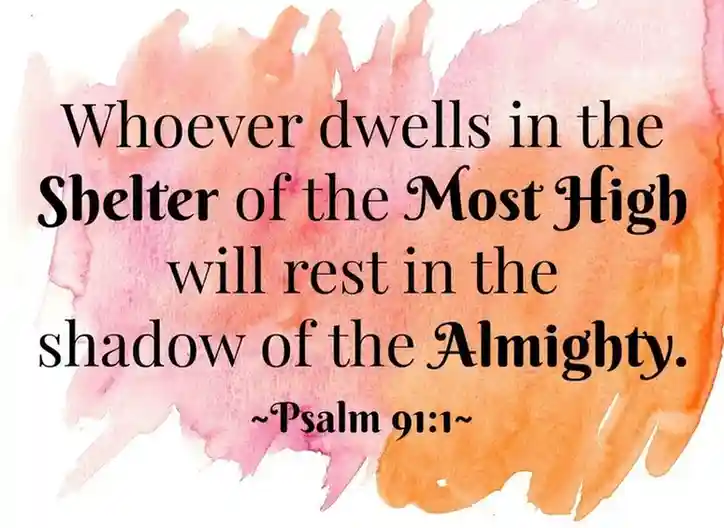
“He who dwells in the shelter of the Most High will abide in the shadow of the Almighty. I will say of the Lord, He is my refuge and my fortress, my God, in whom I trust.”
The psalm opens with a condition, not a guarantee for everyone automatically. The safety described belongs to the one who “dwells” in God’s shelter. The Hebrew word for dwell implies ongoing residence, not a brief visit. This is not a one-time prayer for protection. It describes a settled, daily posture of trust.
The images of “shelter” and “shadow” both suggest closeness. A shadow only falls where the object stands close by. To live in God’s shadow means staying near enough that His presence constantly covers you.
Verse 2 turns from description to personal confession. The psalmist does not just describe God’s protective nature in the abstract. He commits to saying it out loud: “I will say of the Lord, He is my refuge.” Scholars often note the shift from third person (“he who dwells”) to first person (“I will say”) as a literary technique that invites the reader to make the same declaration personally.
Verses 3–4: Deliverance from the Snare and the Wing
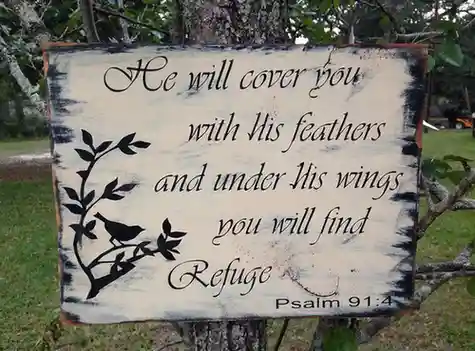
“For he will deliver you from the snare of the fowler and from the deadly pestilence. He will cover you with his pinions, and under his wings you will find refuge; his faithfulness is a shield and buckler.”
Verse 3 introduces two specific dangers: the “snare of the fowler” and “deadly pestilence.” A fowler was a hunter who trapped birds using hidden nets or snares. The image suggests danger that is concealed rather than obvious, the kind of threat you do not see coming. Pestilence, by contrast, represents visible, widespread disease, a very real fear in the ancient world where plague could wipe out entire cities.
Verse 4 shifts to one of the psalm’s most tender images: a mother bird covering her chicks with her feathers. This picture appears elsewhere in Scripture, including Jesus’s own words over Jerusalem in Matthew 23:37, where He longed to gather the city’s people “as a hen gathers her brood under her wings.” The image communicates warmth and intimacy alongside protection. God’s care is not cold or distant. It is close, personal, and tender.
The verse ends with a change in metaphor: “his faithfulness is a shield and buckler.” A buckler was a small, close-combat shield, different from the larger shield used at a distance. The pairing suggests protection at every range, near and far, gentle and forceful.
Verses 5–6: No Fear of Terror by Night or Arrow by Day
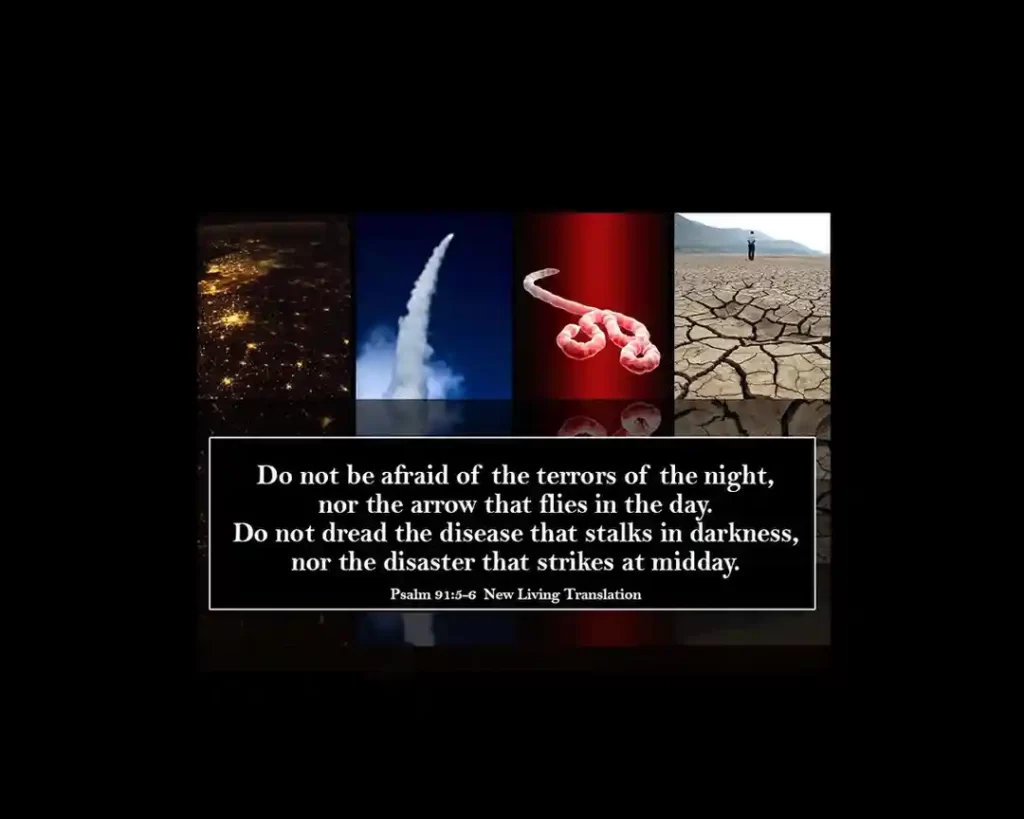
“You will not fear the terror of the night, nor the arrow that flies by day, nor the pestilence that stalks in darkness, nor the destruction that wastes at noonday.”
These two verses list four dangers arranged in a deliberate pattern: night, day, darkness, and noon. This structure covers every hour of the clock. No time of day is safe from potential harm, and no time of day is outside God’s protection either.
“The arrow that flies by day” pictures open, visible attack, like an enemy soldier shooting from a distance. “The pestilence that stalks in darkness” pictures unseen danger, disease moving silently through a population. Ancient readers connected this kind of imagery to Resheph, a Canaanite deity associated with plague, fever, and sudden death, often depicted holding a bow. Scholars who study the psalm’s ancient Near Eastern context read verses 5 and 6 as a direct rebuttal of that belief system: the God of Israel, not a plague-deity with an arrow, controls sickness and safety.
Verses 7–8: A Thousand Fall Beside You
“A thousand may fall at your side, ten thousand at your right hand, but it will not come near you. You will only look with your eyes and see the recompense of the wicked.”
This is one of the most striking claims in the entire psalm. It does not promise a world free of danger or death. It promises that the reader, specifically, will be spared even while catastrophe strikes all around. The numbers “a thousand” and “ten thousand” evoke battlefield language, large-scale loss happening in close proximity.
Verse 8 adds a second element: the reader will “look” and “see” the consequences that fall on the wicked. This introduces a theme of moral order. The psalm assumes a universe where faithfulness and wickedness eventually lead to different outcomes, even if that difference is not always visible in the moment.
Verses 9–10: No Evil Shall Befall You
“Because you have made the Lord your dwelling place, the Most High your habitation, no evil shall be allowed to befall you, no plague come near your tent.”
These verses repeat the “dwelling” language from verse 1, tying the whole psalm back to its opening image. The protection described is conditional on that dwelling: because the reader has made the Lord a permanent home rather than an occasional refuge, evil finds no entry point.
The mention of “tent” locates this promise in everyday life. A tent was the ordinary home of the ancient Israelite family, not a palace or a temple. The promise of protection extends into ordinary, domestic life, not just moments of dramatic crisis.
Verses 11–13: Angels, Lions, and Serpents
“For he will command his angels concerning you to guard you in all your ways. On their hands they will bear you up, lest you strike your foot against a stone. You will tread on the lion and the adder; the young lion and the serpent you will trample underfoot.”
These three verses are the most famous in the psalm, largely because of how they appear later in the New Testament. Verse 11 promises angelic protection, described in detail: angels will “guard” and “bear up” the one who trusts God, preventing even a stumble against a stone.
Verse 13 shifts from angelic protection to personal power. The reader will “tread on the lion and the adder” and “trample” young lions and serpents underfoot. In the ancient world, lions and snakes represented the deadliest natural predators a person could face. The verse promises not just survival against these threats but dominance over them.
This imagery became deeply influential in Christian art. Early Christian and medieval artists frequently depicted Christ standing on a lion and a serpent, a motif directly drawn from this verse and connected to the broader biblical theme of victory over evil, going back to Genesis 3:15, where the serpent’s head is crushed.
Verses 11 and 12 hold particular significance because they appear, quoted almost word for word, in one of the most dramatic scenes in the Gospels.
Verses 14–16: God Speaks
“Because he holds fast to me in love, I will deliver him; I will protect him, because he knows my name. When he calls to me, I will answer him; I will be with him in trouble; I will rescue him and honor him. With long life I will satisfy him and show him my salvation.”
The final three verses change speaker entirely. Up to this point, a human voice has been describing God’s protection. Now God speaks directly, in the first person, and the tone shifts from description to promise.
Verse 14 begins with love: “because he holds fast to me in love.” The Hebrew word behind this phrase suggests deep attachment and clinging devotion, not casual belief. Protection in this psalm is not automatic or unconditional. It flows from a relationship built on love and knowledge of God’s name, meaning knowledge of His character, not merely His title.
Verse 15 promises three things in sequence: God will answer when called, be present in trouble, and rescue and honor the one who calls. This verse does not promise the absence of trouble. It promises presence within trouble: “I will be with him in trouble.” That distinction matters enormously for how readers apply this psalm to real suffering, a point explored further below.
Verse 16 closes with two final gifts: long life and the sight of God’s salvation. Together, these sixteen verses move from a human declaration of trust to a divine oath of rescue, forming one of the most complete pictures of covenant protection found anywhere in the Psalms.
Historical and Cultural Background of Psalm 91
Psalm 91 did not emerge in a vacuum. Ancient Israel existed alongside cultures that believed disease, disaster, and sudden death came from specific gods who needed to be appeased. Canaanite religion, in particular, included Resheph, a deity connected to plague, fire, and lightning, frequently pictured holding a bow and arrow.
Read against that backdrop, Psalm 91’s references to “pestilence that stalks in darkness” and “the arrow that flies by day” take on new meaning. The psalm is not only offering comfort. It is making a theological argument. It insists that Israel’s God, not any regional plague-deity, holds authority over sickness, disaster, and death. This kind of polemic, where biblical language directly counters neighboring religious beliefs, appears throughout the Old Testament and helps explain why the psalm’s imagery feels so specific and pointed rather than generic.
The psalm’s placement within the Psalter also carries historical weight. Book Four of the Psalms, spanning Psalms 90 through 106, is widely believed to have taken shape during or after the Babylonian exile, a period when the Israelite monarchy had fallen and the nation’s future felt uncertain. Psalms in this section repeatedly turn attention away from human kings and toward God’s eternal kingship. Read in that light, Psalm 91 offered a displaced, uncertain community a reason to trust that God’s protection did not depend on political stability or a functioning throne in Jerusalem.
Why Satan Quoted Psalm 91 to Jesus
Psalm 91 appears directly in the New Testament, in one of the most theologically loaded scenes in the Gospels. During the temptation of Jesus in the wilderness, Satan quotes verses 11 and 12 almost word for word, urging Jesus to throw Himself from the temple, citing the promise that angels would catch Him.
Matthew records the exchange in chapter 4: Satan tells Jesus that Scripture promises angelic protection and challenges Him to test that promise physically. Jesus responds not by denying the psalm’s truth but by citing a different Scripture: “You shall not put the Lord your God to the test.”
This moment matters for understanding Psalm 91 correctly. Satan’s quotation is accurate but misapplied. He lifts a genuine promise out of its context and uses it to justify presumption, testing God rather than trusting Him. Jesus’s response teaches a lasting principle for reading this psalm: God’s protection is not a tool for reckless behavior. The psalm describes trust, not a magic formula for avoiding the natural consequences of foolish choices. This distinction between trust and testing runs through nearly every responsible commentary on Psalm 91.
Is Psalm 91 a Promise of Literal, Physical Safety?
This is the hardest question the psalm raises, and honest readers have to sit with it. Psalm 91 uses sweeping, unconditional-sounding language: “no evil shall befall you,” “it will not come near you,” “a thousand may fall at your side.” Read alone, these lines can sound like a guarantee that faithful believers will never suffer harm.
Scripture itself complicates that reading. Directly before Psalm 91 sits Psalm 88, widely regarded as the bleakest psalm in the entire Bible. Psalm 88 ends without resolution, with the psalmist describing darkness as his closest friend. Read side by side, Psalm 88 and Psalm 91 present two very different experiences of faith: one of unresolved suffering, one of confident deliverance.
The rest of the Bible reinforces this tension rather than resolving it neatly. Faithful prophets suffered persecution. John the Baptist, described by Jesus as among the greatest ever born, was executed in prison. The apostle Paul, who quoted the Psalms extensively, endured shipwrecks, beatings, and eventually martyrdom. None of this suggests the psalm is false. It suggests the psalm needs careful reading.
Most careful commentators read Psalm 91 as poetry expressing deep covenantal trust rather than a legal guarantee against every form of harm. The psalm’s core claim is relational, not transactional: God is present with His people in trouble, He ultimately delivers and vindicates them, and evil does not have the final word over their lives. Verse 15’s phrase, “I will be with him in trouble,” assumes trouble happens. The promise is companionship and ultimate rescue within and through hardship, not an exemption from it.
This reading does not weaken the psalm. It deepens it. A promise that God remains present and faithful through real suffering offers something sturdier than a promise that bad things simply will not happen, a promise daily experience often contradicts.
Psalm 91 as “The Soldier’s Psalm”
Psalm 91 carries a well-known nickname: the soldier’s psalm. Military chaplains have distributed printed copies of this chapter to troops for generations, and many soldiers carry it into combat zones as a source of comfort and courage.
The psalm’s battlefield imagery makes this connection natural. Its language of arrows, falling comrades, hidden snares, and deliverance from danger speaks directly to the fears a soldier faces. Verses 7 and 8, describing thousands falling nearby while the psalmist remains untouched, resonate powerfully with anyone who has survived combat while others did not.
This tradition also illustrates how the psalm functions in real crisis. Soldiers reading Psalm 91 are not claiming a guarantee of physical invincibility. They are drawing on its language of presence and courage, the assurance that God remains near in the most dangerous circumstances a human being can face.
How to Pray Psalm 91
Many readers want to move beyond studying the psalm and start praying it. Here is a practical approach, grounded in the psalm’s own structure.
Start with verse 1 and 2 as a personal declaration. Speak the words aloud, using your own name if it helps: “I will say of the Lord, He is my refuge and my fortress, my God, in whom I trust.”
Name your specific fears using verses 5 and 6. The psalm lists concrete dangers: night terror, daytime attack, hidden disease, sudden disaster. Replace these ancient images with whatever you currently fear, whether illness, financial loss, or a difficult diagnosis, and bring that fear directly into the prayer.
Ask for God’s presence, not just protection, using verse 15. Because the psalm’s deepest promise is companionship in trouble, pray specifically for God’s nearness during hardship rather than only for the removal of the hardship itself.
Close with verse 16 as a statement of hope. End your prayer by affirming trust in God’s ultimate salvation and faithfulness, even when circumstances remain uncertain.
Praying the psalm this way keeps its comfort intact while avoiding the trap Satan set for Jesus: using the psalm’s promises to demand a specific outcome rather than to deepen genuine trust.
Psalm 91 in Jewish and Christian Tradition
Psalm 91 holds a significant place in worship traditions on both sides of the biblical canon.
In Jewish practice, Psalm 91 appears in the evening liturgy and has long been associated with protection from harm during sleep, a vulnerable time when a person cannot watch over themselves. Some traditions also connect the psalm to funeral rites and to rituals meant to guard against misfortune, reflecting its ancient reputation as a psalm of shelter.
In Christian tradition, Psalm 91 became part of Compline, the final prayer service of the day in many liturgical traditions, recited before sleep. This placement mirrors the Jewish evening usage and reflects the same instinct: end the day by placing oneself under God’s watchful care through the night. The psalm’s vivid imagery of angels, shields, and shelter also shaped centuries of Christian art and hymnody, most famously in works inspired by verse 13’s picture of trampling the lion and the serpent.
Psalm 91 Across Bible Translations
Different English translations render Psalm 91 with slightly different word choices, and comparing them sharpens understanding of the original Hebrew.
The King James Version uses the phrase “the secret place of the most High” in verse 1, language that has shaped how generations of English readers picture this psalm, evoking a hidden, intimate refuge. The English Standard Version and New International Version both choose “shelter” instead, a more common word that trades poetic mystery for everyday clarity.
Verse 3’s “snare of the fowler” stays fairly consistent across translations, since the image translates cleanly into English. Verse 6’s “destruction that wasteth at noonday,” from the King James Version, becomes “the plague that destroys at midday” in the New International Version, a shift that trades archaic phrasing for modern readability without losing meaning.
Verse 16 offers one of the more interesting translation differences. The King James Version reads, “with long life will I satisfy him.” Some modern translations, including certain renderings that follow variant Hebrew traditions, translate this phrase as “length of days,” which some scholars connect to a promise of fullness of life rather than a strict guarantee of many years. This distinction matters for readers who wonder whether the verse promises longevity specifically or a complete, satisfied life more broadly.
No matter which English translation a reader prefers, the underlying Hebrew text remains stable across all major manuscript traditions. The differences reflect translation philosophy, not disagreement about the original wording.
Common Misconceptions About Psalm 91
Several misunderstandings surround this psalm, and clearing them up helps readers apply it responsibly.
Misconception: Psalm 91 is a magic spell against harm.
Some popular teaching treats the psalm as a formula that guarantees physical safety if recited with enough faith or frequency. The psalm itself does not support this reading. It describes a relationship of trust, not an incantation. Jesus’s own response to Satan’s misuse of verses 11 and 12 directly rejects the idea that Scripture functions as a guarantee to be tested or demanded on command.
Misconception: Psalm 91 was written by Moses.
As covered earlier, this claim rests on the psalm’s placement next to Psalm 90 rather than on any internal evidence or manuscript title. The Hebrew text itself carries no author’s name, and most scholars treat the Mosaic attribution as a later, unverified tradition rather than a historical fact.
Misconception: Psalm 91 promises believers will never get sick or die young.
Verse 16 promises satisfaction and “length of days,” but Scripture elsewhere records faithful believers who died young or suffered greatly, including John the Baptist and several apostles. Reading Psalm 91 as an ironclad guarantee against illness or early death creates painful confusion for believers who face these realities despite deep faith. The psalm’s promise centers on God’s presence and ultimate deliverance, not a fixed timeline of years.
Misconception: Psalm 91 applies automatically to everyone.
The psalm’s opening verse sets a condition: “he who dwells in the shelter of the Most High.” The protection described flows from an ongoing relationship of trust, described again in verse 14 as “he holds fast to me in love.” The psalm does not describe unconditional protection extended to every person regardless of their relationship with God.
Psalm 91 and Anxiety: A Pastoral Reading
Beyond its historical and theological dimensions, Psalm 91 continues to function as a primary text for people struggling with fear and anxiety. Its structure offers a natural pattern for anyone working through worry.
The psalm begins by naming a place of safety before it names any danger. Verse 1 establishes shelter first; only afterward, in verses 3 through 6, does the psalm name specific threats. This ordering matters pastorally. Anxiety often works in reverse, starting with the danger and searching afterward for safety. Psalm 91 models the opposite pattern: settle first into a place of trust, then look at what frightens you from that vantage point.
The specific fears the psalm names, hidden traps, disease, nighttime terror, and sudden disaster, cover nearly every category of anxiety a modern reader might recognize. Financial fear resembles the “snare of the fowler,” a hidden threat that can spring without warning. Health anxiety resembles the “pestilence that stalks in darkness.” Fear about the future resembles “the destruction that wastes at noonday.” Because the psalm’s imagery is broad rather than narrowly tied to ancient warfare alone, readers across centuries have found their own fears reflected in its language.
Verse 15’s promise, “I will be with him in trouble,” offers a foundation for anxiety that does not depend on circumstances changing. Even when the outcome remains uncertain, the promise of presence remains constant. Many pastoral counselors point to this verse specifically when working with people who cannot control their circumstances but can still hold onto the certainty of companionship within them.
Psalm 91 in Times of Public Crisis
Historically, Psalm 91 has surged in popularity during seasons of widespread danger, including wartime, epidemics, and natural disasters. Its direct references to “pestilence” and “plague” made it a natural text for communities facing outbreaks of disease throughout history, long before modern medicine could explain how illness spread.
This pattern repeated during the COVID-19 pandemic, when searches for Psalm 91 rose sharply worldwide. Congregations read it during virtual services. Individuals posted its verses on social media. The psalm’s ancient language about pestilence “that stalks in darkness” felt immediately relevant to a global health crisis, even though it was written thousands of years before anyone understood viruses or contagion.
This recurring pattern says something important about how the psalm functions across history. It was never meant to explain the mechanics of disease or disaster. It was meant to give people language for trust when explanations run out. Communities facing plague in the ancient world and communities facing pandemic in the modern world have reached for the same sixteen verses because the underlying human need, safety and presence amid the unknown, has not changed.
Psalm 91 and Its Cross-References Across Scripture
Reading Psalm 91 alongside related passages deepens its meaning and shows how its themes echo throughout the Bible.
Genesis 3:15 introduces the promise that a future offspring will crush the serpent’s head. Psalm 91:13, with its image of treading on the serpent, picks up this same thread of victory over evil, connecting a patriarchal promise to a worship song written centuries later.
Exodus 6:2-3 records God revealing His personal name, Yahweh, to Moses, and introduces El Shaddai as the name known to the patriarchs. Psalm 91 draws directly on both names in its opening verses, linking the psalm’s promises to the same covenant history stretching back to Abraham.
Deuteronomy 32:11 compares God’s care for Israel to an eagle stirring up its nest and spreading its wings to catch its young. Psalm 91:4 uses nearly identical imagery, describing God covering the believer with feathers and wings, suggesting the psalmist drew on this older poetic tradition from the Song of Moses.
Matthew 4:6 and Luke 4:10-11 record Satan quoting Psalm 91:11-12 during the wilderness temptation. This New Testament scene remains the most direct link between Psalm 91 and the life of Jesus, and it fundamentally shapes how responsible readers interpret the psalm’s promises today.
Matthew 23:37 shows Jesus using the same mother-bird imagery found in Psalm 91:4, longing to gather Jerusalem “as a hen gathers her brood under her wings.” The echo suggests Jesus Himself drew on this psalm’s language when describing His own care for people.
Romans 8:28 promises that God works all things together for good for those who love Him, a New Testament parallel to Psalm 91’s Old Testament promise of ultimate deliverance. Both passages acknowledge real hardship while insisting that hardship does not have the final word.
Revelation 12:9 describes the ancient serpent, identified as Satan, ultimately defeated. Read against this backdrop, Psalm 91:13’s image of trampling the serpent gains an added layer of meaning, pointing forward to the final, complete defeat of evil described at the end of the biblical story.
These cross-references show that Psalm 91 does not stand alone. It draws on earlier biblical history, gets directly quoted in the Gospels, and anticipates later New Testament promises. Understanding these connections helps readers see the psalm as part of a much larger, unified biblical narrative rather than an isolated poem of comfort.
Common Questions About Psalm 91
What does Psalm 91 mean in simple terms?
Psalm 91 means that the person who stays close to God does not need to live controlled by fear. It promises God’s protection, presence, and ultimate rescue for those who trust Him.
Who wrote Psalm 91?
The psalm has no named author in the original Hebrew text. Jewish tradition often credits Moses, based on its placement next to Psalm 90. The Greek Septuagint credits David. Most modern scholars consider the author unknown.
Why is Psalm 91 called the soldier’s psalm?
Military members have long turned to Psalm 91 for comfort in combat because of its imagery of surviving danger, arrows, and battlefield loss while trusting in God’s protection.
Did Satan quote Psalm 91 to Jesus?
Yes. In Matthew 4, Satan quotes Psalm 91:11-12 during the wilderness temptation, urging Jesus to jump from the temple based on the promise of angelic protection. Jesus refuses, teaching that Scripture should not be twisted to justify testing God.
Does Psalm 91 guarantee that nothing bad will ever happen to believers?
Most careful readings say no. The psalm expresses deep covenantal trust rather than a literal guarantee against all harm. Verse 15 promises God’s presence “in trouble,” which assumes trouble occurs. The Bible elsewhere shows faithful people suffering, which points readers toward trust and presence as the psalm’s core promise, not an exemption from hardship.
What are the four names of God in Psalm 91?
The psalm uses El Elyon (Most High), El Shaddai (Almighty), Yahweh (the Lord), and Elohim (God), each highlighting a different aspect of God’s character in the first two verses.
Why does Psalm 91 mention lions and serpents?
Verse 13 promises that the one who trusts God will tread on the lion and the serpent, symbols of the deadliest threats in the ancient world. This image later shaped Christian art depicting Christ’s victory over evil.
Is Psalm 91 connected to Psalm 90?
Yes. The two psalms sit together in Book Four of the Psalter and form a deliberate pair. Psalm 90 laments human frailty and the shortness of life. Psalm 91 answers with the promise of shelter and protection under God’s care.
What is the “secret place of the Most High” in Psalm 91:1?
This King James Version phrase describes an intimate, hidden dwelling with God, rendered as “shelter” in most modern translations. It pictures closeness rather than a literal physical location, describing the ongoing posture of trust the whole psalm builds on.
How many verses does Psalm 91 have?
Psalm 91 contains sixteen verses, divided into three sections by speaker: a personal declaration (verses 1-2), promises addressed to the reader (verses 3-13), and God’s own words of assurance (verses 14-16).
What does “tread upon the lion and the adder” mean in Psalm 91:13?
This verse pictures the believer overcoming the deadliest natural threats of the ancient world, lions and venomous snakes, through God’s protection. Early Christian artists later used this image to depict Christ’s victory over evil, connecting it to Genesis 3:15’s promise about crushing the serpent.
Can Psalm 91 be prayed for someone else, such as a sick family member?
Yes. Many believers adapt the psalm’s language, replacing pronouns with a loved one’s name, as an intercessory prayer. This practice fits the psalm’s broader use throughout history as a prayer of shelter spoken over both oneself and others facing danger or illness.
Key Takeaways
Psalm 91 offers far more than a comforting quote for hard days. It presents a structured, three-part message: a personal declaration of trust, a detailed promise of protection, and a closing divine oath spoken directly by God. Its four names for God build a picture of a supreme, powerful, personal, and possessive deity, one who is both cosmically sovereign and individually near. Its verses answered real fears in the ancient world, countering beliefs about plague-gods with a bold claim about Israel’s God. And its most famous verses, quoted by Satan himself in the wilderness, remind every reader that genuine trust looks different from presumptuous testing.
Read carefully, in its full historical and literary context, Psalm 91 does not promise a life free from danger. It promises a God who stays present through danger, who answers when called, and who ultimately delivers and honors those who love Him. That promise, tested against the full weight of Scripture rather than isolated verses, is what has made this psalm a source of courage for readers across three thousand years.
Whether you come to Psalm 91 as a scholar studying its Hebrew grammar, a soldier facing danger overseas, or a worried parent praying beside a hospital bed, the psalm offers the same invitation it has offered every generation before you: stop searching for safety in your own strength, and instead make your home in the shelter of the Most High.