
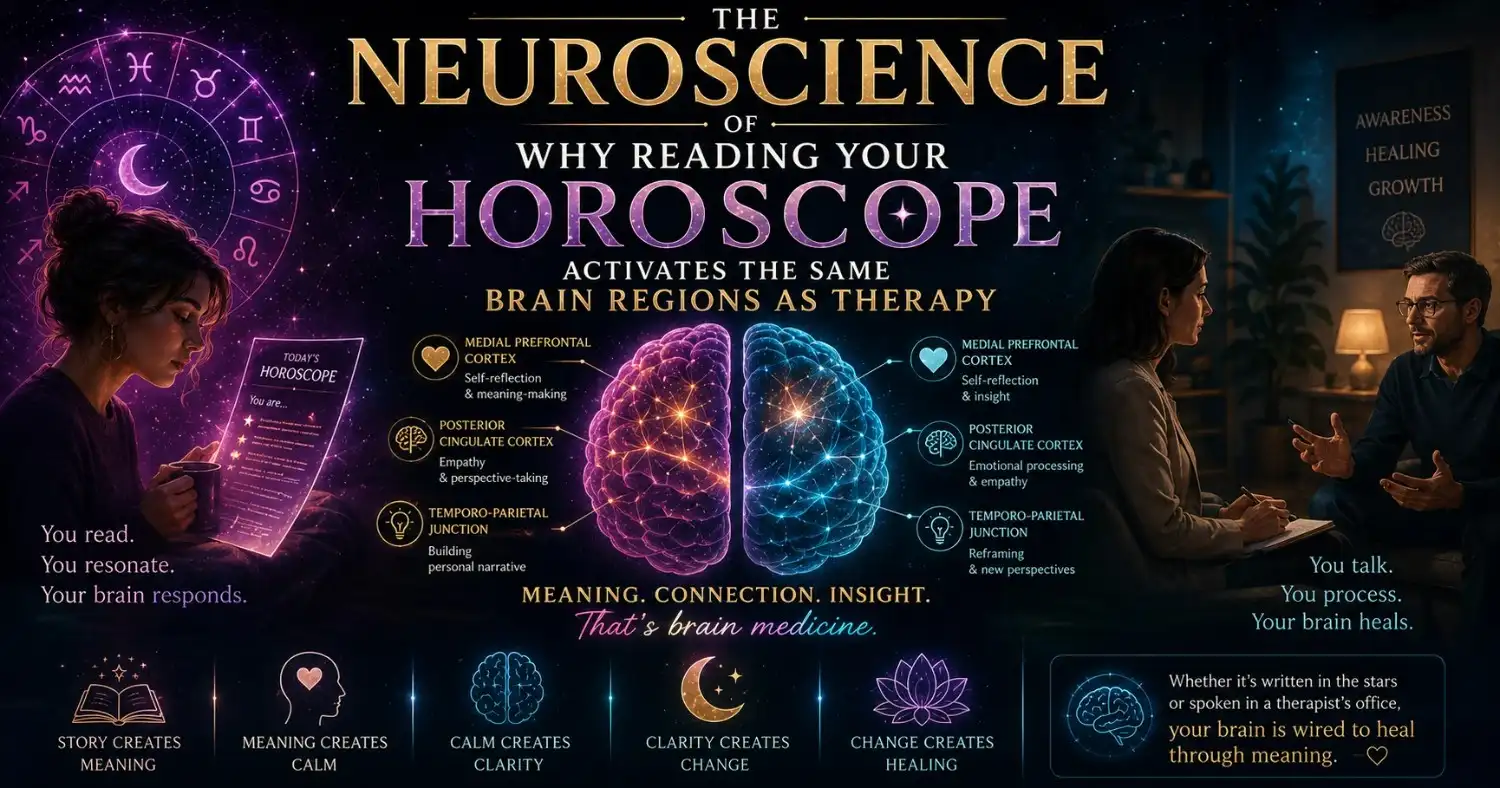
For millions of people around the world, reading a daily horoscope is more than a fleeting moment of curiosity. It is a ritual. A pause. A moment of reflection before the demands of the day begin. Some people consult their horoscope during times of uncertainty, others during major life transitions, and many simply enjoy the sense of meaning and perspective it provides.
Critics often dismiss horoscopes as entertainment, while devoted astrology enthusiasts view them as tools for self-understanding. Yet an intriguing question has emerged at the intersection of psychology, neuroscience, and astrology:
Why do so many people report feeling understood, validated, comforted, and emotionally clearer after reading their horoscope?
Interestingly, modern neuroscience offers some clues.
While there is currently no scientific evidence proving that planetary positions directly influence human behavior in the way astrology proposes, researchers have extensively studied the neural mechanisms involved in self-reflection, meaning-making, emotional processing, narrative identity, and personal insight. Many of these processes activate remarkably similar brain networks to those engaged during psychotherapy.
This does not mean that reading a horoscope is equivalent to clinical therapy. Therapy is a structured, evidence-based process conducted by trained professionals. However, the psychological experience of engaging deeply with a horoscope may activate some of the same cognitive and emotional systems that therapy relies upon.
From self-reflection and emotional validation to pattern recognition and narrative construction, astrology engages several fundamental functions of the human brain. Understanding why can reveal something profound not only about astrology but about human nature itself.
Why Humans Are Wired to Search for Meaning
To understand why horoscopes feel powerful, we must first understand one of the brain’s primary functions: creating meaning.
The human brain is not simply a data-processing machine.
It is a meaning-making machine.
Throughout evolution, survival depended on recognizing patterns:
- Identifying threats
- Predicting outcomes
- Understanding social relationships
- Learning from experience
The brain continuously seeks connections between events.
This tendency helps us:
- Create narratives
- Understand our experiences
- Predict future possibilities
- Establish identity
Horoscopes naturally tap into this cognitive process.
When someone reads:
“Today may challenge your patience, but an opportunity for growth lies beneath the surface.”
The brain immediately begins searching for relevant experiences.
This process activates networks involved in:
- Reflection
- Interpretation
- Emotional evaluation
- Personal relevance
These are many of the same cognitive systems used in therapeutic conversations.
The Brain’s Default Mode Network and Self-Reflection
One of the most important discoveries in modern neuroscience is the Default Mode Network (DMN).
The DMN is a collection of interconnected brain regions that becomes active when we engage in:
- Self-reflection
- Daydreaming
- Personal memory
- Future planning
- Identity exploration
- Social understanding
Key areas include:
- Medial prefrontal cortex
- Posterior cingulate cortex
- Angular gyrus
- Precuneus
These regions become active when we think about ourselves and our place in the world.
How Horoscopes Engage the Default Mode Network
Reading a horoscope often prompts questions such as:
- Does this describe me?
- What am I currently experiencing?
- How does this apply to my life?
- What changes am I facing?
The moment we begin connecting horoscope content to our personal experiences, the Default Mode Network becomes engaged.
Interestingly, many forms of psychotherapy also rely heavily on activating these self-reflective networks.
Both astrology and therapy encourage individuals to examine:
- Personal beliefs
- Emotional reactions
- Life patterns
- Future possibilities
The mechanism differs, but the neurological process shares similarities.
Narrative Identity: The Stories We Tell Ourselves
Psychologists often describe human beings as storytelling creatures.
We make sense of life through narrative.
Every person carries an internal story involving:
- Who they are
- What they’ve experienced
- Why events happened
- Where they’re going
This internal narrative forms what psychologists call narrative identity.
Astrology as a Narrative Framework
Astrology provides a symbolic language that helps people organize experiences.
For example:
- Saturn becomes a symbol of challenge and responsibility.
- Jupiter represents growth and opportunity.
- Pluto symbolizes transformation.
- Venus reflects relationships and values.
These archetypes create a framework for understanding life events.
When individuals interpret experiences through these symbols, they engage the same narrative-building processes often explored in therapy.
Therapists frequently help clients:
- Reframe experiences
- Create coherent life narratives
- Discover meaning in adversity
- Identify recurring patterns
Astrology often serves a similar narrative function.
Emotional Validation and the Brain
One reason people feel comforted after reading horoscopes is emotional validation.
Humans possess a deep psychological need to feel:
- Seen
- Understood
- Acknowledged
- Accepted
When experiences are validated, the brain often responds positively.
The Neuroscience of Validation
Research suggests emotional validation may influence regions involved in:
- Emotional regulation
- Stress reduction
- Social connection
These include:
- Ventromedial prefrontal cortex
- Anterior cingulate cortex
- Insula
When individuals encounter horoscope descriptions that resonate emotionally, they often experience:
- Recognition
- Relief
- Comfort
- Increased self-awareness
A statement like:
“You’ve been carrying more responsibility than others realize.”
can create a sense of being understood.
Therapy frequently provides similar emotional experiences through empathetic listening and reflection.
Pattern Recognition: The Brain’s Favorite Activity
The human brain evolved to detect patterns.
Pattern recognition helps us:
- Learn
- Predict outcomes
- Navigate uncertainty
- Create order
Astrology naturally appeals to this cognitive tendency.
Why Patterns Feel Meaningful
When people notice recurring themes between:
- Relationships
- Career challenges
- Emotional cycles
- Personal growth experiences
they often experience insight.
Horoscopes frequently encourage pattern recognition by prompting reflection on:
- Repeated behaviors
- Emotional habits
- Relationship dynamics
- Personal strengths
Therapists similarly help clients identify recurring patterns that influence their lives.
Both processes activate cognitive systems associated with:
- Learning
- Interpretation
- Meaning-making
The Role of Archetypes in the Human Brain
One reason astrology remains culturally powerful is its use of archetypes.
Archetypes are universal symbolic patterns that appear across cultures and historical periods.
Examples include:
- The Hero
- The Caregiver
- The Warrior
- The Sage
- The Rebel
Carl Jung believed archetypes emerged from what he called the collective unconscious.
Zodiac Signs as Archetypal Symbols
Each zodiac sign functions as an archetype.
For example:
- Aries symbolizes initiative.
- Taurus symbolizes stability.
- Gemini symbolizes curiosity.
- Cancer symbolizes nurturing.
- Leo symbolizes self-expression.
- Scorpio symbolizes transformation.
These symbols provide psychologically meaningful categories through which people interpret experience.
The brain responds strongly to symbolic narratives because symbols help simplify complex emotional realities.
Why Astrology Can Reduce Anxiety
One of the brain’s least favorite states is uncertainty.
Neuroscience research consistently shows that uncertainty increases stress.
Humans generally prefer:
- Predictability
- Structure
- Understanding
- Direction
Horoscopes Provide Psychological Structure
Horoscopes often offer:
- Guidance
- Perspective
- Reflection
- Context
Even when predictions are broad, they create a sense of psychological organization.
Consider the difference between:
“I have no idea what’s happening.”
and
“This period is about growth and learning.”
The second statement provides a narrative framework.
Frameworks reduce ambiguity.
Reduced ambiguity often lowers perceived stress.
Therapy frequently accomplishes something similar by helping clients organize overwhelming experiences into understandable narratives.
The Brain’s Reward System and Insight
Humans enjoy insight.
When we suddenly understand something important, the brain often releases dopamine.
Dopamine is associated with:
- Motivation
- Reward
- Learning
- Curiosity
The “Aha!” Moment
Reading a horoscope sometimes produces an experience like:
“That’s exactly what I’ve been feeling.”
This recognition can trigger:
- Emotional relief
- Cognitive clarity
- Increased motivation
Therapy often generates similar moments of realization.
These insights strengthen engagement because the brain rewards meaningful discoveries.
Self-Reflection and Emotional Regulation
One of therapy’s primary goals is improving emotional awareness.
Research shows that simply labeling emotions can reduce emotional intensity.
This process involves regions such as:
- Prefrontal cortex
- Amygdala
Astrology Encourages Emotional Labeling
Horoscopes frequently prompt reflection on:
- Fear
- Confidence
- Relationships
- Ambition
- Change
By encouraging people to identify emotional states, astrology may indirectly support emotional regulation.
For example:
A horoscope discussing frustration may encourage someone to recognize emotions they had not consciously acknowledged.
This awareness can reduce emotional reactivity.
Social Connection and Shared Meaning
Humans are social creatures.
Our brains evolved within communities.
Shared belief systems often strengthen social bonds.
Astrology as Social Language
Astrology creates common frameworks for discussing:
- Personality
- Relationships
- Challenges
- Growth
Many people use zodiac language as a way to communicate emotional experiences.
Examples include:
- “I’m struggling with my Scorpio intensity.”
- “My Virgo perfectionism is showing.”
- “I’m embracing my Leo confidence.”
These conversations promote social connection and self-disclosure.
Therapy similarly relies upon interpersonal connection and shared understanding.
Why Astrology Feels Personal
One fascinating psychological phenomenon is the tendency to find personal meaning in generalized statements.
Psychologists call this the Barnum Effect.
The Barnum Effect Explained
People often perceive vague statements as uniquely accurate when they believe those statements apply specifically to them.
For example:
“You have untapped potential and sometimes doubt yourself.”
Most people can relate to this.
However, astrology’s effectiveness cannot be explained entirely by the Barnum Effect.
Many people engage with astrology not because they believe every statement is literally predictive, but because it stimulates reflection and personal exploration.
The emotional value often comes from interpretation rather than prediction.
Astrology and the Search for Identity
Identity formation is a lifelong process.
Humans constantly ask:
- Who am I?
- What motivates me?
- Why do I behave this way?
- What is my purpose?
These questions activate many of the same neural systems involved in self-reflection and autobiographical memory.
Zodiac Signs as Identity Tools
Astrology provides identity frameworks that help people explore:
- Strengths
- Weaknesses
- Emotional tendencies
- Relationship styles
Whether literally true or symbolically meaningful, these frameworks encourage introspection.
Therapy frequently explores similar questions from a psychological perspective.
The Role of Hope in Brain Function
Hope is a powerful neurological force.
Research suggests hopeful thinking influences:
- Motivation
- Goal pursuit
- Emotional resilience
- Stress reduction
Horoscopes Often Promote Hope
Many horoscopes emphasize:
- Growth
- Opportunity
- Resilience
- Positive change
Hopeful narratives activate motivational systems within the brain.
Therapy often seeks to cultivate realistic hope as part of emotional healing.
The shared mechanism is not prediction.
It is possibility.
Astrology, Mindfulness, and Present-Moment Awareness
Mindfulness involves paying attention to thoughts, emotions, and experiences without judgment.
Many horoscope readers engage in a form of informal mindfulness.
They pause and ask:
- How am I feeling?
- What am I experiencing?
- What needs attention?
This reflective pause can interrupt automatic thinking patterns.
Why This Matters
Modern life often encourages distraction.
Astrology rituals create moments of intentional reflection.
These moments activate awareness rather than autopilot behavior.
Therapy similarly encourages conscious observation of internal experiences.
Can Reading Horoscopes Replace Therapy?
The answer is no.
Therapy and astrology serve fundamentally different purposes.
Therapy Provides
- Clinical assessment
- Evidence-based interventions
- Emotional support
- Behavioral strategies
- Trauma treatment
Astrology Provides
- Reflection
- Symbolism
- Meaning-making
- Self-exploration
- Personal insight
While some neural processes overlap, astrology should not be viewed as a substitute for mental health treatment.
However, astrology can complement self-reflection practices for many individuals.
Why Astrology Continues to Thrive in the Modern World
Astrology has survived for thousands of years despite enormous cultural and scientific changes.
Part of its endurance may stem from the fact that it addresses fundamental human needs:
- Meaning
- Identity
- Hope
- Connection
- Self-understanding
These needs are deeply rooted in human psychology and neuroscience.
The brain naturally seeks stories that help explain experience.
Astrology provides one such story.
The Intersection of Science and Symbolism
Science and astrology often occupy different domains.
Science asks:
- What can be measured?
- What can be tested?
- What can be verified?
Astrology asks:
- What does this mean?
- What patterns connect these experiences?
- How can symbolism deepen self-understanding?
While these approaches differ, both engage humanity’s enduring quest for understanding.
The growing interest in neuroscience and astrology reflects a broader desire to understand not only how the brain works but why certain symbolic systems continue to resonate so powerfully.
Final Thoughts
The neuroscience of why reading your horoscope can feel therapeutic lies not in planetary influence alone, but in the remarkable architecture of the human brain. Reading horoscopes activates processes associated with self-reflection, narrative identity, emotional validation, pattern recognition, meaning-making, and future-oriented thinking—all functions that are also deeply involved in psychotherapy.
This does not mean astrology and therapy are the same. Therapy remains a professional, evidence-based practice designed to address mental health challenges and emotional wellbeing. Astrology operates primarily as a symbolic framework for reflection and personal exploration.
Yet the overlap reveals something fascinating about human nature. People are not simply seeking predictions when they read horoscopes. They are seeking understanding. They are looking for language to describe their experiences, frameworks to organize uncertainty, stories that provide meaning, and symbols that help them navigate life’s complexities.
In many ways, the enduring popularity of astrology may tell us less about the stars and more about the human mind itself. The brain is wired for reflection, connection, and meaning. Whether through therapy, journaling, storytelling, spirituality, or astrology, we continually search for tools that help us understand who we are and where we are going.
That search—for insight, purpose, and self-awareness—may be one of the most deeply human experiences of all.
Guides
- Using Astrology for Better Relationships: A Complete Guide to Understanding, Connecting, and Thriving With Your Partner
- Kundali Matching: The 8 Ashtakoota System Explained (Complete Guide to Guna Milan)
- When Will I Meet My Soulmate According To Astrology?
- Zodiac Sign With Highest Divorce Rate
- Vedic Astrology: Guide For Beginners
- Mayan Astrology: Guide For Beginners
- Chinese Astrology: Guide For Beginners
- Why Believe in Astrology?
- Astrocartography Explained: The Complete Expert Guide
- What Is Astrology? A Complete Beginner’s Guide
My Today’s Horoscope is filled with carefully researched articles, daily horoscopes, spiritual guidance, zodiac compatibility insights, numerology meanings, tarot interpretations, and astrology tools for readers of every experience level — from curious beginners to advanced astrology enthusiasts. (See our Site Index to quickly find what we have to offer).