
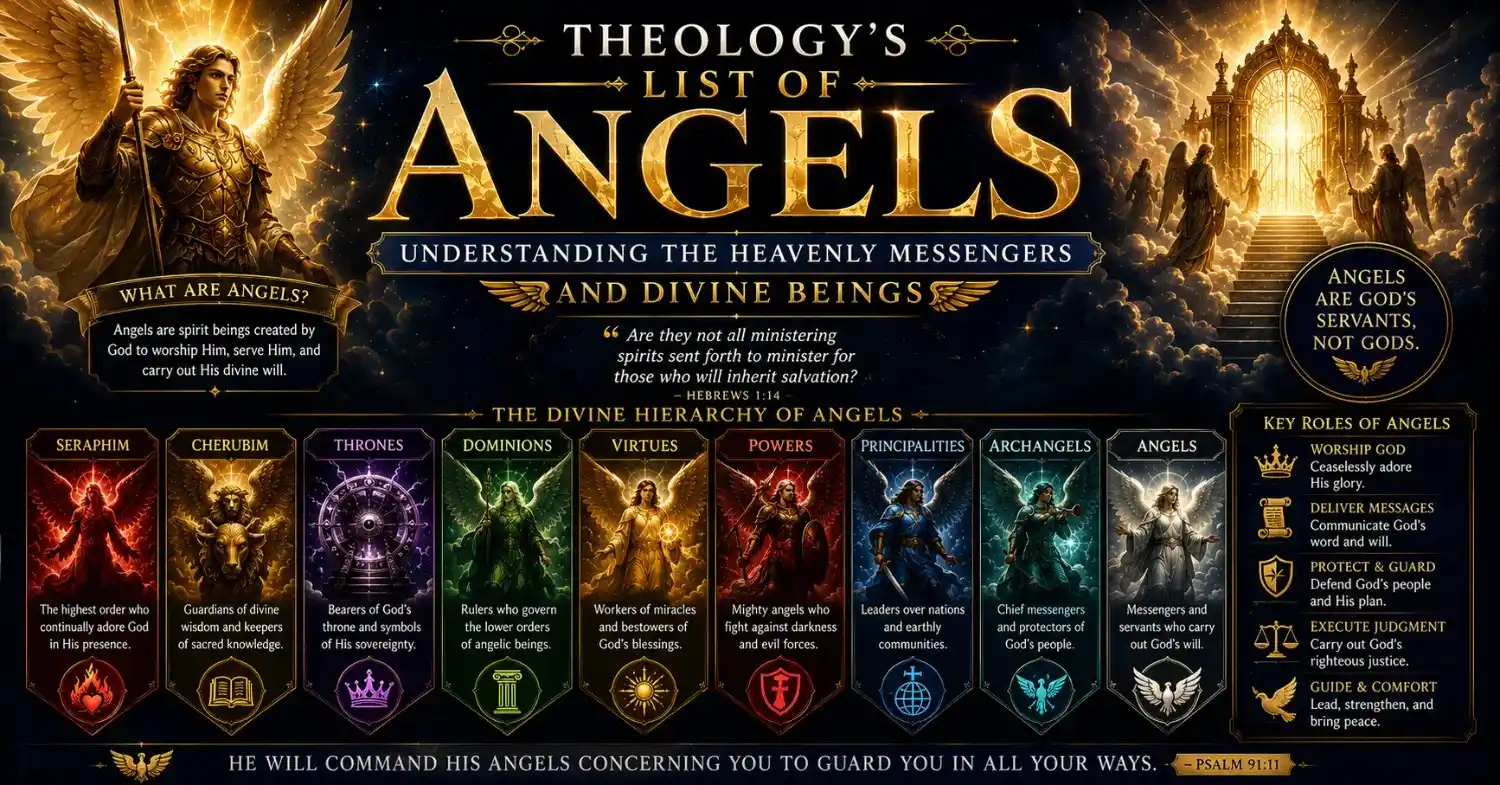
For thousands of years, angels have occupied a sacred place in theology, spirituality, and religious imagination. Across Christianity, Judaism, Islam, and mystical traditions, angels are described as divine messengers, heavenly warriors, guardians of humanity, and servants of God’s will. Yet beyond the familiar names like Michael and Gabriel exists an extraordinary theological universe filled with celestial hierarchies, mysterious beings, and symbolic spiritual powers.
Theology’s list of angels is not simply a collection of supernatural names. It represents centuries of scriptural interpretation, mystical visions, philosophical theology, and spiritual symbolism. From the fiery Seraphim surrounding God’s throne to guardian angels believed to guide human souls, angelology remains one of theology’s most fascinating explorations of the unseen world.
Although the Bible does not provide one complete catalog of angelic beings, theologians throughout history developed classifications by studying passages from Isaiah, Ezekiel, Daniel, Revelation, Colossians, and Ephesians. One of the most influential systems emerged through the writings of Pseudo-Dionysius the Areopagite in the 5th or 6th century, organizing angels into nine heavenly orders known as the “Celestial Hierarchy.”
Today, interest in angels extends far beyond formal religion. Angels continue to appear in meditation practices, spiritual healing, dreams, literature, art, astrology, and popular culture because they symbolize hope, divine guidance, protection, and the possibility that humanity is connected to a higher spiritual reality.
What Are Angels in Theology?
The word “angel” comes from the Greek word angelos, meaning “messenger.” In Hebrew, the word malakh carries a similar meaning. Theologically, angels are spiritual beings created by God to carry out divine purposes and serve as intermediaries between Heaven and Earth.
Throughout religious tradition, angels are understood as:
- Immortal spiritual beings
- Messengers of divine will
- Protectors and guardians
- Worshippers surrounding God’s throne
- Agents of judgment and guidance
- Defenders against spiritual darkness
Unlike humans, angels are generally viewed as non-physical beings not limited by ordinary earthly boundaries. Yet sacred texts frequently describe them appearing in visible form during important spiritual events.
Interestingly, biblical angels are often described as overwhelming and awe-inspiring rather than gentle human-like figures. Many angelic encounters begin with the phrase “Fear not,” suggesting that their presence carried immense spiritual power.
The Origins of Angelic Hierarchies
The Bible itself does not provide a fully organized hierarchy of angels. Instead, theologians developed angelic classifications by interpreting scattered scriptural references and combining them into structured systems.
The most influential theological system came from Pseudo-Dionysius the Areopagite through his work De Coelesti Hierarchia (“On the Celestial Hierarchy”). His writings organized angels into:
- Three heavenly spheres
- Nine angelic choirs or orders
This hierarchy later influenced major Christian thinkers such as Thomas Aquinas and became central to medieval angelology.
According to this system, angels are arranged according to:
- Their closeness to God
- Their spiritual responsibilities
- Their role in transmitting divine wisdom
The higher orders remain closest to divine presence, while lower orders interact more directly with humanity and earthly affairs.
The First Sphere: Angels Closest to God
The first sphere represents the highest and most spiritually exalted angels. These beings exist continually in God’s presence and embody divine worship, wisdom, and cosmic truth.
Seraphim
The Seraphim are considered the highest order of angels in Christian angelology. Their name means “burning ones,” symbolizing divine fire, purity, and sacred love.
The Prophet Isaiah described Seraphim as six-winged beings surrounding God’s throne and proclaiming:
“Holy, holy, holy is the Lord Almighty.”
Seraphim are associated with:
- Divine love
- Spiritual purification
- Sacred fire
- Eternal worship
- Heavenly devotion
Spiritually, Seraphim symbolize the soul’s highest aspiration toward divine union and enlightenment.
Cherubim
Cherubim are among the most misunderstood angelic beings because modern culture transformed “cherubs” into innocent winged babies. Biblically, however, Cherubim are majestic guardians of divine wisdom and sacred mysteries.
In Ezekiel’s visions, Cherubim appear with:
- Multiple wings
- Four faces
- Human hands
- Eyes covering their bodies
Cherubim first appear in Genesis when God places them at the entrance of the Garden of Eden to guard the Tree of Life.
They symbolize:
- Sacred knowledge
- Divine wisdom
- Guardianship
- Cosmic awareness
- Protection of holy mysteries
Thrones
The Thrones complete the first heavenly sphere. They are associated with divine justice, cosmic balance, humility, and sacred authority.
Some theologians associate Thrones with the Ophanim — the mysterious “wheels within wheels” described in Ezekiel’s visions. These fiery wheels covered in eyes symbolize divine awareness and universal harmony.
Thrones represent:
- Divine justice
- Cosmic order
- Spiritual balance
- Humility
- Harmony in creation
Spiritually, Thrones remind humanity that divine wisdom operates beyond ordinary human understanding.
The Second Sphere: Governors of Heaven
The second sphere governs the structure of the universe itself. These angels oversee spiritual laws, divine administration, miracles, and cosmic harmony.
Dominions
Dominions, also called Dominations, regulate the duties of lower-ranking angels and symbolize divine leadership and heavenly governance.
Unlike warrior angels, Dominions are calm, disciplined, and authoritative. Their role is to maintain cosmic order and guide lower angelic beings.
Dominions symbolize:
- Leadership
- Responsibility
- Discipline
- Divine authority
- Spiritual order
In spiritual symbolism, Dominions teach that true leadership is rooted in wisdom and service rather than control.
Virtues
Virtues are associated with miracles, blessings, inspiration, courage, and divine grace. Some traditions believe they govern natural forces and celestial movements.
Virtues represent divine energy flowing into the physical world.
They symbolize:
- Miracles
- Blessings
- Encouragement
- Spiritual courage
- Healing and grace
Many spiritual traditions connect Virtues with emotional strength and perseverance during life’s challenges.
Powers
Powers are heavenly warrior angels responsible for defending creation against spiritual darkness and chaos.
These angels symbolize spiritual protection, justice, and divine strength.
Powers represent:
- Spiritual warfare
- Protection
- Courage
- Defense against evil
- Inner resilience
Spiritually, the Powers reflect humanity’s internal struggle between fear and faith.
The Third Sphere: Angels Connected to Humanity
The third sphere interacts most directly with human beings and earthly life. These angels guide individuals, nations, institutions, and spiritual journeys.
Principalities
Principalities oversee nations, cities, organizations, and collective groups of people. They are associated with leadership, social harmony, and spiritual guidance.
Principalities symbolize:
- National guidance
- Leadership
- Diplomacy
- Protection of communities
- Collective spiritual evolution
In mystical traditions, Principalities represent the spiritual destiny of civilizations and societies.
Archangels
Archangels are among the most recognized angels in theology and spirituality. Unlike ordinary angels, Archangels carry major divine missions and appear during important moments in sacred history.
Archangel Michael
Michael is the great warrior and protector against evil.
Michael symbolizes:
- Courage
- Divine protection
- Justice
- Spiritual strength
Archangel Gabriel
Gabriel serves as Heaven’s messenger and announcer of divine revelation.
Gabriel symbolizes:
- Communication
- Prophecy
- Guidance
- Creativity
Archangel Raphael
Raphael is associated with healing, compassion, and restoration.
Raphael symbolizes:
- Healing
- Compassion
- Emotional restoration
- Safe journeys
Many mystical traditions also recognize additional Archangels such as Uriel, Jeremiel, Zadkiel, and Raguel.
Angels
The final order in the hierarchy is simply called Angels. These are the celestial beings most closely associated with humanity. Guardian angels belong to this category in many traditions.
Throughout Scripture, angels:
- Deliver divine messages
- Protect individuals
- Offer comfort
- Guide spiritual journeys
- Warn against danger
Angels symbolize:
- Protection
- Hope
- Guidance
- Comfort
- Divine presence
For many believers, angels represent reassurance that humanity is never spiritually alone.
Named Angels in Theology
Although theology recognizes countless angels, only a few are directly named in canonical Scripture.
Michael
Michael is considered the chief heavenly warrior and protector.
Associated with:
- Spiritual warfare
- Protection against evil
- Divine justice
Gabriel
Gabriel is Heaven’s divine messenger.
Associated with:
- Revelation
- Communication
- Inspiration
- Prophecy
Raphael
Raphael appears prominently in the Book of Tobit.
Associated with:
- Healing
- Compassion
- Restoration
- Guidance
Uriel
Uriel appears mainly in apocryphal and mystical traditions.
Associated with:
- Wisdom
- Enlightenment
- Knowledge
- Prophetic vision
Fallen Angels in Theology
No discussion of theology’s list of angels is complete without mentioning fallen angels.
According to religious tradition, certain angels rebelled against God through pride and became associated with darkness and corruption. Lucifer is traditionally connected with this rebellion, though interpretations vary among theological traditions.
Fallen angels symbolize:
- Pride
- Temptation
- Spiritual rebellion
- Corruption of divine purpose
The concept reflects one of theology’s deepest themes: the consequences of misused free will.
Guardian Angels and Divine Protection
The belief in guardian angels remains one of the most beloved aspects of angelic theology.
Many religious traditions teach that individuals are spiritually protected or guided by angelic beings throughout life. Several biblical passages suggest angelic guardianship over humanity.
Guardian angels symbolize:
- Divine care
- Protection during hardship
- Spiritual companionship
- Guidance through life’s challenges
For believers, the idea of guardian angels offers emotional comfort and spiritual reassurance.
Biblically Accurate Angels vs. Popular Culture
Modern culture often portrays angels as beautiful humans with white robes and feathered wings. Biblical descriptions, however, are frequently far more mysterious and symbolic.
Scripture describes angels with:
- Multiple wings
- Many eyes
- Fiery forms
- Hybrid faces
- Wheels of light
Recently, “biblically accurate angels” became popular online because these descriptions seem unusual or even frightening. Yet theologians explain that these symbolic forms reflect divine transcendence — realities beyond ordinary human understanding.
The Spiritual Meaning Behind Theology’s Angels
Beyond literal interpretation, theology’s list of angels carries profound symbolic meaning.
Each angelic order reflects a spiritual principle:
- Seraphim symbolize divine love
- Cherubim symbolize wisdom
- Thrones symbolize justice
- Dominions symbolize leadership
- Virtues symbolize miracles
- Powers symbolize protection
- Principalities symbolize guidance
- Archangels symbolize revelation
- Angels symbolize personal connection
Together, they form a symbolic map of divine order flowing throughout creation.
Final Thoughts
Theology’s list of angels offers one of the most fascinating visions of the spiritual universe ever developed in religious thought. Through centuries of scriptural interpretation, mystical experience, and theological reflection, angels became symbols of divine wisdom, cosmic order, healing, protection, and spiritual transformation.
From the fiery Seraphim surrounding God’s throne to guardian angels believed to walk beside humanity, every angelic order reflects a unique dimension of sacred reality.
Whether understood literally, symbolically, or spiritually, angels continue to inspire awe because they remind humanity of a profound possibility: that unseen forces of wisdom, love, and protection may exist beyond the material world, guiding creation through divine order and eternal light.
My Today’s Horoscope is filled with carefully researched articles, daily horoscopes, spiritual guidance, zodiac compatibility insights, numerology meanings, tarot interpretations, and astrology tools for readers of every experience level — from curious beginners to advanced astrology enthusiasts. (See our Site Index to quickly find what we have to offer).