
Quick Answer: Europe — specifically the ancient, historically layered, and institutionally formidable nations of Southern and Western Europe — is the continent that most completely favours Capricorn. Rome is Capricorn’s city above all cities on Earth, and Great Britain — whose astrological birth chart falls under Capricorn — is the sign’s truest national mirror. But the Sea-Goat’s relationship with mountains, legacy, and enduring civilisation echoes across every continent. Read on for the full, Saturn-structured guide.
Understanding What Capricorn Truly Needs From the World
Of all twelve zodiac signs, Capricorn is the one that the world most consistently underestimates — and then, inevitably, answers to. The sign of the Sea-Goat does not seek the world’s approval. It seeks the world’s best: its oldest institutions, its most enduring achievements, its hardest-won monuments to human ambition and civilisational discipline. When Capricorn travels, it does not drift. It ascends.
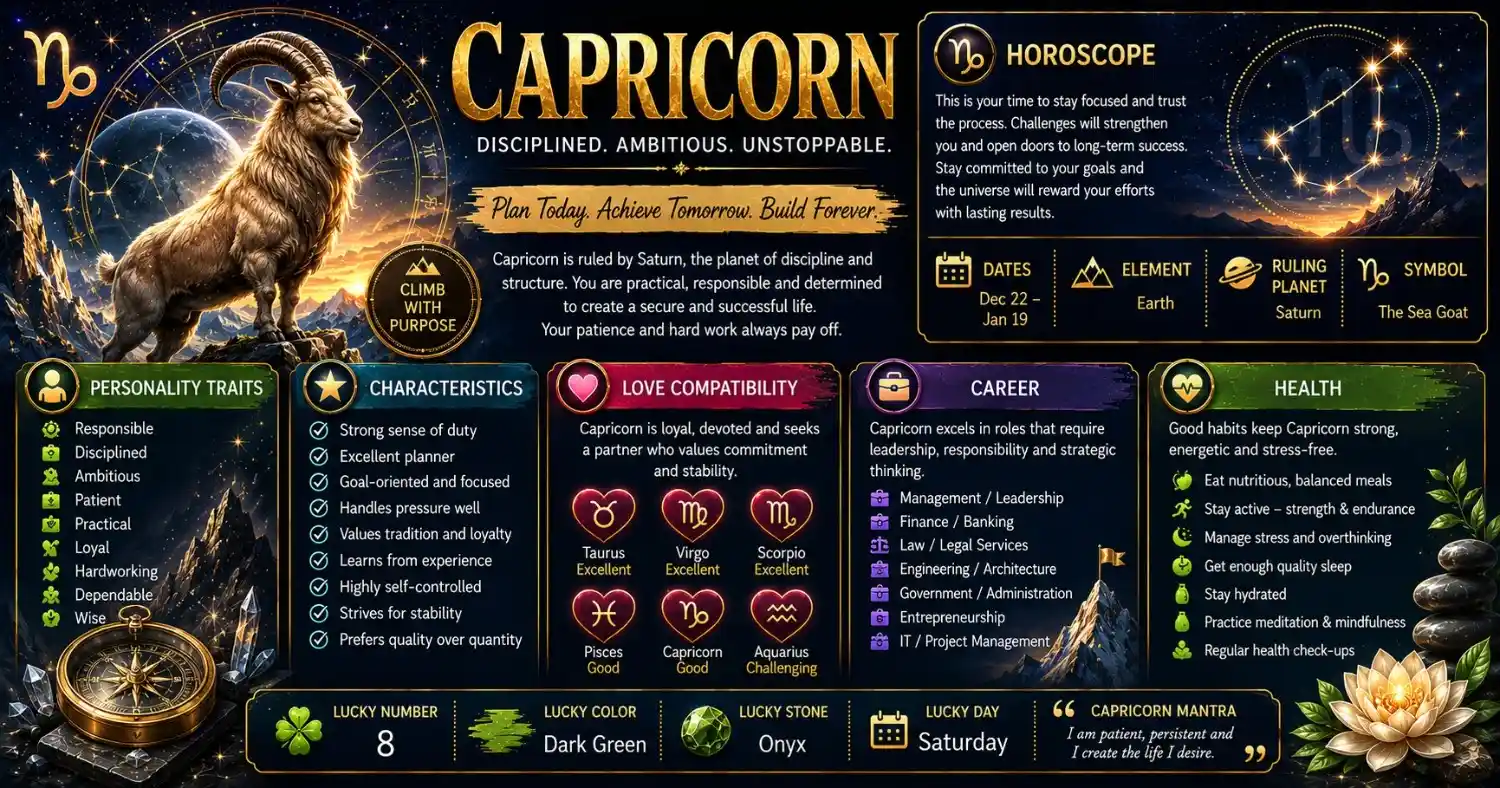
Capricorn (December 22 – January 19) is the tenth sign of the zodiac, a cardinal Earth sign ruled by Saturn — the stern, ancient planet of discipline, time, restriction, legacy, and the slow, inevitable rewards of patient effort. Saturn is the planet that demands you earn everything you receive. Its influence makes Capricorn people practical and responsible, focused, disciplined, and deeply oriented toward long-term achievement and the construction of lasting structures. Capricorn is symbolised by the Mountain Goat — a creature of sure footing and extraordinary endurance, climbing steadily, methodically, always upward, never looking down.
Capricorn is known as the most organised and goal-oriented of all signs. Just like ancient Babylon — whose ruler Hammurabi established what many historians consider the first comprehensive rule of law in world history — Capricorns are all about law, order, and logic. You are the architect and master builder of the zodiac. Focused, disciplined and determined — Capricorns always keep an overview and approach everything carefully.
This has enormous implications for travel and continent compatibility. Capricorn does not want novelty for its own sake — that belongs to Gemini and Sagittarius. It does not want sensory indulgence as the primary experience — that is Taurus and Leo’s domain. Capricorn wants encounters with legacy: places that have endured. Civilisations that built things designed to outlast the people who built them. Landscapes that mirror the Sea-Goat’s own inner geography — mountains, stone, ancient ruins that carry the weight of centuries without apology.
Capricorn travels with a plan. Instead of spontaneity, sense, structure and depth count. It is not interested in trendy spots. It will find the most peace in places that feel rock-solid and enduring — landscapes that remind it that the world is old and Capricorn does not have to carry the weight of it alone.
🌍 1. Europe — The Continent Built on Capricorn’s Values
Verdict: The #1 Continent for Capricorn — Structured, Ancient, and Built to Last
Europe is Capricorn’s continent with a force that goes far beyond mere personality matching. The connection is astrological, historical, and civilisational. Great Britain — whose birth chart as a unified nation falls on December 25, 1066 — is a Capricorn country in the classical astrological tradition. The United Kingdom embodies Capricorn values with uncanny precision: institutional conservatism, respect for tradition, a class system built on the Saturnian principles of earned position and inherited structure, a parliamentary democracy that is simultaneously the world’s oldest and most stubbornly unchanged, and a culture that takes its history — its monuments, its ceremonies, its inherited rules — with complete and unwavering seriousness.
Countries ruled by Capricorn include Bulgaria, Mexico, the UK, Albania, Bosnia, Afghanistan, Lithuania, and India. Cities ruled by Capricorn include Brandenburg, Brussels, Delhi, Mexico City, Port Said, Oxford, and Ghent. The concentration of major European capitals and centres of institutional power in this list is not coincidental. Capricorn is the zodiac sign most associated with the architecture of civilisation itself — governments, legal systems, established churches, ancient universities, and the structures of power that outlast their individual builders.
Rome: The Most Capricorn City on Earth
No city in the history of human civilisation better embodies Capricorn’s core essence than Rome — and the historical evidence for this is extraordinary. Augustus, the first emperor of Rome and the architect of the Pax Romana, used Capricorn as his personal sign — stamping it on coins, engraving it in cameos, identifying his imperial authority with the Sea-Goat’s qualities of stern moral authority, discipline, and the divine legitimacy of structured power. Capricorn, then as now, was associated with stern moral authority, the sign in which the Sun passes through the winter solstice and is, in a sense, reborn.
For Capricorn travellers, Rome is not merely a city. It is the single greatest physical manifestation of the values Capricorn holds most sacred: the belief that human ambition, properly disciplined and sustained over centuries, can construct something that genuinely outlasts the individual. The Colosseum has stood for almost two millennia. The Pantheon’s unreinforced concrete dome remains the largest of its kind on Earth. The Roman legal code, the Latin alphabet, the engineering of the aqueducts — the Romans built in Capricorn’s native language: the language of systems designed to endure.
In spring, the motto for Capricorn is “pure culture” — to be found in Rome, Istanbul or Athens. And few experiences better satisfy the Sea-Goat’s deep respect for institutional achievement than walking the Roman Forum at dawn, when the crowds have not yet arrived and the ancient stones can be heard in their silence.
The British Isles: Capricorn’s Ancestral European Homeland
Capricorn is a sea goat that prefers to earn pleasure through exertion. Sea Goats can satisfy their standards by walking the 73 miles of England’s Hadrian’s Wall Path. A ruin from the Roman era, the wall once marked the northern border of the empire. This recommendation is astrologically precise: Hadrian’s Wall is a Capricorn structure — built with Roman engineering discipline across the most demanding terrain imaginable, designed to endure, and now, two thousand years later, still standing.
The Scottish Highlands, recommended by astrocartographer Clarisse Monahan specifically for Capricorn in 2026, offer the sign something even more elemental. Remote and majestically patient, the Highlands allow Capricorn to clear its head and put itself first, exploring ancient stone ruins, storied castles, and breathtaking landscapes. For the Sea-Goat — whose inner life is frequently overloaded by the weight of its own ambitions and responsibilities — landscapes of ancient, patient grandeur are genuinely therapeutic. The Highlands have been standing their ground against weather, invasion, and time for millions of years. For a sign that specialises in doing exactly that on a human scale, the Highlands are a mirror.
In the fall, Capricorn is drawn to characterful cities such as Edinburgh and Lisbon — both cities where history is not merely preserved but lived. In winter, warmth in thermal resorts such as Maribor in Slovenia or Abano in Hungary offers the disciplined Sea-Goat permission to finally rest.
Athens and Greece: The Architecture of Western Thought
Athens holds a profound Capricorn resonance that most travel guides miss. Greece was the civilisation that built the philosophical and legal frameworks upon which Western institutions — Capricorn’s native domain — are constructed. The Parthenon, standing on the Acropolis for 2,500 years, is one of the most Capricorn structures on Earth: built not merely for use but for permanence, for the statement that a civilisation had reached a level of achievement worth recording in stone for eternity. For Capricorn, standing before the Parthenon is not admiring art. It is recognising kin.
Best European destinations for Capricorn: Rome, Athens, Edinburgh, the Scottish Highlands, London, Oxford, Brussels, Hadrian’s Wall, Lisbon, Vienna, Kraków, the Swiss Alps
🌏 2. Asia — Mountains, Mastery, and Millennial Civilisations
Verdict: Powerfully Favourable — Asia’s Ancient Civilisations and Mountain Landscapes Resonate Deeply
Asia offers Capricorn something Europe — for all its historic grandeur — cannot fully provide: civilisations of comparable or greater antiquity, and mountain ranges of a scale that make even the Alps feel modest. Both dimensions speak to the Sea-Goat’s inner world.
Japan: The Civilisation of Mastery, Craft, and the Long Game
Japan is among the most Capricorn-compatible nations in Asia, and the alignment is visible in every aspect of Japanese culture. The concept of shokunin — the master craftsperson who devotes decades to perfecting a single discipline — is a Capricorn philosophy elevated to national virtue. The Japanese work ethic, their institutional loyalty, their profound respect for seniority and earned hierarchy, their culture of meticulous planning and patient execution — all of these are Saturnian values wearing Japanese clothes.
Osaka in particular suits Capricorn in 2026: Capricorn respects tradition but appreciates a city that doesn’t take itself too seriously. Osaka is Japan’s anti-Tokyo — louder, funnier, less polished, and absolutely obsessed with food. Capricorn’s practical nature will appreciate the extraordinary value for money that Osaka’s food culture represents — best quality at honest price. The day trip to Nara’s deer park, the Osaka Castle history deep-dive, the Dotonbori street food marathon — these are purposeful, structured pleasures that satisfy Capricorn’s need to feel that every experience was earned.
The Himalayas: The Mountain Range for the Sign of the Mountain Goat
For Capricorn — whose symbol is a creature built for mountain terrain — the Himalayas are not merely a travel destination. They are an archetype made geographical. Nepal’s Annapurna Circuit or the approach to Everest Base Camp offer the Sea-Goat an experience of altitude, effort, and reward that is metaphysically aligned with the sign’s deepest nature. Every step higher requires more from the body. Every camp earned by genuine physical expenditure. Every summit view purchased with real effort. This is the Capricorn philosophy of existence distilled to its physical essence: nothing given, everything earned, and the view from the top is worth every step.
The Himalayas also house some of the world’s most ancient living spiritual traditions — Tibetan Buddhism, with its centuries-old monastic institutions, its meticulous philosophical traditions, its respect for accumulated wisdom and the authority of experience — carries a distinctly Capricorn institutional character.
India: The World’s Oldest Continuous Civilisation
India is a Capricorn-ruled country in traditional astrology — and the connection is immediately understandable. India is the world’s longest continuously inhabited civilisation, a place where institutions — religious, linguistic, philosophical, caste-based — have persisted with extraordinary tenacity across thousands of years. For Capricorn, which values nothing more than the structures that endure, India’s ancient living civilisation is profoundly compelling.
The temples of Rajasthan — built by rulers who measured their achievements in centuries, not years — and the Mughal architectural legacy of Agra, Delhi, and Fatehpur Sikri offer Capricorn encounters with the kind of sustained civilisational ambition it most deeply respects. Delhi, a Capricorn-ruled city, carries layers of empire upon empire — Mughal, British, and now the world’s largest democracy — all compressed into a single living city of extraordinary historical density.
🌎 3. The Americas — Heritage, Scale, and the Architecture of New Worlds
Verdict: Selectively Favourable — The Right American Destinations Resonate with Capricorn’s Values
Mexico — a Capricorn-ruled country — offers the Sea-Goat one of the most extraordinary encounters with ancient civilisational achievement in the Western Hemisphere. The Aztec, Maya, and Olmec civilisations built structures that have endured for millennia: the pyramids of Teotihuacán, Chichén Itzá’s astronomical precision, Palenque’s jungle-swallowed temples. Mexico City — a Capricorn-ruled city built on the ruins of Tenochtitlan, one of the greatest urban civilisations of the ancient world — gives the Sea-Goat a capital of extraordinary historical layering, where every plaza rests on older foundations and every modern institution carries the weight of pre-Columbian and colonial history simultaneously.
In North America, Peru’s Machu Picchu deserves special Capricorn attention. The Inca built their mountain citadel at an altitude that would test the most capable climber, using engineering techniques so precise that their stone blocks fit together without mortar and have survived five centuries of Andean earthquakes. For Capricorn — who believes that the quality of a structure is its test of time — Machu Picchu is an encounter with true mastery.
The United States offers Capricorn its own powerful encounters with institutional legacy: Washington D.C.’s neo-classical architecture modelled directly on Roman civic buildings, the Library of Congress’s extraordinary collections, the Smithsonian’s systematic preservation of human achievement. For a Capricorn with professional interests in law, government, or institutional leadership, Washington D.C. is a deeply compatible city.
🌍 4. Africa — Ancient Civilisation, Desert Endurance, and the Earth’s Oldest Mountains
Verdict: Powerfully Moving for the Historically Oriented Capricorn
Africa offers Capricorn a confrontation with civilisational legacy that predates even Rome. Egypt’s contribution to Capricorn’s travel map is extraordinary: the pyramids of Giza are the most durable structures in human history, built with a mathematical and engineering precision that modern architects still study with respect bordering on awe. For the Sea-Goat — who measures achievement by its longevity — the fact that the Great Pyramid has stood for 4,500 years and remained the tallest human-made structure on Earth for 3,800 of them is the ultimate Capricorn achievement made physical.
Ethiopia’s ancient civilisation, one of the world’s oldest continuous cultures, offers Capricorn a different African encounter: the rock-hewn churches of Lalibela, carved directly into living stone by medieval Christian builders over centuries of patient, dedicated effort; the ancient obelisks of Aksum, one of the world’s earliest urban civilisations; the mountain monasteries of the Simien range, perched at altitudes that test the body while rewarding the spirit with views of extraordinary majesty.
🌏 5. Oceania — New Zealand and the Long White Road
Verdict: Restorative and Surprisingly Resonant for the Weary Sea-Goat
New Zealand offers Capricorn something it genuinely needs but rarely grants itself: permission to stop. The country’s pristine national parks, its well-maintained hiking infrastructure (the Great Walks are the world’s best-organised trail system — a very Capricorn achievement), and its culture of practical outdoor accomplishment all appeal. The climb of Tongariro Alpine Crossing — a volcanic mountain trail of genuine challenge and extraordinary beauty — is precisely the kind of earned reward that satisfies the Sea-Goat’s need to feel that beauty was purchased through effort rather than merely consumed.
Summer brings time out in nature; in New Zealand’s case, that nature is among the most dramatically beautiful and meticulously preserved on Earth — a Capricorn-compatible value proposition if ever there was one.
The Cosmic Wildcard: Saturn’s 2026 Lessons for Capricorn
There’s a lot of clarity and action energy in Capricorn’s world this year. Jupiter continues its journey through Cancer — Capricorn’s opposite sign — until late June 2026, deepening roots, family connections, and the inner emotional world that the industrious Sea-Goat frequently neglects in favour of external achievement. This transit has opened more of Capricorn’s own self-nurturance, connecting it on an emotional and intuitive level with the buoyancy that comes from feeling inner and outer world truth with itself.
The message for Capricorn’s 2026 travel is therefore unusual and important: the best journey this year is not toward more achievement — it is toward renewal. The Scottish Highlands that remind the Sea-Goat that the world is old and it need not carry all its weight. The Roman Forum at dawn that whispers that even the greatest empires built on the values Capricorn holds most dear eventually rested. The Himalayan trail that proves there are mountains worth climbing simply for the view from the top, with no professional outcome required.
You are the architect and master builder of the zodiac. But even master builders must sometimes set down their tools and remember why they started building in the first place.
The Cosmic Summary: Continents Ranked for Capricorn
| Rank | Continent | Key Reason |
|---|---|---|
| 🥇 1 | Europe | Rome’s imperial legacy, Britain’s Capricorn birth chart, Athens’ institutional philosophy, Scottish Highlands’ patient grandeur |
| 🥈 2 | Asia | Japan’s mastery culture, the Himalayas’ mountain archetype, India’s ancient civilisational continuity |
| 🥉 3 | The Americas | Mexico’s pre-Columbian legacy, Peru’s Machu Picchu, Washington D.C.’s Roman-model institutions |
| 4 | Africa | Egypt’s pyramids as ultimate Capricorn achievement, Ethiopia’s ancient mountain monasteries |
| 5 | Oceania | New Zealand’s earned outdoor experiences, well-organised national parks, restorative nature |
| 6 | Antarctica | Capricorn would respect the endurance required — but there is nothing to build there |
What Capricorn Should Look for in Any Destination
Wherever the Sea-Goat plants its sure footing, the environments that truly favour this sign always carry these essential qualities:
- Ancient history and enduring civilisations — places built to last thousands of years, not trending for a season
- Institutional grandeur — great museums, universities, legal systems, cathedrals — the architecture of organised human achievement
- Mountains and elevated terrain — Capricorn’s native landscape, where effort is required and the view is earned
- Quality over novelty — exceptional restaurants, historic hotels, artisanal craftsmanship that reflects generations of accumulated skill
- A purposeful itinerary — Capricorn does not drift; it appreciates destinations with enough depth to merit thorough, planned engagement
- Respect for tradition and structure — cultures that honour the past, that understand why rules and institutions matter
- The opportunity to feel the weight of time — ancient ruins, geological formations, civilisations measured in millennia not decades
The Final Verdict: Europe — Where Capricorn’s Deepest Values Were Built in Stone
After examining the full Saturn-ruled landscape of Capricorn’s nature — its cardinal Earth sign ambition directed toward legacy and endurance, its profound respect for institutional achievement, its mountain-goat relationship with earned reward, its Saturnian need to encounter civilisations that have withstood the test of time — one continent emerges from the pages of history with unmistakable authority: Europe.
Rome is Capricorn’s city on Earth — the greatest monument to disciplined human ambition in the history of civilisation, the place where Capricorn’s ruling emperor Augustus stamped the Sea-Goat on his imperial coins and declared that structured authority and moral discipline were the foundations of a lasting world. Great Britain — born on a Capricorn date, governed by Capricorn institutions, shaped by Capricorn values — is the sign’s national mirror. The Scottish Highlands offer the weary Sea-Goat the ancient, patient grandeur it needs when ambition threatens to overwhelm wisdom.
Asia runs a powerful second — with Japan’s culture of mastery, the Himalayas’ mountain archetype, and India’s ancient civilisational continuity offering Capricorn encounters with legacies built on Saturnian time scales. And the Americas offer the Sea-Goat Mexico’s pre-Columbian monuments and Machu Picchu’s mountain citadel — achievements built by civilisations that understood, as Capricorn does, that nothing worth having comes without sustained, patient, disciplined effort.
But it is in Europe — walking Hadrian’s Wall in the cold morning air, standing in the Roman Forum as the sun rises over two millennia of history, climbing the Scottish Highlands as ancient stone castles rise from the mist — that Capricorn finds what it has always been climbing toward: not merely the summit, but the proof that the climb was worth it.
Plan the itinerary carefully. Book the historically significant hotel. Walk the ancient wall. You are, after all, a Capricorn — and the world’s greatest achievements have been waiting for someone serious enough to truly appreciate them.
Astrology is a tool for self-understanding and exploration. Planetary influences interact uniquely with each individual’s full natal chart. Consult a professional astrologer for personalised guidance.