
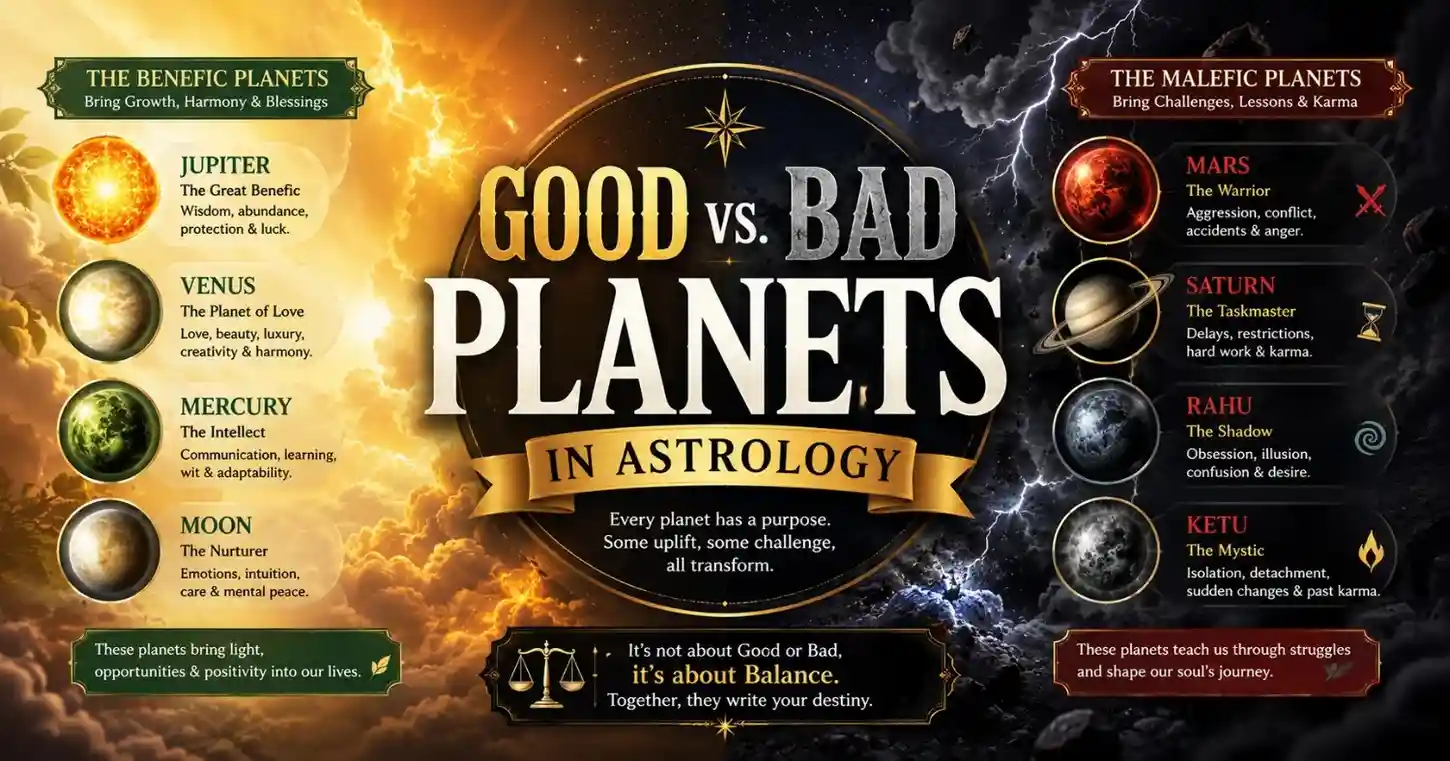
Somewhere between an astrology meme and a birth chart reading, most people run into the same confusing idea: some planets are “good,” and some are “bad.” Jupiter shows up and everyone celebrates. Saturn shows up and someone starts talking about karma and hardship. But what does that actually mean, and is it even true?
The short answer is: astrology does classify planets as benefic (good) or malefic (bad) — but the long answer is far more interesting, and far less black-and-white, than a simple good guy/bad guy story. A planet’s “goodness” or “badness” depends on where it sits, what it touches, whether you were born in daylight or after dark, and even what phase the Moon was in on the day you arrived. A so-called bad planet can be the reason you succeed. A so-called good planet can quietly underperform.
This guide walks through everything you need to know about benefic and malefic planets — what they are, why the classification exists, how astrologers refine it for your individual chart, what it actually feels like when these planets are active in your life, and how people traditionally work with the more difficult ones. Whether you’re new to astrology or trying to make sense of a reading you already received, you’ll leave with a clear, practical understanding of the good-vs-bad-planet debate.
What Do “Good” and “Bad” Planets Really Mean in Astrology?
In astrology, benefic planets are those traditionally associated with ease, growth, harmony, and good fortune. Malefic planets are associated with friction, restriction, delay, and difficulty. The words themselves come from Latin: “benefic” essentially means “good-doer,” while “malefic” means “doing ill.”
This isn’t a modern invention. The benefic/malefic framework goes back to ancient Greek and Hellenistic astrology, and it plays an especially central role in Vedic (Jyotish) astrology, where it’s used constantly to interpret a birth chart, a planetary period (dasha), or a transit. Western astrology acknowledges the concept too, though it tends to lean on it less heavily than Vedic traditions do.
It’s worth being precise about what “good” and “bad” mean here, because the label doesn’t describe the planet’s morality — it describes its typical behavioral tendency. A benefic planet tends to bring things that feel pleasant: opportunity, charm, comfort, expansion. A malefic planet tends to bring things that feel like effort: obstacles, tension, loss, or transformation you didn’t necessarily ask for. Neither label is a verdict on your character or your fate. It’s more like a weather forecast for a particular area of life — useful information, not a life sentence.
Why This Distinction Matters for Reading a Chart
Understanding which planets are benefic and which are malefic gives you a fast, practical shorthand. If a naturally benefic planet is well-placed in your chart, you can generally expect more ease in the life area it governs. If a naturally malefic planet is poorly placed, you might expect to grow through friction in that same area. It’s a starting point for interpretation — never the whole story, but a useful first filter before diving into houses, aspects, and timing.
The Natural Benefics: Planets Considered “Good”
Across most astrological systems, a small group of planets are consistently treated as naturally benefic. These are the placements people are usually happy to see prominent in their chart.
Jupiter: The Greater Benefic
Jupiter is almost universally regarded as the most benefic planet in the sky. It represents expansion, luck, higher learning, generosity, and abundance. Wherever Jupiter sits strongly in a chart, it tends to widen opportunities — more education, more prosperity, more optimism, more room to grow. In Vedic astrology, Jupiter is often called “Guru,” the teacher, and a strong Jupiter is associated with wisdom, ethics, and good fortune that seems to arrive with relatively little resistance.
Venus: The Lesser Benefic
Venus is the second core benefic, ruling love, beauty, pleasure, relationships, and material comfort. A well-placed Venus is linked to harmonious partnerships, charm, artistic talent, and an overall smoother experience of life’s finer things. Interestingly, in classical and Vedic thought, Venus and Jupiter aren’t ranked identically — some traditions treat Venus as even more refined or “wise” than Jupiter in certain symbolic contexts, though Jupiter typically keeps the title of “greater” benefic due to its association with growth and protection on a larger scale.
Mercury: The Conditional Benefic
Mercury is usually classified as benefic, but with an asterisk. Mercury is considered neutral or “changeable” by nature — a planet of communication, business, and intellect that tends to take on the qualities of whatever it’s associating with. When Mercury sits near or aspects a benefic planet like Jupiter or Venus, it behaves like one. When it’s tied to a malefic planet, its effects shift in that direction. This chameleon-like quality is one of the first clues that the benefic/malefic system isn’t rigid.
The Moon: Benefic, But It Depends on the Sky That Night
The Moon is one of the more fascinating cases in this whole framework, because its benefic or malefic status isn’t fixed at all — it’s determined by its relationship to the Sun at the moment of birth. A Moon that’s moving away from the Sun (the waxing phase, heading toward a full moon) is considered increasingly benefic. A Moon that’s approaching the Sun (the waning phase, heading toward a new moon) is considered increasingly malefic. At the exact new moon, the Moon is regarded as fully malefic; at the exact full moon, fully benefic. This is one of the clearest illustrations in astrology that “good” and “bad” aren’t permanent identities — they’re conditions that shift with context.
The Natural Malefics: Planets Considered “Bad”
On the other side of the ledger are the planets traditionally linked to hardship, restriction, and conflict. These aren’t villains in the chart — they’re the planets responsible for growth through resistance rather than growth through ease.
Saturn: The Greater Malefic
Saturn carries the heaviest reputation of all the malefics. It governs discipline, time, boundaries, responsibility, and delay. A prominent or afflicted Saturn is associated with obstacles, slow timelines, isolation, and situations that demand patience and maturity before they resolve. But Saturn’s difficulty has a purpose baked into the symbolism: it’s the planet of long-term structure. Saturn placements that feel restrictive in the short term are frequently the placements that produce durable, hard-won success later on — success that lasts precisely because it wasn’t handed over easily.
Mars: The Lesser Malefic
Mars represents action, aggression, courage, and conflict. Its “hot and dry” classical nature made ancient astrologers link it with anger, impulsiveness, and physical intensity. A difficult Mars placement can show up as arguments, accidents, impatience, or a short fuse. A well-integrated Mars, though, is exactly what gives someone the drive to fight for what they want, take initiative, and push through obstacles other people avoid. Mars is malefic in the sense of being intense — not in the sense of being useless or purely destructive.
The Sun: A Mild Malefic
The Sun occupies an interesting middle position. Most traditions treat it as a mild or minor malefic, since intense solar placements can be associated with ego friction, authority conflicts, or a tendency toward pride and burnout. That said, the Sun’s malefic reputation is much softer than Saturn’s or Mars’s — it’s the planet of vitality, leadership, and identity, and its “damaging” quality is usually described as far less severe than the other traditional malefics.
Rahu and Ketu: The Shadow Malefics
Unique to Vedic astrology, Rahu and Ketu are the lunar nodes — mathematical points rather than physical bodies, representing where the Moon’s orbit crosses the Sun’s apparent path. They are both classified as malefic, but each expresses that difficulty differently. Rahu is linked to obsession, illusion, ambition without limits, and sudden disruptive change; it magnifies whatever it touches, often past a healthy point. Ketu is linked to detachment, spiritual restlessness, loss, and a pull away from material concerns, sometimes to the point of confusion or aimlessness. Both nodes are considered especially unpredictable because they don’t behave like ordinary planets — their effects tend to feel more fated, more sudden, and less within personal control.
An Important Exception: Ketu Isn’t Always Malefic
Even within the “shadow malefic” category, there’s nuance. Ketu, for example, is frequently described as capable of acting like a benefic when placed in the third, sixth, or eleventh houses of a chart — houses traditionally associated with effort, competition, and gain. This single exception is a perfect preview of the next section: the natural classification is only step one.
Why “Bad” Planets Aren’t Actually Evil
If there’s one myth worth retiring early, it’s this: malefic does not mean cursed, and benefic does not mean charmed. Malefic planets aren’t punishing you. They’re the parts of the chart responsible for resistance training.
Think of it this way — benefic planets are like a supportive mentor who tells you you’re doing great and hands you opportunities. Malefic planets are more like a demanding coach who pushes you through discomfort you didn’t choose, precisely because that discomfort builds something the encouragement alone never could. Saturn’s delays often produce the discipline someone needed all along. Mars’s conflicts often produce the courage someone needed to develop. Rahu’s obsessive drive, when eventually tempered, can produce extraordinary ambition and innovation. None of this is “evil” — it’s simply a different mechanism for growth.
The flip side is just as important: a benefic planet doesn’t guarantee a trouble-free life either. A poorly placed or heavily afflicted Jupiter or Venus can underdeliver, show up as excess, or create complacency. Ease isn’t automatically better than effort — both are just different roads to the same destination.
Natural vs. Functional Benefics and Malefics
Here’s where the good-vs-bad-planet conversation gets genuinely sophisticated, and where most surface-level explanations stop short. The planets described above are natural benefics and malefics — their default temperament, independent of anyone’s individual chart. But Vedic astrology adds a second, more personalized layer: functional benefics and malefics, which depend entirely on your rising sign, or ascendant.
Here’s the key idea: every planet rules over two houses in your chart based on your ascendant, and depending on which houses those are, the same planet can behave completely differently for two different people. Jupiter, a natural benefic, might function as a functional malefic for one ascendant sign if it rules over difficult houses in that particular chart — and Saturn, a natural malefic, might function as a functional benefic for another ascendant if it rules helpful houses instead.
A few structural rules astrologers commonly apply when working out functional status:
- Any planet ruling the 1st, 5th, or 9th house (the most auspicious houses, tied to self, creativity/intelligence, and fortune) is very rarely treated as malefic for that ascendant, regardless of its natural nature.
- Planets ruling the 3rd, 6th, or 11th houses (associated with effort, conflict, competition, and gain through struggle) tend to behave in a more malefic way for that ascendant, even if they’re naturally benefic.
- Planets ruling “dusthana” houses — the 6th, 8th, and 12th, associated with illness, sudden events, and loss — are generally considered weaker or more difficult regardless of their natural temperament.
This is why two people with the same natural benefic prominent in their chart can have very different life experiences with that planet. The natural classification tells you a planet’s baseline personality. The functional classification tells you how that personality plays out specifically for you.
Key Factors That Shift a Planet From “Good” to “Bad” (or Back Again)
Beyond natural and functional status, several additional layers determine how a planet’s energy actually shows up. This is the part of astrology that separates a superficial reading from a genuinely useful one.
Sect: Was the Chart Born in Daylight or at Night?
Classical astrology places heavy emphasis on sect — whether someone was born during the day or after dark. In diurnal (day) charts, Jupiter is considered the stronger, more positively expressed benefic, while Mars is treated as the more difficult malefic. In nocturnal (night) charts, the roles shift: Venus becomes the stronger benefic, and Saturn becomes the more challenging malefic. Sect doesn’t change whether a planet is benefic or malefic in the broad sense — it changes the intensity and flavor of how that nature is expressed.
Moon Phase: Waxing vs. Waning
As covered earlier, the Moon’s benefic or malefic quality is directly tied to its angular distance from the Sun. A Moon growing in light (waxing) trends benefic; a Moon shrinking toward darkness (waning) trends malefic. Around the midpoint of each phase, the Moon is considered roughly neutral.
Conjunctions and Aspects
A planet rarely acts alone. When a natural benefic sits close to, or receives a challenging aspect from, a natural malefic, its positive expression can be diluted or complicated. The reverse is also true: a naturally malefic planet positioned near a strong benefic can have its harsher tendencies softened. This is one of the most common reasons a “textbook benefic” underdelivers in a real chart, or a “textbook malefic” turns out surprisingly constructive.
House Placement
Where a planet physically sits in the chart — which of the twelve houses it occupies — shapes which area of life feels its influence most, and how comfortably it settles in. A benefic in a difficult house (like the 6th, 8th, or 12th) may struggle to express its natural ease. A malefic in a favorable, “own” or exalted position may express its energy far more constructively than its base reputation would suggest.
Dignity: Exaltation, Debilitation, and Own Sign
Every planet has signs where it’s considered especially strong (exalted) or especially weak (debilitated), along with signs it rules outright (its “own sign”). A malefic planet in its own sign or exaltation — Saturn in Libra, for example, or Mars in Capricorn — tends to express its difficult themes far more productively: discipline instead of despair, courage instead of recklessness. Conversely, even a natural benefic can underperform in its debilitated sign. Astrologers are careful to note that dignity doesn’t override the benefic/malefic label entirely, but it strongly colors how that nature comes through.
Timing: Dashas, Transits, and Retrogrades
Even a well-placed planet has moments where its energy becomes more active and noticeable — during its planetary period (dasha in Vedic astrology), during a significant transit, or while retrograde. A malefic planet’s difficult themes tend to surface most clearly during its own active period, which is one reason the same chart can feel very different to live through at age 25 versus age 45.
How to Identify Benefic and Malefic Planets in Your Own Chart
If you want to move from theory to your actual chart, the process generally follows these steps:
- Generate an accurate birth chart. You’ll need your exact birth date, time, and location — timing especially matters, since it determines your ascendant, which everything else is measured against.
- Identify your ascendant (rising sign). This is the anchor point for determining functional benefics and malefics specific to you.
- Check natural status first. Note which planets are naturally benefic (Jupiter, Venus, and conditionally Mercury and the Moon) versus naturally malefic (Saturn, Mars, the Sun mildly, and Rahu/Ketu).
- Layer in functional status. Based on your ascendant, determine which houses each planet rules, and apply the general rules above — 1st/5th/9th lords lean benefic, 3rd/6th/11th lords lean malefic, and 6th/8th/12th lords tend to be weaker regardless.
- Check placement and dignity. Look at the house each planet sits in and whether it’s exalted, debilitated, or in its own sign.
- Check conjunctions and aspects. Note which planets are near or interacting with each other, since this can shift the tone significantly.
- Consider sect and Moon phase. Factor in whether the birth was diurnal or nocturnal, and where the Moon sat relative to the Sun.
Many astrology websites now offer free benefic/malefic calculators that automate the natural and functional classification once you enter your birth details. These are a genuinely useful starting point, but they typically can’t fully account for aspects, dignity, and nuance — for a complete picture, a full chart reading (or serious self-study) is still the more reliable route.
What It Actually Feels Like When Malefic Planets Are Active
One of the most practical reasons people study this topic is timing — trying to understand why a certain period of life felt unusually hard, or unusually smooth. When a malefic planet becomes active through a major planetary period or a significant transit, the effects commonly described include:
- Delays or obstacles in areas the planet governs — career stalls under an active Saturn period, for instance, or communication breakdowns under an afflicted Mercury.
- Increased conflict, impatience, or physical intensity during an active Mars period.
- A sense of confusion, restlessness, or disproportionate ambition during an active Rahu period.
- Detachment, loss, or a pull toward introspection during an active Ketu period.
It’s worth repeating that these periods are widely described as temporary and purposeful rather than punitive. Difficult dashas and transits are frequently framed as the exact windows in which durable change happens — the discomfort is the mechanism, not a design flaw.
Remedies: Traditional Ways of Working With Malefic Planetary Energy
Across Vedic astrology in particular, an entire tradition of remedial measures exists for softening the harder edges of malefic planetary influence. These aren’t presented as guarantees or replacements for practical action — they’re symbolic, devotional, or lifestyle-based practices meant to bring a person into better alignment with a planet’s energy. A few commonly cited examples:
For Saturn
Practices associated with easing Saturn’s influence include consistent acts of charity (especially toward those in need), simple and disciplined daily routines, and mantra recitation dedicated to Saturn. The underlying theme across nearly all Saturn remedies is discipline and humility — leaning into the very qualities Saturn is trying to teach, rather than resisting them.
For Mars
Common Mars-related practices emphasize channeling excess energy constructively: physical activity, disciplined action, and charitable acts tied to courage and generosity. The goal isn’t to suppress Mars’s intensity but to direct it somewhere productive.
For Rahu
Rahu remedies typically focus on grounding an otherwise restless, expansive energy — through routine, service to others, and mantra practice aimed at reducing illusion and mental agitation.
For Ketu
Ketu-related practices tend to lean toward spiritual grounding and simple charitable acts, reflecting Ketu’s themes of detachment and non-attachment. The emphasis is usually on finding meaning and stability rather than drifting into disconnection.
A word of caution belongs here: remedial astrology is a matter of tradition and personal belief, not scientifically validated intervention. If you’re navigating a genuinely difficult period — financially, medically, emotionally, or otherwise — the most reliable path forward is combining any symbolic or spiritual practices you find meaningful with real-world support: financial planning, medical care, or professional guidance, as appropriate to the situation.
Common Myths About Good and Bad Planets
Myth: Malefic planets mean a “bad” or “cursed” person. Reality: Malefic placements describe a tendency toward growth-through-friction in a specific life area, not a moral judgment on the person.
Myth: A benefic-heavy chart guarantees an easy life. Reality: Poorly placed or afflicted benefics can underperform, and an easy chart isn’t inherently “better” than a challenging one — both simply produce different kinds of life experience.
Myth: The benefic/malefic label never changes. Reality: As shown throughout this guide, sect, house rulership, conjunctions, dignity, and even Moon phase can all shift how a planet’s nature expresses itself.
Myth: You can permanently “cancel out” a malefic planet with remedies. Reality: Traditional remedies are generally described as ways to work with a planet’s energy more constructively, not as a way to erase its themes from a chart entirely.
Myth: Modern planets (Uranus, Neptune, Pluto) fit neatly into this system. Reality: Because they weren’t visible to the naked eye and weren’t part of the original classical or Vedic framework, these outer planets aren’t traditionally assigned fixed benefic or malefic status — some modern astrologers treat them as malefic only in difficult aspect, but this isn’t universal.
How Benefic and Malefic Placements Show Up in Different Life Areas
Reading about planetary nature in the abstract only goes so far — it helps to see how the same benefic-vs-malefic framework plays out across the areas of life people actually care about.
Career and Ambition
A benefic like Jupiter placed favorably in a career-related house often shows up as steady recognition, mentorship, and opportunities that arrive without excessive struggle. A malefic like Saturn in the same area tends to describe a slower climb — more setbacks, more waiting — but frequently one that ends in a level of authority or expertise that the “easier” path rarely produces. Mars, when well-integrated, is often behind entrepreneurial drive, competitive success, or careers that reward decisiveness and physical courage.
Relationships and Partnership
Venus is the classic signature of harmonious, affectionate partnerships, and a strong Venus placement often coincides with ease in attraction and compromise. A difficult Mars placement in the same house can describe passionate but combustible relationships, marked by intensity, jealousy, or conflict that either burns out fast or forges a fiercely loyal bond once both people learn to work with it. Saturn in a relationship house is frequently linked to delayed partnerships or relationships that take real commitment to build — but ones that, once established, tend to be built for the long haul.
Health and Vitality
Because the Sun and Mars both relate to physical vitality, difficult placements involving either can coincide with higher stress, inflammation-prone tendencies, or accident-proneness in classical interpretation. Saturn’s involvement in health matters is traditionally tied to chronic or slow-developing conditions rather than sudden ones — again reflecting its broader theme of delay. Jupiter, by contrast, is generally associated with resilience, recovery, and overall constitutional strength when well-placed.
Money and Resources
Jupiter and Venus are the two planets most associated with financial ease — inherited wealth, generosity that comes back around, or a natural knack for accumulating resources. Rahu’s involvement in financial matters often describes sudden windfalls or equally sudden losses, since its core theme is amplification without built-in restraint. Saturn tends to describe wealth built slowly, through frugality and long-term planning, rather than through quick gains.
None of these associations are deterministic. They describe tendencies that shift considerably based on every factor discussed earlier in this guide — house strength, aspects, dignity, and timing all still apply.
Frequently Asked Questions
What are the benefic planets in astrology?
Jupiter and Venus are the two universally recognized benefic planets. Mercury and the Moon are considered conditional benefics, since their nature shifts depending on planetary association and, in the Moon’s case, lunar phase.
What are the malefic planets in astrology?
Saturn and Mars are the primary malefics, with Saturn typically viewed as the more intense of the two. The Sun is considered a mild malefic. In Vedic astrology, Rahu and Ketu are also classified as malefic.
Can a malefic planet ever be good for you?
Yes. Through functional status (based on your ascendant), favorable house placement, strong dignity, or beneficial aspects, a naturally malefic planet can produce constructive, even highly favorable, results in an individual chart.
Can a benefic planet ever be bad for you?
Yes, for the same reasons in reverse — an afflicted, poorly placed, or functionally malefic benefic can underperform or create complications.
What’s the difference between natural and functional malefics?
A natural malefic is a planet considered difficult by default across all charts (Saturn, Mars, the Sun, Rahu, Ketu). A functional malefic is determined individually, based on which houses that planet rules for your specific ascendant — meaning even a natural benefic can act as a functional malefic for certain rising signs.
Do malefic planets mean bad luck?
Not exactly. They’re more accurately described as indicators of growth through challenge rather than growth through ease. Many people trace their greatest strengths, resilience, and long-term success directly back to a well-worked malefic placement.
How do I find out which planets are benefic or malefic in my own chart?
Start with an accurate birth chart based on your exact birth date, time, and location. From there, identify your ascendant, check each planet’s natural status, apply functional rules based on house rulership, and consider dignity, conjunctions, and sect for a fuller picture.
Final Thoughts
The “good planets vs. bad planets” framing is a useful entry point into astrology, but it’s really the beginning of a much richer conversation. Every planet — benefic or malefic — is trying to hand you something: ease, expansion, and comfort in one case; resilience, depth, and hard-earned growth in the other. Neither category is optional in a well-rounded life, and neither guarantees an outcome on its own.
If there’s one takeaway worth carrying forward, it’s this: a chart full of only benefics would offer very little friction to grow against, and a chart full of only malefics would offer very little softness to enjoy. The interplay between the two — softened here by dignity, intensified there by conjunction, shifted by sect, timed by transit — is what actually produces a real, lived human life. Understanding that interplay, rather than memorizing a simple good/bad list, is what turns a surface-level astrology fact into genuine chart literacy.
My Today’s Horoscope is filled with carefully researched articles, daily horoscopes, spiritual guidance, zodiac compatibility insights, numerology meanings, tarot interpretations, and astrology tools for readers of every experience level — from curious beginners to advanced astrology enthusiasts. (See our Site Index to quickly find what we have to offer)