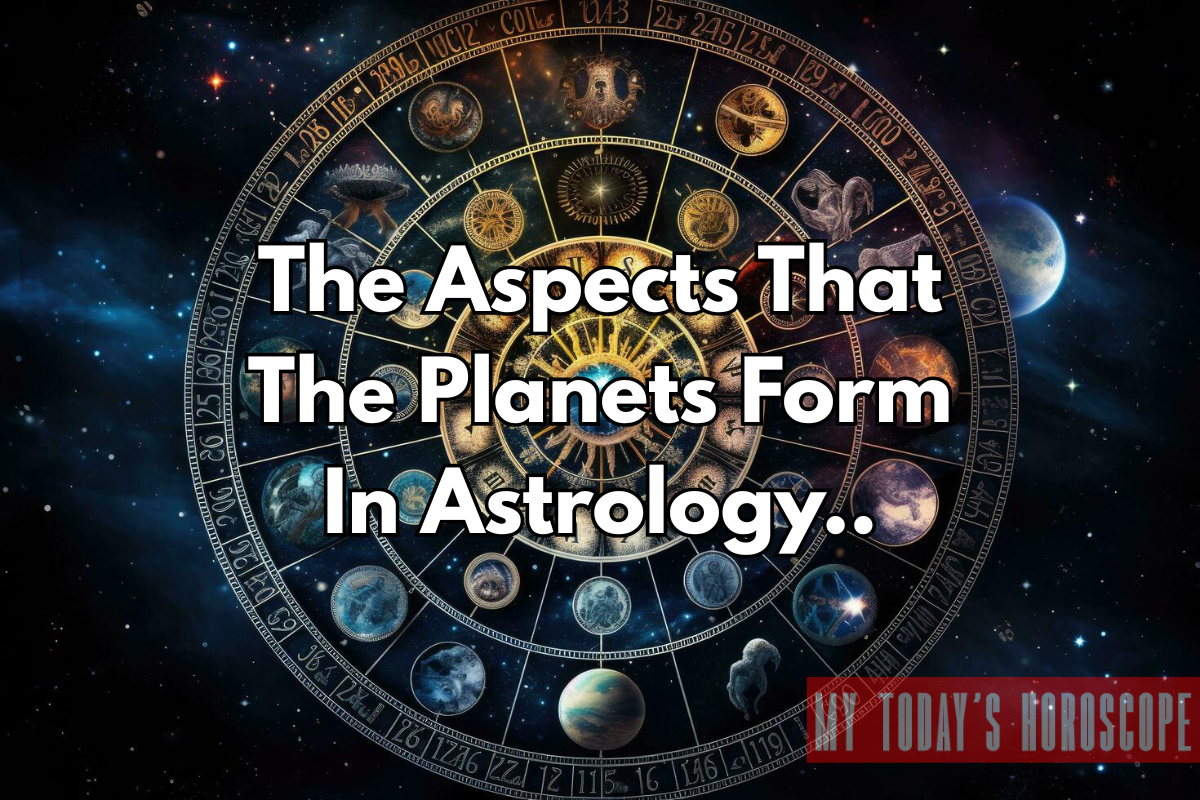
Within the zodiacal mandala, we have the planets located in certain astrological signs and houses, but there is also an angular relationship between them, called aspects.
The planets are functions within our birth chart; the sign they occupy determines how those particular functions manifest, and the astrological house represents the specific area of life where the greatest impact is felt. Imagine each planet as a member of a family; they need to communicate with each other, and we call this communication “aspects”—the relationship between them. It’s also worth noting that planets transiting the sky form aspects with those in the birth chart.
While each aspect has a predetermined number of degrees separating them, this does not have to be exact. For example, if squaring is 90 degrees apart, the tolerated range is between 84 and 96 degrees.
Also read: What’s My Venus Sign? Unveiling the Cosmic Key to Love, Beauty, and Values
The aspects most commonly used in astrology are:
The Conjunction (0 degrees):
This occurs when two or more planets are within a few degrees of each other, whether they are in the same sign or not. The conjunction is the most powerful aspect, as it signifies a planetary alliance and a merging of the energies of both planets.
It’s a somewhat blind spot because it leads us to situations we don’t immediately notice. We usually only become aware of them after we’ve become much more conscious of them. This happens in conjunctions because, with planets in the same sign, it’s difficult to discern which one is influencing the outcome.
For example, when Venus (the ruling planet of relationships) and Pluto (the ruling planet of power) are in conjunction in a person’s birth chart, Pluto’s intensity will come to the fore when they connect with others. This means that the person will experience intense and transformative relationships, often without realizing it—without warning.
The Opposition (180 degrees):
Imagine a scale with a planet on each side. The more one side tips, the more the other loses weight, but this second side inevitably reappears at some point to balance the whole. In this sense, both planets are complementary, and finding a middle ground is the healthiest approach.
For example, when Saturn (the planet of responsibility) is in opposition to Neptune (the planet of confusion), the more extremely orderly and realistic a certain attitude is, the more situations of Neptunian chaos and confusion will arise. Conversely, the more one lives in a dream world, the more forcefully some factor will appear that will cause us to clash with reality and order.
The Square (90 degrees):
This aspect signifies a planetary tension that feels like a crisis. It’s the sensation of being blocked, but it’s precisely a learning experience and exercise; it may be difficult, but it ultimately yields productive results. Within a birth chart, it represents a perception that something is divided within.
For example, when the moon is in square aspect to Mars, it creates a tendency to be alert and defensive, but also to attack. To manage this aspect, one must seek to release tension and find one’s ideal potential.
The Trine (120 degrees):
As its most positive aspect, the trine usually occurs between planets in signs of the same element (fire, earth, air, water). It is a harmonious relationship between the planets involved, as it is facilitative, but it can also become quite comfortable. To take advantage of it, it is necessary to activate it.
For example, when the sun is in trine with Mars, our consciousness and being flow with action. That is, we know what we are doing, why, and for what purpose, but it is such a powerful gift that it might lead us to be lazy because we know that even without effort, things will come to us on their own.
The Quinquin (150 degrees):
This aspect is rather unpleasant, when one planet gets in the way of another, or rather, when they are “afraid” of each other. Even worse, there’s not much that can be done to remedy this crisis.
For example, when Mars forms a quinquennial with Saturn, the Martian spirit of undertaking a project begins with great enthusiasm, but it generates a lot of pressure or is extremely laborious to sustain it over time.
The Sextile (60 degrees):
This aspect is extremely dynamic (even more so than a trine), as both planets are in constant communication. Unlike a conjunction, the combined energy of the planets does not all flow in the same direction; instead, they feed off each other.
For example, when Venus is in sextile with Mars, it creates a direct connection between what we desire and the way to conquer and achieve our goals.
The Semi-square (45 degrees):
This aspect is the opposite of a sextile because communication between the two planets is cut off—and work needs to be done on it.
For example, when the moon is in a semi-square with Mercury, there is a strong tendency to have difficulty expressing emotions.
Also read: Effect Of Saturn In Each Of The 12 Houses And Remedies
Other important astrological aspects
Stellium:
This term is used when there are 3 or more natal planets in conjunction, giving it even more strength.
Feral Planet:
It’s a planet that has no aspects with any other planet; it’s isolated. Imagine it’s a family member who doesn’t communicate with the other members of the household. These planets require a lot of work for their energy to be integrated and recognized within a birth chart.
Planet PUMA (Planet only poorly aspected):
This occurs when a planet receives only conjunction, square, and/or quinquennial aspects. Such a planet requires significant focus to be able to perform its function more effectively.