
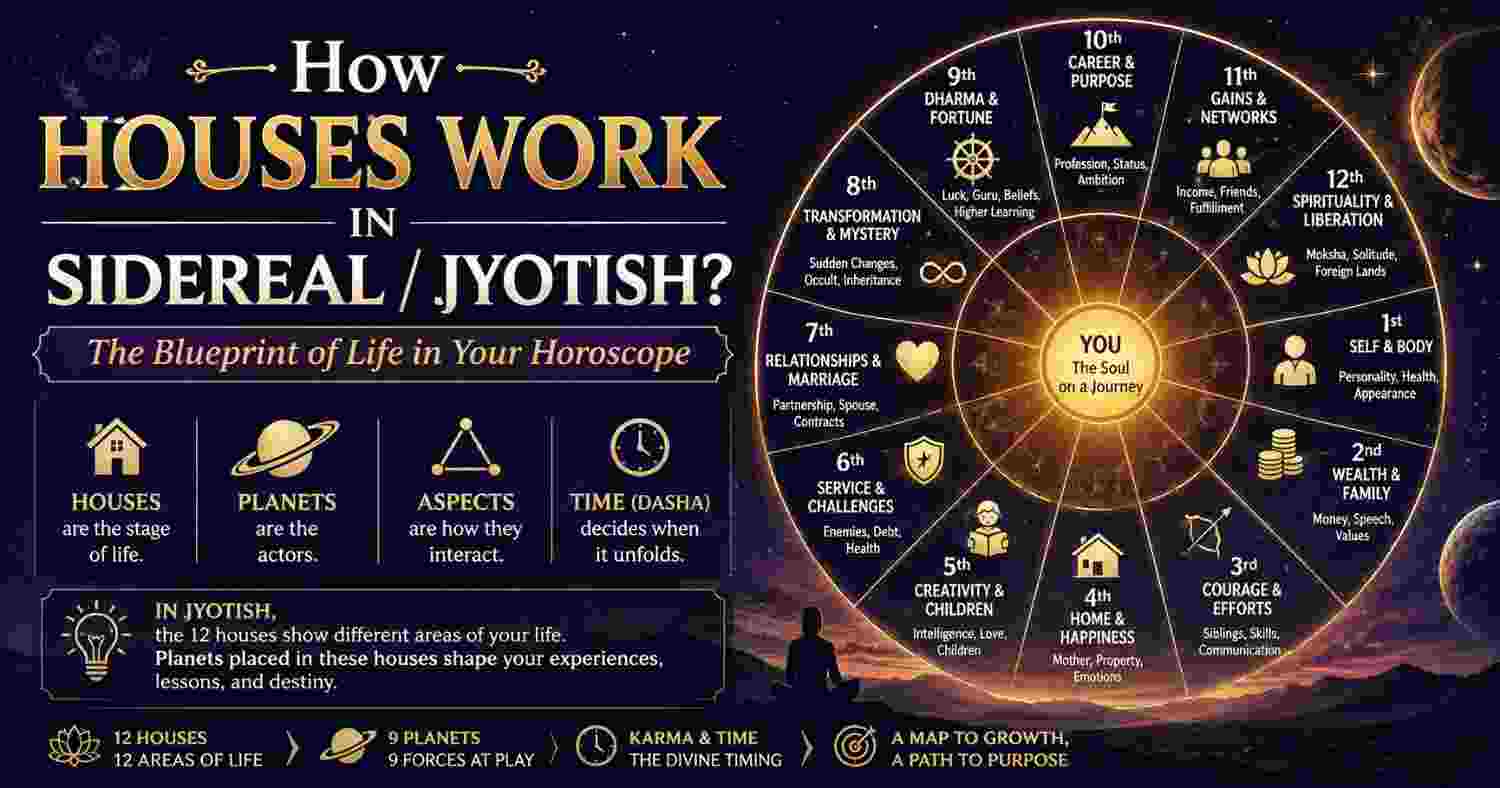
Every Vedic astrology reading rests on one structure: the twelve houses. Astrologers call them bhavas. These twelve divisions turn a birth chart from a static map of planets into a living story about your body, your family, your money, your marriage, your career, and your fate. If you understand the planets but skip the houses, you only have half the picture. This guide fixes that gap. It explains exactly how houses work in sidereal Jyotish, from the ascendant that anchors the entire chart to the dashas that activate each house at the right time in your life.
This article follows the classical framework used in texts like Brihat Parashara Hora Shastra. It also reflects how practicing Jyotish astrologers apply these rules today. You will learn what a house is, how astrologers calculate it, what each house governs, how house lords work, and how planets change a house’s story. By the end, you will read a birth chart the way a trained astrologer does: house by house, lord by lord, layer by layer.
What Is a House (Bhava) in Vedic Astrology?
A house is a division of life. The zodiac wheel spans 360 degrees. Jyotish astrologers split that wheel into twelve equal parts, and each part represents a distinct area of human experience. Think of the zodiac signs as the backdrop and the houses as the stage. Planets are the actors. The sign colors a planet’s style. The house tells you where that planet performs its role in your actual life.
Western astrology uses the word “house” the same way, but the calculation methods differ sharply. Vedic astrology employs the sidereal zodiac, which accounts for the fixed positions of stars, unlike the tropical zodiac used in Western astrology. This creates a real gap between the two systems. The difference between the sidereal and tropical zodiacs can create roughly a 23-degree gap between planetary and house positions in both systems. That gap is called the ayanamsha, and it grows larger every year because of the slow wobble of the Earth’s axis.
Sign, house, and planet work together as a three-part code. The sign shows the raw quality of energy. The house shows the life area that energy touches. The planet shows the actor carrying that energy. Read all three together, and a chart starts to speak in full sentences instead of scattered words.
Bhava Comes From Sanskrit, and the Word Matters
“Bhava” means “state of being” or “condition of existence” in Sanskrit. That root meaning is not decorative. It tells you what a house actually measures. A house does not just list topics like marriage or career. It measures the condition of your existence in that domain. The seventh house does not just mean “marriage.” It means the state of your partnerships, the quality of your one-on-one relationships, and how open commitment feels to you. Keep that root meaning in mind as you study each house below.
Sidereal Zodiac: The Foundation Jyotish Builds On
Before houses make sense, you need to understand the zodiac they sit inside. The sidereal zodiac is defined by the fixed stars rather than the seasonal reference points used in the tropical system. Western astrology tracks the sun’s relationship to the seasons. Jyotish tracks the sun’s relationship to the actual constellations in the sky.
Because the Earth slowly wobbles on its axis over a cycle of roughly 25,800 years, the tropical zodiac and the sidereal zodiac drift apart over time. Astrologers correct for this drift using an ayanamsha value. A key technical difference is the ayanamsha, the correction used to account for the shifting relationship between the tropical zodiac and the sidereal zodiac over time. Several ayanamsha systems exist. The most widely used in India is the Lahiri ayanamsha, though Raman, Krishnamurti, and other systems also exist. Most Jyotish software defaults to Lahiri because Indian government publications use it as the official standard.
This shift matters directly for houses. Your rising sign in Vedic astrology often differs from your rising sign in Western astrology. That means your entire house structure shifts too. A person with a Western Aries ascendant may carry a sidereal Pisces ascendant instead. Every house label moves back one sign. This single fact explains why Vedic and Western readings of the same birth data can sound so different. They are not reading the same chart.
The Ascendant: Where the First House Begins
The ascendant, called Lagna in Sanskrit, is the true starting point of every Vedic chart. It is the sign rising on the eastern horizon at the exact moment and place of birth. The ascendant is located in the sign of the zodiac that appears to be rising on the Eastern horizon at the time of birth. If the eastern horizon shows 20 degrees of Capricorn at the moment of birth, the native carries a Capricorn ascendant. This calculation uses the sidereal zodiac applied in Jyotish, not the tropical zodiac used in Western astrology.
The ascendant is not a minor data point. It is the pivot for the entire chart. Every house counts outward from the ascendant. The ascendant sign becomes house one. The next sign becomes house two. This pattern continues around the full circle until you reach house twelve, which sits right behind the ascendant.
Because birth time drives this calculation, accuracy matters enormously. A birth certificate that rounds the time to the nearest five minutes can shift the ascendant into a different sign near a cusp. Skilled and experienced Vedic astrologers can sometimes work backward from major life events to determine a person’s birth time, a process called rectification of birth time. If your reading feels off, an incorrect birth time is often the culprit. Always confirm your birth time before you trust a detailed house analysis.
The Ascendant Lord Sets the Chart’s Tone
Every ascendant has a ruling planet, called the ascendant lord or Lagna lord. This planet governs the sign that occupies house one. Its placement, strength, and condition color the entire life story the chart tells. A strong, well-placed ascendant lord supports the native through most life events, regardless of what else happens in the chart. A weak or badly placed ascendant lord creates friction, even when other planets look promising. Always check the ascendant lord first. It is the anchor for every house reading that follows.
Whole Sign Houses: The Classical Jyotish System
Jyotish and Western astrology diverge sharply in how they draw house boundaries, and this difference shapes everything about how houses work in the sidereal system.
In Jyotish, each of the twelve houses corresponds exactly with a particular sign, so a house cannot overlap between two signs. This is called the whole sign house system, and it is the classical default across almost all branches of Vedic astrology. If the exact ascendant position falls at one degree Leo, or twenty-nine degrees Leo, or anywhere in between, the first house still corresponds to the entire thirty degrees of Leo. The second house corresponds to the entire sign of Virgo, the third to Libra, and so on.
Compare that to Western astrology. Western astrology usually starts the first house at the exact degree of the ascendant, which creates unequal house sizes that can stretch or compress based on latitude and time of year. Vedic astrology sidesteps that complexity for its primary chart. The twelve houses in which planets sit follow the whole house system in Vedic astrology, and Vedic astrology does use equal house systems in some contexts, but that use remains optional rather than standard. The house system used follows the whole sign approach prescribed in classical Jyotish texts like Brihat Parashara Hora Shastra.
This clean design is one reason Jyotish predictions feel structured and repeatable. A planet’s house is fixed the moment you know its sign and the ascendant sign. No cusp calculations, no house size adjustments, no guesswork about borderline degrees.
Reading House Numbers From the Ascendant
Counting houses is mechanical once you understand the pattern. Start at the ascendant sign and call it house one. Move forward through the natural zodiac order, one sign at a time, and each sign becomes the next house. If your ascendant is Gemini, house one is Gemini, house two is Cancer, house three is Leo, and the pattern continues through all twelve signs back to Taurus as house twelve.
This counting method never changes, no matter which chart style you use. The South Indian chart format, often considered the easiest style for beginners, numbers houses in a clockwise direction starting from the sign containing the ascendant. North Indian charts use a diamond layout with a fixed house grid and a moving sign number instead. East Indian, or Bengali, charts use yet another visual layout. The visual style changes. The underlying counting logic does not.
Rasi Chart Versus Bhava Chalit Chart: A Distinction Every Serious Student Must Learn
Once students grasp whole sign houses, a second question always appears: what about the exact degree of the ascendant? This is where the Bhava Chalit chart enters the picture, and it is one of the most misunderstood tools in Jyotish.
The Rashi chart shows planets placed in zodiac signs, while the Bhava Chalit chart shows planets placed in actual houses, and the two can differ significantly. In the Rashi chart, each house equals one complete sign of thirty degrees. In reality, the ascendant can sit at any degree within a sign, and that creates a mismatch between sign-based houses and the true angular houses a planet influences.
The Bhava Chalit chart calculates the actual midpoint of each house, known as the Bhava Madhya, and builds house cusps around that midpoint. These cusps can place a planet in a different house than the Rashi chart shows. Consider a chart where the Lagna sits at twenty-five degrees Aries and Jupiter sits at five degrees Taurus. The Rashi chart places Jupiter in the second house because Taurus is the second sign from Aries. But in Bhava Chalit, the first house cusp can extend from roughly ten degrees Aries to ten degrees Taurus, so Jupiter at five degrees Taurus may functionally fall inside the first house instead.
This distinction changes how astrologers weigh predictions. The Rasi chart is useful for understanding personality traits, tendencies, and intrinsic planetary strength, while the Bhava Chalit chart is more precise for predicting events and timing, because it accounts for the actual spatial placement of planets in houses rather than just signs. A planet can appear in one sign in the Rasi chart yet occupy a different house in the Bhava Chalit chart. For example, a planet near the very end of Aries may fall in the second house in Bhava Chalit even though it sits in Aries in Rasi, which shifts wealth-related interpretations toward the second house rather than the Aries sign.
In short, the Rasi chart describes essence, and the Bhava Chalit chart describes manifestation. The two are not contradictory. They complement each other. When the ascendant sits near fifteen degrees within its sign, the two charts look nearly identical. The gap widens as the ascendant moves toward the very start or very end of a sign.
Practicing astrologers rely on both charts together. Experienced astrologers check both charts: the Rasi chart for sign-based analysis such as planetary dignity and aspects, and the Bhav Chalit chart for accurate house-level predictions in areas like career, marriage, and wealth. One more detail deserves attention here. Planets sitting on a house border, called Sandhi, are weakened in Bhava Chalit and deliver mixed results drawn from both neighboring houses.
For a beginner, this can feel like extra complexity you do not need yet. Start with the Rasi chart and its whole sign houses. Once you are comfortable there, layer in Bhava Chalit for finer event timing. Do not skip straight to Bhava Chalit without a solid Rasi foundation, or your interpretations will lack the grounding they need.
The Twelve Houses and What Each One Rules
This is the core of Jyotish house theory. Each house governs a defined slice of life. Some traditions expand these meanings into long lists of sub-significations, but every list traces back to a core theme. Learn the core theme first, and the details will make sense on their own.
First House: The House of Self
The first house is the seed from which the entire chart grows. It governs your physical body, your general health, your natural temperament, your appearance, and how you present yourself to the world. This house governs physical constitution, personality, general health, vitality, and the native’s approach to life, and the ascendant lord becomes the chart’s most important planet. Astrologers sometimes call it the house of “self” because it represents the lens through which you experience everything else in the chart. A strong first house supports vitality and resilience across the whole life, even when other houses face challenges.
Second House: The House of Wealth and Speech
The second house rules accumulated wealth, family values, food habits, and the voice. It governs accumulated wealth, family of origin, speech and voice quality, food intake, facial features such as the mouth and right eye, early childhood, and death when acting as a maraka house. This house tells you how you earn, save, and speak. It also connects to the family you were born into, not the family you build later. Many astrologers check the second house first when a client asks about savings, financial stability, or communication style.
Third House: The House of Courage and Communication
The third house governs siblings, short journeys, courage, communication skills, and personal effort. It sits three signs from the ascendant, so it belongs to the Upachaya group, meaning it grows stronger with age and effort. This house also relates to hobbies, writing, and the drive that pushes you to take initiative. A well-placed third house supports a person who works hard for their goals and builds strong sibling bonds.
Fourth House: The House of Home and Mother
The fourth house rules your home, your mother, emotional foundation, property, vehicles, and inner peace. As a Kendra house, it forms one of the four pillars of the chart. This house shapes your sense of belonging and domestic happiness. It also connects to education at the foundational level and to your comfort with your roots. When this house suffers affliction, a person often struggles with emotional security, even if outward life looks stable.
Fifth House: The House of Creativity and Children
The fifth house governs children, intelligence, creativity, romance, and past-life merit. As a Trikona house, it ranks among the most auspicious houses in the chart. This house reveals how you think, how you create, and what talents flow naturally through you. It also governs speculative gains, such as investments or games of chance, and connects to higher learning that stems from personal interest rather than obligation.
Sixth House: The House of Obstacles and Service
The sixth house rules disease, debt, enemies, daily work, and the ability to overcome obstacles. It belongs to both the Dusthana group and the Upachaya group, which makes it one of the more paradoxical houses in the chart. The sixth house, eighth house, and twelfth house are considered the Dusthana houses, or evil houses, and these houses along with their lords bring difficulties, suffering, loss, anxiety, worries, obstacles, diseases, debts, confinements, isolation, enemies, and lawsuits into a native’s life. Yet this same house also governs service, competition, and the strength that comes from struggle. Malefic planets often perform surprisingly well here because they thrive on conflict and challenge.
Seventh House: The House of Partnership
The seventh house governs marriage, business partnerships, and all formal one-on-one relationships. As a Kendra house directly opposite the ascendant, it represents the “other” in your life, the person who complements or challenges your first-house identity. This house reveals how you approach commitment and what kind of partner you attract. Malefic planets placed in the seventh house are not considered favorable, since they can produce negative desire or friction within partnerships.
Eighth House: The House of Transformation
The eighth house rules sudden change, inheritance, hidden matters, longevity, and deep transformation. It is the most intense Dusthana house. The eighth house is generally considered unfavorable for the placement of most planets, yet it also governs occult knowledge, research, and the capacity to survive crisis and emerge changed. This house does not simply mean misfortune. It means whatever forces reshape you from the inside, whether through loss, healing, or hidden discovery.
Ninth House: The House of Fortune and Dharma
The ninth house governs luck, higher philosophy, long journeys, the father, and religious or spiritual pursuits. As the strongest Trikona house after the first, it represents accumulated merit from past actions. This house shapes your worldview, your ethical compass, and your relationship with teachers and mentors. A strong ninth house often brings unexpected support at critical life moments, the kind of fortune that arrives without obvious cause.
Tenth House: The House of Career and Status
The tenth house rules career, public reputation, authority, and life direction. As a Kendra house at the very top of the chart, it represents your visible role in society. This house shows what you are known for and how the world perceives your achievements. It connects closely to the father in some traditions and to the mother in others, though most modern astrologers treat it primarily as the career and status house.
Eleventh House: The House of Gains and Aspirations
The eleventh house governs income, social networks, elder siblings, and the fulfillment of desires. It belongs to the Upachaya group, so it strengthens with time and effort. Among the Trishadaya houses of the third, sixth, and eleventh, the eleventh house is generally considered favorable for the placement of most planets. This house reveals your friend circles, your professional network, and the gains that flow from your tenth-house efforts. Many astrologers treat a strong eleventh house as one of the most reliable markers of material success.
Twelfth House: The House of Loss and Liberation
The twelfth house governs expenses, foreign lands, isolation, sleep, and spiritual liberation. As the final Dusthana house, it often carries a reputation for hardship, yet it also holds deep spiritual significance. This house governs what you release, whether that means money, attachments, or the ego itself. It connects to moksha, the ultimate goal of liberation in classical Vedic philosophy, and to experiences that happen away from your home environment, including foreign travel and quiet retreat.
House Classification: Why Not All Houses Carry Equal Weight
Jyotish groups the twelve houses into overlapping categories. Each category tells you something different about a house’s power, purpose, and typical results. Learning these categories turns a flat list of twelve meanings into a structured system you can actually use for prediction.
Kendra Houses: The Pillars of the Chart
The first, fourth, seventh, and tenth houses form the Kendra houses, also called angular houses, and they lie at angular positions from the ascendant. Kendras are considered auspicious because they represent some of the most fundamental areas of life: the body and innate nature, home and mother, marriage and relationships, and position in society through profession and status. These four houses sit at the center of a sidereal chart and represent the four cardinal signs, Aries, Libra, Cancer, and Capricorn. Planets placed in Kendra houses generally gain strength and visibility in life, even when the planet is not naturally benefic.
Trikona Houses: The Houses of Fortune
The first, fifth, and ninth houses form the Trikona, or trinal, houses, and they are the most auspicious houses, representing dharma, past merit, and fortune. Trikonas are dharmasthanas, and they bring spirituality, knowledge, goodness, generosity, and well-being when they are well placed and unafflicted. Planets that rule Trikona houses are considered beneficial regardless of their natural planetary status. This rule matters a great deal in practice. Even a naturally malefic planet like Saturn or Mars can deliver strongly positive results if it rules a Trikona house for a given ascendant.
Dusthana Houses: The Houses of Difficulty
The sixth, eighth, and twelfth houses form the Dusthana houses, and they are challenging houses connected to enemies, transformation, and losses. The third house acts as a mild dusthana in some respects, but houses six, eight, and twelve carry extremely strong malefic weight. Even so, Dusthana lords placed well in a chart can bring resilience and spiritual growth rather than pure hardship. Do not read a Dusthana placement as an automatic curse. Context, aspects, and the overall chart strength always shape the final outcome.
Upachaya Houses: The Houses That Grow Stronger
The third, sixth, tenth, and eleventh houses form the Upachaya group, meaning “houses of growth.” These houses improve with age, effort, and time. Unlike Kendra and Trikona houses, which tend to show their results earlier in life, Upachaya houses often deliver their best results in the later decades. Malefic planets like Mars, Saturn, and Rahu perform especially well in these houses because their aggressive energy channels into overcoming challenges, competition, and achieving material success.
Trishadaya Houses: The Houses of Struggle
The third, sixth, and eleventh houses form the Trishadaya houses, and they carry a generally malefic weight. Notice the overlap with Upachaya houses, since three of the four Upachaya houses also fall in this group. This overlap is intentional. It shows that growth in Jyotish philosophy often comes through struggle rather than ease. Life does not hand these houses easy wins. It demands effort first.
Maraka Houses: The Houses Linked to Vitality
The second and seventh houses are called Marakasthanas, or killer houses. The third and eighth houses represent longevity, and since the second and seventh houses sit twelfth from those longevity houses, they can cause a loss of longevity. The second and eighth houses are called Maraka Sthana, or house of death, and planets occupying or ruling these houses can bring health disturbances and challenging periods during their planetary cycles.
Do not let the word “death” alarm you. In classical Jyotish, Maraka influence usually shows up as periods of low vitality, health scares, or major life transitions rather than literal death in every case. Planets occupying or ruling these houses cause serious trouble specifically when the individual’s overall longevity allotment runs low, and if these influences activate before that time, they typically cause a disturbance of health rather than death itself. Skilled astrologers weigh Maraka influence alongside dozens of other longevity factors before drawing any serious conclusion.
House Lords: The Planets That Rule Each House
Every house has a ruling sign, and every sign has a ruling planet. That planet becomes the house lord. The lord of a house is the planet that rules the zodiac sign on the cusp of that house, and its placement, conjunctions, and aspects determine how the house’s significations manifest.
House lords carry the story of one house into whichever house they occupy. For example, a seventh lord placed in the tenth house may indicate meeting a spouse through career or professional circles. This is one of the most powerful interpretive tools in Jyotish. It lets you connect any two houses by tracing where one house’s lord physically sits.
Kendradhipati Dosha: When Rulership Becomes a Trap
Kendra houses hold enormous power, but that power comes with a strange rule. Kendradhipati Dosha means that natural benefic planets ruling Kendra houses lose some of their beneficence, while natural malefic planets ruling Kendra houses lose some of their maleficence. This rule surprises many beginners. It means Jupiter, a natural benefic, can weaken slightly when it rules only a Kendra house for certain ascendants. Meanwhile Saturn, a natural malefic, can soften considerably when it rules a Kendra house instead of a Dusthana house. This single rule explains many chart outcomes that otherwise look contradictory.
Yogakaraka: The Planet That Rules Both Power Centers
The Yogakaraka is the planet that holds rulership over both a Kendra house and a Trikona house at the same time. This dual rulership makes the Yogakaraka one of the most powerful planets a chart can contain, because it merges the strength of the Kendra with the auspiciousness of the Trikona. A single planet can only earn Yogakaraka status if it simultaneously rules a Kendra and a Trikona for that specific ascendant. Not every ascendant produces a Yogakaraka. Where one exists, though, it usually becomes the single most important planet in the entire chart, capable of delivering major positive results during its planetary periods.
Trikona Lords: Consistently Auspicious
Trikona lords, ruling the first, fifth, and ninth houses, remain beneficial regardless of their natural planetary status. This holds true even for Mars, Saturn, Rahu, or Ketu. If any of these planets rules a Trikona house for a given ascendant, its results in that role tend toward the positive, even though the same planet might behave very differently when it rules a different type of house elsewhere in the chart.
Dusthana Lords: Generally Challenging
Dusthana lords, ruling the sixth, eighth, and twelfth houses, are generally malefic for the ascendant. A planet that rules one of these houses tends to bring the themes of that house into whatever house it occupies, and it often creates friction wherever it sits in the chart. As noted earlier, this does not mean automatic misfortune. It means increased volatility that requires careful reading alongside the rest of the chart.
Maraka Lords: Neutral but Watchful
Maraka lords, ruling the second and seventh houses, remain neutral overall but carry death-inflicting potential during their planetary periods. Astrologers pay close attention to Maraka lord periods, especially later in life, since these periods can coincide with health challenges or major turning points tied to vitality.
Karakas: The Natural Significators of Each House
Every house also has a natural significator, called a karaka, independent of who rules that house in a specific chart. The karaka represents the universal energy connected to that house, the same for every person regardless of ascendant.
The Sun acts as karaka for the soul, father, authority, and government matters. The Moon governs the mind, mother, emotions, and public popularity. Mars represents courage, siblings, property, and conflict. Mercury rules communication, intellect, and business skill. Jupiter governs wisdom, children, wealth, and spirituality. Venus rules love, marriage, luxury, and artistic talent. Saturn represents longevity, discipline, sorrow, and hard-earned success. Among all these significators, the most important is the Atmakaraka, the significator of the soul, which has the strongest influence on the chart’s subject according to astrologers. The Atmakaraka is either the Sun or another planet, determined by that planet’s degree strength within the specific chart being analyzed.
When you read a house, check both the ruling lord and the natural karaka together. If both point toward the same theme, expect that theme to dominate strongly in the native’s life. If they conflict, expect a more layered, mixed expression of that house’s energy.
House Strength: What Makes a House Powerful or Weak
A house does not exist in isolation. Its strength shifts based on several factors working together.
Occupation matters first. A house gains strength through benefic planets occupying it and through benefic aspects landing on it. A house filled with well-placed benefics tends to deliver its promised results smoothly. A house filled with weak or afflicted malefics tends to struggle, even if the house itself belongs to an auspicious category like Kendra or Trikona.
Aspect matters second. Planets cast influence, called drishti, on houses ahead of their own position. Every planet aspects the house seventh from itself. Mars, Jupiter, and Saturn carry additional special aspects beyond the seventh. Jupiter aspects the fifth and ninth houses from its position. Mars aspects the fourth and eighth houses from its position. Saturn aspects the third and tenth houses from its position. A benefic aspect on a house tends to support and protect it. A malefic aspect can strain it, especially when the house already carries a difficult classification like Dusthana.
Lord placement matters third. Even a well-classified house can underperform if its ruling lord sits in a weak or difficult position elsewhere in the chart. Always trace the house lord’s placement before drawing a final conclusion about that house’s strength.
Sign quality matters fourth. A house located in a sign where its lord sits exalted tends to perform better than a house located in a sign where its lord sits debilitated. Own-sign placements and exaltation placements both strengthen a house’s promise.
Houses and Dashas: Timing When Results Arrive
A house tells you what will happen. A dasha tells you when. Vimshottari Dasha, the most widely used timing system in Jyotish, divides life into planetary periods based on the Moon’s nakshatra at birth. This system runs on a one-hundred-twenty-year predictive cycle based on the Moon’s nakshatra.
During a planet’s major period, called Mahadasha, the houses that planet rules or occupies become activated. If Jupiter runs its Mahadasha and Jupiter rules your ninth and twelfth houses, expect ninth and twelfth house themes to surface strongly during that period. This is why two people with similar career potential can experience career growth at very different ages. Their dasha sequences activate their tenth house at different times in life.
Sub-periods, called Antardashas, refine this timing further. A Jupiter Mahadasha with a Saturn Antardasha blends the themes of both planets and the houses they rule, creating a specific window where certain house combinations become active together. Serious event prediction in Jyotish always combines house analysis with dasha analysis. Neither tool works well alone.
Common Mistakes Students Make When Learning Houses
Many beginners read a single house in isolation and stop there. A house never tells the full story by itself. Always cross-check the house’s occupants, its lord’s placement, and any aspects landing on it before forming a conclusion.
Many beginners also treat Dusthana houses as purely negative. That reading oversimplifies the system. The sixth house grants competitive strength. The eighth house grants transformative depth and research skill. The twelfth house grants spiritual insight and the capacity for genuine rest. Learn to read the constructive side of every house, not just its difficult reputation.
Another frequent error involves ignoring the Bhava Chalit chart entirely. As shown earlier, whole sign houses give you the foundation, but they can miss finer distinctions near sign boundaries. A planet sitting near the end of a sign deserves a Bhava Chalit check before you finalize any prediction tied to timing.
Finally, many beginners forget that a planet’s natural nature can shift based on its house lordship. A “malefic” planet like Saturn is not always bad. If Saturn rules a Trikona or a Kendra house for your ascendant, it can become one of your most supportive planets. Always check functional nature alongside natural nature.
Frequently Asked Questions About Houses in Sidereal Jyotish
What is the difference between a house and a sign in Vedic astrology?
A sign is a fixed 30-degree segment of the zodiac wheel, always in the same order: Aries, Taurus, Gemini, and so on. A house is a life area that shifts position based on your ascendant. The same sign, Leo for example, might be your first house, or it might be your fourth or tenth house, depending entirely on which sign rises at your birth.
Why does Vedic astrology use whole sign houses instead of unequal house systems?
Classical Jyotish texts prescribe whole sign houses as the default method, and this approach keeps house boundaries aligned exactly with sign boundaries. This removes ambiguity about which house a planet occupies and keeps the primary chart simple and consistent across all birth locations and times.
Is the Bhava Chalit chart more accurate than the Rasi chart?
Neither chart is universally “more accurate.” They answer different questions. The Rasi chart shows sign-based dignity, personality, and inherent planetary strength. The Bhava Chalit chart shows precise house-level placement for event timing. Most experienced astrologers use both charts together rather than choosing one over the other.
Which houses matter most in a Vedic birth chart?
The Kendra houses, meaning the first, fourth, seventh, and tenth, and the Trikona houses, meaning the first, fifth, and ninth, generally matter most. The first house belongs to both groups, which is why astrologers treat the ascendant as the single most important point in the chart.
Can a malefic planet give good results through house lordship?
Yes. A planet’s functional nature depends on which houses it rules for a specific ascendant, not only on its fixed natural nature. A naturally malefic planet like Saturn or Mars can deliver excellent results if it rules a Kendra or Trikona house for your ascendant.
What does it mean when a house has no planets in it?
An empty house is not a weak or ignored house. Astrologers read an empty house through its ruling lord’s placement, any planetary aspects landing on it, and the natural karaka connected to that house’s themes. A house with no occupants can still show strong or weak results based on these other factors.
How do astrologers determine which house a transiting planet affects?
Transit analysis in Jyotish typically counts houses from the Moon sign, called Chandra Lagna, in addition to the ascendant. A transiting planet’s effect depends on which natal house it moves through and what it aspects along the way, layered against the ongoing dasha period.
Do the twelve houses mean the same thing in every Vedic astrology tradition?
The core meanings stay consistent across traditions, since they trace back to shared classical texts like Brihat Parashara Hora Shastra. Different schools, including mainstream Parashari astrology and KP astrology, apply different technical refinements, but the foundational house themes remain stable across almost all lineages.
Bringing It All Together
Houses turn a birth chart into a narrative. The ascendant sets the starting point. The whole sign system fixes each house’s boundary at exactly one sign. The Bhava Chalit chart refines that picture for precise event timing. Each of the twelve houses governs a distinct life domain, from the body and wealth in the early houses to fortune, career, and liberation in the later ones. Classifications like Kendra, Trikona, Dusthana, Upachaya, and Maraka tell you how much weight to give each house and what kind of results to expect from it. House lords carry one house’s story into another, and karakas add a universal layer beneath any individual chart’s specifics. Dashas decide when all of this comes alive.
Master these layers one at a time. Start with your ascendant. Learn what each house rules. Study your house lords and where they sit. Add classification rules once the basics feel natural. Layer in aspects, strength factors, and dasha timing as your confidence grows. This is exactly how houses work in sidereal Jyotish, and it is exactly how a real reading comes together, house by house, lord by lord, until the whole chart speaks as one coherent story about a single life.
Guides
- Using Astrology for Better Relationships: A Complete Guide to Understanding, Connecting, and Thriving With Your Partner
- Kundali Matching: The 8 Ashtakoota System Explained (Complete Guide to Guna Milan)
- When Will I Meet My Soulmate According To Astrology?
- Zodiac Sign With Highest Divorce Rate
- Vedic Astrology: Guide For Beginners
- Mayan Astrology: Guide For Beginners
- Chinese Astrology: Guide For Beginners
- Why Believe in Astrology?
- Astrocartography Explained: The Complete Expert Guide
- What Is Astrology? A Complete Beginner’s Guide
My Today’s Horoscope is filled with carefully researched articles, daily horoscopes, spiritual guidance, zodiac compatibility insights, numerology meanings, tarot interpretations, and astrology tools for readers of every experience level — from curious beginners to advanced astrology enthusiasts. (See our Site Index to quickly find what we have to offer).