
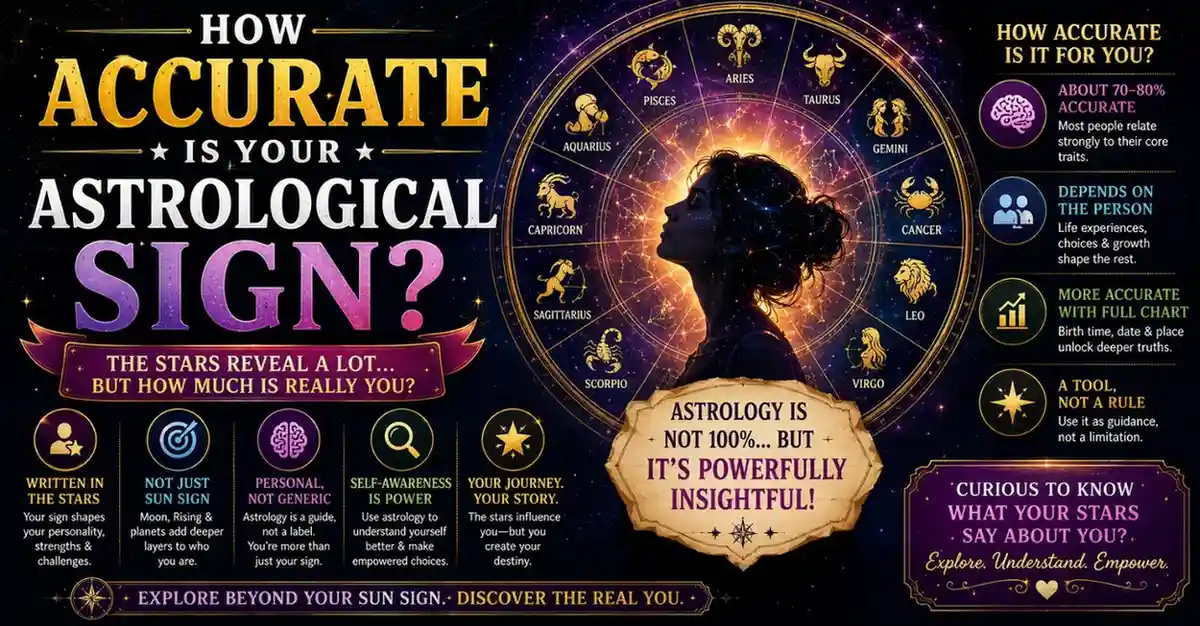
You already know the script. Someone asks your sign, you say “Scorpio,” and they immediately nod like you’ve just handed over your entire psychological file. Intense. Jealous. Magnetic. Never wrong, apparently, even when they’ve known you for ninety seconds.
That reaction is the whole reason this question keeps surfacing in search bars around the world: how accurate is your astrological sign, really? Is it a genuine map of your personality, a coincidence dressed up in poetry, or something in between that neither the skeptics nor the believers are quite explaining correctly?
After years of reading charts, sitting with the research, and watching both camps talk past each other, I can tell you the honest answer isn’t a single number. It’s not “94% accurate” and it’s not “complete nonsense” either, no matter how confidently either side states it. The real answer requires taking apart three separate things that most conversations about astrology accidentally mash together: your sun sign, your full birth chart, and the psychological reasons any personality description feels true. Once you separate those three threads, the accuracy question actually becomes answerable.
This is a long read, because the short answer does astrology, and you, a disservice. Let’s do it properly.
What “Your Sign” Actually Means (and What It Doesn’t)
When someone asks “what’s your sign,” they’re almost always asking about your sun sign — the zodiac constellation the sun appeared to be passing through on the day you were born. It’s the sign printed in newspaper horoscopes, the one on birthday-themed mugs, the one that dominates casual conversation.
Here’s the problem: your sun sign is exactly one placement out of roughly ten that astrologers actually use when building a real reading. A complete birth chart, sometimes called a natal chart, maps the position of the sun, moon, Mercury, Venus, Mars, Jupiter, Saturn, Uranus, Neptune, and Pluto at the precise moment and location of your birth, then organizes all of it into twelve houses and a web of angles between planets called aspects.
Your sun sign speaks to your core identity and general life force — the “you” that shows up when you’re being your most essential self. It does not, on its own, account for:
- Your moon sign, which governs emotional instincts and how you self-soothe
- Your rising sign (ascendant), which shapes first impressions and outward behavior
- Mercury’s placement, which influences communication style
- Venus and Mars, which shape how you love and how you fight
- The houses, which locate all of this activity in specific life areas like career, relationships, or home
So when a skeptic says “I’m nothing like a typical Gemini,” an astrologer’s honest response isn’t defensiveness — it’s agreement, followed by a question: what’s your rising sign? Sun-sign astrology was never designed to be a full personality inventory. It’s a chapter, not the book. Judging the accuracy of an entire practice based on one-twelfth of its actual toolkit is a bit like reviewing a novel after reading a single paragraph.
That distinction matters enormously for this whole discussion, because most of the studies debunking astrology — and most of the disappointed “this doesn’t sound like me” reactions people have — are testing sun signs alone, not astrology as astrologers actually practice it.
A Brief History: Why Sun Signs Became the Default
If sun signs were never meant to carry this much weight, it’s worth asking how they ended up as the entire public face of astrology. The answer has more to do with publishing than with the stars.
Natal astrology, tracking full birth charts for individuals, dates back thousands of years, to Babylonian and later Hellenistic astrologers who calculated planetary positions by hand for wealthy or notable clients. It was slow, specialized, and required knowing someone’s exact birth time and location — information that simply wasn’t practical to collect from a mass audience.
That changed in the 1930s, when British astrologer R.H. Naylor published one of the first mass-market newspaper horoscope columns, reportedly organized around the newly born Princess Margaret’s chart. Naylor quickly realized that asking millions of readers for their birth time and location was unworkable, so he simplified the entire practice down to a single, easily obtained variable: birth date, and therefore sun sign. Readers loved it, other papers copied the format, and within a couple of decades “what’s your sign” had replaced “what’s your chart” as the default entry point into astrology worldwide.
In other words, the sun-sign horoscope wasn’t designed by ancient astrologers as the purest form of the practice — it was a 20th-century media adaptation, built for scale rather than precision. That history matters, because it means the version of astrology most people encounter, test, and judge is a simplified offshoot rather than the tradition’s original methodology, which never claimed one variable could describe a person completely.
Why Your Horoscope Feels So Accurate (the Psychology Behind It)
Before we get to whether astrology is “true,” we need to deal with a much more measurable phenomenon: why does it feel so accurate, even to people who don’t fully believe in it?
The Barnum Effect
In 1948, psychologist Bertram Forer gave his students a personality assessment, then handed each of them what he claimed was a personalized analysis based on their answers. Students rated the accuracy of their descriptions at an average of over 4 out of 5. In reality, every single student had received the exact same paragraph, stitched together from vague, universally applicable statements — things like having a need for people to like you while also being critical of yourself, or having unused capacity that hasn’t been turned to your advantage.
This became known as the Barnum effect (or Forer effect), named after showman P.T. Barnum’s reputed philosophy of having a little something for everyone. It describes our tendency to rate broad, flattering, non-specific statements as strikingly personal, simply because we’re the ones reading them and we naturally fill in our own details.
Horoscopes and sun-sign descriptions are built almost entirely from Barnum-style language. “You value your independence but sometimes crave connection.” “You’re more sensitive than people realize.” “You’ve been carrying more than you let on lately.” Read any twelve sun-sign profiles back to back and you’ll notice the traits overlap constantly — loyalty, sensitivity, ambition, and self-doubt appear in nearly every one, just with different adjectives layered on top.
Confirmation Bias Does the Rest
Once a description feels personal, confirmation bias takes over. If your horoscope says today favors bold decisions and you happen to make one, you notice and remember it. If nothing bold happens, you forget the prediction ever existed. Nobody keeps a scoreboard of the horoscope’s misses; we only tally the hits. Over years of casual exposure, this selective memory quietly builds an impression of uncanny accuracy that a controlled study would never support.
Cold-Reading Language
Professional horoscope writers, whether they realize it or not, often use techniques that resemble cold reading — statements phrased to sound specific while remaining flexible enough to apply broadly. “There’s tension at home that you’re not addressing directly” applies to an enormous share of adult readers on any given week. It isn’t fraud, exactly; many horoscope writers are simply drawing on decades of archetypal astrological language that was built this way from the start. But it does mean the accuracy you’re sensing is partly a language trick, not just a celestial one.
None of this proves astrology is false. It proves that human psychology alone can manufacture a feeling of accuracy, which means we need better evidence than “it felt true” before we can answer the accuracy question honestly.
What the Science Says: Astrology Under the Microscope
So does astrology hold up when it’s tested in controlled conditions rather than felt in daily life? This is where the research gets genuinely interesting, and more contested than most pop-science articles let on.
The Carlson Double-Blind Study (1985)
The most famous test remains physicist Shawn Carlson’s 1985 experiment published in the journal Nature. Carlson recruited professional astrologers, gave them real, detailed birth charts for real test subjects, and asked the astrologers to match each chart to the correct personality profile out of several options, based on standardized psychological testing (the California Psychological Inventory). The astrologers themselves helped design the test conditions in advance, which gave the study unusual credibility among skeptics — this wasn’t a strawman version of astrology, it was astrologers testing their own claims under fair terms.
The result: astrologers performed no better than chance. Carlson concluded that natal astrology, as practiced by working professionals, failed to demonstrate any predictive validity when tested rigorously.
That said, the Carlson study is not the closed case it’s often presented as. Several later re-analyses, including work by researchers Vidmar and Ertel, argued that Carlson’s own stated grading criteria, if applied exactly as originally specified, actually produced results modestly better than chance on certain sub-measures — results Carlson downplayed or reclassified in his final write-up. This doesn’t rehabilitate astrology as a predictive science, but it’s a useful reminder that even astrology’s most famous “debunking” has some genuine academic debate baked into it, rather than being the unanimous verdict it’s often summarized as.
Do Sun Signs Predict Personality Traits?
Separate from natal-chart matching, researchers have directly tested whether people born under the same sun sign share measurable personality traits. Using standardized frameworks like the Big Five (openness, conscientiousness, extraversion, agreeableness, and neuroticism), multiple studies — including large-sample analyses run by psychologists specifically to test popular stereotypes like “Scorpios are intense” or “Virgos are meticulous” — have found no statistically significant clustering of personality traits by sun sign. Being a Virgo does not reliably predict higher conscientiousness scores. Libras are not measurably more diplomatic than Capricorns. Whatever differences appear in small samples tend to disappear or reverse when the sample size grows, which is the classic signature of a statistical fluke rather than a real effect.
The Forer/Barnum Studies on Astrology Specifically
Researchers have run Forer-style experiments using astrological content directly, not just generic personality blurbs. In these studies, participants are shown two personality summaries — one generated from their actual, correct natal chart and one that’s entirely fabricated or belongs to someone else — and asked to identify which one is really theirs. Across multiple replications, participants have failed to reliably pick their correct astrological summary at a rate better than chance, while simultaneously rating both summaries as reasonably accurate. That combination — can’t identify the real one, but rates the fake one just as believable — is close to a smoking gun for the Barnum effect operating independently of any genuine astrological signal.
Taken together, the peer-reviewed research is fairly consistent on one point: when astrology is tested for the kind of predictive, differentiable accuracy that a science needs to demonstrate, it does not clear that bar. That’s a meaningful, evidence-based conclusion, and any honest article on this topic needs to say so plainly.
The Astrologer’s Rebuttal: Why Sun Signs Were Never Meant to Stand Alone
Here’s where I’ll push back, not on the data, but on what the data is actually measuring.
Your Whole Chart, Not One Placement
Every study above — Carlson’s included — is testing a version of astrology far thinner than what serious astrologers actually practice. A single sun sign is a caricature by design; it has to be, because it’s trying to sort eight billion people into just twelve categories using only one variable. Real natal chart work uses your exact birth time and location to calculate all ten planetary placements, the rising sign, and twelve houses — creating a combinatorial space so large that no two charts, even for twins born minutes apart, are truly identical once the rising sign and house cusps shift.
This is the single most important nuance missing from most articles that answer “how accurate is your astrological sign” with a flat yes or no. Asking whether a sun sign alone predicts your personality is closer to asking whether your zip code alone predicts your income — there’s a loose, population-level correlation at best, and treating it as a precise personal descriptor was always going to disappoint.
Why Two People With the Same Sign Feel So Different
If you’ve ever met another member of your sign and thought “we have nothing in common,” this is exactly why. Your moon sign might sit in a completely different part of the zodiac than theirs, shaping your emotional temperament in an entirely different direction. Your rising sign, formed by your specific birth hour, changes every two hours — meaning two people born on the same date in the same city, six hours apart, can have different ascendants, different house placements, and by most astrologers’ accounts, a meaningfully different presentation to the world.
This is also why astrologers generally treat sun-sign horoscope columns as entertainment rather than serious practice. Ask any working astrologer whether a generic newspaper horoscope should be taken as gospel, and the honest ones will tell you: no, and we never intended it to be. It’s the difference between a horoscope and an astrology — one is mass media, the other is a bespoke calculation.
The Precession Problem: Has Your Sign Even Shifted?
There’s a scientific wrinkle that complicates the picture further, and it has nothing to do with psychology — it’s astronomical.
The zodiac most Western astrologers use, the tropical zodiac, is anchored to the seasons: it fixes the start of Aries to the spring equinox, regardless of which constellation the sun is actually in front of on that date. But there’s also a sidereal zodiac, used in Vedic (Jyotish) astrology, which is anchored to the actual, observable positions of the constellations.
Because of a slow wobble in Earth’s rotational axis called axial precession, the constellations have drifted relative to the seasons over roughly 2,000 years — currently by about one full zodiac sign. That means if you go strictly by which constellation the sun was actually passing through on your birthday, your “real” astronomical sign may be one sign earlier than the one on your birthday cake.
Tropical astrologers will tell you this doesn’t matter, because tropical astrology was never claiming to track literal constellations — it’s a seasonal, symbolic coordinate system, not a telescope reading. Sidereal astrologers will tell you the opposite: that ignoring precession severs astrology from the actual sky it claims to be reading. Both positions are internally consistent; they’re simply using two different definitions of what “sign” means. But it’s worth knowing this exists, because it quietly undercuts the idea that there’s one single, universally agreed-upon “correct” sign for anyone in the first place.
So Is Astrology “Real”? Separating Predictive Accuracy From Symbolic Accuracy
This is the crux of the whole debate, and I think most coverage of this topic collapses two very different questions into one:
- Does astrology predict measurable, external outcomes — your career trajectory, whether your relationship will last, your personality scores on a validated psychological test — better than chance? The research above says, consistently, no.
- Does engaging with your birth chart produce a useful, meaningful framework for self-reflection, the way journaling, tarot, or even a well-written horoscope can prompt genuine insight? That’s a completely different kind of “accuracy,” and it’s much harder to falsify, because its value isn’t predictive — it’s interpretive.
Astrology functions less like a weather forecast and more like a mirror with symbols painted on it. When you read that your Mars in Scorpio suggests intensity and difficulty letting go of conflict, you’re not receiving a scientific measurement. You’re receiving a prompt — a structured invitation to reflect on your own patterns around anger and control, using language rich enough that you can project your actual, specific experience onto it.
That’s not nothing. Structured self-reflection tools have real psychological value regardless of their metaphysical claims, in much the same way that a well-designed personality framework can be clinically useful even when its underlying taxonomy is debated by researchers. The difference is honesty about what’s happening: astrology as a reflective tool is a defensible, even valuable practice. Astrology as a predictive science, tested against the standards we’d apply to medicine or meteorology, does not hold up.
How to Actually Test the Accuracy of Your Own Sign
If you want to move past vibes and actually pressure-test this for yourself, here’s how an astrologer would suggest doing it fairly — and how a skeptic would suggest doing it rigorously. Both approaches are worth trying.
Get your real, full birth chart, not just your sun sign. Free chart calculators exist online; you’ll need your exact birth date, time, and location. Read your moon and rising sign descriptions alongside your sun sign before deciding whether “your sign” describes you.
Run a blind test on yourself. Read the personality description for your actual sun sign, then read the descriptions for two other, randomly chosen signs, without labels attached. If you can’t confidently pick out which one is truly yours, that’s a strong sign the Barnum effect, not astrology, is doing the work.
Separate specific predictions from general traits. “You’re an intense, emotionally private person” is a trait claim, essentially unfalsifiable in casual conversation. “You will receive unexpected financial news this Thursday” is a specific, testable prediction. Track the second kind over a few months and you’ll get a much clearer, harder signal than vibes ever provide.
Ask what a description would need to say to be wrong. A genuinely informative personality description should be specific enough that it could fail to describe you. If every trait sounds like it would flatter or apply to almost anyone you know, you’re looking at Barnum language, not personalized insight.
Compare against people you actually know well. Rather than testing yourself, where bias runs deepest, test a friend’s sign description blind, without telling them which sign it belongs to, and ask them to rate its accuracy for themselves. Do this across a group and you’ll start to see how much of the “accuracy” is genuinely differentiating people versus applying to the whole room equally.
Where Astrology Gets Something Right (Even Skeptics Should Admit This)
It’s worth being fair to the other side of this argument, because dismissing astrology entirely also overstates the case.
It’s an excellent framework for language around emotion and identity. Even people who don’t believe astrology causes anything find its vocabulary useful — describing a friend as “going through a very Saturn-return kind of year” communicates something real about upheaval and maturation that a lot of people intuitively understand, independent of any belief in planetary influence.
There’s a documented, if small, birth-season effect on some traits. Separate from astrology entirely, some legitimate research has found modest correlations between birth month and factors like temperament in early childhood, certain health outcomes, and personality tendencies — likely explained by seasonal light exposure during infancy affecting neurodevelopment, or by school-enrollment cutoff dates shaping social development relative to same-grade peers. This is a real, scientifically studied phenomenon, but it’s a byproduct of season and light, not planetary alignment, and the effect sizes are far smaller than sun-sign folklore suggests.
It functions as a low-stakes social ritual. Talking about signs, retrogrades, and compatibility is often less about literal belief and more about shared cultural language and connection — not unlike discussing a horoscope the way you’d discuss a Buzzfeed quiz result: for the conversation it generates, not the certainty it provides.
Self-selected engagement can create real behavioral change. If reading that Mercury retrograde favors caution in communication makes you actually pause before sending an angry email, the outcome — better communication — is real, even if the causal mechanism astrology proposes isn’t.
Where It Falls Apart
To stay balanced, the honest limitations deserve equal space.
Sun-sign compatibility is astrology’s weakest, most oversimplified claim. Reducing relationship compatibility to “Geminis and Virgos never work” ignores the moon, Venus, Mars, and rising sign placements that astrologers themselves consider essential to real compatibility work. It’s the sun-sign equivalent of judging a marriage by matching blood types.
Specific, falsifiable predictions consistently fail under testing. Stock market forecasts, election predictions, and disaster predictions made by astrologers have a long, public track record of missing, without the accompanying public correction when they do.
The underlying mechanism has no established physical basis. No known force connects the gravitational or radiative influence of distant planets to human personality at the moment of birth in a way that would produce the effects astrology claims; the gravitational pull of the delivering obstetrician is measurably larger than that of Mars.
Vague language is doing more work than most readers realize. As covered above, the feeling of accuracy is heavily manufactured by broadly applicable phrasing, not necessarily by genuine personalized insight.
The Verdict: How Accurate Is Your Sign, Really?
If you’re looking for a single takeaway to walk away with, here it is: your sun sign, in isolation, is not a scientifically validated predictor of your personality, compatibility, or future — multiple controlled studies, including the famous 1985 Carlson experiment in Nature, have failed to find it performing better than chance when tested rigorously. Much of the “accuracy” people feel comes from well-documented psychological phenomena, chiefly the Barnum effect and confirmation bias, that would produce a similar sense of accuracy from almost any warm, generalized personality description, astrological or not.
At the same time, dismissing the entire practice as meaningless overstates the case in the other direction. A full birth chart, built from your exact birth time and location, is a far richer and more individualized tool than a sun sign alone, and using it as a structured framework for self-reflection has genuine psychological value, independent of whether the underlying celestial mechanism is real. The fairest, most accurate answer to “how accurate is your astrological sign” is this: as a scientific predictor, not very. As a symbolic language for thinking about yourself, often surprisingly useful — which is a very different, and much more honest, kind of accuracy than the one most horoscope columns are implicitly promising you.
Frequently Asked Questions
Is your zodiac sign based on your birth date accurate at all?
Your birth-date sun sign reflects one placement in a much larger birth chart. Controlled studies haven’t found it reliably predicting personality traits on its own, though many people find the archetypal language useful for self-reflection.
Why do horoscopes feel so accurate if astrology isn’t scientifically proven?
Mostly the Barnum effect: vague, broadly flattering statements feel personal because you supply your own specific details while reading them, combined with confirmation bias, which makes hits memorable and misses forgettable.
Do identical twins have the same astrological sign, and does that prove or disprove astrology?
Identical twins typically share the same sun sign and often a very similar rising sign, yet frequently show notably different personalities — a common argument skeptics raise, though astrologers point to the moon sign, house cusps, and minute-level chart differences as the intended source of that variation.
Is your rising sign more accurate than your sun sign?
Many people report that their rising sign describes their outward personality and first impressions more precisely than their sun sign, since it’s calculated from your exact birth time and reflects a much narrower, more individualized window than the sun’s month-long sign.
Has any scientific study ever supported astrology?
The most cited test, Carlson’s 1985 double-blind study in Nature, concluded astrologers performed no better than chance; some later re-analyses have disputed how that data was interpreted, but no peer-reviewed, replicated study has established astrology as a reliable predictor of personality or events.
Should you trust daily horoscopes for decision-making?
Daily horoscopes are written broadly enough to apply to a large audience and aren’t designed as reliable individual predictions; treating them as light entertainment or a reflection prompt is a more accurate use of them than treating them as actionable forecasting.
My Today’s Horoscope delivers carefully researched articles, accurate daily horoscopes, expert spiritual guidance, in-depth zodiac compatibility insights, birthday horoscopes, numerology interpretations, tarot readings, and practical astrology tools for everyone—from curious beginners to seasoned astrology enthusiasts. (See our Site Index to quickly find what we have to offer)