
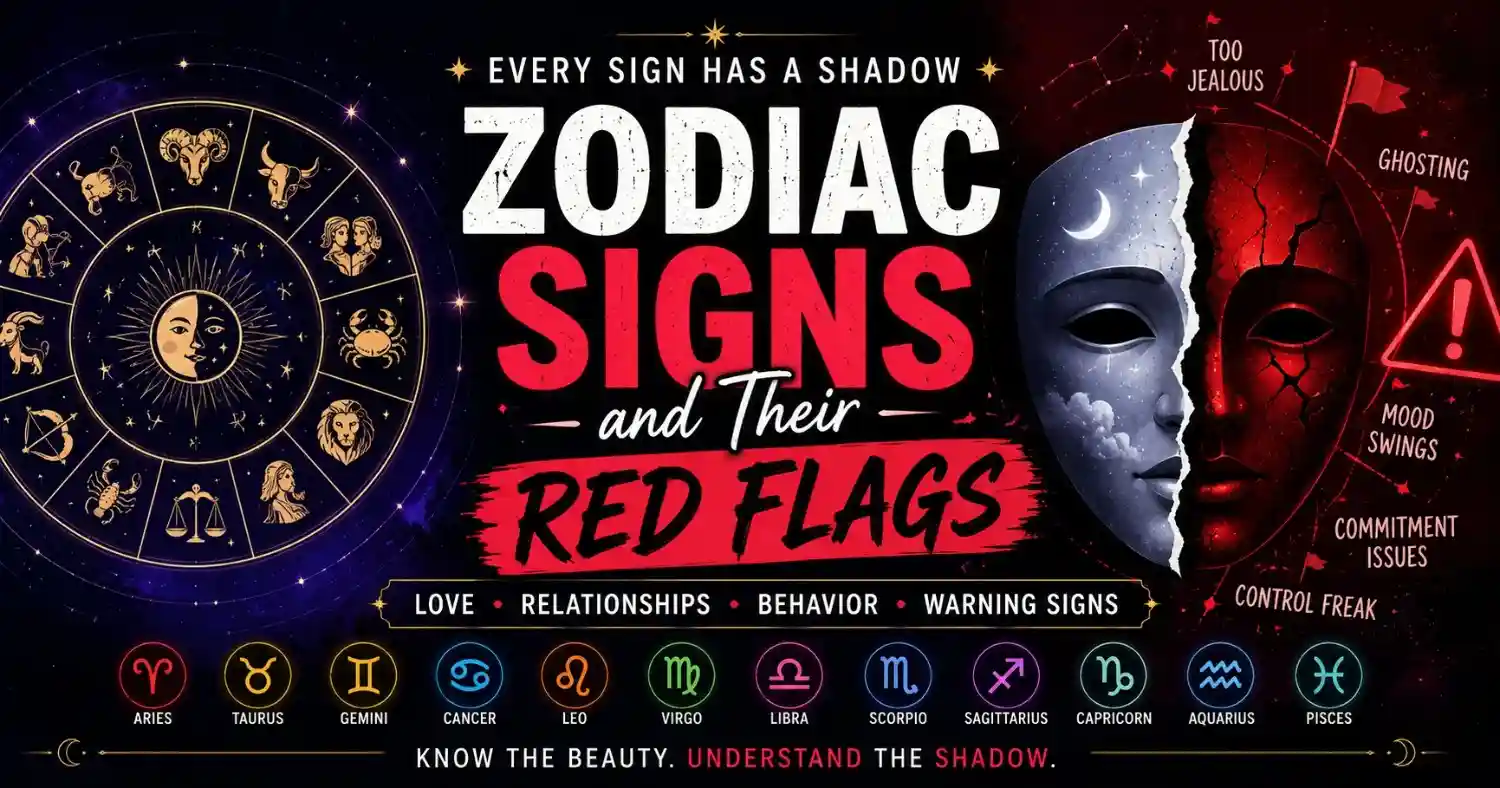
Every zodiac sign carries two sides of the same coin. The trait that makes an Aries a fearless leader is the same trait that makes them reckless in an argument. The loyalty that makes a Taurus a devoted partner is the same loyalty that turns into stubbornness when they refuse to budge. Astrology does not divide people into “good signs” and “bad signs.” Instead, it shows how each sign’s core energy can tip from a strength into a struggle when it goes unchecked.
This guide breaks down the red flags associated with all twelve zodiac signs, explains why those patterns show up, and offers practical guidance on how to recognize them in yourself or someone you are dating, befriending, or working with. You will also learn how element and modality shape behavior, how red flags differ across relationships, friendships, and careers, and how to turn a red flag into real personal growth.
Nobody is defined entirely by their sun sign, and no chart sentences a person to repeating the same mistake forever. Awareness is the whole point. Once you can name a pattern, you can choose a different response to it.
This guide takes a user-first approach rather than a list of vague generalizations. Instead of simply labeling each sign as “difficult” or “toxic,” every section explains the planetary and elemental root of the pattern, shows how it plays out in real relationships, and offers a concrete way to work through it. Whether you came here to understand your own chart, decode a partner’s behavior, or simply satisfy your curiosity about how astrology explains personality, you will find a complete, practical breakdown below.
What Does “Red Flag” Actually Mean in Astrology?
In everyday language, a red flag is a warning sign that something in a relationship, friendship, or work dynamic needs attention. In astrology, a red flag usually points to a trait that is rooted in a sign’s ruling planet, element, or modality, expressed in an unbalanced or immature way. It is not a character flaw carved in stone. It is a tendency that surfaces more easily under stress, insecurity, or a lack of self-awareness.
Understanding a sign’s red flags does three things for you. First, it helps you recognize patterns early, before they cause real damage in a relationship. Second, it helps you extend compassion to people who are still learning to manage their own energy, including yourself. Third, it gives you language for behavior you may have noticed for years without knowing how to describe it.
It helps to remember that a red flag is context-dependent. A trait that feels intolerable in a romantic partner might be completely harmless in a coworker. A pattern that damages a friendship might barely register in a casual acquaintance. As you read through each sign, think about how the flag shows up specifically in the kind of relationship that matters most to you right now.
Red Flags Are Not Destiny
Before diving into each sign, it is worth setting one expectation clearly: a red flag described here is a tendency, not a guarantee. Two people born under the same sign can express the identical placement in wildly different ways depending on their upbringing, their moon and rising signs, the rest of their birth chart, and simply how much self-work they have done.
Astrology works best as a mirror, not a verdict. Use this guide to spot patterns, ask better questions, and communicate more clearly, not to write anyone off based on twelve traits alone. With that context established, here is a full breakdown of the shadow side of every sign in the zodiac.
Aries (March 21–April 19): Impulsiveness and a Short Fuse
Aries is ruled by Mars, the planet of action, drive, and confrontation, and it is the first sign of the zodiac. That placement gives Aries incredible initiative, but it also gives them a habit of leaping before they look.
Primary Red Flag: Acting Before Thinking
Aries moves fast. When an idea strikes, they act on it immediately, which means decisions about relationships, money, or big life changes sometimes happen without enough deliberation. This impulsiveness can leave partners feeling like they are always chasing an Aries who has already moved three steps ahead, or worse, already changed their mind.
Secondary Red Flag: A Quick Temper
Because Mars governs aggression as well as drive, Aries can flare up quickly during conflict. They are rarely the type to hold a grudge for long, but in the heat of the moment, an Aries can say something sharp and regret it minutes later. Partners who need calm, measured conversations during disagreements may find an Aries’s fiery reactions overwhelming.
How It Shows Up in Relationships
An Aries partner might pick fights to release tension rather than sitting with discomfort. They can also grow bored quickly if a relationship feels too predictable, chasing the thrill of the chase even after the relationship has become serious.
Growth Tip
Aries benefits enormously from pausing before reacting. A simple habit, like counting to ten or stepping outside for air during an argument, channels their natural energy productively instead of destructively. When an Aries learns to slow down just slightly, their courage and honesty become some of the most attractive traits in the zodiac.
Taurus (April 20–May 20): Stubbornness and Resistance to Change
Taurus is ruled by Venus, the planet of love, beauty, and comfort, and it is an earth sign known for steadiness. That steadiness is a gift, but it becomes rigidity when a Taurus digs in their heels.
Primary Red Flag: Immovable Stubbornness
Once a Taurus makes up their mind, changing it is one of the hardest things you can attempt. They will hold a position long after the facts have shifted, simply because backing down feels like losing. This trait can make compromise difficult, especially in a partnership where both people need to bend occasionally.
Secondary Red Flag: Possessiveness
Taurus values security deeply, and that need for stability can slide into possessiveness over people, routines, and material comfort. A Taurus who feels threatened by change may cling to a relationship out of fear of loss rather than genuine desire to stay.
How It Shows Up in Relationships
A Taurus partner may resist trying new restaurants, new routines, or new approaches to communication simply because the old way feels safer. In arguments, they can shut down and refuse to engage rather than working through the discomfort together.
Growth Tip
Taurus grows the most when they practice sitting with discomfort instead of avoiding it. Learning that flexibility does not equal instability helps a Taurus loosen their grip and build relationships based on trust rather than control.
Gemini (May 21–June 20): Inconsistency and Emotional Detachment
Gemini is ruled by Mercury, the planet of communication, and represented by the twins, a symbol of duality. Gemini’s adaptability is a major strength, but it also fuels one of the most talked-about red flags in the zodiac: inconsistency.
Primary Red Flag: Hot-and-Cold Behavior
A Gemini can be warm, engaged, and endlessly curious one day, then distant and hard to reach the next. This is not usually manipulation; it often reflects genuine shifts in mood and mental stimulation. Still, for a partner who needs consistency, this pattern can feel confusing and destabilizing.
Secondary Red Flag: Avoiding Emotional Depth
Gemini thinks its way through the world more comfortably than it feels its way through. Deep emotional conversations can feel exhausting or even threatening to a Gemini who prefers to keep things light. This avoidance can leave partners feeling like they never quite reach the real person underneath the wit.
How It Shows Up in Relationships
Geminis may change plans last minute, lose interest once the novelty of a relationship fades, or deflect serious conversations with humor. Their restlessness can also translate into wandering attention, whether that means flirting with new people or jumping between hobbies and interests.
Growth Tip
Gemini benefits from building small rituals of consistency, like a regular check-in conversation, so their natural need for variety does not come at the cost of a partner’s sense of security. Learning to sit through an uncomfortable conversation instead of deflecting it builds trust fast.
Cancer (June 21–July 22): Moodiness and Emotional Guarding
Cancer is ruled by the Moon, which governs emotion, intuition, and the subconscious. This water sign feels everything deeply, which is the source of both its legendary nurturing warmth and its most difficult red flags.
Primary Red Flag: Mood Swings
A Cancer’s emotional state can shift with the speed of the tides. What seems like a small comment can trigger a wave of hurt feelings that a Cancer struggles to explain, leaving partners feeling like they are walking on eggshells.
Secondary Red Flag: Using Guilt or Withdrawal Instead of Direct Communication
When hurt, Cancer often retreats into its shell rather than addressing the problem head-on. This can look like silent treatment, passive-aggressive comments, or guilt-tripping instead of a direct conversation about what is actually wrong.
How It Shows Up in Relationships
A Cancer partner may become clingy or overly protective when they feel insecure, checking in constantly or reading too much into small changes in tone. They may also hold onto old hurts far longer than the situation warrants, letting past wounds color present interactions.
Growth Tip
Cancer grows by learning to name feelings directly instead of expecting a partner to intuit them. Journaling or therapy can help a Cancer separate an old wound from a present-day trigger, so reactions match the actual situation rather than years of accumulated hurt.
Leo (July 23–August 22): Ego and a Need for Constant Validation
Leo is ruled by the Sun, the center of the solar system, and that placement gives Leo a natural radiance and confidence. When that confidence is not grounded in genuine self-worth, it can tip into some of the most recognizable red flags in the zodiac.
Primary Red Flag: Needing to Be the Center of Attention
Leos crave recognition, and when they do not get it, they can grow sulky or attempt to redirect focus back to themselves, even in moments that should belong to someone else. A Leo who feels ignored may unconsciously one-up a friend’s story or make a shared moment about their own feelings.
Secondary Red Flag: Difficulty Admitting Fault
Because Leo’s identity is closely tied to pride, admitting a mistake can feel like a direct hit to their self-image. This can show up as defensiveness during disagreements or a reluctance to apologize, even when a Leo knows they are wrong.
How It Shows Up in Relationships
A Leo partner may expect grand gestures of appreciation and feel wounded when their efforts go unnoticed. In conflict, they may focus more on protecting their pride than resolving the actual issue, which can leave problems unaddressed for far too long.
Growth Tip
Leo thrives when it learns that true confidence does not require an audience. Practicing small, private acts of humility, like admitting a minor mistake without being asked, helps a Leo build the kind of self-assurance that no longer needs external praise to feel secure.
Virgo (August 23–September 22): Overcriticism and Perfectionism
Virgo is ruled by Mercury, like Gemini, but expresses that mental energy through analysis and precision rather than chatter. Virgo’s eye for detail is an enormous strength professionally and personally, but it becomes a red flag when it turns inward or outward as constant criticism.
Primary Red Flag: Being Overly Critical
Virgos notice what is wrong before they notice what is right, a habit that is useful for solving problems but exhausting in daily relationships. A Virgo partner may point out small flaws, from a typo in a text to the way dishes are stacked, in a way that feels nitpicky rather than helpful.
Secondary Red Flag: Perfectionism That Never Feels Satisfied
Virgo holds itself, and often everyone around it, to standards that are nearly impossible to meet consistently. This can create a dynamic where nothing ever feels quite good enough, leaving partners feeling like they are constantly falling short.
How It Shows Up in Relationships
A Virgo may rewrite a partner’s plans, correct small mistakes in public, or struggle to relax and enjoy a moment without mentally cataloging what could be improved. Overthinking can also lead a Virgo to spiral over minor missteps in a relationship long after the other person has moved on.
Growth Tip
Virgo benefits from practicing praise before critique. Naming what is working well before pointing out what needs improvement softens the delivery and helps a Virgo’s genuinely useful insights land the way they are intended.
Libra (September 23–October 22): Codependency and Conflict Avoidance
Libra is ruled by Venus, and as the sign of the scales, it seeks balance and harmony above almost everything else. That desire for peace is admirable, but it becomes a red flag when it prevents a Libra from setting boundaries or standing alone.
Primary Red Flag: Fear of Being Alone
Libras are deeply relationship-oriented, and some Libras jump from one partnership to the next without pausing to process what happened in the last one. This pattern often stems from discomfort with solitude rather than genuine excitement about a new connection.
Secondary Red Flag: Avoiding Necessary Conflict
Because Libra values harmony so highly, they can avoid confrontation even when a conversation is overdue. This people-pleasing tendency can lead a Libra to agree with whoever they are talking to in the moment, only to feel resentful later for not voicing their real opinion.
How It Shows Up in Relationships
A Libra partner may say yes to plans they do not actually want to attend, suppress frustration until it builds into a bigger blowup, or struggle to make decisions independently because they are so focused on weighing everyone else’s preferences.
Growth Tip
Libra grows by practicing solitude on purpose, not as a punishment but as a chance to reconnect with their own preferences outside of a relationship. Learning to voice disagreement in small, low-stakes moments builds the confidence to speak up when it matters most.
Scorpio (October 23–November 21): Jealousy and Control
Scorpio is ruled by Mars and Pluto, giving this water sign an intensity that few others match. Scorpio’s passion and loyalty run deep, but that same intensity can curdle into jealousy, secrecy, or a need for control when trust feels threatened.
Primary Red Flag: Jealousy and Possessiveness
Scorpio forms deep emotional bonds and can feel threatened by anything that seems to challenge that closeness, whether it is a partner’s friendships, an ex who resurfaces, or simple attention paid to someone else. This can manifest as checking a partner’s phone, asking probing questions, or feeling wounded by innocent interactions.
Secondary Red Flag: Secrecy and Difficulty Trusting
Scorpio protects itself by controlling what others know about it. While this guardedness makes sense given how deeply Scorpio feels things, it can create a one-sided dynamic where a Scorpio expects total transparency from a partner while revealing very little themselves.
How It Shows Up in Relationships
A Scorpio partner may test loyalty through subtle manipulation, withdraw affection as a form of punishment, or hold onto a perceived betrayal for a long time, sometimes plotting how to address it rather than confronting it directly.
Growth Tip
Scorpio benefits from practicing vulnerability in small doses, sharing a fear or insecurity out loud instead of guarding it. Learning that trust is built through mutual openness, not surveillance, transforms Scorpio’s intensity from something guarded into something genuinely intimate.
Sagittarius (November 22–December 21): Commitment Issues and Bluntness
Sagittarius is ruled by Jupiter, the planet of expansion, luck, and philosophy. This fire sign craves freedom and adventure, which fuels an adventurous spirit but also a resistance to anything that feels like a cage, including commitment.
Primary Red Flag: Fear of Commitment
Sagittarius values independence so highly that settling down can feel like giving up options. A Sagittarius partner may keep a relationship casual for far longer than the other person wants, or pull away the moment things start to feel serious.
Secondary Red Flag: Blunt Honesty Without Tact
Sagittarius prizes truth, but they do not always pair that honesty with sensitivity. A Sagittarius may say exactly what they think without considering how the words will land, leaving the other person hurt by delivery even when the underlying point was fair.
How It Shows Up in Relationships
A Sagittarius may avoid labeling a relationship, prioritize travel or personal freedom over a partner’s need for stability, or respond to a partner’s emotional moment with blunt logic instead of empathy.
Growth Tip
Sagittarius grows by learning that commitment does not have to mean losing freedom. Choosing a partner who respects their independence, and practicing pausing before speaking bluntly, helps Sagittarius’s honesty become a gift rather than a wound.
Capricorn (December 22–January 19): Workaholism and Emotional Distance
Capricorn is ruled by Saturn, the planet of discipline, responsibility, and structure. This earth sign’s ambition drives real achievement, but it can also crowd out emotional availability and personal relationships.
Primary Red Flag: Prioritizing Work Over Everything Else
Capricorn measures self-worth largely through achievement, which can lead them to pour nearly all their energy into career goals while relationships take a back seat. A Capricorn partner may cancel plans for work, respond to personal conversations with distraction, or treat rest as something to be earned rather than needed.
Secondary Red Flag: Emotional Guardedness
Capricorn often learned early to rely on themselves rather than lean on others, which can translate into difficulty asking for help or expressing vulnerability. This self-sufficiency can come across as coldness, even when a Capricorn cares deeply.
How It Shows Up in Relationships
A Capricorn partner may seem more comfortable discussing logistics and long-term plans than emotions in the moment. They may also judge a partner’s choices through a lens of productivity, growing impatient with anything that looks like a lack of ambition.
Growth Tip
Capricorn benefits from scheduling downtime with the same seriousness they schedule work, treating rest and connection as legitimate priorities rather than distractions. Practicing small moments of vulnerability, like naming a feeling instead of a plan, helps a Capricorn’s partner feel truly seen.
Aquarius (January 20–February 18): Emotional Detachment and Stubborn Independence
Aquarius is ruled by Uranus, the planet of rebellion and innovation, and it is an air sign known for original thinking. Aquarius’s independence and progressive mindset are refreshing, but that same detachment can leave partners feeling emotionally shut out.
Primary Red Flag: Difficulty With Emotional Intimacy
Aquarius often processes the world intellectually rather than emotionally, which can make it hard for them to sit with raw feelings, either their own or a partner’s. An Aquarius may intellectualize a painful moment instead of simply feeling it, which can come across as detached or dismissive.
Secondary Red Flag: Resisting Compromise in the Name of Independence
Aquarius values its individuality deeply and can resist anything that feels like it threatens personal freedom, including the natural give-and-take of a close relationship. This can look like stubbornness dressed up as principle.
How It Shows Up in Relationships
An Aquarius partner may pull away when a relationship becomes emotionally intense, prioritize a friend group or cause over one-on-one time, or struggle to say “I love you” even when the feeling is genuine.
Growth Tip
Aquarius grows by practicing emotional presence, staying in an uncomfortable feeling instead of retreating into logic. Learning that intimacy does not erase independence helps an Aquarius build closeness without feeling like they are losing themselves.
Pisces (February 19–March 20): Escapism and Difficulty Setting Boundaries
Pisces is ruled by Neptune, the planet of dreams, imagination, and illusion. This water sign’s empathy and creativity are profound gifts, but that same sensitivity can make reality feel overwhelming, leading to avoidance rather than confrontation.
Primary Red Flag: Escaping Reality Instead of Facing It
Pisces can retreat into daydreams, fantasy, or even unhealthy coping mechanisms when life feels like too much. A Pisces partner may avoid a difficult conversation by changing the subject, disappearing into a hobby, or simply pretending a problem does not exist.
Secondary Red Flag: Struggling to Set Boundaries
Pisces absorbs the emotions of everyone around them, which makes it hard to say no or protect their own needs. This can lead to a pattern of overextending themselves for others and then feeling resentful or drained.
How It Shows Up in Relationships
A Pisces partner may agree to things they do not actually want, avoid confrontation until resentment builds, or romanticize a relationship’s potential rather than seeing it clearly as it actually is.
Growth Tip
Pisces benefits from building small, consistent boundaries and practicing direct communication, even when it feels uncomfortable. Grounding practices, like spending time in nature or maintaining a simple daily routine, help a Pisces stay connected to reality without losing their imaginative spark.
How Element Shapes a Sign’s Red Flags
Astrology groups the twelve signs into four elements: fire, earth, air, and water. Each element expresses red flags in a distinct way, which helps explain why an Aries and a Leo, both fire signs, share a tendency toward ego-driven conflict even though their specific traits differ.
Fire Signs: Aries, Leo, and Sagittarius
Fire signs act first and reflect later. Their red flags tend to involve impulsiveness, ego, and a low tolerance for feeling controlled or bored. When fire signs struggle, it usually looks like an outburst, a sudden exit, or a bruised ego rather than quiet withdrawal.
Earth Signs: Taurus, Virgo, and Capricorn
Earth signs value stability and control, so their red flags often involve rigidity, criticism, or an overemphasis on practicality at the expense of emotion. When earth signs struggle, they tend to dig in rather than lash out, resisting change until they feel forced to confront it.
Air Signs: Gemini, Libra, and Aquarius
Air signs process life through thought and communication, so their red flags often involve detachment, inconsistency, or avoidance of emotional depth. When air signs struggle, they tend to intellectualize or deflect rather than sit with uncomfortable feelings directly.
Water Signs: Cancer, Scorpio, and Pisces
Water signs feel everything intensely, so their red flags often involve moodiness, guardedness, or escapism. When water signs struggle, they tend to retreat inward, either through emotional walls or through avoidance, rather than confronting the source of their discomfort head-on.
How Modality Shapes a Sign’s Red Flags
Beyond element, each sign also falls into one of three modalities: cardinal, fixed, or mutable. This second layer explains why some signs initiate red flags, some entrench them, and others shape-shift around them.
Cardinal Signs: Aries, Cancer, Libra, and Capricorn
Cardinal signs initiate action, which means their red flags often involve control, whether that is rushing a decision, guarding emotional territory, avoiding confrontation to keep the peace, or steering a relationship toward personal goals.
Fixed Signs: Taurus, Leo, Scorpio, and Aquarius
Fixed signs resist change, which means their red flags often involve stubbornness in one form or another, whether that is refusing to compromise, needing constant validation, guarding trust too tightly, or clinging to independence at all costs.
Mutable Signs: Gemini, Virgo, Sagittarius, and Pisces
Mutable signs adapt constantly, which means their red flags often involve inconsistency, whether that is shifting moods, shifting standards, shifting commitment, or shifting into avoidance whenever reality feels too heavy.
Red Flags Look Different in Love, Friendship, and Work
A trait that damages a romance might barely register at the office, and a pattern that erodes a friendship might feel manageable in a relationship. Context changes everything.
In Romantic Relationships
Romantic partnerships expose red flags the fastest because they demand emotional vulnerability and daily compromise. A Scorpio’s jealousy or a Libra’s conflict avoidance rarely shows up on a first date, but it surfaces once real intimacy and daily life enter the picture.
In Friendships
Friendship red flags often look different from romantic ones. A Gemini’s inconsistency might mean canceling plans repeatedly, while a Leo’s need for attention might mean dominating every group conversation. Friendships tend to tolerate more distance, so these patterns can go unaddressed for years.
In the Workplace
At work, red flags often show up as friction with authority, deadlines, or collaboration. A Capricorn’s workaholism might make them an excellent employee but a difficult manager who expects the same relentless pace from everyone else. A Virgo’s perfectionism might slow down a team that values speed over precision.
How to Handle a Zodiac Red Flag, in Yourself or Someone Else
Recognizing a red flag is only useful if it leads to action. Here is how to work with these patterns constructively, whether you are looking inward or navigating a relationship with someone else.
If You See the Red Flag in Yourself
Start by separating the trait from your identity. Being a Taurus does not mean you are doomed to be stubborn forever; it means stubbornness is a pattern you were born more likely to lean into, and awareness gives you the power to choose differently. Notice the moments when the pattern shows up, whether that is a Cancer withdrawing after a small conflict or a Sagittarius deflecting a serious conversation with a joke, and practice a small, deliberate alternative response each time.
If You See the Red Flag in Someone Else
Approach the pattern with curiosity rather than judgment. Ask direct questions instead of assuming the worst. A Scorpio who seems distant may be protecting themselves rather than hiding something. An Aquarius who seems emotionally unavailable may simply process feelings differently than you do. Clear communication about what you need, paired with honest observation of whether the other person is willing to grow, tells you far more than the sign alone ever could.
Knowing the Difference Between a Growth Area and a Dealbreaker
Not every red flag needs to end a relationship, but not every red flag should be excused either. The real question is whether the person is aware of the pattern and actively working on it, or whether they deny it exists and blame everyone else when it causes harm. A partner who says, “I know I shut down during conflict, and I am working on staying present,” is showing you a growth area. A partner who insists their behavior is entirely someone else’s fault is showing you a dealbreaker.
Green Flags: The Other Half of Every Sign
It would be incomplete to talk about red flags without acknowledging that the same traits, expressed with maturity, become some of the most attractive qualities a person can offer. Aries’s impulsiveness becomes spontaneity and courage. Taurus’s stubbornness becomes reliability and follow-through. Gemini’s restlessness becomes curiosity and adaptability. Cancer’s moodiness becomes deep empathy. Leo’s ego becomes generous, magnetic confidence. Virgo’s criticism becomes thoughtful problem-solving. Libra’s people-pleasing becomes genuine diplomacy. Scorpio’s intensity becomes unmatched loyalty. Sagittarius’s bluntness becomes refreshing honesty. Capricorn’s ambition becomes steady provision and protection. Aquarius’s detachment becomes visionary independence. Pisces’s escapism becomes boundless creativity and compassion.
Every red flag is simply a green flag that has not yet matured. That reframe matters because it shifts the goal from avoiding certain signs entirely to understanding what growth looks like for the people already in your life, including yourself.
How to Talk to Each Sign About Their Red Flag
Naming a pattern is only half the job. The other half is delivering that observation in a way the person can actually hear. Each sign responds better to a specific approach, and the wrong delivery can shut down a conversation before it starts.
Aries:
Responds best to direct, short conversations rather than long emotional lectures. Say what you need plainly and give them room to react without escalating the moment into a bigger fight.
Taurus:
Needs time to process before responding, so avoid demanding an answer on the spot. Frame the conversation around shared stability rather than criticism, since Taurus digs in when they feel attacked.
Gemini:
Engages best when the conversation stays light at first and grows serious gradually. Coming in too intensely can trigger deflection, so ease into the real issue rather than opening with it.
Cancer:
Needs reassurance alongside honesty. Lead with warmth so the conversation does not feel like rejection, since Cancer can interpret criticism as a threat to the relationship itself.
Leo:
Responds well to conversations that acknowledge their effort before addressing the problem. Protecting their dignity while still being honest keeps a Leo engaged instead of defensive.
Virgo:
Appreciates specificity and evidence over vague emotional statements. Concrete examples help a Virgo understand exactly what to adjust, rather than leaving them to guess and overanalyze.
Libra:
Needs a calm, balanced tone, since raised voices or ultimatums can push a Libra straight into people-pleasing mode instead of honest dialogue. Give them space to share their true opinion.
Scorpio:
Requires privacy and trust before any real conversation can happen. Bringing up a concern publicly or casually will likely close them off completely, so choose a quiet, one-on-one moment.
Sagittarius:
Appreciates directness paired with humor. A heavy, formal tone can make a Sagittarius want to bolt, while a straightforward, low-pressure conversation keeps them present and receptive.
Capricorn:
Takes feedback more seriously when it is framed around long-term goals and outcomes. Show how the pattern affects the bigger picture they care about, and they will engage seriously.
Aquarius:
Prefers a logical, unemotional framing at first, even for emotional topics. Presenting the issue as a problem to solve together, rather than a feelings-based confrontation, keeps an Aquarius from retreating.
Pisces:
Needs gentleness and patience, since direct confrontation can send a Pisces into avoidance. Grounding the conversation in specific facts, delivered kindly, helps keep them present instead of drifting away.
Frequently Asked Questions About Zodiac Red Flags
Which zodiac sign has the most red flags?
No single sign holds a monopoly on red flags, since every sign carries its own version of a shadow trait. That said, signs associated with intensity and control, such as Scorpio, and signs associated with detachment, such as Gemini and Aquarius, tend to come up most often in conversations about difficult relationship patterns because their red flags create confusion or emotional distance that is hard to name.
Can someone change their zodiac red flags?
Yes. A red flag described by a sun sign is a tendency shaped by personality, not a permanent trait fixed by birth. Self-awareness, honest communication, and consistent effort can soften even deeply ingrained patterns over time. The rest of a person’s birth chart, including their moon and rising signs, also plays a major role in how strongly a red flag shows up.
Should I avoid dating a sign known for red flags?
Avoiding an entire sign rarely works as a strategy, since every sign has both strengths and challenges. A better approach is paying attention to how a specific person handles their own patterns. Someone who acknowledges their tendencies and works on them will behave very differently than someone who denies the pattern exists.
Do red flags mean the same thing for people of all genders of the same sign?
The core red flag associated with a sign does not change based on gender, since it comes from the sign’s ruling planet and element rather than gender roles. However, cultural expectations can shape how a trait gets expressed or perceived, which is worth keeping in mind when comparing experiences.
How do I know if a red flag is serious or just a personality quirk?
Look at the impact and the pattern, not just the trait itself. A quirk becomes a serious red flag when it repeatedly causes harm, when the person refuses to acknowledge it, or when it prevents genuine intimacy and trust from developing. A one-time instance of moodiness or bluntness is very different from a consistent pattern that never gets addressed.
What is the difference between a red flag and simple incompatibility?
A red flag involves behavior that can cause harm regardless of who is on the receiving end, such as jealousy, dishonesty, or emotional withdrawal. Incompatibility is different; it means two otherwise healthy people simply want different things, like one partner craving constant togetherness while the other needs significant independence. Both matter, but only one requires personal growth to resolve.
Do rising signs or moon signs affect red flags too?
Yes, and often more than the sun sign does. The sun sign shapes core identity, but the moon sign governs emotional reactions, and the rising sign shapes first impressions and instinctive behavior under pressure. A person with a Scorpio sun but a Libra moon may show far less jealousy than the sun sign alone would suggest, because the moon softens how those feelings get expressed. For a fuller picture of anyone’s red flags, look at the whole birth chart rather than the sun sign in isolation.
Can two people with clashing red flags still make a relationship work?
Absolutely, and in many cases, clashing patterns become the exact friction that pushes both people to grow. A Sagittarius who fears commitment paired with a Cancer who fears abandonment will need real communication to thrive, but that same pairing can also teach the Sagittarius the value of security and teach the Cancer the value of independence. What matters most is mutual willingness to name the pattern and work with it rather than around it.
Final Thoughts: Using Red Flags as a Tool for Self-Awareness
The most useful way to read this guide is as a mirror rather than a warning label. Every sign in the zodiac carries the potential for both harm and healing within the same core trait. An Aries who learns patience keeps their courage. A Cancer who learns to communicate directly keeps their empathy. A Capricorn who learns to rest keeps their ambition.
Astrology does not excuse harmful behavior, and it should never be used as a reason to accept mistreatment. What it does offer is a language for understanding where certain patterns come from, which makes it easier to have honest conversations, set healthy boundaries, and recognize genuine growth when you see it. Whether you are examining your own chart or trying to understand someone important in your life, the goal is the same: turn awareness into action, and let every red flag become an invitation to grow into the greener version of the same trait. Keep this guide as a reference, revisit it as your relationships evolve, and let it deepen how you understand the people, including yourself, written into every corner of the zodiac wheel.
My Today’s Horoscope delivers carefully researched articles, accurate daily horoscopes, expert spiritual guidance, in-depth zodiac compatibility insights, birthday horoscopes, numerology interpretations, tarot readings, and practical astrology tools for everyone—from curious beginners to seasoned astrology enthusiasts. (See our Site Index to quickly find what we have to offer)