
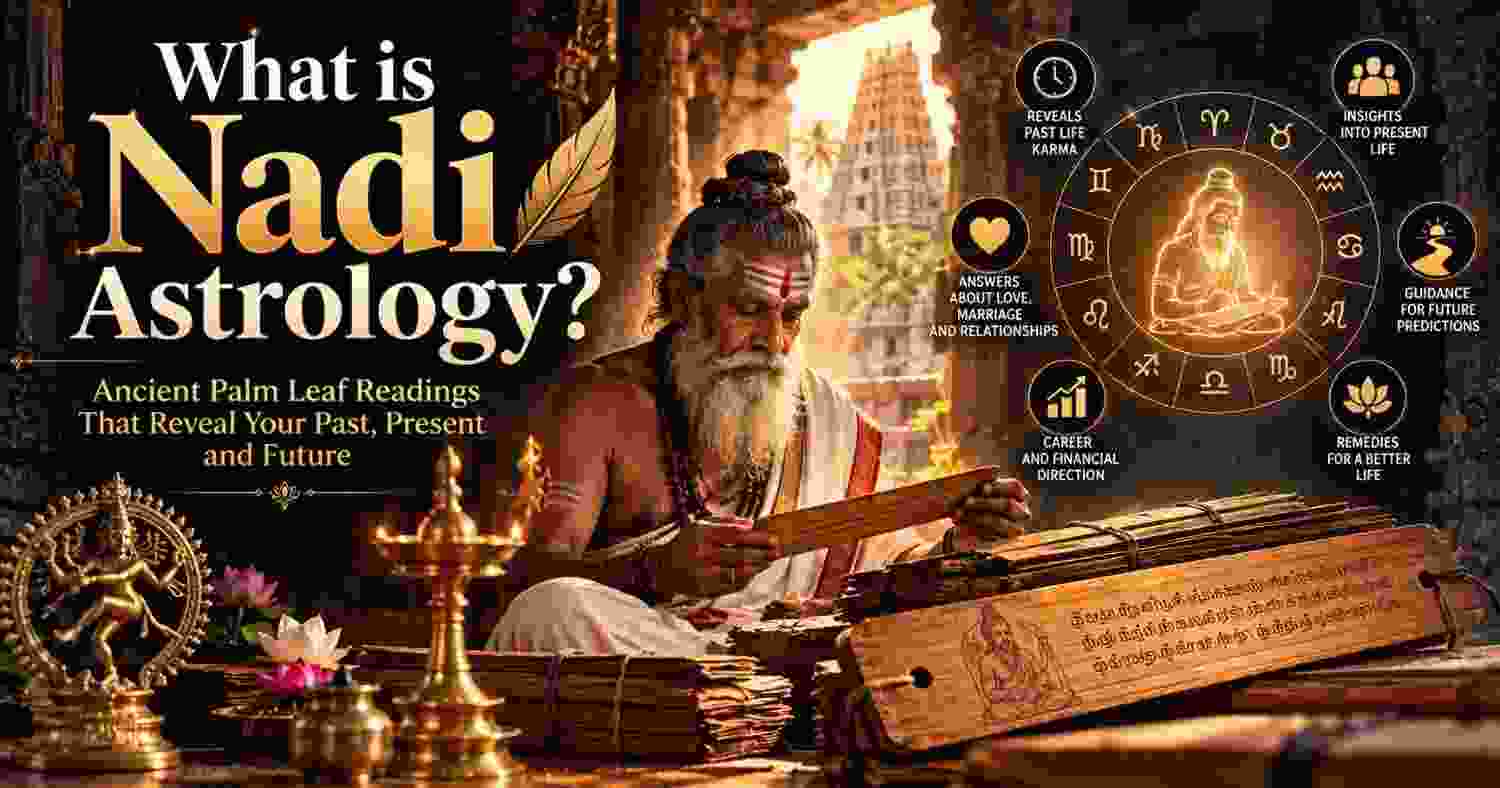
Nadi astrology is one of the most unusual prediction systems in the world. It does not begin with a birth chart. It begins with a thumb. A reader in South India searches through bundles of old palm leaves and looks for one that matches your thumb impression. Believers say that leaf holds your life story. Skeptics say no one has proven the claim. Both views deserve a fair hearing.
This guide explains Nadi astrology from the ground up. You will learn what the word means, where the tradition began, and which texts it uses. Follow a reading step by step. You will also learn what the system cannot prove, how to spot fraud, and how to prepare for a session. Each section answers a question that real seekers ask.
Quick Answer: What Is Nadi Astrology?
Nadi astrology, also spelled Naadi and called Nadi Jyotisham or Nadi Jothidam, is a South Indian system of prediction based on palm-leaf manuscripts. Practitioners say ancient sages wrote verses about the lives of individual people. A Nadi reader finds a person’s leaf through a thumb impression and a series of confirming questions. The reader then recites the verses. They cover family, career, marriage, health, past karma, and remedies.
Key Takeaways
- Nadi astrology comes from Tamil Nadu. Its best-known center is Vaitheeswaran Koil.
- Readers use palm leaves, not just birth charts.
- Tradition credits sages such as Agastya with writing the verses.
- Your thumb impression helps the reader locate your leaf.
- Readers confirm your identity with yes-or-no questions before they read.
- Many readers divide the content into chapters called kandams.
- No scientific study has verified the predictions.
- Fake centers exist, so careful research matters.
Nadi Astrology Defined
Nadi astrology is a predictive tradition. It rests on the belief that sages saw the lives of all people through deep meditation. Tradition says they recorded those lives in verse. They wrote the verses on palm leaves. Families of readers then preserved the leaves across many generations.
The system differs from mainstream Vedic astrology in one key way. Vedic astrologers calculate a chart from your birth date, time, and place. They interpret the planets, houses, and signs. A Nadi reader works the other way around. The reader first finds your leaf. Only then does the reader discuss your life, and the verses often mention planetary positions as part of the story.
Three ideas define Nadi astrology.
First, the leaf already exists. Believers say the sages wrote your record before you were born. You do not create it. You only find it.
Second, the leaf finds you at the right time. Many readers teach that a person reaches a Nadi center only when destiny allows it. Some leaves even mention the age at which the person will arrive.
Third, karma drives the story. Readers often link present problems to actions in earlier lives. They then suggest remedies to ease the effects.
You can think of Nadi astrology as a blend of astrology, scripture, and oral performance. The reader does not simply report facts. The reader interprets verses, speaks with the seeker, and adds guidance.
What Does the Word “Nadi” Mean?
The word “nadi” carries several meanings in Indian traditions. This overlap confuses many newcomers. Knowing the differences will save you time and money.
Nadi in Nadi Astrology
In this context, nadi refers to a palm-leaf text or a group of such texts. Many Tamil speakers also link the word to the idea of seeking. A person seeks the leaf, and the leaf seeks the person. Scholars debate the precise root. Most agree on the practical meaning: a Nadi is a manuscript that holds a prediction.
Some traditions also use nadi as a unit of the zodiac. Under this idea, each sign holds 150 small divisions. Texts that follow this method use the divisions to refine predictions. A reader may call each division a nadi. This usage appears in several Nadi texts, including those that students study in Kerala.
Nadi in Marriage Matching
Vedic matchmaking uses the same word for a different idea. Here, nadi describes one of three body-energy types: Adya, Madhya, and Antya. Each type links to a group of lunar mansions, called nakshatras. Astrologers also link the types to the Ayurvedic principles of vata, pitta, and kapha.
Nadi carries the highest score in the Ashtakoota system. It earns up to eight of thirty-six points. If a couple share the same nadi, astrologers announce a “Nadi dosha.” Many families treat this as a serious concern. This usage has nothing to do with palm leaves.
Nadi in Yoga and Ayurveda
Yoga texts use nadi for the subtle channels of energy in the body. The three best known are ida, pingala, and sushumna. Ayurvedic doctors use nadi pariksha for pulse diagnosis. A doctor reads the pulse at the wrist to assess the body’s balance.
Why the Distinction Matters
When you search online, results from all four meanings mix together. You may land on a matchmaking page when you wanted palm leaves. Always check which meaning the page uses. This guide focuses only on palm-leaf Nadi astrology.
The Origins and History of Nadi Astrology
The history of Nadi astrology blends legend with documented fact. The legend comes from temple families and texts. The documented history comes from libraries, colonial records, and modern research. This section keeps the two apart.
The Legend of Sage Agastya and the Siddhars
Tradition credits the sage Agastya with the core of Nadi astrology. Tamil culture reveres Agastya as a founder of the Tamil language and a great Siddhar. Siddhars were saints and adepts who combined spiritual practice, medicine, alchemy, and astrology.
According to the legend, Agastya and other sages received knowledge through deep meditation. They saw the lives of countless beings across time. Lord Shiva, in some versions, answered questions that his consort Parvati asked. The sages then recorded the answers in verse. They wrote one verse after another on palm leaves. Each leaf became a small unit of prophecy.
Believers say thousands of sages took part. Some accounts name 18 great Siddhars. Others describe far larger numbers. The texts that carry the sage names, such as Agastya Nadi and Kaushika Nadi, reflect this tradition.
Historians cannot confirm these origins. No document proves that Agastya wrote the leaves. Many scholars treat the sage as a symbolic author. That view does not weaken the tradition for believers. It simply separates faith from evidence.
The Role of Tamil Script and Language
Readers say the original leaves use an old form of Tamil. Some describe the script as Vatteluttu, an ancient Tamil writing system. Others describe a poetic style that mixes archaic words and unusual grammar. The verses follow a fixed meter.
This old language creates a need for readers. Few modern people can read the script. A trained reader interprets the verses and explains them in a modern language. Many centers also employ translators for visitors who speak Hindi, English, Telugu, Kannada, or Malayalam.
Temples, Kings, and Libraries
Over the centuries, temple towns became the homes of the leaves. Vaitheeswaran Koil, near Sirkazhi and Mayiladuthurai, rose to fame. The town hosts the Vaitheeswaran Temple, which honors Shiva as the divine healer. It also ranks among the nine Navagraha temples, where devotees worship the planets. The temple honors Mars in particular.
Rulers also played a part. The Chola dynasty, which governed much of South India for centuries, patronized temples and scholarship. Later, the Nayaks and the Marathas ruled Thanjavur. Their royal library, now called the Saraswathi Mahal Library, gathered thousands of palm-leaf manuscripts. Many writers link the Nadi leaves to this library. A popular account says the leaves once sat in the royal collection. Then, over time, families took custody of them.
Accounts of how the leaves left the library vary. One popular story blames British officials who removed or auctioned manuscripts. Another says royal scholars distributed copies to trusted families. A third says the families already held the leaves long before the library existed. Researchers have not settled the question.
Spread Beyond Vaitheeswaran Koil
Nadi readers once worked mostly in temple towns. In recent decades, they have opened offices in Chennai, Bengaluru, Hyderabad, Mumbai, and Delhi. Some centers now serve clients in the United States, Europe, and the Middle East through video calls. The tradition has moved from village temples to smartphones. The core method, however, still revolves around the leaf.
What Are Nadi Leaves?
Nadi leaves are strips cut from palm leaves. Traditionally, scribes used the talipot or palmyra palm. They dried and trimmed the leaves into long narrow bands. They then etched letters with a metal stylus and rubbed ink or soot into the grooves. This technique keeps writing legible for centuries when conditions stay dry and cool.
Physical Features
A typical Nadi leaf is thin, long, and dark with age. It carries lines of tiny script. Readers tie bundles of leaves together with cords. They keep each bundle in cloth, wood, or metal boxes. Families guard these collections closely. Many readers refuse to show the leaves to outsiders for long periods, and they often stop visitors from photographing them.
How Readers Organize the Leaves
Readers sort the leaves by a system that outsiders rarely see in full. Most centers describe the thumb impression as the first filter. They group leaves by the pattern of lines on the thumb. Some centers say there are 108 categories. Others use different counts. A reader may then narrow the search with further details, such as the seeker’s name, the names of parents, and the age.
How Much a Leaf Contains
Accounts differ on how much text a single leaf holds. Some readers say each leaf holds a single line or a few lines. Others say a person’s full story spreads across many leaves. In practice, a reader may go through a large bundle for one seeker. The reader may read some verses, skip others, and return to the bundle later.
Preservation Challenges
Palm leaves decay. Insects, moisture, and fire damage them. Older leaves may crumble when readers handle them. Because of this, some families recopy leaves onto fresh ones. Critics point out that recopying raises questions about authenticity. Supporters answer that recopying has long been part of how scribes preserved texts. Some institutions have started digitizing palm-leaf manuscripts to protect them. The Saraswathi Mahal Library and other archives hold large collections of such manuscripts, though they do not label them as Nadi leaves.
Types of Nadi Texts and Traditions
Not all Nadi readings use the same texts. Centers often advertise a specific type. Each type carries its own name, reputation, and method. The list below covers the most common names. Different centers may describe the same text in slightly different ways.
Agastya Nadi
Agastya Nadi is the best-known type. Readers connect it to Sage Agastya. Many centers in Vaitheeswaran Koil and elsewhere offer it. The reading often covers a person’s life in detail. It often includes remedies.
Kaushika Nadi
Kaushika Nadi traces to the sage Kaushika, often identified with Vishwamitra. Readers who use this text usually describe it as a distinct tradition. Seekers sometimes receive it when their Agastya leaf cannot be found.
Shiva Nadi and Maha Shiva Nadi
Many readers treat the Shiva Nadi as a text that comes from Lord Shiva himself. They describe the Maha Shiva Nadi as the most detailed and the most respected. Some say it can address even sensitive subjects such as the time of death. Responsible readers avoid giving this information, and seekers should treat such claims with caution.
Saptarishi Nadi
Saptarishi Nadi relates to the seven great sages of Indian tradition. Readers who use this text say it offers a broad view of the seeker’s life. Several centers outside Tamil Nadu use this name.
Bhrigu Samhita
Bhrigu Samhita belongs to North India. It carries the name of the sage Bhrigu. Writers often compare it to Tamil Nadi astrology because both traditions say sages recorded individual lives. Many printed works and websites use the Bhrigu name without any real link to the tradition. Seekers should verify any source before trusting it.
Chandra Kala Nadi and Deva Keralam
Chandra Kala Nadi, also known as Deva Keralam, is a text associated with Kerala. R. Santhanam edited and translated it into English, and Sagar Publications released it in 1992. It uses a system of divisions within each zodiac sign. The book borrows ideas from other schools. Experts say it shows the spirit of Nadi astrology but differs from the palm-leaf method that Tamil Nadu temples use.
Other Names
You may also hear about Dhruva Nadi, Nandi Nadi, Guru Nadi, and Sukra Nadi. Many of these names refer to specific techniques or text families. Some describe astrological methods that use planetary positions without palm leaves. Always ask a center which text it uses and how it works.
A Word of Caution About Labels
Labels sell services. Some centers use grand names to justify high prices. A famous name does not guarantee authenticity. Judge a center by its method, its transparency, and its honesty, not by its title.
How a Nadi Astrology Reading Works
A reading follows a pattern. The details differ by reader, but the steps remain similar. Here is how a typical session unfolds.
Step 1: Book a Visit
Most seekers contact a center in advance. Some centers accept walk-ins. In busy seasons, seekers may wait days or weeks. Many centers ask you to arrive with a clear mind and an open schedule.
Step 2: Give Your Thumb Impression
The reader asks you to press your thumb on an ink pad and then on paper. Tradition says men give the right thumb and women give the left thumb. The reader studies the print. The pattern of ridges helps the reader decide which bundle of leaves to open.
Note that the reader does not usually ask for your birth data at this stage. This is a major point of difference from other forms of astrology.
Step 3: Search for the Leaf
The reader opens a bundle and reads the first lines of various leaves. Each leaf begins with a statement that describes the seeker. The reader puts questions to you. These questions help the reader confirm or reject each leaf.
The search can take minutes or hours. Sometimes the reader cannot find a matching leaf. In that case, the reader may ask you to return on another day. Believers say the leaf appears only when the time is right.
Step 4: Answer Confirming Questions
The reader asks questions that you can answer with yes or no. The questions may cover your parents’ names, your siblings, your spouse, your birthplace, or your work. For example, the reader may ask whether your father’s name begins with a certain letter. If you say no, the reader moves to another leaf.
This step carries heavy weight. It identifies the leaf. It also draws the most criticism, which later sections of this guide explore.
Step 5: Hear the Reading
When the reader finds a match, the reading begins. The reader recites the verses and explains them in your language. Many sessions include a translator. The reader covers the topics that the leaf mentions. Common topics include family, education, career, marriage, children, property, health, and spiritual progress.
Readers often describe past events first. They say this builds trust. Then they move to the present and the future.
Step 6: Record the Session
Most centers record the reading. Some give you an audio file. Others give a written summary or a printed transcript. A few allow you to take photos of the leaf, though many forbid it. Ask about recording policies before you begin.
Step 7: Receive Remedies
If the leaf mentions problems, the reader suggests remedies. Remedies may include temple visits, prayers, fasting, charity, or rituals. The reader may also recommend a pooja performed at the center. This is the point where costs can rise sharply, so read the guidance on scams below.
How Long a Reading Takes
A typical session lasts from one to several hours. A full reading that spans many chapters may take several visits. The time varies with how quickly the reader finds your leaf.
Kandams: The Chapters of a Nadi Reading
Many readers organize a reading into chapters called kandams. Each kandam covers one area of life. The structure resembles the twelve houses in a Vedic chart. Not every center uses the same list, but the following pattern appears often.
| Kandam | Typical Topics |
|---|---|
| 1st Kandam | Personality, appearance, general life overview |
| 2nd Kandam | Family, speech, wealth, early education |
| 3rd Kandam | Siblings, courage, short journeys |
| 4th Kandam | Mother, home, vehicles, property, education |
| 5th Kandam | Children, creativity, merit from past lives |
| 6th Kandam | Enemies, debts, disease, service |
| 7th Kandam | Spouse, marriage, partnerships |
| 8th Kandam | Longevity, sudden events, obstacles |
| 9th Kandam | Father, fortune, spiritual guidance |
| 10th Kandam | Career, status, public life |
| 11th Kandam | Gains, friends, fulfillment of desires |
| 12th Kandam | Losses, foreign travel, liberation |
Special Chapters
Beyond the twelve main kandams, many readers describe extra chapters. These often include the following.
- Shanti Parihara Kandam: This chapter lists remedies for problems that earlier chapters reveal.
- Dasa Bhukti Kandam: This chapter discusses planetary periods and sub-periods and what they bring.
- Deeksha Kandam: This chapter describes spiritual initiation or advice for the seeker’s path.
- Other chapters: Some centers mention chapters on medicine, education, or past lives.
Why Chapters Matter
Chapters give structure. They also help you plan. If you care most about marriage or work, you can ask the reader to focus on those chapters. Good readers respect that request. They also tell you honestly when a leaf does not address your question.
What Can You Learn From a Nadi Reading?
Seekers visit for many reasons. Readers say the leaf can speak to the following areas.
Life Story and Character
The reader may describe your personality, your temperament, and your major turning points. Many seekers say this part feels personal.
Family and Relationships
Readers often mention parents, siblings, spouse, and children. They may name relatives or describe family events.
Career and Finances
Readers discuss professions, job changes, business ventures, and income patterns. They sometimes suggest the best periods for new ventures.
Marriage and Children
Marriage questions top the list for many seekers. The reader may discuss the timing of marriage, the spouse’s background, and the number of children.
Health
Readers may mention health tendencies and the periods when problems may arise. Responsible readers do not replace medical care. A leaf should never replace a doctor.
Past Lives and Karma
Many readers describe past-life events that shaped the present. They connect those events to current challenges. Believers value this feature most. It offers a moral explanation for suffering.
Spiritual Direction
Some leaves point to a deity, a temple, or a practice. Seekers often take this guidance seriously and change their religious routines.
What a Nadi Reading Cannot Do
A reading cannot guarantee outcomes. It cannot replace legal, medical, or financial advice. It cannot give you control over other people. Responsible readers say this clearly. Treat any reader who promises certainty with suspicion.
Remedies in Nadi Astrology
Remedies, called pariharas, play a major role. Readers say remedies reduce the effect of difficult karma. They do not claim that remedies erase it. The following suggestions appear often.
Temple Visits and Worship
Readers may ask you to visit a specific temple or worship a certain deity. They often mention the Navagraha temples near Kumbakonam, which honor the nine planets. These temples are real, accessible, and open to all devotees. A visit costs little.
Prayer, Fasting, and Mantras
Readers may suggest chanting a mantra, fasting on certain days, or reciting a hymn. These practices cost nothing beyond time and effort.
Charity and Service
Readers often recommend feeding the people with no income, supporting a temple, or helping animals. These acts carry clear social value, whatever you believe about karma.
Rituals and Poojas
Some readers offer rituals that their staff perform. These may include fire ceremonies or special prayers. Prices vary widely. Ask for a clear written price before you agree. Never feel pressure to buy a ritual on the spot.
Gemstones and Objects
Some readers recommend gemstones, amulets, or yantras. Compare these suggestions against independent advice. Expensive objects should raise your guard.
A Practical Rule
Free or low-cost remedies, such as prayer, charity, and temple visits, carry little risk. High-cost remedies deserve a second opinion. A genuine tradition does not demand that you empty your savings.
Nadi Astrology vs. Vedic Astrology vs. Palmistry
People often confuse these three systems. They share a cultural background, but they work differently.
| Feature | Nadi Astrology | Vedic Astrology | Palmistry |
|---|---|---|---|
| Starting point | Thumb impression and palm leaf | Birth date, time, and place | Lines and shapes on the hand |
| Main source | Palm-leaf manuscripts | Birth chart and classical texts | Hand features |
| Who reads | Nadi reader, often from a family tradition | Astrologer using charts | Palmist |
| Birth data needed | Often not at first | Always | No |
| Use of planets | Yes, within verses | Yes, central | Limited |
| Prediction style | Verses read aloud and interpreted | Chart analysis and dasha periods | Line interpretation |
| Verification | Yes-or-no confirmation questions | Birth time accuracy | Visual match |
Where Nadi and Vedic Astrology Overlap
Both systems use planets, signs, houses, and planetary periods. Both link life events to cosmic influences. Many Nadi readers use Vedic terms such as dasha and bhukti. Some Vedic astrologers also consult Nadi techniques.
Where They Diverge
The leaf marks the biggest split. A Vedic astrologer calculates your future from data you provide. A Nadi reader claims to read a record that already exists. The two methods also differ in how they treat error. If your birth time is wrong, a Vedic chart changes. In Nadi astrology, the reader tries other leaves until one matches.
Where Palmistry Fits
Palmistry reads lines on the hand. Nadi astrology uses only the thumb impression to locate a leaf. The thumb does not tell the future in Nadi astrology. It acts as a filing index.
Where to Experience Nadi Astrology
You can find Nadi readers in many places. The most famous remain in Tamil Nadu.
Vaitheeswaran Koil
This small town draws the most seekers. It hosts dozens of centers. Many carry names that invoke Agastya, Shiva, or other sages. Visitors combine a reading with a visit to the temple. The town lies a short distance from Chidambaram, Kumbakonam, and Thanjavur. Plan your travel in advance, as crowds peak during holidays.
Other Cities
Chennai, Bengaluru, Hyderabad, Mumbai, Delhi, and Pune host many centers. Some are branches of Tamil Nadu families. Others are independent. Quality varies. Treat a branch office with the same care you give any new service.
Kerala and North India
Kerala has its own Nadi traditions, and Punjab and parts of North India host Bhrigu readers. These traditions differ in texts and methods. Compare them before you decide.
Online Readings
Many centers now offer readings by phone or video. Seekers send a thumb impression by photo or mail. The reader searches for the leaf and shares the reading remotely. This option helps people who live abroad.
Online Nadi Astrology: Benefits and Risks
Online readings have grown fast. They offer convenience. They also bring new risks.
Benefits
- You save travel time and cost.
- You can book at your convenience.
- You can record the session easily.
- You can compare more than one reader.
Risks
- Fraudsters can copy the look of famous centers.
- You cannot see the leaves or the setting.
- Payment scams occur more often online.
- Remote readings may rely on generic statements.
How to Protect Yourself
Check the center’s address and phone number. Ask for references from past clients. Pay through traceable methods. Avoid centers that ask for large payments before any reading. Record the session, and keep a copy of all messages.
How Accurate Is Nadi Astrology?
Accuracy is the question most seekers ask. The honest answer has two sides.
What Believers Report
Many people say their readings matched their lives in surprising ways. Some report that the reader named family members or described past events. They find the experience moving, and they often return for guidance. For believers, these experiences count as proof.
What Skeptics Argue
Scientists and rationalists offer different explanations. They point to several well-known effects.
- Cold reading: A skilled reader can gather clues from your clothes, words, and reactions. The reader then makes statements that fit.
- The Barnum effect: People accept vague statements as personal. Lines such as “you have faced hardship in your early years” fit almost everyone.
- Confirmation bias: People remember hits and forget misses.
- Leading questions: Yes-or-no questions reveal information. Each answer narrows the options, and the reader can steer toward the right story.
- Information leaks: Some centers may collect data before the session. Online records can also provide details.
No controlled study has shown that Nadi readers can predict individual lives at a rate beyond chance. Researchers who have examined astrology in general have found no reliable predictive power. Most scientific bodies do not treat astrology as a science.
Verifiable and Unverifiable Claims
Past details can be checked against your memory. Future predictions can only be checked later. Claims about previous lives cannot be checked at all. This asymmetry matters. Treat unverifiable claims as beliefs, not facts.
A Balanced View
You do not need to choose between blind faith and total rejection. Many people approach Nadi astrology as a cultural and spiritual practice. They value the reflection it prompts. They also keep their own judgment. That middle path protects your money and your decisions.
How to Find a Genuine Nadi Reader and Avoid Scams
Because the field has little regulation, scams occur. Use the following checklist.
Signs of a Trustworthy Reader
- The reader explains the method clearly.
- The reader states fees upfront and in writing.
- The reader allows you to record the session.
- The reader admits when a leaf cannot be found.
- The reader avoids fear-based statements.
- The reader encourages medical and legal advice.
- The reader has a physical address that you can verify.
Warning Signs
- The reader demands payment before searching for your leaf.
- The reader predicts disaster and sells an expensive fix.
- The reader claims to know the exact date of death.
- The reader pressures you to decide immediately.
- The reader refuses to answer questions about fees.
- The reader uses a famous center’s name without proof of ties.
Beware of Touts
In Vaitheeswaran Koil, agents may approach visitors at the bus stand or temple. They often steer travelers to centers that pay commissions. Research your center before you arrive. Book directly if you can.
Questions to Ask Before You Book
- Which Nadi text do you use?
- How long will the reading take?
- What does it cost, and what does that price include?
- Will you provide a recording or transcript?
- What happens if you cannot find my leaf?
- Do you charge for remedies, and how much?
Know Your Rights
If a center cheats you, you can file a complaint with local police or a consumer forum. Keep receipts and recordings. These records help your case.
How to Prepare for a Nadi Astrology Reading
Preparation helps you get more value from a session and protects you from mistakes.
Set Your Intent
Decide what you hope to learn. Write down your questions. Prioritize them. Many seekers forget their questions in the moment.
Gather Basic Facts
Know the names and birth details of close family. The reader may ask for them. Having accurate answers speeds the search.
Bring a Companion
A friend or relative can listen with fresh ears. This person can also help you remember details later.
Set a Budget
Decide in advance how much you will spend. Include the reading, travel, and any remedies. Stick to your plan.
Keep an Open but Careful Mind
Listen without rushing to conclusions. Take notes. Wait a few days before you act on any major advice.
Plan Your Travel
If you visit Vaitheeswaran Koil, book lodging early. Check the temple’s schedule. Respect local customs. Dress modestly.
How to Interpret and Use Your Reading
A reading means little unless you use it wisely. These tips can help.
Separate Facts From Predictions
List what the reader said about the past. Check each item. Then list the predictions. Mark them as untested.
Avoid Major Decisions Based Only on a Leaf
Do not quit a job, end a marriage, or invest your savings because of a prediction. Combine the guidance with practical advice.
Look for Useful Themes
A reading may highlight strengths, fears, or habits. Use those themes for reflection. A thoughtful reading can inspire you to improve relationships or find purpose.
Share With Care
Think before you share predictions with relatives. Negative predictions can cause stress. Positive ones can create unrealistic expectations.
Seek Professional Help When Needed
If a reading raises serious fears about health, money, or safety, talk to a doctor, a financial advisor, or a counselor. A leaf cannot replace professional support.
Common Myths About Nadi Astrology
Myth 1: Every Nadi Leaf Is Thousands of Years Old
Many leaves date from recent centuries. Some are copies. No public carbon-dating study confirms the age of leaves held by private readers.
Myth 2: Nadi Astrology Needs No Information From You
Readers do need information. You give a thumb impression, and you answer many questions. The reader uses your answers to find the leaf.
Myth 3: Everyone Has a Leaf
Believers say everyone has one. Practice shows that readers do not always find a leaf. They often explain that the time has not come.
Myth 4: A Nadi Reading Fixes Your Fate
Readers say remedies ease karma. They do not claim that a reading changes the past. Treat any promise of total control with caution.
Myth 5: High Cost Means High Quality
Price tells you nothing about authenticity. Some of the best-known readers charge modest fees. Some scammers charge enormous ones.
Myth 6: Nadi Astrology Conflicts With Religion
Most Nadi readers present the tradition within Hinduism. Others see it as a spiritual art. Many seekers of different faiths take part. Your own beliefs should guide your choice.
Cultural Importance and Modern Relevance
Nadi astrology holds a strong place in South Indian culture. Families often visit a reader before major events. The tradition also shapes local economies. Temple towns host hotels, shops, guides, and translators who all depend on seekers.
In the modern era, the tradition faces new questions. Younger generations ask for evidence. Digital tools make the leaves easier to share and easier to fake. Some readers have embraced technology and now use video calls and digital transcripts. Others fear that technology weakens the tradition.
Researchers in anthropology and religious studies also take an interest. They study how Nadi astrology builds trust, offers comfort, and shapes decisions. These studies treat the practice as a social and cultural phenomenon. They do not need to decide whether the predictions work.
For many people, the appeal lies in meaning. A reading offers a story about why life unfolds as it does. It gives hope in uncertain times. It also gives a sense of connection to an ancient lineage.
Ethical Considerations
Responsible practice needs clear ethics. Readers should respect confidentiality. They should avoid frightening clients. Should refuse to predict death dates. They should urge seekers to consult professionals about health and money. Seekers, in turn, should treat readers with respect and avoid demanding certainty.
If you feel distressed after a reading, pause. Talk with someone you trust. Consider speaking with a mental health professional if the prediction causes ongoing anxiety.
Frequently Asked Questions About Nadi Astrology
What is Nadi astrology in simple words?
Nadi astrology is a South Indian tradition of prediction. A reader finds a palm leaf that matches your thumb impression. The reader then recites verses that supposedly describe your life.
Who wrote the Nadi leaves?
Tradition credits ancient sages, especially Agastya. Historians have found no proof of this authorship. The origin remains a matter of faith.
Where does Nadi astrology come from?
It comes from Tamil Nadu in South India. Vaitheeswaran Koil is its best-known center. Related traditions exist in Kerala and North India.
Why does the reader need my thumb impression?
The thumb impression acts as an index. Readers group leaves by thumb pattern. The print helps them narrow the search before they ask more questions.
Do I need my birth details for a Nadi reading?
Often you do not need them at first. The reader may ask for details later to confirm the leaf. Some centers also use birth data to check planetary positions.
Can Nadi astrology predict the future accurately?
Believers say it can. Scientific studies have not confirmed this. You should treat predictions as possibilities, not certainties.
What is the difference between Nadi astrology and Vedic astrology?
Vedic astrology calculates a chart from your birth data. Nadi astrology claims to read a pre-existing palm-leaf record. Both use planets and houses.
How long does a Nadi reading take?
A reading can last one to several hours. The search for the leaf may take extra time. Some seekers must return on another day.
How much does a Nadi reading cost?
Prices vary by center, city, and reading type. Ask for a written quote. Avoid centers that refuse to state fees.
Is online Nadi astrology reliable?
Some online readers are honest. Many are not. Verify the center, ask for references, and avoid large upfront payments.
What is the Maha Shiva Nadi?
Readers describe it as the most detailed type of Nadi text. They link it to Lord Shiva. You should verify any center that uses this name.
What are kandams?
Kandams are chapters of a Nadi reading. Each covers an area of life, such as family, career, or marriage. Some chapters cover remedies.
What if the reader cannot find my leaf?
This happens often. Readers may say the time has not come. Do not pay extra to force a search. Try another reader if you wish.
Is Nadi astrology the same as Nadi dosha?
No. Nadi dosha belongs to marriage matching. It deals with body-energy types in two charts. It has nothing to do with palm leaves.
Is Nadi astrology safe?
The reading itself carries little physical risk. The risks lie in scams, high-pressure sales, and fear-based predictions. Stay alert and keep your own judgment.
Can Nadi remedies change my destiny?
Believers say remedies ease the effects of past karma. No evidence shows that they change outcomes. Treat remedies as spiritual practices, not guarantees.
Final Thoughts: Is Nadi Astrology Worth Exploring?
Nadi astrology offers a rare mix of scripture, ritual, and storytelling. It draws on ancient Tamil culture. It uses palm leaves, thumb impressions, and the voices of trained readers. For believers, it reveals a life written long ago. For skeptics, it shows how stories, hope, and suggestion shape human experience.
If you decide to explore it, go in with clear eyes. Learn the tradition. Choose a reader with care. Set a budget. Test claims against your own memory. Treat every prediction as a guide for reflection, not as a command. Keep making your own choices.
The tradition has lasted for centuries because it answers a deep human need. People want to know who they are and where they are going. Nadi astrology offers one answer. You decide how much weight to give it.