
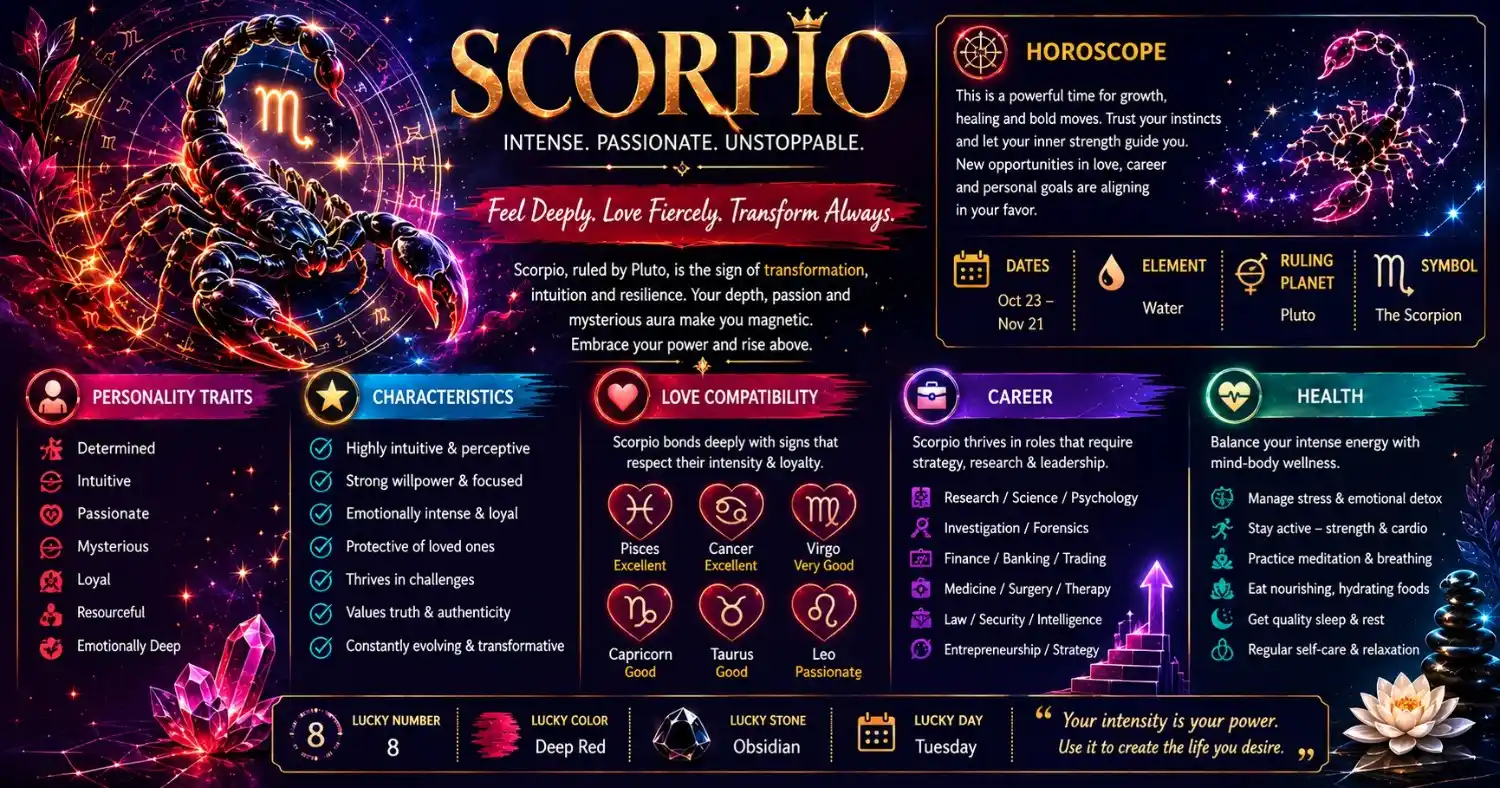
Scorpio travels through more myth than any other sign in the zodiac. Almost every ancient sky-watching culture looked at the same curved chain of stars near the summer horizon, saw the same stinging creature, and built a story around it. Some of those stories involve a hunter who never stops running. Some involve a goddess who protects the dead. Nearly all of them involve danger, transformation, and a sting that changes everything it touches.
I have read charts for clients on four continents, and Scorpio is the sign people ask about most, in every language I have ever worked in. I have explained the eighth sign to a Chennai engineer who called it Viruchigam, to a Cairo shopkeeper who called it Al-Aqrab, and to an Oslo nurse who called it Skorpionen. The word shifts shape from region to region. The intensity underneath it never does.
This guide gives you every major translation of Scorpio, the correct pronunciation, the cultural story behind each name, and the astrological substance that sits underneath all of it. Use it as a reference. Save the tables. Come back when you need them.
Quick Answer: What Does Scorpio Mean in Other Languages?
Scorpio means “scorpion” in Latin, taken from Greek. Nearly every language on Earth names the sign after that same small, armored, venomous creature. Languages split into four naming patterns:
- They keep the Latin/Greek word. Spanish Escorpio, Italian Scorpione, Romanian Scorpion, Indonesian Skorpio.
- They translate “scorpion” into their own word. German Skorpion, Polish Skorpion (a shared Slavic-Latin form), Turkish Akrep, Hebrew Akrav, Arabic Al-Aqrab.
- They borrow the Sanskrit term. Hindi Vrishchik, Thai Phijik, Khmer Kok, Sinhala Vrushchika.
- They build a compound with a “constellation” suffix. Chinese Tiānxiē zuò, Japanese Sasori-za, Korean Jeongal-jari.
The dates stay close in Western astrology: October 23 to November 21. The dates shift substantially in Vedic astrology: roughly November 16 to December 15. The traditional ruling planet stays Mars everywhere in classical systems, though modern Western astrology adds Pluto as a co-ruler. The element stays Water everywhere. The quality stays Fixed everywhere.
Now let’s go deeper.
The Root Meaning of Scorpio: Where the Word Comes From
The English word Scorpio comes from Latin scorpio or scorpius, meaning “scorpion.” Latin borrowed it from Ancient Greek σκορπίος (skorpíos), a word of uncertain deeper origin that some linguists connect to a Proto-Indo-European root meaning “to cut” or “to pierce” — a fitting sense for a creature known by its stinger.
The Greek word itself may carry older roots. Some etymologists link skorpíos to a Semitic root through ancient trade contact, similar to the way taurus and thawr share ancestry across language families. The connection is debated, but the pattern is familiar: a word for a dangerous desert animal moving along the same trade routes that carried astrology itself, from Mesopotamia through the Levant into Greece.
English keeps the root in ordinary vocabulary. Scorpion is the direct descendant. The military uses “scorpion” for various stinging weapons throughout history, including Roman siege engines called scorpio. Even the word “excoriate,” meaning to strip the skin or harshly criticize, sits in a different but visually related word family that reinforces the same cluster of ideas: cutting, piercing, wounding.
So when you say “I’m a Scorpio,” you are naming yourself after a small animal that ancient people feared and respected in equal measure, long before telescopes existed. That single fact should reframe how you read everything that follows. This is not a sign about surface conflict. It is a sign built entirely around what happens beneath the surface, out of sight, until it strikes.
Why a Scorpion? The Origin Story Behind the Symbol
Astrology did not invent the scorpion. Astronomy noticed the shape first, and mythology explained why it mattered.
Mesopotamia named it first
Babylonian astronomers recorded this constellation as GIR.TAB, “the Scorpion,” in cuneiform star catalogs stretching back to at least 1000 BCE. The MUL.APIN tablets place GIR.TAB among the oldest named constellations on record. Mesopotamian religion linked the scorpion to Ishara, a goddess connected to love, oath-taking, and the underworld, and later to the scorpion-men who guarded the gates of the sun in the Epic of Gilgamesh.
Notice that pairing. From the very beginning, the scorpion sat at the threshold between the visible world and the underworld. It guarded gates. It was not simply a pest to be avoided. It was a sentinel.
Egypt gave it a protective goddess
Egypt assigned the scorpion to Serqet (also spelled Selket), a goddess who both caused venomous stings and cured them. Serqet appears on the sarcophagi of pharaohs, arms outstretched in protection, because Egyptians believed the same power that could kill could also guard the dead through the afterlife.
This double nature — the poison and the antidote living in the same creature — became one of the defining ideas of the sign. Ancient Egyptian priests who served Serqet were also healers, called on to treat scorpion stings and snakebites using ritual and medical knowledge together.
Greece told the hunter’s downfall
Greek myth gives Scorpio its most famous story, and it is a story about consequence. Orion, the great hunter, boasted that he could kill every animal on Earth. Gaia, the earth goddess (in some versions, Artemis, angered by a separate offense), sent a scorpion to stop him. The scorpion stung Orion’s heel, and the hunter died.
Zeus placed both figures in the sky, but he placed them on opposite sides of the celestial dome. When Scorpio rises in the east, Orion sets in the west. They can never occupy the sky together. That single astronomical fact, still true and still visible tonight, is the clearest myth-to-sky match in the entire zodiac. Ancient Greek audiences watched the seasons prove the story every year.
Read that detail carefully, because it matters for the sign’s psychology. Scorpio’s myth is not about a monster attacking for pleasure. It is about a small, unglamorous creature humbling the most confident hunter alive. Scorpio energy distrusts arrogance and excess pride, because its origin story is a lesson about exactly that failure.
India saw the transformer
Vedic tradition names the sign Vrishchika, from Sanskrit vṛścika, related to the verb root vraśc, “to cut” or “to sever.” The same root gives Sanskrit words connected to surgery and cutting away. Indian astrologers read Vrishchika as the sign of surgical removal: what no longer serves must be cut away before anything new can grow.
Vrishchika sits under the rulership of Mars (Kuja/Mangal) in classical Vedic texts, exactly as in Western tradition, which is one of the rare points where the two systems agree without qualification.
Three ancient cultures. One animal. Three overlapping meanings: guardian of the threshold, punisher of arrogance, agent of necessary cutting. All three describe the same underlying force.
Scorpio in Indian Languages: The Vedic Family
India holds enormous variety in zodiac vocabulary because its many languages descend from two large families, Indo-Aryan and Dravidian, and both adopted the Sanskrit astrological system centuries ago.
The master table for Indian languages
| Language | Native Script | Romanization | Literal Sense |
|---|---|---|---|
| Sanskrit | वृश्चिक | Vṛścika | Scorpion, the cutter |
| Hindi | वृश्चिक राशि | Vrishchik Rashi | Scorpion sign |
| Marathi | वृश्चिक रास | Vrishchik Raas | Scorpion sign |
| Gujarati | વૃશ્ચિક રાશિ | Vrushchik Rashi | Scorpion sign |
| Bengali | বৃশ্চিক রাশি | Brishchik Rashi | Scorpion sign |
| Odia | ବୃଶ୍ଚିକ ରାଶି | Brushchika Rashi | Scorpion sign |
| Assamese | বৃশ্চিক ৰাশি | Brishchik Rashi | Scorpion sign |
| Punjabi | ਬ੍ਰਿਸ਼ਚਿਕ / ਵ੍ਰਿਸ਼ਚਿਕ | Brishchik / Vrishchik | Scorpion sign |
| Nepali | वृश्चिक राशि | Vrishchik Rashi | Scorpion sign |
| Tamil | விருச்சிகம் / விருச்சிக ராசி | Viruchigam / Viruchiga Rasi | Scorpion sign |
| Telugu | వృశ్చిక రాశి | Vrushchika Rasi | Scorpion sign |
| Kannada | ವೃಶ್ಚಿಕ ರಾಶಿ | Vrushchika Rashi | Scorpion sign |
| Malayalam | വൃശ്ചികം | Vrischikam | Scorpion sign, eighth month |
| Sinhala | වෘශ්චික | Vrushchika | Scorpion sign |
| Urdu | برج عقرب | Burj-e-Aqrab | House of the Scorpion |
Sanskrit: Vrishchika, the root of them all
Vṛścika (वृश्चिक) derives from the root vraśc, meaning “to cut, hew, or sever.” Sanskrit dictionaries connect the word to the scorpion’s slashing, curved tail-strike, but Indian astrologers extend the meaning far past the animal itself. The sign governs endings, surgery, cutting away of the old, and any process that requires destruction before renewal.
Every Vedic astrologer I know reaches for that etymology first when reading a Vrishchika chart. This is not a sign that adds. It is a sign that removes, so that something truer can remain.
Hindi and the northern languages
North Indian speakers say Vrishchik Rashi (वृश्चिक राशि). As with Taurus, the word rashi means “heap” or “accumulated measure,” a thirty-degree wedge of the zodiac. Newspapers and horoscope columns across Hindi-speaking India use the full compound consistently, unlike some other signs that get shortened in casual speech.
Tamil: Viruchigam and the Dravidian sound shift
Tamil says விருச்சிகம் (Viruchigam) or, in fuller astrological phrasing, விருச்சிக ராசி (Viruchiga Rasi). Tamil phonology reshapes the Sanskrit consonant cluster vṛśc into the smoother viruchi, a common pattern when Sanskrit loanwords enter Dravidian languages.
Tamil astrology, Jothidam, runs on the sidereal zodiac, so a Tamil speaker who calls himself Viruchigam was very likely born in mid-November through mid-December, not late October. The same date gap that applies to every sign in the Vedic system applies here, and I will unpack it fully below.
Telugu and Kannada
Telugu uses వృశ్చిక రాశి (Vrushchika Rasi). Kannada uses ವೃಶ್ಚಿಕ ರಾಶಿ (Vrushchika Rashi). Both languages preserve the Sanskrit root almost letter for letter, with only minor vowel adjustments typical of southern Indian phonology.
Malayalam: the calendar month again
Malayalam calls the sign വൃശ്ചികം (Vrischikam), and exactly as with Edavam for Taurus, this word doubles as the name of a month in the Malayalam solar calendar, running from roughly mid-November to mid-December.
Vrischikam carries special weight in Kerala beyond astrology. The Sabarimala pilgrimage season, one of the largest annual pilgrimages in the world, begins during the Malayalam month of Vrischikam. Millions of pilgrims observe a 41-day vow that starts as this month opens. In Kerala, the word is inseparable from themes of austerity, discipline, and spiritual intensity — themes that map almost perfectly onto the astrological character of the sign itself.
Urdu and the Persian-Arabic route
Urdu again takes the separate path it took for Taurus. It calls the sign برج عقرب (Burj-e-Aqrab), borrowing the Arabic aqrab, scorpion, through Persian. Burj means tower or house, exactly as before.
So a Hindi speaker says Vrishchik, rooted in Sanskrit, and an Urdu speaker in the same city might say Aqrab, rooted in Arabic. Two closely related spoken languages, two entirely different etymological ancestries for the same eight-legged symbol.
The nakshatras inside Vrishchika
Vedic astrology divides the sky into 27 lunar mansions, and Scorpio contains parts or all of three of them:
- Vishakha (final quarter) — ruled by Jupiter, symbol a decorated archway, associated with purpose and achievement
- Anuradha (all four quarters) — ruled by Saturn, symbol a lotus or staff of devotion, associated with friendship and disciplined success
- Jyeshtha (first two quarters) — ruled by Mercury, symbol an umbrella or earring, associated with seniority, protection, and secret power
Jyeshtha means “the eldest” or “the most senior,” and its presiding deity is Indra, king of the gods. Jyeshtha sits directly on Antares, the star at the scorpion’s heart, and Vedic tradition has called this exact star Jyeshtha for millennia — a naming choice astronomers confirmed independently through Persian sources describing the same star as one of the four ancient royal guardians of the sky.
Scorpio in European Languages
Europe again splits into recognizable families. Romance languages lean on Latin. Germanic and Slavic languages mostly keep a shared international form, which is unusual — Scorpio is one of the few signs where Latin-derived vocabulary dominates almost the entire continent, rather than splitting into native translations the way Taurus (bull) or Leo (lion) sometimes do.
Romance languages
| Language | Name | Pronunciation |
|---|---|---|
| Latin | Scorpio / Scorpius | SKOR-pee-oh |
| Italian | Scorpione | skor-pee-OH-neh |
| Spanish | Escorpio / Escorpión | es-KOR-pee-oh |
| Portuguese | Escorpião | es-kor-pee-OWN |
| French | Scorpion | skor-pee-OHN |
| Romanian | Scorpion | skor-pee-ON |
| Catalan | Escorpí | es-kor-PEE |
| Galician | Escorpión | es-kor-pee-ON |
Spanish shows the same careful distinction it made for Taurus. The astrological sign is Escorpio, while an actual scorpion in the desert is un escorpión. A Spanish speaker says “Soy Escorpio” for the star sign, keeping the shortened astrological form rather than the full zoological noun, though “Soy Escorpión” is also heard and understood.
Germanic languages
| Language | Name | Notes |
|---|---|---|
| German | Skorpion | Direct Latin/Greek borrowing |
| Dutch | Schorpioen | Direct borrowing |
| Danish | Skorpionen | “The Scorpion,” definite form |
| Norwegian | Skorpionen | “The Scorpion,” definite form |
| Swedish | Skorpionen | “The Scorpion,” definite form |
| Icelandic | Sporðdrekinn | “The Tail-Dragon,” native compound |
| Afrikaans | Skerpioen | Direct borrowing |
Icelandic breaks the European pattern entirely, the way it so often does. Sporðdrekinn is a native compound: sporður means “tail,” and dreki means “dragon.” Icelandic, isolated from Southern European Latin influence for most of its history, built its own descriptive word rather than importing Greek skorpíos. The result is almost poetic: not “the scorpion,” but “the tail-dragon,” a name that leans into the same fear the ancients felt without needing the desert animal at all.
Slavic languages
| Language | Name | Romanization |
|---|---|---|
| Russian | Скорпион | Skorpion |
| Ukrainian | Скорпіон | Skorpion |
| Belarusian | Скарпіён | Skarpiyon |
| Bulgarian | Скорпион | Skorpion |
| Polish | Skorpion | Skorpion |
| Czech | Štír | Shteer |
| Slovak | Škorpión | Shkorpee-on |
| Serbian | Шкорпија / Škorpija | Shkorpiya |
| Croatian | Škorpion | Shkorpee-on |
| Slovenian | Škorpijon | Shkorpee-yon |
| Macedonian | Скорпија | Skorpiya |
Czech stands alone here, exactly as Sweden stood alone for Taurus. Štír is a native Czech word for scorpion unrelated to the Greek borrowing every neighboring Slavic language uses. Linguists trace štír to an older Slavic root, though its ultimate origin is debated; some connect it distantly to words for sharpness or piercing, echoing the same “to cut” sense found in the Sanskrit root vraśc.
Baltic, Celtic, and other European branches
| Language | Name | Notes |
|---|---|---|
| Lithuanian | Skorpionas | Latin borrowing |
| Latvian | Skorpions | Latin borrowing |
| Estonian | Skorpion | Latin borrowing |
| Finnish | Skorpioni | Latin borrowing |
| Hungarian | Skorpió | Latin borrowing |
| Greek | Σκορπιός (Skorpiós) | The original word |
| Albanian | Akrepi | Related to Arabic-Turkish akrep |
| Basque | Eskorpioia | Latin borrowing |
| Irish | An Scairp | Native/adapted form |
| Scottish Gaelic | An Sgairp | Native/adapted form |
| Welsh | Y Sgorpion | Latin borrowing |
| Armenian | Կարիճ (Karich) | Native word |
| Georgian | მორიელი (Morieli) | Native word |
| Turkish | Akrep | Arabic borrowing |
Notice how uniform this list is compared to the corresponding Taurus table. Bulls and oxen were farm animals every culture already had its own word for. Scorpions were exotic, dangerous, mostly desert-dwelling creatures that many Northern and Eastern European cultures encountered only through astronomy and imported texts, not through daily life. Where there was no existing word to translate the concept into, the Greek and Latin term simply moved in wholesale. Albanian Akrepi and Turkish Akrep both echo the Arabic aqrab, a sign of trade and cultural contact along the old Ottoman and Mediterranean routes rather than of Indo-European inheritance.
Scorpio in Middle Eastern and Semitic Languages
The Middle East holds the oldest continuous astrological tradition connected to this sign, and appropriately, the word for scorpion here has stayed remarkably stable for thousands of years.
| Language | Native Script | Romanization | Meaning |
|---|---|---|---|
| Arabic | برج العقرب | Burj al-Aqrab | House of the Scorpion |
| Hebrew | מזל עקרב | Mazal Akrav | Constellation of the Scorpion |
| Persian (Farsi) | عقرب / کژدم | Aqrab / Kazhdom | Scorpion |
| Turkish | Akrep Burcu | Akrep Burjoo | Scorpion sign |
| Kurdish | Dûpişk | Dûpishk | Scorpion (native compound) |
| Pashto | عقرب | Aqrab | Scorpion |
| Azerbaijani | Əqrəb | Aqrab | Scorpion |
| Aramaic | עַקְרַבָּא | Aqrabba | Scorpion |
| Amharic | ጊንጥ | Gint | Scorpion |
Arabic: Al-Aqrab
Arabic says برج العقرب (Burj al-Aqrab), “house of the scorpion.” The root ʿ-q-r-b runs deep and consistently through the Semitic language family; Hebrew, Aramaic, and Arabic all preserve close cognates, unlike the Taurus root, which showed more divergence across the same family.
Classical Arabic astronomy, inherited from and expanded on Ptolemaic Greek sources, gave individual stars in this constellation their own names, several of which are still used by astronomers worldwide. Shaula, marking the scorpion’s stinger, comes from Arabic al-shawlā, “the raised tail” — describing exactly the pose of a scorpion about to strike. Sargas, one of the tail stars, likely traces to an even older Sumerian name.
Hebrew: Mazal Akrav
Hebrew says מזל עקרב (Mazal Akrav). As with Taurus, mazal carries the double sense of “constellation” and “fortune,” and akrav is the ordinary Hebrew word for scorpion, appearing in the Torah’s account of the Israelites’ desert wanderings among “serpents and scorpions” (Deuteronomy 8:15).
Jewish tradition connects Scorpio to the Hebrew month of Cheshvan and, in some classical sources, to the tribe of Dan. Rabbinic and Kabbalistic writings often treat the scorpion with ambivalence: dangerous and low to the ground, yet also associated with acute perception, since the scorpion senses vibration through the earth itself, detecting danger long before it arrives.
Persian: two words, two eras
Modern Persian uses عقرب (Aqrab), the Arabic-derived form, in formal astrological writing and in the Iranian solar calendar, where Aban overlaps this period and Aqrab or Aghrab names the eighth zodiacal month directly.
Older Zoroastrian and pre-Islamic Persian sources sometimes use the native Iranian word کژدم (Kazhdom), which is still the standard everyday Persian word for the actual arachnid today, even though aqrab dominates astrological usage.
Turkish: Akrep
Turkish says Akrep Burcu. Akrep is a direct Arabic loanword, unlike Turkish Boğa for Taurus, which was a native Turkic word. Turkish absorbed the astrological scorpion term wholesale from Arabic religious and scientific scholarship during the Ottoman period, while keeping its own native word for bull. Vocabulary borrowing rarely follows one single pattern, even within a single language.
Scorpio in East Asian Languages
East Asia adopted the Western zodiac relatively recently, mostly through nineteenth- and twentieth-century contact with European astronomy and popular astrology. As with Taurus, the resulting names read as careful, descriptive compounds rather than inherited words.
| Language | Native Script | Romanization | Literal Translation |
|---|---|---|---|
| Chinese (Mandarin) | 天蝎座 | Tiānxiē zuò | Heavenly Scorpion constellation |
| Chinese (Cantonese) | 天蠍座 | Tin1 hit3 zo6 | Heavenly Scorpion constellation |
| Japanese | 蠍座 / さそり座 | Sasori-za | Scorpion constellation |
| Korean | 전갈자리 | Jeongal-jari | Scorpion seat/place |
| Vietnamese | Cung Bọ Cạp | Cung Bọ Cạp | Scorpion sign |
| Mongolian | Хилэнц | Khilents | Scorpion |
Chinese: the Heavenly Scorpion
Mandarin says 天蝎座 (Tiānxiē zuò). Break it down: 天 (tiān) means heaven or sky, 蝎 (xiē) means scorpion, 座 (zuò) means seat or constellation. Chinese astrologers frequently point out that this “heavenly” prefix elevates the creature, framing it as a celestial guardian rather than a mere desert pest, echoing the same guardian symbolism found in Egypt and Mesopotamia.
As with Taurus and the Chinese zodiac Ox year, be careful not to confuse 天蝎座 with anything from the twelve-year Chinese zodiac cycle. There is no scorpion among the twelve Chinese zodiac animals; 天蝎座 belongs entirely to the imported Western month-based system.
Traditional Chinese astronomy divided this same patch of sky differently, assigning much of it to the Azure Dragon of the East (東方青龍), with the mansions Xin (心, the Heart) and Wei (尾, the Tail) covering the scorpion’s body. Antares itself is 心宿二 (Xīnxiù èr), “the second star of the Heart mansion” — a name almost identical in concept to the Roman Cor Scorpionis, “Heart of the Scorpion,” despite the two civilizations developing it independently.
Japanese: Sasori-za
Japanese writes 蠍座 and reads it さそり座 (Sasori-za). 蠍 (sasori) means scorpion, and 座 (za) is the same constellation suffix seen in Oushi-za for Taurus. Japanese print media almost always use the hiragana form さそり座, since the kanji 蠍 is uncommon enough that many readers would not recognize it on sight.
Korean: Jeongal-jari
Korean says 전갈자리 (Jeongal-jari). 전갈 (jeongal) is the Sino-Korean word for scorpion, and 자리 (jari), as with Taurus, is the native Korean suffix meaning “seat” or “place,” used consistently across all Korean constellation names.
Vietnamese: Bọ Cạp
Vietnamese departs from the Sino-Vietnamese pattern used for several other signs and says Cung Bọ Cạp, using bọ cạp, the everyday native Vietnamese word for scorpion, rather than borrowing a Chinese-derived term. Cung means “palace” or “sign,” paralleling Chinese zuò and Arabic burj.
Scorpio in Southeast Asian Languages
Southeast Asia received its zodiac from India, so the vocabulary again runs straight back to Sanskrit Vṛścika, filtered through Pali and local phonology exactly as with Taurus.
| Language | Native Script | Romanization | Source |
|---|---|---|---|
| Thai | ราศีพิจิก | Rasi Phijik | Sanskrit Vrishchika |
| Khmer | រាសីវិច្ឆិកា | Reasei Vichhika | Sanskrit Vrishchika |
| Lao | ລາສີພິຈິກ | Lasi Phichik | Sanskrit Vrishchika |
| Burmese | ဗြိစ္ဆာရာသီ | Byeissa Yathi | Sanskrit Vrishchika |
| Indonesian | Skorpio / Kalajengking | Skorpio | Latin / native “scorpion” |
| Malay | Skorpio / Kala Jengking | Skorpio | Latin / native “scorpion” |
| Filipino (Tagalog) | Scorpio / Alakdan | Scorpio | Latin via Spanish/English |
| Javanese | Skorpio | Skorpio | Latin |
Thai and the calendar connection
Thai says ราศีพิจิก (Rasi Phijik). Rasi is the familiar Sanskrit rashi, and Phijik is the Thai phonological rendering of Vṛścika, with the consonant cluster smoothed the same way it was for Phruetsopha from Vṛṣabha.
Thailand’s month names again mirror the zodiac. The Thai month พฤศจิกายน (Phruetsajikayon), meaning November, contains a recognizable echo of the same Sanskrit root, reinforcing how thoroughly Sanskrit astrological vocabulary embedded itself into everyday Thai timekeeping centuries ago.
Indonesian, Malay, and Filipino
Indonesian and Malay generally keep Skorpio, borrowed through Dutch and English colonial contact, though Kalajengking (Indonesian) and Kala Jengking (Malay), the native words for scorpion, appear in more descriptive or folkloric writing.
Filipino keeps Scorpio from English and earlier Spanish contact, with Alakdan, the native Tagalog word for scorpion, used in casual speech and in older almanacs that translated the zodiac into local vocabulary.
Scorpio in African Languages
As with Taurus, African-language astrological vocabulary shows significant variation, since the terms arrived through different colonial, religious, and trade routes depending on the region.
| Language | Name | Literal Meaning |
|---|---|---|
| Swahili | Nge | Scorpion |
| Amharic | ጊንጥ | Scorpion |
| Zulu | Ufezela | Scorpion |
| Xhosa | Ufezela | Scorpion |
| Yoruba | Àkéekèe | Scorpion |
| Hausa | Kunama | Scorpion |
| Shona | Chinyongoro | Scorpion |
| Somali | Dib-qallooc | Scorpion (curved tail) |
| Wolof | Jaan bu ñaw | Stinging creature |
Swahili astrology columns across Kenya and Tanzania use Nge, the ordinary Swahili word for scorpion, without needing a separate astrological loanword, since Swahili astrology terminology for the Western zodiac tends to translate descriptively rather than transliterate.
Zulu and Xhosa Ufezela carries strong folkloric weight independent of astrology. In parts of Southern African oral tradition, the scorpion appears in cautionary stories about hidden danger and swift, decisive retaliation — themes that map comfortably onto the astrological sign whenever local writers translate horoscope columns for regional newspapers.
As with the earlier caution around Taurus, treat these as descriptive translations rather than fixed, universally standardized astrological terms. Regional usage varies, and many African-language publications simply retain the English or French “Scorpio/Scorpion” rather than translating it at all.
Scorpio in Sign Languages, Constructed Languages, and Symbols
The astrological glyph
Scorpio uses the symbol ♏, encoded in Unicode as U+264F. The glyph resembles the letter M with an arrow or barb curling off the final stroke. Read literally, most astrologers interpret it as a stylized scorpion’s tail arching up and over, ready to strike — the same raised-tail posture that gave Arabic star name al-Shawlā its meaning.
Some traditions offer a second, more esoteric reading of the same glyph, tying it to the sign’s three classical symbolic levels: the scorpion (base instinct and self-destruction), the eagle (transformation and higher perception), and, in the most elevated readings, the phoenix (rebirth from one’s own ashes). Few other zodiac symbols carry three tiered animal meanings the way Scorpio does, and astrologers frequently use all three when describing where a person sits on their own path of transformation.
Esperanto and constructed languages
Esperanto says Skorpio. Interlingua says Scorpio. Both, unsurprisingly, follow the international Latin-Greek form directly, exactly as they did for Taurus.
American Sign Language
ASL has no single universally standardized sign for the zodiac sign Scorpio specifically. Deaf astrology communities commonly adapt the general sign for “scorpion,” which typically depicts pincers and a curling, striking tail motion, sometimes combined with fingerspelling for clarity in astrological contexts. As with Taurus, regional variation exists, so check with local Deaf communities rather than assuming one standard form.
How to Say “I Am a Scorpio” in 25 Languages
Here is the phrase people actually need, ready to use.
| Language | Phrase |
|---|---|
| Spanish | Soy Escorpio |
| French | Je suis Scorpion |
| German | Ich bin Skorpion |
| Italian | Sono dello Scorpione |
| Portuguese | Sou de Escorpião |
| Dutch | Ik ben Schorpioen |
| Russian | Я Скорпион (Ya Skorpion) |
| Polish | Jestem Skorpionem |
| Greek | Είμαι Σκορπιός (Eímai Skorpiós) |
| Turkish | Ben Akrep burcuyum |
| Arabic | أنا برج العقرب (Ana burj al-aqrab) |
| Hebrew | אני מזל עקרב (Ani mazal akrav) |
| Persian | من متولد عقرب هستم (Man motavalled-e aqrab hastam) |
| Hindi | मेरी राशि वृश्चिक है (Meri rashi Vrishchik hai) |
| Bengali | আমার রাশি বৃশ্চিক (Amar rashi Brishchik) |
| Tamil | என் ராசி விருச்சிகம் (En rasi Viruchigam) |
| Telugu | నా రాశి వృశ్చికం (Naa rasi Vrushchikam) |
| Kannada | ನನ್ನ ರಾಶಿ ವೃಶ್ಚಿಕ (Nanna rashi Vrushchika) |
| Malayalam | എന്റെ രാശി വൃശ്ചികം (Ente rashi Vrischikam) |
| Urdu | میرا برج عقرب ہے (Mera burj Aqrab hai) |
| Chinese | 我是天蝎座 (Wǒ shì tiānxiē zuò) |
| Japanese | 私はさそり座です (Watashi wa sasori-za desu) |
| Korean | 저는 전갈자리예요 (Jeoneun jeongal-jari-yeyo) |
| Thai | ฉันเป็นราศีพิจิก (Chan pen rasi phijik) |
| Vietnamese | Tôi là cung Bọ Cạp |
| Swahili | Mimi ni Nge |
The Date Problem: Why Scorpio Starts on Different Days
This is the single most common source of confusion in this entire subject, and Scorpio suffers from it more than most signs, because it also carries the odd “thirteenth sign” story that resurfaces online every year or two.
Western (tropical) astrology
Western astrology uses the tropical zodiac, anchored to the seasons rather than the stars themselves. Scorpio runs from about October 23 to November 21 every year, marking the deepening of autumn in the Northern Hemisphere, when daylight thins fastest and the natural world visibly turns toward dormancy.
The exact boundary shifts by up to a day depending on the year and your time zone. If you were born on October 23 or November 21, check your exact birth time, since those are cusp dates.
Vedic (sidereal) astrology
Indian astrology uses the sidereal zodiac, anchored to the fixed stars. Because of the roughly 24-degree drift caused by the precession of the equinoxes over the past two millennia, sidereal Vrishchika runs from approximately November 16 to December 15.
So someone born on November 25 is a Scorpio in Western tropical astrology and a Sagittarius (Dhanu) in Vedic sidereal astrology. Neither calculation is a mistake. The two systems are simply measuring different reference points against the sky.
Why both systems still work
Tropical astrology tracks the sun’s relationship to the seasons, describing psychological and archetypal patterns tied to the time of year in which someone was born. Sidereal astrology tracks the sun’s position against the actual background stars, anchoring a predictive system built on planetary periods and precise nakshatra placements.
I read both, and I explain both to clients regularly. If your Western sign and your Vedic sign disagree — and for Scorpio, they very often do — you have not been given wrong information. You have two separate, internally consistent maps layered over the same underlying sky.
The Ophiuchus and constellation-boundary issue
Modern astronomy adds a well-known complication here. The International Astronomical Union fixed official constellation boundaries in 1930, and under those boundaries the sun’s path actually crosses through the Scorpius constellation for only about six days, from roughly November 23 to November 29, before spending nearly three weeks passing through the neighboring constellation Ophiuchus, the so-called “thirteenth sign.”
This is the fact behind nearly every “NASA changed the zodiac” headline that resurfaces periodically. It is purely an astronomy observation about uneven constellation sizes along the ecliptic, not an astrology change. Astrologers have used twelve equal thirty-degree divisions of the zodiac for over two thousand years, and the physical constellations — which vary wildly in width — have never matched those equal divisions precisely, for Scorpio or for any other sign.
What Scorpio Actually Means: The Astrology Underneath the Words
Names change from language to language. The astrological content underneath them does not. Here is the substance every tradition largely agrees on.
The core signature
- Element: Water
- Modality: Fixed
- Ruling planet: Mars (traditional), with Pluto as a modern co-ruler in Western astrology; Mars (Kuja/Mangal) alone in Vedic astrology
- Symbol: The Scorpion (with the Eagle and Phoenix as higher symbolic expressions)
- Polarity: Receptive, yin, feminine
- House correspondence: Eighth house
- Detriment: Venus
- Fall: The Moon
- Body rulership: Reproductive organs, genitals, excretory system
- Tarot correspondence: Death
- Colors: Deep red, black, maroon
- Stones: Garnet, obsidian, topaz
- Season: Late autumn in the Northern Hemisphere
Fixed Water, explained properly
Fixed signs hold and sustain rather than initiate or adapt. Water signs deal in emotion, instinct, and the unseen currents beneath surface events.
Combine them, and you get emotion that does not dissipate. Cardinal water (Cancer) reacts quickly and protectively. Mutable water (Pisces) dissolves and merges. Fixed water holds a feeling, a suspicion, or a commitment for years if necessary, refining it under pressure rather than releasing it.
That single combination generates nearly every trait attributed to Scorpio in horoscope writing worldwide: intensity, loyalty, jealousy, secrecy, and an almost geological patience when pursuing a goal or working through a wound.
Mars and Pluto rule through depth, not surface
Mars alone, as the sign’s classical and Vedic ruler, gives Scorpio its drive, its willingness to fight, and its association with surgery, cutting instruments, and decisive action — echoing the Sanskrit root vraśc, “to cut,” almost exactly.
Modern Western astrology adds Pluto as co-ruler, named for the Roman god of the underworld. Pluto governs what is buried: power, death, regeneration, obsession, and the parts of the psyche a person keeps hidden even from themselves. Where Mars gives Scorpio its edge, Pluto gives it its depth. Together, they describe a sign equally capable of decisive external action and of near-bottomless internal excavation.
Vedic astrology, working with Mars alone, reads Vrishchika through a slightly different lens: courage, surgical precision, and a tendency toward sudden, transformative upheaval in the areas of life the eighth house touches — death, inheritance, hidden matters, and other people’s resources.
The eighth house matters
Scorpio naturally corresponds to the eighth house in both major traditions, and the eighth house governs death, rebirth, shared resources, inheritance, intimacy, and the occult. This is not a coincidental detail. It is the structural key to the entire sign.
Every culture’s origin story for this sign — Ishara guarding the gates of the underworld, Serqet guiding souls through the afterlife, Vrishchika cutting away the old, Orion’s fatal encounter with mortality itself — circles back to this same eighth-house territory: the threshold between what has ended and what has not yet begun.
Core strengths
Scorpio brings extraordinary loyalty once trust is earned, though earning that trust is rarely quick or easy. A Scorpio who commits, commits completely, and expects the same in return.
Scorpio possesses genuine emotional courage. Fixed water does not flinch away from grief, mortality, betrayal, or any of the subjects most people avoid at dinner parties. This makes Scorpios natural crisis counselors, surgeons, researchers, detectives, and therapists — professions the sign is statistically and anecdotally overrepresented in, across multiple cultures’ horoscope traditions.
Scorpio reads people accurately. The sign’s water element combined with fixed intensity produces an almost uncanny instinct for what others are hiding, a trait ancient cultures encoded directly into the animal itself: a scorpion senses vibration through the ground before any other creature notices danger approaching.
Scorpio regenerates. The sign’s mythic and symbolic association with the phoenix is not decorative. Scorpios who go through devastating loss are, more often than most signs, the ones who rebuild an entirely new version of their life rather than simply patching the old one.
Core challenges
Scorpio can slide into control and possessiveness. Fixed water wants certainty in emotional matters, and when that certainty feels threatened, jealousy and manipulation become tempting shortcuts.
Scorpio holds grudges longer than almost any other sign. The same intensity that produces deep loyalty produces deep and lasting resentment when trust is broken.
Scorpio can weaponize its own perceptiveness. Knowing someone’s weak point is not the same as using it kindly, and the sign’s detractors point to this exact temptation as its most dangerous trait.
Scorpio sometimes confuses intensity with intimacy, mistaking drama, secrecy, or power struggles for genuine closeness, when the two are not the same thing at all.
Does the meaning change by culture?
My honest professional answer, after two decades of practice across multiple traditions: the emphasis shifts, but the underlying substance does not.
Western pop astrology emphasizes psychological intensity: the “most misunderstood sign,” the “deepest” sign, the one associated with sex, power, and secrets in nearly every mainstream horoscope column.
Vedic astrology emphasizes surgical and transformative life events tied to the eighth house: sudden change, hidden inheritance, occult study, and the timing of major upheaval through planetary periods.
Chinese-language horoscope media often lean into the “Heavenly Scorpion” framing, treating the sign as a guardian archetype rather than purely a dangerous one, in keeping with the elevated 天 (heavenly) prefix in its name.
Arabic-language traditional astrology, inheriting directly from Ptolemy and medieval scholars like al-Biruni, treats Mars-ruled Scorpio with particular caution in electional astrology, associating it with sharp instruments, conflict, and matters requiring careful timing.
Different emphasis. Same sign. The scorpion does not change its nature when the word for it changes.
Star Names Inside Scorpio Across Languages
This constellation contains one of the most storied stars in the entire night sky, along with several others carrying names still used by working astronomers today.
Antares, the heart of the scorpion
| Culture | Name | Meaning |
|---|---|---|
| Greek | Ἀντάρης (Antárēs) | Rival of Mars |
| Latin | Cor Scorpionis | Heart of the Scorpion |
| Sanskrit | ज्येष्ठा (Jyeshtha) | The eldest, the senior |
| Chinese | 心宿二 (Xīnxiù èr) | Second star of the Heart mansion |
| Persian | Satevis | One of the four royal stars |
| Arabic (folk) | Qalb al-Aqrab | Heart of the Scorpion |
Antares glows a deep, distinctive red, close enough in color to Mars that Greek astronomers named it “rival of Ares,” the god of war, since the two red points of light were easily confused in the night sky. Mesopotamian tradition, older still, called the same star the “Heart of the Scorpion” and linked it to the goddess Lisin, a naming choice the Romans later adopted directly as Cor Scorpionis. Ancient Persian astronomy counted Antares among the four royal stars guarding the four quarters of the heavens, alongside Aldebaran, Regulus, and Fomalhaut — meaning Taurus and Scorpio each anchor one of the same four ancient sky-guardians, a detail that connects these two very different signs at the deepest astronomical level.
Shaula, the raised stinger
| Culture | Name | Meaning |
|---|---|---|
| Arabic | الشولة (al-Shawlā) | The raised tail |
| Latin/English | Shaula | Direct Arabic borrowing |
| Chinese | 尾宿八 (Wěixiù bā) | Eighth star of the Tail mansion |
Shaula marks the very tip of the scorpion’s curling tail, exactly where the stinger sits, and its Arabic name describes the posture precisely: a tail raised and ready to strike. Modern astronomers still use this Arabic-derived name without alteration.
The Pleiades’ opposite number
Where Taurus contains the famous Pleiades cluster, Scorpio sits almost directly opposite it in the sky, roughly six months apart in visibility. Ancient cultures across the world frequently paired these two constellations as symbolic opposites: fertility and abundance in Taurus against death and transformation in Scorpio, the beginning and the ending of the same agricultural and mythic cycle.
Common Mistakes and Mistranslations to Avoid
Mistake 1: Confusing the Scorpio “sting” with simple aggression
Many casual horoscope writers translate Scorpio’s Mars rulership as pure aggression, similar to Aries. This flattens the sign. Mars in Scorpio expresses through depth and timing rather than open confrontation; nearly every cultural tradition above frames the scorpion as a guardian or a patient, precise force rather than a reckless one.
Mistake 2: Assuming Vrishchika and Scorpio cover the same dates
They do not, exactly as with Taurus and Vrishabha. The sidereal and tropical zodiacs differ by roughly three and a half weeks. Always confirm which system a person means before comparing birth dates across cultures.
Mistake 3: Treating “Scorpio” and “Ophiuchus” as competing zodiac signs
Ophiuchus is a constellation the ecliptic happens to pass through under modern IAU boundaries. It has never been part of the twelve-sign astrological zodiac used by Western, Vedic, or Chinese astrology, all of which predate the 1930 IAU boundary decision by many centuries.
Mistake 4: Using the same word for “scorpion” and “Scorpio” without checking capitalization or context
Several languages, including English, Vietnamese, and Swahili, use closely related or identical words for the actual arachnid and the zodiac sign. Context and capitalization matter for clarity in written translation work, exactly as with Spanish toro versus Tauro.
Mistake 5: Assuming every culture views the scorpion negatively
Serqet in Egypt, Ishara in Mesopotamia, and the guardian framing in Chinese astrology all treat the creature with respect and protective symbolism, not simple fear. Do not default to a purely negative translation tone when writing across cultures.
Mistake 6: Machine-translating astrological terms without verification
Translation engines routinely render “Scorpio” inconsistently, sometimes defaulting to the car-model or brand-name sense in commercial contexts, or confusing it with the general zoological term. Always verify with a native speaker for any published astrological content.
Frequently Asked Questions
What does Scorpio mean in English?
Scorpio means “the Scorpion.” English borrowed the word from Latin scorpio, itself borrowed from Greek skorpíos. English uses the term specifically for the constellation and the zodiac sign, distinct from the everyday word “scorpion” used for the animal.
What is Scorpio called in Hindi?
Hindi calls Scorpio वृश्चिक राशि (Vrishchik Rashi), “scorpion sign.” The word comes from Sanskrit vṛścika, related to the root vraśc, meaning “to cut” or “to sever.”
What is Scorpio in Tamil?
Tamil calls Scorpio விருச்சிகம் (Viruchigam) or, in full astrological form, விருச்சிக ராசி (Viruchiga Rasi), both derived directly from the Sanskrit Vṛścika.
What is Scorpio called in Malayalam?
Malayalam calls Scorpio വൃശ്ചികം (Vrischikam). The same word also names a month in the Malayalam solar calendar, running from roughly mid-November to mid-December, and marks the start of the Sabarimala pilgrimage season in Kerala.
What is Scorpio in Arabic?
Arabic calls Scorpio برج العقرب (Burj al-Aqrab), “house of the scorpion.” The root ʿ-q-r-b is shared closely across the Semitic languages, appearing in nearly identical form in Hebrew and Aramaic.
What is Scorpio in Chinese?
Chinese calls Scorpio 天蝎座 (Tiānxiē zuò), literally “Heavenly Scorpion constellation.” There is no overlap with the twelve-animal Chinese zodiac cycle, which has no scorpion among its animals.
What is Scorpio in Japanese?
Japanese calls Scorpio 蠍座, read as さそり座 (Sasori-za), “scorpion constellation.” Print media generally use the hiragana form for easier reading.
What is Scorpio in Korean?
Korean calls Scorpio 전갈자리 (Jeongal-jari). Jeongal is the Sino-Korean word for scorpion, and jari, a native Korean word meaning “seat” or “place,” is used for all twelve constellation names.
What is the Urdu name for Scorpio?
Urdu calls Scorpio برج عقرب (Burj-e-Aqrab). Urdu borrows this term from Arabic through Persian, unlike Hindi, which uses the Sanskrit-derived Vrishchik.
Does Scorpio mean the same thing in every language?
Essentially, yes. Nearly every major language names the sign after a scorpion, sometimes borrowing the Greek-Latin word wholesale and sometimes translating it into a native term. The astrological meaning stays consistent as well: fixed water, ruled by Mars (and Pluto in modern Western astrology), associated with intensity, transformation, secrecy, and depth.
Why do Vedic and Western Scorpio dates differ?
Western astrology uses the tropical zodiac, tied to the seasons, giving dates of October 23 to November 21. Vedic astrology uses the sidereal zodiac, tied to the fixed stars, giving dates of roughly November 16 to December 15. The gap results from the precession of the equinoxes accumulating over roughly two thousand years.
What is the Scorpio symbol called?
The symbol is ♏, resembling an M with an arrow or barb curling from its final stroke. It represents the scorpion’s tail, raised and ready to strike. Unicode encodes it as U+264F.
Which planet rules Scorpio in every tradition?
Mars rules Scorpio in classical Western astrology and in Vedic astrology alike. Modern Western astrology adds Pluto as a co-ruler, reflecting the sign’s associations with death, power, and psychological depth, themes discovered and named after the planet Pluto’s identification in 1930.
What does Vrishchika mean in Sanskrit?
Vṛścika means scorpion. It derives from the root vraśc, meaning to cut or sever, connecting the sign symbolically to surgery, endings, and the deliberate removal of what no longer serves.
Is Scorpio related to Ophiuchus, the “thirteenth sign”?
Not in any astrological tradition. Ophiuchus is a constellation that the ecliptic passes through under modern astronomical boundaries drawn in 1930, but it has never been one of the twelve signs used in Western, Vedic, or Chinese astrology, all of which are far older than that boundary decision.
What is Scorpio in Thai?
Thai calls Scorpio ราศีพิจิก (Rasi Phijik), borrowed from Sanskrit Vrishchika. Thailand’s month name for November carries a related linguistic root.
Which star sits at the heart of Scorpio?
Antares, the brilliant red supergiant marking the scorpion’s heart. Greek tradition calls it “rival of Mars” for its reddish color; Vedic tradition calls it Jyeshtha, “the eldest”; and ancient Mesopotamian and Roman traditions both independently arrived at the same description, “Heart of the Scorpion.”
Key Takeaways
Scorpio survives translation with remarkable consistency, and the reasons run deeper than shared vocabulary.
The scorpion was one of the most feared and respected creatures across the ancient desert world, from Mesopotamia through Egypt and Arabia. It killed with a hidden weapon rather than open force, it guarded thresholds between the living world and the underworld, and it humbled even a legendary hunter in Greek myth. Every culture that lived near scorpions, or inherited stories about them, arrived at a similar symbolic reading: danger paired with guardianship, poison paired with cure.
Then each culture named the sign in its own words.
Remember these essentials:
- Scorpio means “scorpion” in Latin and Greek, and most languages either keep that word directly or translate it faithfully.
- Four naming patterns exist: Latin/Greek borrowing (the most common by far for this sign), native translation, Sanskrit borrowing, and constellation compounds.
- India, Southeast Asia, and Sri Lanka use forms of Sanskrit Vrishchika, rooted in a verb meaning “to cut.”
- Europe overwhelmingly kept the Greek-Latin form, unlike Taurus, since most languages had no pre-existing native word for this exotic desert animal.
- East Asia built descriptive compounds ending in “constellation,” several adding an elevating “heavenly” prefix.
- The Middle East uses the shared Semitic root ʿ-q-r-b, remarkably stable across Arabic, Hebrew, and Aramaic.
- Mars rules the sign in every tradition, with Pluto added as co-ruler in modern Western astrology.
- The eighth house — death, rebirth, shared resources, and hidden things — anchors the sign’s meaning everywhere it appears.
- Western dates run October 23 to November 21. Vedic dates run roughly November 16 to December 15.
Whatever word your language uses, the sign describes the same force. Depth that does not announce itself. Loyalty that does not waver once given. A capacity for ending things cleanly so that something truer can grow in the space left behind.
The scorpion does not strike carelessly. The scorpion waits, and it means it.
This guide covers astrological tradition and comparative linguistics. Astrology is a symbolic and cultural system, not a science. Use it for reflection and self-understanding rather than for medical, financial, or legal decisions.