
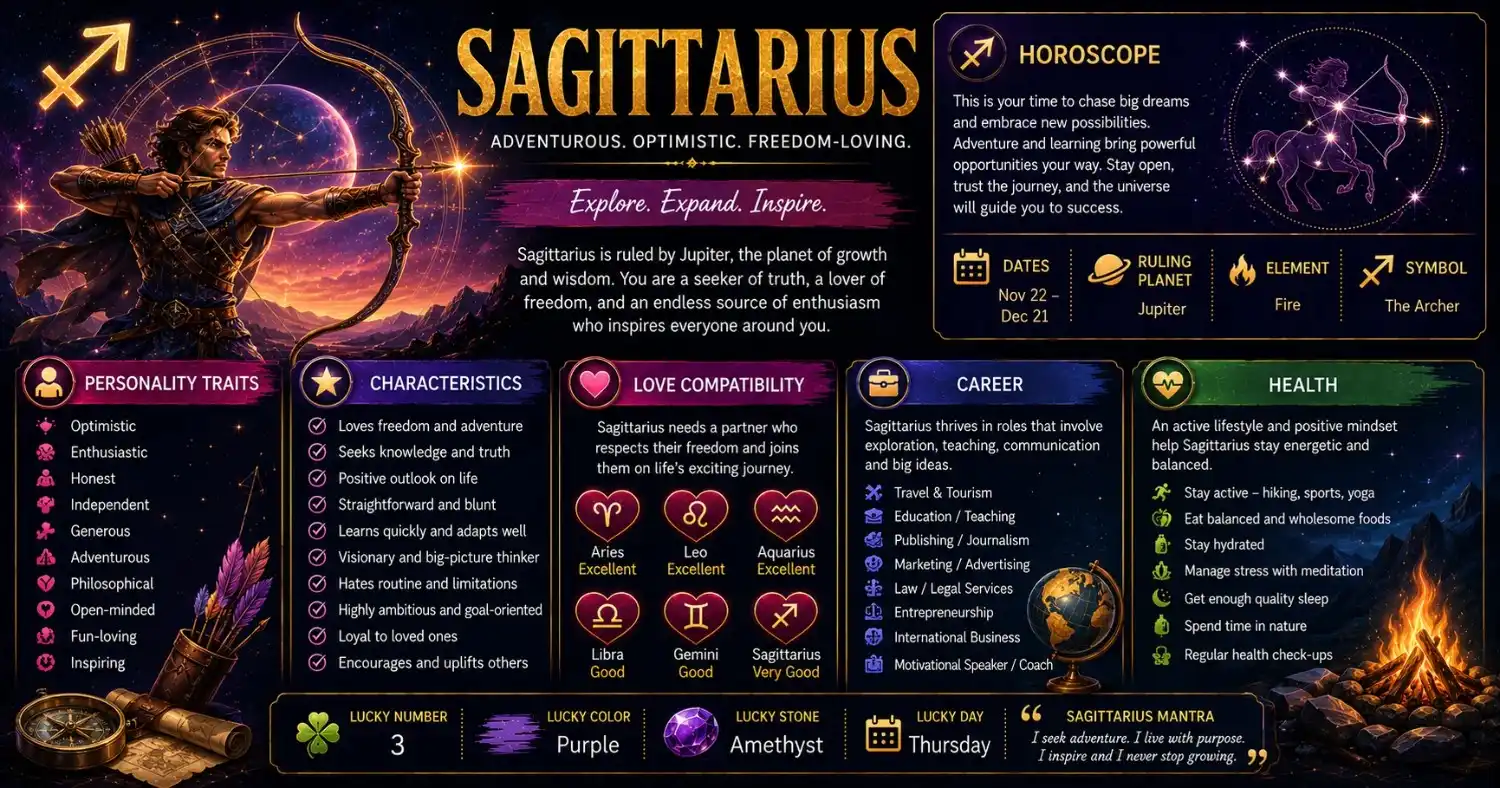
Sagittarius is the zodiac’s traveler. Cultures from Mesopotamia to India to China looked at the same crowded stretch of sky, where the Milky Way is thickest, and saw someone aiming a bow. Each gave that figure a name in its own tongue. The word changes from place to place, but the picture stays the same: a hunter or archer, half human and often half horse, with the bow drawn and pointed at something far away.
This guide covers the major translations of Sagittarius, how each is pronounced, the cultural meaning behind each name, and the astrology that sits under all of them. Use the tables as a reference and come back to them when you need a spelling, a script, or a pronunciation.
Quick Answer: What Does Sagittarius Mean in Other Languages?
Sagittarius is Latin for “archer.” It comes from sagitta, the Latin word for “arrow,” and literally means “the one of the arrow” or “the arrow-shooter.” Most languages fall into four naming patterns:
- They keep the Latin word. Spanish Sagitario, Italian Sagittario, Portuguese Sagitário, French Sagittaire, Romanian Săgetător, Indonesian Sagitarius.
- They translate “archer” or “shooter” into their own word. German Schütze, Dutch Boogschutter, Russian Strelets, Polish Strzelec, Hungarian Nyilas, Finnish Jousimies.
- They name the bow instead of the archer. Sanskrit and Hindi Dhanu, Arabic al-Qaws, Hebrew Keshet, Turkish Yay, Persian Kamān.
- They build a compound ending in “constellation” or “sign.” Chinese Shèshǒu zuò, Japanese Iteza, Korean Gungsu-jari, Vietnamese Nhân Mã (“man-horse”).
The Western dates run from about November 22 to December 21. The Vedic (sidereal) dates run from roughly December 16 to January 14. The ruling planet is Jupiter in every major tradition. The element is Fire in Western astrology, and the quality is Mutable.
The sections below go through each of these points.
The Root Meaning of Sagittarius: Where the Word Comes From
The English word Sagittarius is Latin. It is the form of sagittarius, meaning “archer” or “bowman,” and it was built from sagitta, “arrow.” Where sagitta itself came from is not settled. Etymologists have proposed several ideas without agreeing on one, so it is safest to say the word’s deeper origin is uncertain.
The Latin words behind English are easy to spot once you know them:
- Sagittal describes the plane that divides the body into left and right, imagined as an arrow passing front to back through the skull.
- Sagittate is a botanical term for leaves shaped like an arrowhead.
- Sagitta is also the name of a small, separate constellation, the Arrow, which sits in the northern sky.
- Sagittarii is the Latin genitive form used in star names. Astronomers write “Alpha Sagittarii” or “Epsilon Sagittarii” to mean “of the Archer.”
Greek supplies a second layer. The Greek name for the constellation is Τοξότης (Toxótēs), “the archer.” It comes from τόξον (tóxon), meaning “bow.” A curious English word lives here: toxic. It descends from the Greek phrase toxikon pharmakon, “poison for arrows.” A word meaning “poison” began as a word meaning “bow-related.” Every time someone says “toxic,” they are unknowingly using the vocabulary of Sagittarius.
English archer comes through Old French from Latin arcarius, built on arcus, “bow.” The same root gives us arc, arch, and arcade, all words that describe a curve.
That curve is the key to how the sign travels between languages. In many tongues the word for “bow” is the same as the word for “rainbow” or “arc”:
- Hebrew קשת (keshet) means both “bow” and “rainbow.”
- Arabic قوس (qaws) means “bow” and “arc,” and “rainbow” is qaws quzah.
- Sanskrit धनुस् (dhanus) means “bow,” and “rainbow” is indradhanus, Indra’s bow. Hindi indradhanush keeps it.
- Latin arcus gave French arc-en-ciel, “arc in the sky.”
So when you say “Sagittarius” in Hebrew, Arabic, or Sanskrit, you are often saying “the Bow,” and the rainbow is a close relative of the word.
Why an Archer? The Origin Story Behind the Symbol
The archer is one of the oldest figures in the sky. The stars we call Sagittarius were being drawn as a bow-wielding hybrid figure thousands of years ago.
Mesopotamia drew the first archer
Babylonian astronomers recorded a constellation named Pabilsaĝ (written MUL.PA.BIL.SAG in cuneiform). The name is usually understood as something like “elder” or “ancestor.” The figure was drawn as a hybrid archer, often described as a centaur-like creature with a bow and sometimes with wings and a scorpion’s tail. The god Pabilsaĝ was linked with Ninurta, a warrior deity of hunting and storms.
This matters for the design of the sign. The idea of a human-animal hybrid drawing a bow was in place long before Greek myth arrived.
Greece told two stories
The Greeks inherited the constellation and attached myths to it. The best-known story links the archer to Chiron, the wise centaur. Unlike the other centaurs, who were wild and violent, Chiron was a healer and teacher. Legend says he tutored Achilles, Asclepius, and Jason. The hero Heracles accidentally wounded him with a poisoned arrow. Chiron was immortal and could not die, so the wound became endless agony. In the story he gave up his immortality to free Prometheus, and Zeus placed him among the stars.
Note the detail that suits the sign: the teacher, philosopher, and healer is the same figure as the archer. Sagittarius is the zodiac’s professor as much as its hunter.
A second Greek tradition identifies the archer as Crotus, a satyr and the son of the god Pan. Crotus lived with the Muses on Mount Helicon, was said to have invented archery and hunting on horseback, and applauded the Muses’ songs. Zeus set him in the sky to honor the applause. Sources disagree on which story is “correct,” and both persisted. Many ancient star maps show a centaur drawing a bow toward the Scorpion, whose bright red star Antares glows just to the west.
India saw the bow itself
Vedic tradition named the sign Dhanu (also Dhanus), “the bow.” The bow is central to Indian epic and myth. Rama’s bow, Arjuna’s bow Gandiva, and Shiva’s bow Pinaka are all famous. The ancient Sanskrit science of warfare and archery is called Dhanurveda, “knowledge of the bow.” In Vedic astrology, the sign is ruled by Guru, the planet Jupiter, whose mythic form Brihaspati is the teacher of the gods.
The Indian picture pairs a bow with a teacher. It is the same union the Greeks reached with Chiron, arrived at independently.
China drew a dipper
Traditional Chinese astronomy divided the sky differently. The stars of Sagittarius include a group called the Southern Dipper (南斗, Nándǒu), a six-star asterism that mirrors the famous Northern Dipper. Folk belief held that the Northern Dipper governed death and the Southern Dipper governed life and lifespan. The Chinese tradition reads this part of the sky as a dipper of life, while the Western tradition reads it as a bow.
Persia and the Arabic world kept the bow
Persian tradition used the word for a bow, kamān, and the Arabic-speaking world used al-Qaws, “the Bow.” The names of many stars in the constellation still carry this Arabic root, as you will see in the star section below.
Across these cultures the constellation is a person or a weapon, but always a shooting one. It is also a hybrid, half-wild and half-thoughtful, and that hybrid quality shows up in the personality attributed to the sign.
Sagittarius in Indian Languages: The Vedic Family
India has the richest zodiac vocabulary in the world. Its languages descend from two large families, Indo-Aryan and Dravidian, and both adopted the Sanskrit zodiac system.
The master table for Indian languages
| Language | Native Script | Romanization | Literal Sense |
|---|---|---|---|
| Sanskrit | धनु / धनुस् | Dhanu / Dhanus | Bow |
| Hindi | धनु राशि | Dhanu Rashi | Bow sign |
| Marathi | धनु रास | Dhanu Raas | Bow sign |
| Gujarati | ધન રાશિ | Dhan Rashi | Bow sign (short form) |
| Bengali | ধনু রাশি | Dhanu Rashi | Bow sign |
| Odia | ଧନୁ ରାଶି | Dhanu Rashi | Bow sign |
| Assamese | ধনু ৰাশি | Dhanu Rashi | Bow sign |
| Punjabi | ਧਨੁ | Dhanu | Bow |
| Nepali | धनु राशि | Dhanu Rashi | Bow sign |
| Konkani | धनू | Dhanu | Bow |
| Tamil | தனுசு / தனுசு ராசி | Dhanusu / Dhanusu Rasi | Bow sign |
| Telugu | ధనుస్సు / ధనుస్సు రాశి | Dhanussu / Dhanussu Rasi | Bow sign |
| Kannada | ಧನು ರಾಶಿ | Dhanu Rashi | Bow sign |
| Malayalam | ധനു | Dhanu | Bow, ninth month |
| Sinhala | ධනු | Dhanu | Bow |
| Urdu | برج قوس | Burj-e-Qaus | House of the Bow |
Sanskrit: Dhanu, the bow
Dhanus (धनुस्) is the ordinary Sanskrit word for “bow.” It also serves as a unit of length in older texts and can mean “arc.” The word for the sign is usually shortened to Dhanu.
The Sanskrit word for a zodiac sign, rashi (राशि), literally means “heap” or “accumulated mass.” A rashi is a measured heap of sky, thirty degrees wide. English says “sign,” while Sanskrit says “heap,” which is more literal and arguably more accurate.
Hindi and the northern languages
North Indian speakers say Dhanu Rashi (धनु राशि). Newspapers and horoscope columns use it almost without exception. Marathi, Bengali, Odia, Assamese, and Nepali follow the same pattern with small differences in vowel and spelling.
Gujarati is the interesting exception. Gujarati usually shortens the name to Dhan Rashi (ધન રાશિ). This can confuse learners, because the Hindi word dhan (धन) means “wealth.” In Gujarati, Dhan here is a shortened form of Dhanu, the bow, not a reference to wealth. It is a false friend inside the same sign.
Tamil: Dhanusu
Tamil says தனுசு (Dhanusu) or தனுசு ராசி (Dhanusu Rasi). The Tamil calendar month that corresponds to the sun’s passage through this sign is Margazhi (மார்கழி), which runs from about mid-December to mid-January.
Margazhi is deeply important in Tamil culture. It is the month of dawn devotions, of the Thiruppavai hymns of the poet-saint Andal, and of the Chennai music and dance season. In Tamil Nadu, a woman drawing intricate kolam patterns before sunrise in Margazhi is taking part in the month of Dhanu, whether or not she thinks of it as astrology.
Telugu and Kannada
Telugu writes ధనుస్సు (Dhanussu) for the sign, and the month is called Dhanurmasam (ధనుర్మాసం). Kannada writes ಧನು ರಾಶಿ (Dhanu Rashi). Both keep the Sanskrit closely.
The concept of Dhanurmas matters across South India. It is the period when the sun is in Dhanu, considered spiritually significant, and many households observe special rituals. In parts of North India the same period is called Kharmas, and traditionally is considered less suitable for weddings and new ventures.
Malayalam: Dhanu the month
Malayalam uses ധനു (Dhanu) for both the sign and the ninth month of the Malayalam solar calendar. Like Taurus’s “Edavam,” this is a case where the sign and the calendar month share a name. A Malayali who says “Dhanu” may mean the sign, the month, or both.
Urdu and the Persian-Arabic route
Urdu takes the Perso-Arabic path and says برج قوس (Burj-e-Qaus), “the house of the bow.” So a Hindi speaker in Delhi says Dhanu and an Urdu speaker in Lahore says Qaus. The two languages are close cousins, but their astrological words come from opposite directions.
The nakshatras inside Dhanu
Vedic astrology divides each sign into lunar mansions. Sagittarius contains:
- Mula (all four quarters), ruled by Ketu. The name means “root.”
- Purva Ashadha (all four quarters), ruled by Venus. The name means “the earlier undefeated.”
- Uttara Ashadha (first quarter), ruled by the Sun. The name means “the later undefeated.”
Mula is a nakshatra about getting to the root of a matter, which suits the philosophical searching of the sign. Purva Ashadha carries the theme of invincibility and persuasion, while Uttara Ashadha carries the theme of final, lasting victory. Together they give Dhanu its combination of investigation, optimism, and determination.
Sagittarius in European Languages
Europe divides into clear groups. The Romance languages keep the Latin. The Germanic and Slavic languages translate the meaning into their own word for “archer” or “shooter.” A few outliers reach for the bow instead.
Romance languages
| Language | Name | Pronunciation |
|---|---|---|
| Latin | Sagittarius | sah-git-TAH-ree-oos |
| Italian | Sagittario | sah-jee-TAH-ryoh |
| Spanish | Sagitario | sah-hee-TAH-ryoh |
| Portuguese | Sagitário | sah-zhee-TAH-ryoo |
| French | Sagittaire | sah-zhee-TAIR |
| Romanian | Săgetător | suh-jeh-tuh-TOR |
| Catalan | Sagitari | sah-zhee-TAH-ree |
| Galician | Sagitario | sah-gee-TAH-ryo |
Spanish drops the double “t” and writes Sagitario. Learners who copy the English or Latin spelling into Spanish text are making a small but common error.
Romanian Săgetător is the most transparent of the group. It comes from săgeată, “arrow,” which descends directly from Latin sagitta. Romanian is in effect the sign’s name translated into a native word for “arrow-shooter” that still preserves the Latin root.
Germanic languages
| Language | Name | Literal Meaning |
|---|---|---|
| German | Schütze | Shooter, marksman |
| Dutch | Boogschutter | Bow-shooter, archer |
| Danish | Skytten | The Shooter |
| Norwegian | Skytten | The Shooter |
| Swedish | Skytten | The Shooter |
| Icelandic | Bogmaðurinn | The Bowman |
| Afrikaans | Boogskutter | Bow-shooter |
German Schütze is a rich word. It means “shooter,” “marksman,” or “archer,” and it can also refer to a private soldier of infantry or a goalkeeper’s counterpart, the scorer in a game. In Germany, a Schützenfest is a traditional marksmen’s festival held in many towns. The zodiac sign uses the same word, so the sign is a sharpshooter in everyday German.
Scandinavian languages use the same idea, “the Shooter,” and add the definite ending. Icelandic goes a different way with Bogmaðurinn, literally “the bow-man.”
Slavic languages
| Language | Name | Romanization |
|---|---|---|
| Russian | Стрелец | Strelets |
| Ukrainian | Стрілець | Striletš |
| Belarusian | Стралец | Stralets |
| Bulgarian | Стрелец | Strelets |
| Polish | Strzelec | Strzelec |
| Czech | Střelec | Střelec |
| Slovak | Strelec | Strelec |
| Serbian | Стрелац / Strelac | Strelac |
| Croatian | Strijelac | Strijelac |
| Slovenian | Strelec | Strelec |
| Macedonian | Стрелец | Strelets |
Every Slavic language chose the word for “shooter” or “archer,” built on the Slavic root for “arrow” (strěla, in modern Russian strela). Russian Стрелец (Strelets) has an extra historical echo. The streltsy were the famous musketeer regiments of the Russian tsars, and the word means literally “shooters.” So the zodiac sign and the historic soldiers share a root.
Baltic, Finno-Ugric, and other European branches
| Language | Name | Notes |
|---|---|---|
| Lithuanian | Šaulys | Shooter, marksman |
| Latvian | Strēlnieks | Shooter, rifleman |
| Estonian | Ambur | Archer |
| Finnish | Jousimies | Bowman |
| Hungarian | Nyilas | Archer, from nyíl, arrow |
| Greek | Τοξότης (Toxótēs) | The archer, original Greek name |
| Albanian | Shigjetari | Archer, from shigjetë, arrow |
| Welsh | Y Saethydd | The archer |
| Armenian | Աղեղնավոր (Aghegnavor) | Bow-bearer, archer |
| Georgian | მშვილდოსანი (Mshvildosani) | Archer, from mshvild, bow |
| Turkish | Yay | Bow |
Hungarian and Finnish do not belong to the Indo-European family, yet both chose the archer. Finnish Jousimies is a straightforward compound of jousi (bow) and mies (man). Hungarian Nyilas takes its name from nyíl, “arrow.”
Turkish is a fine example of a bow-first language. Yay means “bow” and also “spring” in the mechanical sense, since a coiled spring and a drawn bow share the same idea of stored tension. The full phrase is Yay Burcu, “sign of the bow.” It mixes a native Turkic word with the Arabic-origin burç.
Greek is the original. Greek Τοξότης (Toxótēs) is the ancestor of the Western concept, and modern Greek horoscope columns still use it.
Sagittarius in Middle Eastern and Semitic Languages
The Middle East holds the oldest continuous astrological tradition. Babylonian methods traveled to Greece, then to India, then back through Arabic scholarship into medieval Europe.
| Language | Native Script | Romanization | Meaning |
|---|---|---|---|
| Arabic | برج القوس | Burj al-Qaws | House of the Bow |
| Hebrew | מזל קשת | Mazal Keshet | Constellation of the Bow |
| Persian (Farsi) | قوس / کمان | Qows / Kamān | Bow |
| Turkish | Yay Burcu | Yay Burju | Bow sign |
| Pashto | قوس | Qaws | Bow |
| Azerbaijani | Oxatan | Okhatan | Archer |
| Aramaic | קַשְׁתָּא | Qashta | Bow |
Arabic: Al-Qaws
Arabic calls the constellation القوس (al-Qaws), “the Bow,” and the sign برج القوس (Burj al-Qaws). The word qaws is also used for “arc” and appears in qaws quzah, “rainbow.”
Many of the constellation’s stars still carry Arabic names. The bright stars Kaus Australis, Kaus Media, and Kaus Borealis all take their first word from qaws, and the Latin words australis, media, and borealis mean “southern,” “middle,” and “northern.” So the bow’s three key stars are literally the “southern bow,” “middle bow,” and “northern bow.”
Hebrew: Mazal Keshet
Hebrew says מזל קשת (Mazal Keshet). Mazal means constellation, luck, or destiny, and gives us the greeting “mazel tov,” literally “good constellation.” Keshet (קשת) is the biblical word for “bow” and also for “rainbow.” In Genesis, the covenant sign after the flood is the keshet in the clouds.
Jewish tradition traditionally pairs Sagittarius with the Hebrew month of Kislev, the month of Hanukkah, and some sources link the sign to the tribe of Benjamin, a tribe described in the Bible as skilled with the bow.
Persian: two words, two layers
Persian uses قوس (Qows), the Arabic borrowing, in formal astrological contexts. It also has the native word کمان (Kamān), “bow.” The same root produced kamancheh, the bowed string instrument of Persian music, whose name literally means “little bow.”
In the Afghan solar calendar, Qaws is the ninth month, running from roughly late November to late December, so Afghan calendar users share the same sign-and-month connection found in Kerala and Thailand.
Turkish: Yay
As covered above, Turkish uses Yay Burcu. Turkish horoscope columns treat the name as a standard term.
Sagittarius in East Asian Languages
East Asia imported the Western zodiac relatively late, mostly through the nineteenth and twentieth centuries. The names read like careful, descriptive translations rather than inherited words.
| Language | Native Script | Romanization | Literal Translation |
|---|---|---|---|
| Chinese (Mandarin) | 射手座 | Shèshǒu zuò | Archer constellation |
| Chinese (astronomy) | 人马座 | Rénmǎ zuò | Man-horse constellation |
| Chinese (Cantonese) | 射手座 | Se6 sau2 zo6 | Archer constellation |
| Japanese | 射手座 / いて座 | Iteza | Archer constellation |
| Korean | 궁수자리 | Gungsu-jari | Archer seat, archer place |
| Vietnamese | Nhân Mã | Nhân Mã | Man-horse |
| Mongolian | Харваач | Kharvaach | Archer |
Chinese: two names for two purposes
Mandarin uses 射手座 (Shèshǒu zuò). Break it down: 射 (shè) means “to shoot,” 手 (shǒu) means “hand” or “person who does something,” and 座 (zuò) means “seat” or “constellation.” Together: “the shooter constellation.”
Chinese also has a second name, 人马座 (Rénmǎ zuò), “man-horse constellation.” This is the standard astronomy term for the constellation, while 射手座 is the everyday horoscope term. A Chinese speaker reading a science article and a horoscope column will see two different names for the same stars.
Traditional Chinese astronomy has yet another view. The region includes the Southern Dipper (南斗, Nándǒu), which belongs to the mansion 斗 (Dǒu) in the Azure Dragon of the East. Folk belief tied the Southern Dipper to lifespan and blessing.
Japanese: Iteza
Japanese writes 射手座 and reads it いて座 (Iteza). The first two characters are the same as in Chinese, but the Japanese reading is ite. Magazines often print the hiragana form いて座 for readability, especially on covers and in horoscope lists.
Korean: Gungsu-jari
Korean says 궁수자리 (Gungsu-jari). 궁수 (gungsu) is Sino-Korean for “bow-hand,” meaning archer, and 자리 (jari) is the native Korean word for “seat” or “place.” Korean also uses 사수자리 (Sasu-jari) in some horoscope contexts, built on a different Sino-Korean word for “shooter.” Both are understood.
Vietnamese: Nhân Mã
Vietnamese says Nhân Mã, the Sino-Vietnamese reading of 人馬, “man-horse.” It is one of the most vivid sign names anywhere, because it names the centaur image directly instead of the archer’s job.
Sagittarius in Southeast Asian Languages
Southeast Asia received much of its astrology from India, so the names come from Sanskrit filtered through local phonology, although the more modern Western sign names were also imported.
| Language | Native Script | Romanization | Source |
|---|---|---|---|
| Thai | ราศีธนู | Rasi Thanu | Sanskrit Dhanu |
| Khmer | ធនូ | Thanu | Sanskrit Dhanu |
| Lao | ລາສີທະນູ | Lasi Thanu | Sanskrit Dhanu |
| Burmese | ဓနုရာသီ | Danu Yathi | Sanskrit Dhanu |
| Indonesian | Sagitarius | Sagitarius | Latin via Dutch |
| Malay | Sagittarius / Pemanah | Pemanah | Latin / native “archer” |
| Filipino (Tagalog) | Sagittarius / Sagitaryo | Sagitaryo | Latin via Spanish |
Thai and the calendar connection
Thai says ราศีธนู (Rasi Thanu). The Thai word for December is ธันวาคม (Thanwakhom), which is built from the same Dhanu root plus the ending -akhom. Thai month names ending in -akhom and -ayon were coined from zodiac signs, so the calendar and the zodiac share one vocabulary.
Cambodian follows a similar pattern. The Khmer word for December is ធ្នូ (Thnou), a direct descendant of the same Sanskrit word. So in Thailand, Cambodia, Laos, and Kerala, Sagittarius is not just a sign. It is also a month word on the wall calendar.
Indonesian and Malay
Indonesia spells it Sagitarius, with a single “t,” following Dutch and local spelling habits. Malay speakers sometimes use Pemanah (“archer,” from panah, “arrow”), though the Latin form is dominant in horoscope publishing.
Filipino
Filipino uses Sagittarius in print and Sagitaryo in casual writing, following the Spanish colonial route.
Sagittarius in African Languages
African languages show the most variation, because astrological vocabulary arrived through different colonial and trade routes in different regions. Many languages have no single fixed, standardized term, and columnists often translate descriptively.
| Language | Name | Literal Meaning |
|---|---|---|
| Afrikaans | Boogskutter | Bow-shooter |
| Swahili | Mpiga Mishale | Arrow-shooter |
| Yoruba | Tafàtafà | Archer |
| Hausa | Maharbi | Hunter, archer |
| Amharic | ቀስተኛ (Qesteña) | Archer |
Treat this table with care. Afrikaans has an established term thanks to its close relation to Dutch. The others are descriptive renderings based on the ordinary word for “archer” or “one who shoots arrows,” and published horoscopes may use the Latin name or an English loanword instead. If you need a term for a publication, check regional usage with a native speaker rather than assuming.
Sagittarius in Symbols, Sign Languages, and Constructed Languages
The astrological glyph
Sagittarius uses the symbol ♐, encoded in Unicode as U+2650. It is drawn as an arrow pointing to the upper right, with a short crossbar near the tail. It is one of the simplest and most legible zodiac glyphs.
Read it literally: the arrow is the arrow, and the crossbar is the point where the bow is held or the arrow is nocked. Some astrologers also read the diagonal arrow as an aspiration, a straight line aimed upward and outward. It is the only zodiac glyph that is unmistakably a pointing direction.
Esperanto and constructed languages
Esperanto says Sagitario. Interlingua says Sagittario. Both follow the Latin root with small adjustments.
Sign languages
There is no single universal sign for Sagittarius. Deaf communities in different countries use different conventions, often based on a gesture of drawing a bow, combined with fingerspelling or an initialized handshape for clarity. Regional variation is significant, so it is best to ask local Deaf communities rather than assume a standard sign.
How to Say “I Am a Sagittarius” in 25 Languages
Here is the practical phrase, ready to use.
| Language | Phrase |
|---|---|
| Spanish | Soy Sagitario |
| French | Je suis Sagittaire |
| German | Ich bin Schütze |
| Italian | Sono del Sagittario |
| Portuguese | Sou de Sagitário |
| Dutch | Ik ben Boogschutter |
| Russian | Я Стрелец (Ya Strelets) |
| Polish | Jestem Strzelcem |
| Greek | Είμαι Τοξότης (Eímai Toxótēs) |
| Turkish | Ben Yay burcuyum |
| Arabic | أنا برج القوس (Ana burj al-qaws) |
| Hebrew | אני מזל קשת (Ani mazal keshet) |
| Persian | من برج قوس هستم (Man burj-e qows hastam) |
| Hindi | मेरी राशि धनु है (Meri rashi Dhanu hai) |
| Bengali | আমার রাশি ধনু (Amar rashi Dhanu) |
| Tamil | என் ராசி தனுசு (En rasi Dhanusu) |
| Telugu | నా రాశి ధనుస్సు (Naa rasi Dhanussu) |
| Kannada | ನನ್ನ ರಾಶಿ ಧನು (Nanna rashi Dhanu) |
| Malayalam | എന്റെ രാശി ധനു (Ente rashi Dhanu) |
| Urdu | میرا برج قوس ہے (Mera burj Qaus hai) |
| Chinese | 我是射手座 (Wǒ shì shèshǒu zuò) |
| Japanese | 私は射手座です (Watashi wa iteza desu) |
| Korean | 저는 궁수자리예요 (Jeoneun gungsu-jari-yeyo) |
| Thai | ฉันเป็นราศีธนู (Chan pen rasi thanu) |
| Vietnamese | Tôi là cung Nhân Mã |
The Date Problem: Why Sagittarius Starts on Different Days
This confuses more people than every translation question combined.
Western (tropical) astrology
Western astrology uses the tropical zodiac, anchored to the seasons. The zodiac begins at the March equinox regardless of which stars happen to sit behind the sun. Sagittarius runs from about November 22 to December 21 each year.
The exact day shifts by a day depending on the year and your time zone. If you were born on November 22 or December 21, check your birth time and place. Those are cusp dates.
Vedic (sidereal) astrology
Indian astrology uses the sidereal zodiac, anchored to the actual stars. Because of the precession of the equinoxes, the two systems have drifted apart by about 24 degrees over two thousand years.
The result is that Vedic Sagittarius, or Dhanu, runs from roughly December 16 to January 14. The Sun’s entry into Dhanu is called Dhanu Sankranti, and its exit is Makara Sankranti, which falls around January 14 and is celebrated as Pongal, Lohri, Uttarayan, and Makar Sankranti across India.
So someone born on December 25 is a Capricorn in Western astrology and a Dhanu in Vedic astrology. Neither system is wrong. They measure different things.
Why both systems still work
Tropical astrology measures the Sun’s relationship to the seasons, and it describes psychological patterns tied to the time of year. Sidereal astrology measures the Sun’s position against the fixed stars, and it anchors a predictive system built on planetary periods. If your Western and Vedic signs disagree, you have two valid maps of the same territory.
The constellation boundaries
Modern astronomy adds a third layer. The International Astronomical Union fixed constellation boundaries in 1930. Under those boundaries, the Sun passes through the actual Sagittarius constellation from about December 18 to January 19. Before that, from about November 30 to December 17, it passes through Ophiuchus, the Serpent Bearer. This is where the periodic “thirteenth sign” story comes from.
It is an astronomy fact, not an astrology change. Astrologers have used twelve equal thirty-degree divisions for over two thousand years, and the real constellations have never matched them exactly.
One more interesting fact belongs here. The December solstice today happens while the Sun is in the constellation Sagittarius, in the direction of the center of our galaxy. Astrologically, the solstice marks the start of Capricorn in the tropical zodiac, but the Sun physically sits in front of the archer’s stars.
What Sagittarius Actually Means: The Astrology Underneath the Words
Names change. The astrological content is remarkably consistent. Here is the substance most traditions agree on.
The core signature
- Element: Fire
- Modality: Mutable
- Ruling planet: Jupiter (Guru or Brihaspati in Vedic astrology)
- Symbol: The Archer, often a centaur
- Polarity: Active, yang, masculine
- House correspondence: Ninth house
- Opposite sign: Gemini
- Detriment: Mercury
- Body rulership: Hips, thighs, liver, sciatic nerve
- Tarot correspondence: Temperance
- Colors: Purple, royal blue, deep violet
- Stones: Turquoise, topaz, amethyst
- Season: Late autumn in the northern hemisphere, moving toward winter
Mutable Fire, explained properly
Fire signs supply energy, enthusiasm, and drive. Mutable signs adapt. They sit at the end of a season, when things are changing, and they carry the job of transition.
Combine them. Sagittarius is fire that adapts, energy that keeps moving, and enthusiasm that adjusts itself to a new situation. Where Aries ignites and Leo sustains, Sagittarius spreads. The archer does not hold a position. The archer looks to the horizon, releases the arrow, and follows it.
That single combination generates most Sagittarius traits in horoscope columns: restlessness, optimism, love of freedom, appetite for exploration, and impatience with anything that feels small or closed.
Jupiter and the ninth house
Jupiter is the planet of expansion, meaning, generosity, teaching, law, philosophy, and faith. The ninth house is the house of long journeys, higher education, religion, publishing, and foreign cultures. The pairing is deliberate. The sign has the same subject as its planet and its house: how a person makes sense of the wider world.
Vedic astrology names the planet Guru, which is also the Sanskrit word for “teacher.” So the ruler of Sagittarius is, in Indian languages, the teacher of the zodiac. In the Greek tradition, the same role is played by Chiron, the teacher-centaur. Two cultures independently arrived at a sign that shoots arrows and teaches.
Core strengths
Sagittarius brings optimism. Where other signs see risk, this sign sees an opening. That outlook can be genuinely useful in a crisis, because it keeps the team moving.
Sagittarius offers honesty. The sign tends to say what it means, and it values truth over comfort. People often consult Sagittarius friends when they want a straight answer.
Sagittarius has curiosity about the whole world. The sign reads widely, travels, learns languages, and connects ideas from different fields. It suits teachers, publishers, guides, lawyers, philosophers, and anyone working between cultures.
Sagittarius has generosity and humor. Jupiter’s influence tends to give a large, warm, sometimes exaggerating personality that fills a room.
Core challenges
Sagittarius can be blunt to the point of carelessness. The arrow, once loosed, cannot be recalled, and honest words sometimes land harder than intended.
Sagittarius struggles with commitment and detail. The sign’s attention is fixed on the far horizon, so the small print and the daily routine can slip. Mutable fire does not enjoy being pinned down.
Sagittarius tends toward overreach. Jupiter expands whatever it touches, including promises, budgets, and opinions. Learning to say “I don’t know” or “I can’t take that on” is often a lifelong exercise.
Sagittarius can preach. The teacher archetype, when it is out of balance, becomes the lecturer who cannot stop advising.
Does the meaning change by culture?
The honest answer is that the tone shifts, but the substance does not.
Western pop astrology emphasizes personality. It reads Sagittarius as adventurous, outspoken, and freedom-loving.
Vedic astrology emphasizes life outcomes. It reads Dhanu ascendants and Dhanu Moons through planetary periods, looking at fortune, learning, mentors, pilgrimage, and dharma.
Chinese-language horoscope media tend to stress independence, optimism, and a love of travel and learning, echoing the archer image.
Arabic-language traditional astrology, drawing on medieval methods, emphasizes Jupiter’s benefic nature and the sign’s association with journeys, religion, and law.
Different emphasis, same sign. The archer does not change when the word for the archer changes.
Compatibility in brief
Traditional astrology pairs Sagittarius most naturally with the other fire signs, Aries and Leo, which share its energy and pace, and with the air signs Libra and Aquarius, which feed the fire with ideas and movement. Gemini, the opposite sign, is a classic attraction and a classic challenge: both are curious and talkative, but Gemini collects facts while Sagittarius seeks meaning. Compatibility is a matter of whole charts, not sun signs alone, so treat these pairings as tendencies.
Star Names Inside Sagittarius Across Languages
Sagittarius contains some of the most significant regions of the sky. It sits in the direction of the center of the Milky Way, so the constellation is crowded with star clouds, nebulae, and clusters.
The Teapot and the galactic center
A well-known asterism inside the constellation is the Teapot, a group of eight stars that looks like a teapot with a spout, handle, and lid. From the Northern Hemisphere in summer, the Milky Way appears to rise like steam from the spout. Astronomers have located the center of our galaxy just to the side of the Teapot. It hosts Sagittarius A*, a supermassive black hole with a mass of around four million suns, about 26,000 light years away. The Event Horizon Telescope collaboration released its first image of that black hole in 2022.
The constellation also contains famous nebulae, including the Lagoon Nebula (M8), the Trifid Nebula (M20), and the Omega Nebula (M17).
Named stars
| Star | Origin | Meaning |
|---|---|---|
| Kaus Australis | Arabic qaws + Latin australis | Southern part of the bow |
| Kaus Media | Arabic qaws + Latin media | Middle of the bow |
| Kaus Borealis | Arabic qaws + Latin borealis | Northern part of the bow |
| Nunki | Traditionally traced to Babylonian | Associated with an ancient star name tied to Eridu |
| Ascella | Latin | Armpit |
| Alnasl | Arabic al-nasl | The arrowhead |
| Rukbat | Arabic rukbat al-rāmī | Knee of the archer |
The brightest star in the constellation is Kaus Australis. Alnasl marks the tip of the spout in the Teapot, and it also happens to be the “arrowhead” in the Arabic name. This is a good example of the way Arabic star names keep the archer picture alive in modern astronomy.
Cultural names for the region
| Culture | Name | Meaning |
|---|---|---|
| Babylonian | Pabilsaĝ | Elder, ancestor |
| Greek | Τοξότης (Toxótēs) | The archer |
| Sanskrit | धनु (Dhanu) | The bow |
| Arabic | القوس (al-Qaws) | The bow |
| Chinese (astronomy) | 人马座 (Rénmǎ) | Man-horse |
| Chinese (traditional) | 南斗 (Nándǒu) | The Southern Dipper |
| Hebrew | קשת (Keshet) | The bow, the rainbow |
Different cultures saw different figures, such as a hybrid archer, a bow, a dipper, or a teapot. The bright crowded band of the Milky Way was always the main event.
Common Mistakes and Mistranslations to Avoid
Mistake 1: Confusing Sagittarius with Sagitta
Sagitta is a separate, small constellation called “the Arrow.” Sagittarius is the Archer. They are different sets of stars. Only the Archer is a zodiac sign.
Mistake 2: Assuming Dhanu and Sagittarius cover the same dates
They do not. The sidereal and tropical zodiacs differ by almost four weeks. Always ask which system someone means.
Mistake 3: Mixing up Dhanu with Dhan
Hindi dhan (धन) means “wealth.” Dhanu (धनु) means “bow.” In Gujarati, the sign is shortened to Dhan, which is a shortened form of the bow’s name and not a reference to money. Keep the two apart when translating.
Mistake 4: Confusing the Chinese sign with the Chinese zodiac animals
射手座 is the Western sign, based on your birth month. The Chinese zodiac animals (Rat, Ox, Tiger, and so on) are based on your birth year in a twelve-year cycle. There is no “archer” in the twelve animals.
Mistake 5: Treating “Schütze” or “Strelets” as an error
These are correct. German and Russian name the sign after the shooter, and both words also have military or sporting meanings. The double meaning is not a mistake.
Mistake 6: Assuming every language has a native word
Many languages simply borrow “Sagittarius” or translate descriptively. If you need a term for publication, check regional usage rather than inventing a plausible-sounding translation.
Mistake 7: Machine-translating astrological terms
Translation engines can render Sagittarius inconsistently, sometimes leaving it in Latin and sometimes choosing a generic word for “archer” that readers will not recognize as the zodiac sign. Always verify with a native speaker for published work.
Frequently Asked Questions
What does Sagittarius mean in English?
Sagittarius means “the Archer.” English borrowed the word directly from Latin, where sagittarius means “archer” or “bowman,” built on sagitta, “arrow.”
What is Sagittarius called in Hindi?
Hindi calls Sagittarius धनु राशि (Dhanu Rashi), which means “bow sign.” The word comes from Sanskrit dhanus, “bow.”
What is Sagittarius in Tamil?
Tamil calls Sagittarius தனுசு (Dhanusu) or தனுசு ராசி (Dhanusu Rasi). The corresponding Tamil month is Margazhi, from mid-December to mid-January.
What is Sagittarius called in Malayalam?
Malayalam calls Sagittarius ധനു (Dhanu). The same word names the ninth month of the Malayalam calendar.
What is Sagittarius in Arabic?
Arabic calls Sagittarius برج القوس (Burj al-Qaws), meaning “house of the bow.” The word qaws also means “arc” and appears in the Arabic word for rainbow.
What is Sagittarius in Hebrew?
Hebrew calls it מזל קשת (Mazal Keshet). Keshet means both “bow” and “rainbow.”
What is Sagittarius in Chinese?
Chinese calls the zodiac sign 射手座 (Shèshǒu zuò), “archer constellation.” Astronomers use 人马座 (Rénmǎ zuò), “man-horse constellation,” for the constellation itself.
What is Sagittarius in Japanese?
Japanese calls Sagittarius 射手座, read いて座 (Iteza). The characters mean “archer constellation.”
What is Sagittarius in Korean?
Korean calls Sagittarius 궁수자리 (Gungsu-jari). Gungsu means archer, and jari means seat or place. 사수자리 (Sasu-jari) is also used.
What is Sagittarius in Vietnamese?
Vietnamese calls it Nhân Mã, meaning “man-horse.” It refers directly to the centaur image.
What is Sagittarius in German?
German calls it Schütze, meaning “shooter” or “marksman.” The same word appears in the German festival tradition of Schützenfeste.
What is Sagittarius in Russian?
Russian calls it Стрелец (Strelets), from the Slavic root for “arrow.” The word is also linked to the historic streltsy regiments.
What is Sagittarius in Spanish?
Spanish calls it Sagitario, with a single “t.”
Does Sagittarius mean the same thing in every language?
Yes, in essence. Every major language names the sign after an archer, a shooter, or a bow. The astrological meaning also stays consistent: mutable fire, ruled by Jupiter, associated with optimism, freedom, learning, travel, and truth-telling.
Why do Vedic and Western Sagittarius dates differ?
Western astrology uses the tropical zodiac, tied to the equinoxes, giving dates of about November 22 to December 21. Vedic astrology uses the sidereal zodiac, tied to the fixed stars, giving dates of roughly December 16 to January 14. Precession of the equinoxes caused the gap.
What is the Sagittarius symbol called?
The symbol is ♐, an arrow pointing upward and to the right, with a crossbar near its tail. Unicode encodes it as U+2650.
Which planet rules Sagittarius?
Jupiter rules Sagittarius in Western astrology. Guru, the Vedic name for Jupiter, rules Dhanu in Indian astrology. Hellenistic, Arabic, and medieval European traditions all agree.
What does Dhanu mean in Sanskrit?
Dhanus means “bow.” It can also mean “arc,” and it appears in indradhanus, “Indra’s bow,” the rainbow.
Is Sagittarius a centaur or an archer?
Both. The Greek tradition often pictures the figure as a centaur, sometimes linked to the wise Chiron. The Sanskrit and Arabic names simply call it “the bow.” The constellation is best understood as a bow-wielding figure, whether human, horse-bodied, or both.
What is at the center of Sagittarius?
The direction of the galactic center lies in Sagittarius. It contains the black hole Sagittarius A*, the radio source at the heart of the Milky Way.
Key Takeaways
Sagittarius survives translation because its image is so direct. A person draws a bow, aims at something far away, and lets go. Every culture that looked at this part of the sky understood that image without needing it explained.
The stars themselves may have helped. The densest part of the Milky Way runs right through the constellation, so it is one of the most striking parts of the night sky. Cultures that shared no astrological ideas still agreed that something important was happening there.
Remember these essentials:
- Sagittarius means “archer” in Latin, and nearly every language follows that idea, either by naming the archer or by naming the bow.
- Four naming patterns exist: Latin borrowing, native translation of “archer” or “shooter,” bow-based names, and constellation compounds.
- India, Southeast Asia, and Sri Lanka use forms of Sanskrit Dhanu, “the bow.”
- Europe splits between Latin forms and native words for “shooter” or “archer.”
- East Asia built descriptive compounds ending in “constellation,” and Vietnamese kept the “man-horse” image.
- The Middle East uses the Semitic root qaws or keshet, both of which also mean “rainbow.”
- Jupiter rules the sign in every major tradition, and the sign’s house is the ninth.
- Western dates run November 22 to December 21. Vedic dates run roughly December 16 to January 14.
Whatever word your language uses, the sign describes the same thing. Optimism aimed at a far horizon. A hunger for meaning and for truth. A teacher’s generosity and an explorer’s restlessness. And a reminder that the arrow only counts once you release it.
This guide covers astrological tradition and comparative linguistics. Astrology is a symbolic and cultural system, not a science. Use it for reflection and self-understanding rather than for medical, financial, or legal decisions. Translations in less widely standardized languages should be verified with a native speaker before publication.