
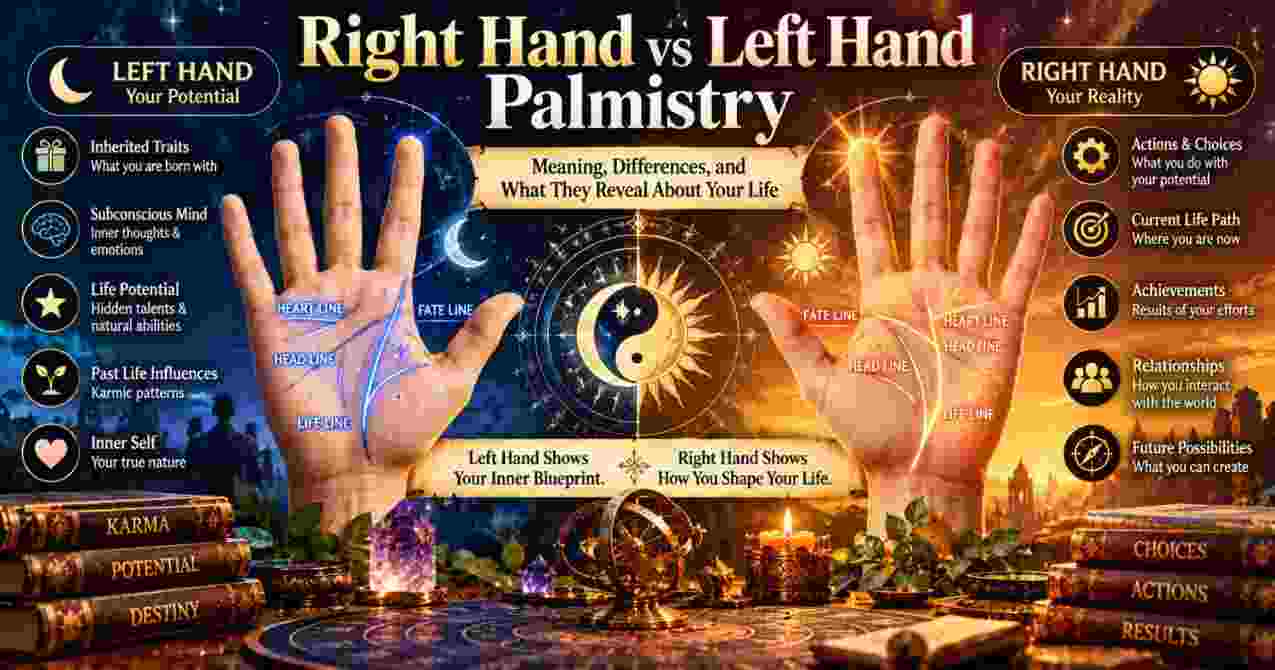
Palmists read both hands. Most traditions treat the dominant hand (the one you write with) as your present life and conscious choices. They treat the non-dominant hand as your inborn nature and untapped potential. Some Indian and Chinese lineages add a gender rule, which this guide explains in full below.
You look down at your palms and see two different maps. The lines curve differently. One hand shows a deep fate line. The other hand shows almost none. So you wonder which hand tells the truth.
Both do. Each hand tells a different part of your story. This guide shows you how palmists separate the two, why the traditions disagree, and how you can compare your own hands with confidence.
I wrote this guide the way I teach a first-time student. I start with the basic rule. Then I add the exceptions. Finally, I show you how to combine everything into one clear reading.
Why Do Palmists Read Two Hands?
Your hands look similar, but they never match perfectly. Lines differ in length, depth, and shape. Mounts rise higher on one side. Fingers bend at different angles. A skilled palmist treats these differences as information.
Palmistry (also called chiromancy or chirology) rests on a simple idea. The hand records who you are and how you live. Two hands record two layers of that story. One layer shows what you carry. The other layer shows what you do with it.
Think of a seed and a tree. The seed holds every possibility. The tree shows which possibilities grew. Palmists use the same logic. They compare the “seed hand” to the “tree hand” and look for the gap between them.
That gap matters more than any single line. A narrow gap means you live close to your nature. A wide gap means life has pushed you far from it. Either result teaches you something useful.
What Palmists Mean by “Hand”
A hand reading covers much more than lines. Palmists study:
- The shape of the palm and fingers
- The skin texture and color
- The three or four major lines
- The raised areas called mounts
- The thumb, including its flexibility
- The fingernails
- The minor lines and special marks
Each feature can differ between your two hands. So a thorough reading compares every feature, not just the lines.
The Core Rule: Dominant Hand vs. Non-Dominant Hand
Most modern palm readers use one rule above all others. They sort your hands by dominance, not by left and right.
Your dominant hand is the hand you use to write, throw, and eat. Your non-dominant hand is the other one. If you write with your right hand, your right hand is dominant. If you write with your left hand, your left hand is dominant.
Here is how the rule works in practice.
| Feature | Dominant Hand | Non-Dominant Hand |
|---|---|---|
| Time focus | Present and near future | Past and deep potential |
| Core meaning | What you have made of your life | What you brought into life |
| Personality layer | Conscious, public self | Instinctive, private self |
| Role in reading | Shows your current path | Shows your starting point |
| Changes over time | Changes often | Changes slowly |
Many palmists summarize it in one line. The non-dominant hand shows what life gave you. The dominant hand shows what you did with it.
Why the Dominant Hand Changes Faster
You use your dominant hand all day. It folds, grips, and flexes thousands of times. Over the years, those movements shape the creases of the palm. Palmists also say your choices, habits, and stress leave marks there. Many practitioners report that lines on the dominant hand shift within months, especially the minor ones.
The non-dominant hand moves less. Its lines usually stay steady for longer. That stability makes it a good baseline.
What This Means for a Right-Handed Person
If you write with your right hand, your right palm shows your current story. It shows your career, relationships, and choices as they stand today. Your left palm shows your inherited temperament and hidden talents.
So a right-handed person reads the right hand first. Then they compare it to the left.
What This Means for a Left-Handed Person
If you write with your left hand, the roles swap. Your left palm becomes the “present” hand. Your right palm becomes the “potential” hand.
Many beginners miss this step. They memorize “left equals past” and apply it to everyone. That shortcut fails for roughly one in ten people. Always ask which hand a person uses to write before you begin.
The Traditional View: Left and Right by Gender
Dominance is not the only system. Several older traditions assign hands by gender. You will meet these rules often, so you should know them.
The Indian Tradition (Hast Samudrik Shastra)
Hast Samudrik Shastra is the classical Indian science of hand reading. Many Indian palmists teach a simple rule. They read the right hand for men and the left hand for women. Many also teach that you should look at both hands together.
Practitioners often explain the rule through symbolism. They link the male side of the body to the right and the female side to the left. Some lineages also say the chosen hand shows the “active” life, while the other shows inherited destiny.
Not every Indian teacher agrees. Some read the dominant hand for everyone. Others read the left hand for karma and the right hand for deeds, regardless of gender. The gender rule is common, but it is not universal.
The Chinese Tradition
Chinese hand reading uses a gender rule too, but the sides differ. Many Chinese sources link the left hand with men and the right hand with women. This pairing is the reverse of the common Indian rule.
Chinese traditions also connect the hand to the five elements: metal, wood, water, fire, and earth. Readers use these elements to describe hand shapes and temperaments. That framework differs from the Western four-element system of earth, air, fire, and water.
The Western Tradition
Western palmistry grew from Greek, medieval, and Victorian sources. Modern Western readers mostly ignore the gender rule. They follow the dominance rule instead. Many also say the left hand shows what you inherited and the right shows what you built, even for left-handed people. Teachers still argue about that last point.
Why the Traditions Disagree
The traditions disagree because they come from different cultures with different symbols. No central authority exists in palmistry. No governing body sets the rules. Each lineage built its own system over centuries.
So you do not need to pick one tradition and reject the rest. You need a method that works consistently. This guide recommends the following approach:
- Read both hands every time.
- Identify the dominant hand first.
- Treat the dominant hand as your present story.
- Treat the other hand as your baseline.
- Note any gender-based tradition if your reader follows one.
This method works under almost every system. It also keeps you from throwing away half the data.
What the Right Hand Reveals
Let me describe the right hand first. I will assume a right-handed person. If you write with your left hand, apply these ideas to your left hand instead.
The Right Hand as the Hand of Action
The right hand shows what you actually do. It records the life you build with your effort. Palmists call it the “hand of actualization” or the “hand of the future.” These names all point to the same idea. The right hand shows potential in motion.
What You Can Read on the Right Hand
Career and ambition. Look at the fate line (the Saturn line) that runs up the center of the palm. A strong fate line on the dominant hand often suggests a clear career direction. A broken or shifting line suggests career changes.
Relationships. Study the heart line and the marriage lines on the edge of the palm. Palmists believe these show how you love now, not how you loved as a child.
Health habits. Check the life line and the mount of Venus at the base of the thumb. A deep, steady curve suggests strong vitality. A thin or chained line suggests stress or fatigue during certain periods.
Decision style. Read the head line. A long, straight line points to practical thinking. A sloping line points to imaginative thinking. Your dominant hand shows how you think today.
Public image. Look at the sun line (the Apollo line) under the ring finger. Palmists link it to recognition, creativity, and how others see you.
Signs the Right Hand Has Grown
A right hand that differs from the left often shows growth. Here are some common patterns palmists notice:
- A longer or deeper life line than the left suggests you built better health habits or recovered from hardship.
- A clear fate line that the left hand lacks suggests you found a purpose.
- A stronger head line suggests training, study, or discipline sharpened your thinking.
- A new sun line suggests creative success or public recognition.
None of these signs guarantees an outcome. They describe a direction. Palmists treat them as tendencies, not verdicts.
What the Left Hand Reveals
Now consider the left hand of a right-handed person. Palmists call it the “hand of potential” or the “hand of the past.” It shows the raw material you received.
The Left Hand as Your Blueprint
Your left hand records temperament, instinct, and natural talent. It shows how you behave when you do not think about it. It also shows gifts you may not use yet.
Many palmists add a spiritual layer. They say the left hand carries karmic patterns or ancestral traits. You can accept that view or treat it as a metaphor. Either way, the practical reading stays the same. The left hand describes your starting point.
What You Can Read on the Left Hand
Natural temperament. The left heart line shows your emotional default. It reveals whether you give love freely or guard it.
Inborn talent. A curved head line that reaches toward the mount of the Moon suggests imagination. If your right hand shows a straighter line, you may have trained that imagination into practical form. Or you may have suppressed it.
Family patterns. Palmists often say the left hand reflects family influence. That includes the traits you copied, resisted, or inherited.
Unused potential. A line that appears on the left but not on the right marks a gift that has not activated. Palmists treat this as an invitation, not a loss.
Early life. Some readers study the first section of the life line on the left hand to understand childhood conditions.
When the Left Hand Feels Like a Hidden Self
Many clients tell me their left palm describes the person they feel like at night. It describes their private self. Their right palm describes the person who goes to work.
That reaction makes sense. The non-dominant hand often matches the inner voice. The dominant hand often matches the daily performance. When the two hands differ sharply, people often feel they live a double life.
Does Brain Hemisphere Theory Explain the Difference?
Some guides link each hand to the opposite side of the brain. The right hand connects to the left hemisphere, which many people associate with logic and detail. The left hand connects to the right hemisphere, which many people associate with intuition and creativity.
This idea sounds neat. It also oversimplifies. Neuroscientists have shown that the brain does connect each hand to the opposite hemisphere for movement. But the popular “logical left brain, creative right brain” split does not hold up well. Both hemispheres work together on almost every task.
So treat the brain idea as a memory aid, not a proof. Palmists use it as a metaphor. It helps them describe the contrast between a practical hand and an intuitive hand. It does not explain why lines form where they do.
Left-Handed, Ambidextrous, and Hand-Switching People
The basic rule works well for most people. A few groups need extra care.
Left-Handed People
If you write with your left hand, your left hand is dominant. Read it as the present hand. Read your right hand as your baseline.
Some traditional teachers disagree. They insist the left hand always shows inheritance, even for left-handers. If you meet a reader with that view, ask them to explain their reasoning. A good reader will tell you why they chose their method.
I suggest a practical test. Compare both hands for a left-handed person. If the left hand looks more developed and more lived-in, it likely plays the dominant role. Then follow the dominance rule.
Ambidextrous People
Some people use both hands equally. For them, ask which hand they use for the most precise tasks. Writing, drawing, and throwing give strong clues. If no clear answer emerges, read both hands as equals. Look for the hand with more detail and more change.
People Who Switched Hands
Some people learned to write with the opposite hand as children. Schools once forced many left-handers to switch. Others switched after an injury.
In these cases, ask two questions. Which hand did you use naturally as a child? Which hand do you use now? The natural hand often shows deeper instincts. The learned hand shows how you adapted. Both stories matter, and the contrast can reveal a lot.
People with Hand Injuries or Amputations
An injury, scar, or amputation changes the reading. A scar can cut across a line and mimic a break. Palmists should note scars and avoid reading them as destiny marks. If a person lacks a hand, the reader uses the remaining hand and focuses on the person’s lived history.
Right Hand vs. Left Hand: A Side-by-Side Comparison
Use this table as a quick reference. It assumes a right-handed person. Left-handers should swap the columns.
| Category | Right Hand (Dominant) | Left Hand (Non-Dominant) |
|---|---|---|
| Time frame | Present and future | Past and origin |
| Theme | What you have built | What you inherited |
| Mind | Conscious thinking | Instinctive thinking |
| Emotion | Expressed feelings | Private feelings |
| Career | Actual path | Natural aptitude |
| Relationships | Current patterns | Early patterns |
| Health | Present vitality | Constitutional strength |
| Change rate | Fast | Slow |
| Best use | Understanding today | Understanding your roots |
Remember that these labels are guidelines. Real hands refuse to follow tidy rules. Always combine the table with your observations.
Reading the Major Lines on Each Hand
Now let’s compare the main lines. For each one, I explain what the line means and what differences between your hands suggest.
The Life Line
The life line curves around the base of the thumb. It shows vitality, energy, and major life changes. It does not predict how long you will live. Palmists say that myth is false and harmful.
What to compare:
- Depth. A deeper line on one hand suggests stronger energy there.
- Length. A longer line suggests steady stamina.
- Breaks. A break often marks a major life transition.
- Chains or islands. These suggest periods of stress or low energy.
Comparing hands. If your right life line looks stronger than your left, palmists say you gained vitality through lifestyle or effort. If your left line looks stronger, they say you started with strong energy but may not use it fully.
The Head Line
The head line runs across the palm below the fingers. It shows how you think, learn, and decide.
What to compare:
- Straight line. Practical, direct, and logical.
- Sloping line. Imaginative, artistic, and intuitive.
- Long line. Thorough, analytical thinking.
- Short line. Quick, focused thinking.
- Forked end. Flexible thinking that blends logic and imagination.
Comparing hands. Suppose your left head line slopes into the mount of the Moon, and your right line runs straight. Palmists read this as a creative person who trained into a practical profession. The imagination still lives inside, but the dominant hand shows a logical work style.
The Heart Line
The heart line runs across the upper palm, under the fingers. It shows emotional style, affection, and how you handle relationships.
What to compare:
- Curved line. Warm, expressive, and open.
- Straight line. Reserved, practical, and measured in love.
- Line ending under the Jupiter finger. Idealistic in love.
- Line ending between the first two fingers. Balanced and loyal.
- Line ending under the Saturn finger. Selective and self-focused.
Comparing hands. A curved heart line on the left and a straighter line on the right suggests warmth that life taught you to guard. A straighter line on the left and a curved line on the right suggests you grew more open over time.
The Fate Line
The fate line (or Saturn line) runs vertically up the center of the palm. Not everyone has one. Palmists connect it to career, responsibility, and external influences.
What to compare:
- Deep line. Strong sense of direction.
- Faint line. Flexible or changing path.
- Starting at the wrist. Early focus on a path.
- Starting at the life line. Self-made direction.
- Starting at the Moon mount. Public or creative influence.
Comparing hands. A clear fate line on the left hand and a faint one on the right suggests you have a strong calling but have not followed it. A faint line on the left and a strong line on the right suggests you built your purpose yourself.
The Sun Line
The sun line (Apollo line) runs toward the ring finger. Palmists connect it to creativity, recognition, and fulfillment.
Comparing hands. A sun line on the dominant hand only suggests you developed talent or earned recognition. A sun line on the non-dominant hand only suggests latent talent.
The Marriage and Relationship Lines
Short horizontal lines on the outer edge of the palm, below the little finger, mark significant bonds. Palmists treat them as signs of important relationships, not literal marriage counts.
Comparing hands. Fewer lines on the dominant hand than on the non-dominant hand may suggest you commit selectively. More lines on the dominant hand may suggest you attract many meaningful bonds.
Reading the Mounts on Each Hand
Mounts are the fleshy pads at the base of each finger and around the palm. Palmists read their fullness and firmness.
| Mount | Location | Meaning |
|---|---|---|
| Jupiter | Under the index finger | Ambition and leadership |
| Saturn | Under the middle finger | Discipline and responsibility |
| Apollo (Sun) | Under the ring finger | Creativity and charm |
| Mercury | Under the little finger | Communication and business sense |
| Venus | Base of the thumb | Love, vitality, and passion |
| Moon (Luna) | Opposite Venus, lower palm | Imagination and intuition |
| Mars | Middle of the palm, two zones | Courage and resilience |
Comparing hands. A fuller mount on one hand suggests that quality feels stronger there. If the mount of Jupiter looks fuller on the non-dominant hand, you may hold natural leadership instincts that you do not yet use. If the Mercury mount looks fuller on the dominant hand, you likely developed communication skills through effort.
Reading Fingers, Thumbs, and Hand Shape
Lines get the attention, but the hand’s structure carries equal weight.
Hand Shape
Many Western readers sort hands into four types, based on the classical elements.
- Earth hands: Square palm, short fingers. Practical, steady, and grounded.
- Air hands: Square palm, long fingers. Curious, social, and analytical.
- Fire hands: Long palm, short fingers. Energetic, bold, and spontaneous.
- Water hands: Long palm, long fingers. Sensitive, intuitive, and emotional.
Chinese systems use five elements instead. Both frameworks serve the same purpose. They give you a quick portrait of temperament before you read any line.
Comparing hands. Your two hands usually share the same basic shape. Small differences, such as a slightly longer finger, add nuance. Don’t over-read tiny gaps. Natural asymmetry exists in every body.
The Thumb
The thumb shows will and logic. A strong, flexible thumb suggests adaptability. A stiff thumb suggests determination. Compare the angle each thumb makes when it stretches away from the palm. A wider angle on the dominant hand may suggest openness developed through experience.
The Fingers
Palmists compare finger length and spacing. Spaces between fingers suggest independence. Tight fingers suggest caution. Look at each finger’s relative length too. A long index finger points to leadership. A long little finger points to persuasive speech.
The Fingernails
Nail shape and condition add detail, but many palmists use them mainly for health clues. Compare nails only after you control for habits like biting or manicures.
Reading Fingerprints and Skin Ridges
The tiny ridges on your fingertips form before birth and stay stable. Palmists study patterns such as loops, whorls, and arches. They compare them across hands.
Because ridges stay fixed, they act as a baseline trait. Differences between the two hands usually reflect natural variation. Palmists use them mostly as supporting evidence.
A Quick Decision Guide: Which Hand Answers Which Question?
Different questions call for different hands. Use this guide when you want a fast answer.
“Who am I at my core?” Study the non-dominant hand. It shows your temperament and natural instincts.
“Where is my life heading right now?” Study the dominant hand. It shows your current direction.
“Why do I feel stuck?” Compare both hands. Look for a gift on the non-dominant hand that the dominant hand does not show. That gap often points to an unused strength.
“Did I change over the years?” Compare today’s dominant hand with an old photo of the same hand. Look at the minor lines first. They shift fastest.
“Do I suit my career?” Compare the fate lines and head lines on both hands. Matching lines suggest a good fit. Clashing lines suggest tension between your work and your nature.
“How do I love?” Compare the heart lines. The non-dominant line shows your emotional default. The dominant line shows how you express love today.
Notice the pattern. Each question has a home hand, but the best answers come from the comparison. Your two hands work like a pair of witnesses. Each one tells the story from a different angle. When both agree, you can trust the pattern. If they disagree, you have found something worth exploring.
When Your Two Hands Match
Sometimes both hands look almost identical. Palmists read this as consistency. It suggests your life closely follows your nature. You act the way you feel. You may also show fewer dramatic changes.
This pattern often appears in people with stable lives. It can also appear in younger people who have not yet changed much.
A matching pair does not mean a boring life. It means little tension exists between who you are and what you do.
When Your Two Hands Differ Strongly
Strong differences tell the most interesting stories. Palmists look for these patterns.
A Stronger Dominant Hand
If your dominant hand shows deeper lines and more detail, you likely developed beyond your starting point. You may have worked hard, trained, or overcome obstacles. Palmists often call this “a self-made hand.”
A Stronger Non-Dominant Hand
If your non-dominant hand looks richer, you may hold untapped potential. Life may have limited you. You may also have chosen safety over ambition. Palmists see this as an invitation to grow.
A Missing Line on One Hand
When a major line appears on only one hand, treat it as meaningful. A fate line on the dominant hand alone suggests purpose you built. A fate line on the non-dominant hand alone suggests purpose you carry but have not claimed.
Opposite Line Shapes
If a line curves one way on the left and the opposite way on the right, you may feel an internal tug. The heart line is a good example. A curved line on one hand and a straight line on the other suggests you feel warmth but express restraint.
Different Hand Textures
Some people have a soft, flexible non-dominant hand and a firm, rigid dominant hand. Palmists read this as a sensitive nature wrapped in a practical shell.
Three Illustrative Examples
These composite examples show how palmists combine both hands. They do not describe real clients.
Example One: The Engineer with a Hidden Artist
A right-handed engineer has a straight head line on the right hand. The left hand shows a head line that curves toward the mount of the Moon. The palmist reads logic in the present and creativity in the background. The engineer may crave a creative outlet. A hobby such as music, writing, or design could balance the two sides.
Example Two: The Late Bloomer
A right-handed woman shows a faint fate line on her left hand. Her right hand shows a deep, clear fate line that starts at the life line. The palmist reads this as a self-made path. She did not inherit direction. She built it. The reading emphasizes her resilience.
Example Three: The Restless Caretaker
A left-handed man shows a deep heart line on both hands. His dominant left hand shows a chain on the life line. His right hand shows a smooth life line. The palmist reads strong emotional capacity and recent stress. The reading suggests rest and boundaries, not alarm.
How to Compare Your Own Hands: A Step-by-Step Method
You can run a simple self-reading at home. Follow these steps.
Step 1: Prepare Your Hands
Wash and dry your hands. Sit under good light. Natural daylight works best. Relax your fingers. Do not clench or stretch them.
Step 2: Identify Your Dominant Hand
Ask yourself which hand you use to write. That hand is dominant. If you feel unsure, note which hand you use for tasks like throwing a ball or using scissors.
Step 3: Take Photos
Photograph each palm with your phone. Use the same distance and angle. Photos let you compare the hands side by side and track changes over time.
Step 4: Study Hand Shape First
Look at palm shape and finger length. Decide whether your hands lean toward earth, air, fire, or water. This step sets the context for every line.
Step 5: Read the Dominant Hand’s Major Lines
Start with the life line. Move to the head line, the heart line, and the fate line. Write down what you see. Note depth, length, and breaks.
Step 6: Read the Non-Dominant Hand
Repeat the process on the other hand. Use the same order. Write your notes in a second column.
Step 7: Compare the Differences
Look for lines that differ between hands. Mark each difference as growth, loss, or tension. Ask what life events might explain it.
Step 8: Read the Whole Picture
Combine hand shape, lines, mounts, and thumbs. Avoid making a big claim from one line. Palmists weigh the full pattern.
Step 9: Repeat Every Year
Photograph your hands once a year. Compare the new images with the old ones. Many people enjoy seeing the minor lines change.
Common Mistakes When Comparing Left and Right Hands
New readers make the same errors again and again. Avoid these.
Memorizing a single rule. “Left is past, right is future” works only for right-handed people. Always check dominance.
Reading only one hand. You lose half the data. Always read both.
Ignoring hand shape. A line means different things on different hand types. Context matters.
Treating every difference as drama. Natural asymmetry exists. Tiny differences rarely matter.
Predicting death or disaster. Responsible palmists never do this. Lines show tendencies, not fixed fates.
Reading a cold or dry hand. Skin condition affects line visibility. Moisturize, rest, and warm the hand first.
Over-trusting one line. A broken life line does not mean early death. It marks a change.
Skipping context. Ask about age, profession, injuries, and handedness. Context turns a guess into an informed reading.
Common Myths About Right and Left Hand Palmistry
Myth One: The Left Hand Always Shows Your Fate
Fate in palmistry does not sit in one hand. Both hands contribute. The left hand shows your starting conditions. The right hand shows your actions. Your fate emerges from both.
Myth Two: The Right Hand Is Only for Men
Some traditions teach this rule. Many modern palmists reject it. A better approach reads both hands for everyone. Then it applies cultural rules only if the client prefers them.
Myth Three: Lines Never Change
Lines do change. Minor lines shift often. Major lines can deepen, fade, or break. Palmists treat this as evidence that hands reflect living change.
Myth Four: A Short Life Line Means a Short Life
A short life line does not predict early death. It can reflect a life that follows a different energy pattern. Never use it to predict lifespan.
Myth Five: Palmistry Predicts Exact Events
Palmistry describes tendencies. It cannot name a date or an event. Anyone who claims otherwise oversells the craft.
What Does Science Say About Palmistry?
You deserve an honest answer. Scientific studies have not validated palmistry as a way to predict personality or future events. Researchers who tested palm lines against life outcomes found no reliable link. Most scientists classify palmistry as a cultural tradition, not a predictive science.
Some real science does touch the hand. Doctors study fingerprints and skin patterns, called dermatoglyphics, to learn about certain genetic conditions. Researchers also study the ratio between the index and ring fingers in relation to prenatal hormones. These areas differ from traditional palmistry, though. They do not support line-based fortune telling.
So how should you use palmistry? Many people treat it as a reflection tool. The practice prompts you to ask questions about your habits, strengths, and goals. A good reading invites you to think. It does not replace medical care, financial advice, or legal counsel.
If a reader makes health or legal claims, walk away. Ethical palmists stay within the limits of the craft.
How to Choose a Good Palm Reader
If you want a professional reading, look for these signs.
- They read both hands. A reader who ignores one hand skips half the evidence.
- They ask about handedness. This simple question shows care.
- They explain their method. You should understand why they reached a conclusion.
- They avoid fear. Good readers never frighten you about death or disaster.
- They offer tendencies, not guarantees. They speak in terms of “may” and “suggests.”
- They respect your privacy. They do not pressure you to share more than you want.
- They welcome questions. They treat you as a partner in the reading.
Practical Ways to Use the Differences Between Your Hands
You can turn a reading into action. Consider these ideas.
If your non-dominant hand shows more creativity: Schedule time for a creative hobby. Even one hour a week can help.
If your dominant hand shows more discipline: Celebrate your progress. You built something real.
If your hands show emotional contrast: Journal about what you feel and what you express. Look for places where you hide your feelings.
If your fate lines differ: Ask what calling you carry. Explore small steps toward it.
If your life lines differ: Review your health habits. Add rest, movement, or social support.
Treat each idea as an experiment. Test it for a few weeks. Keep what helps. Drop what doesn’t.
Frequently Asked Questions
Which hand do you read in palmistry?
Palmists read both hands. They start with the dominant hand to understand your current life. Then they study the non-dominant hand to understand your inborn nature.
Which hand is read for a woman?
It depends on the tradition. Many Indian teachers read the left hand for women and the right for men. Many Western palmists ignore gender and use the dominant hand. The safest approach reads both hands for everyone.
Which hand is read for a man?
Many Indian teachers read the right hand for men. Many Chinese sources link the left hand with men. Western readers usually use the dominant hand. Again, reading both hands avoids confusion.
What does the left hand show in palmistry?
For most right-handed people, the left hand shows inherited traits, instinct, and unused potential. It acts as your baseline.
What does the right hand show in palmistry?
For most right-handed people, the right hand shows your present life, your choices, and the way you have developed your potential.
Which hand should a left-handed person read?
A left-handed person should read the left hand as the dominant hand. The right hand then serves as the baseline. Some traditional teachers disagree, so confirm your reader’s method.
Why do my two hands look different?
Natural asymmetry exists in every body. Differences also come from habits, work, injuries, and life changes. Palmists treat meaningful differences as clues about growth or tension.
Can palm lines change over time?
Yes. Minor lines change often. Major lines can deepen, fade, or shift. Palmists say this reflects your changing life.
Should I read my own palm?
You can. Self-reading works well as a reflection exercise. Take photos, record notes, and avoid dramatic conclusions.
Does palmistry predict the future?
Palmistry describes tendencies and patterns. It cannot predict exact events. Treat any prediction as a possibility, not a promise.
Is palmistry scientifically proven?
No. Researchers have not validated palmistry as a predictive tool. Many people still value it as a tool for reflection and conversation.
What if my hands look the same?
Matching hands suggest harmony between your nature and your actions. They indicate steady alignment, not a lack of depth.
How often should I check my hands?
Once a year works well. Photograph both palms at the same time each year. Compare the images to notice change.
Key Takeaways
- Palmists read both hands, not just one.
- The dominant hand shows your present life and choices.
- The non-dominant hand shows your inborn nature and potential.
- Left-handed people swap the roles.
- Some Indian and Chinese traditions assign hands by gender, but the rules differ.
- The gap between your hands carries the richest information.
- Always read hand shape, lines, mounts, and thumbs together.
- Palmistry describes tendencies, not fixed fate.
- Science has not validated palmistry, so use it for reflection.
Final Thoughts: Let Both Hands Speak
The question “right hand or left hand?” has a simple answer. Look at both.
Your non-dominant hand tells you where you began. Your dominant hand tells you where you stand. The space between them tells you how far you have traveled and where you might go next.
Open your palms tonight. Compare the lines. Notice the differences. Ask what each one might mean for your life. Then use what you learn to make one small, thoughtful change.
That step turns palmistry from a curiosity into a tool. Your hands will keep changing. So keep looking.