
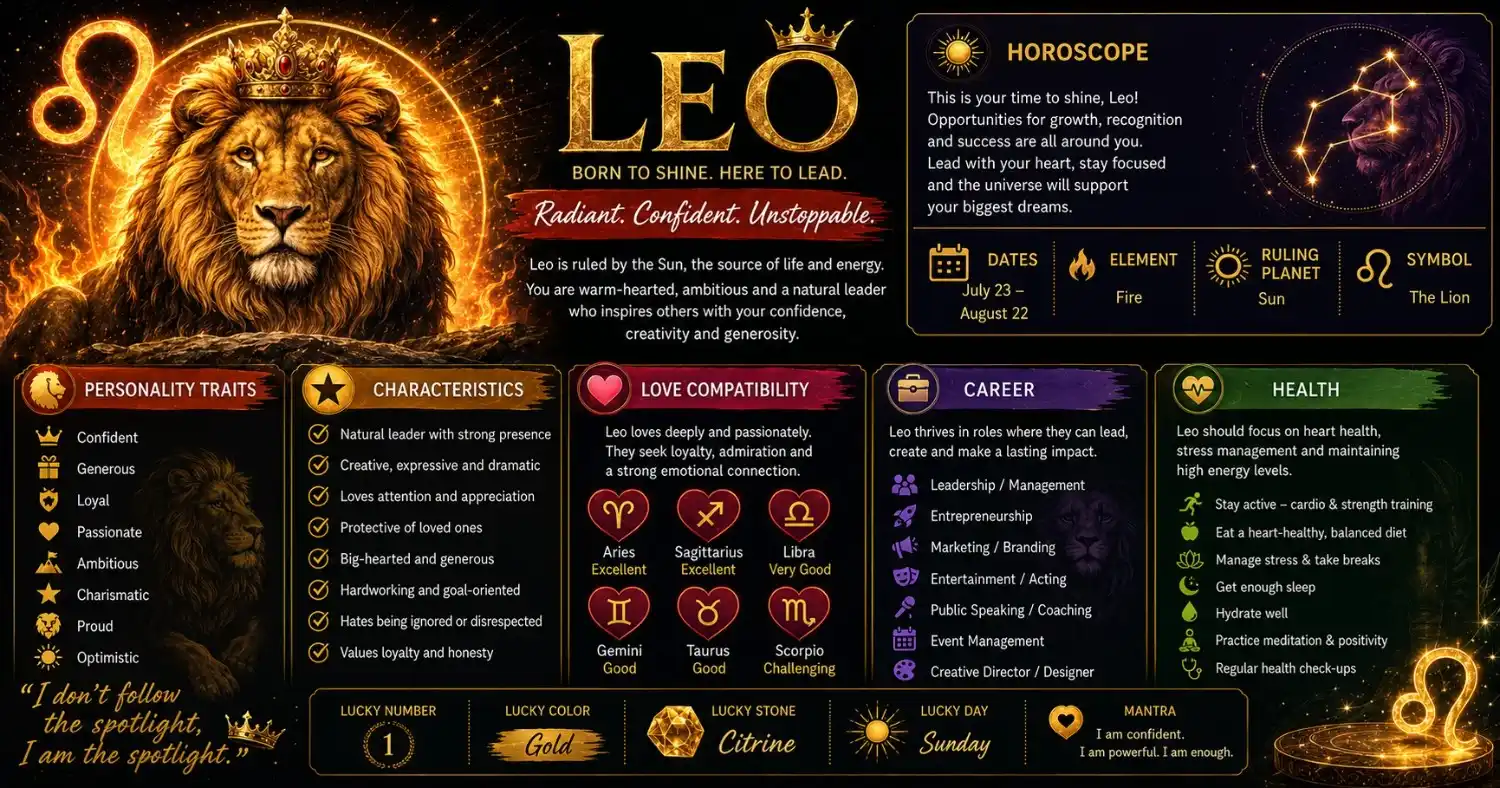
Almost every civilization that looked up at the summer sky saw the same animal: a great cat, crowned, unbothered, and impossible to miss. The word for it changes from language to language. The character behind the word barely moves at all.
Leo is the zodiac’s fifth sign and its most theatrical. Where Taurus is the bull that pulls the plow in silence, Leo is the lion that everyone in the village already knows by name.
This guide walks through where the word “Leo” comes from, why a lion became the symbol in the first place, how dozens of languages translate or borrow the name, when Leo actually starts depending on which astrology you use, and what the sign means once you strip the vocabulary away.
Quick Answer: What Does Leo Mean in Other Languages?
Leo means “lion” in Latin, and the overwhelming majority of the world’s languages name the fifth zodiac sign after that same animal. The naming patterns fall into four broad groups:
- They keep the Latin word. Spanish and Italian Leo, Portuguese Leão, Romanian Leu.
- They translate “lion” into their own native word. German Löwe, Polish Lew, Turkish Aslan, Hebrew Aryeh.
- They borrow the Sanskrit term. Hindi Simha, Thai Singha, Khmer Sattawa, Tamil Simmam.
- They build a compound word ending in a “constellation” or “seat” suffix. Chinese Shīzi zuò, Japanese Shishi-za, Korean Saja-jari.
Western (tropical) astrology dates stay fixed: July 23 to August 22. Vedic (sidereal) astrology shifts the window to roughly August 17 to September 16. The ruling planet is the Sun everywhere. The element is Fire everywhere. The quality is Fixed everywhere.
Where the Word “Leo” Comes From
English Leo comes directly from Latin leo, “lion.” Latin took the word from Ancient Greek λέων (léon). Greek most likely borrowed it from a Semitic or Afroasiatic source rather than inventing it from an Indo-European root — a rare admission for a word this central to Western vocabulary.
The trail runs deep. Egyptian and other Afroasiatic languages carry related forms for “lion.” Hebrew gives aryeh and lavi. Akkadian gives labbu and nēšu. Some linguists connect the Greek and Semitic forms directly; others treat the resemblance as coincidence layered over genuine borrowing elsewhere in the vocabulary. Either way, “lion” behaves like Taurus’s “bull”: a word that traveled between language families because the animal itself mattered enough to name carefully.
English keeps the root in ordinary vocabulary. Leonine describes anything lion-like. Leopard hides the same root, built from Greek leon plus pardos. Even the name Leon and Leonard (“brave as a lion”) descend from the same source.
Why a Lion? The Origin Story Behind the Symbol
The lion did not enter the sky as decoration. It entered as the dominant land predator of the ancient Near East, at exactly the time of year when the sun’s heat felt most dangerous.
Mesopotamia saw a lion first
Babylonian star catalogs recorded the constellation as UR.GU.LA, the “Great Lion,” in cuneiform texts predating Greek astronomy by well over a thousand years. The timing was not accidental. In the ancient calendar, the sun passed through Leo during the hottest, driest weeks of summer — when real lions, driven by thirst, moved closer to the riverbanks and villages. The sky mirrored the season on the ground.
Egypt guarded its temples with lions
Egyptian religion placed lion imagery at the threshold of the sacred. The goddess Sekhmet, lion-headed and fierce, represented both destructive heat and protective power. Twin lion statues guarded temple gateways, marking the horizon between one world and the next — appropriate for a sign that, in the sky, once sat near the point where the sun reached its yearly peak.
Greece told the Nemean story
Greek myth attached Leo to the first of the Twelve Labors of Heracles. The hero was sent to kill the Nemean Lion, a beast whose hide no weapon could pierce. Heracles strangled it with his bare hands, then wore its impenetrable pelt as armor for the rest of his life. Zeus placed the lion among the stars afterward, honoring both the beast and the labor.
India saw the king who devours darkness
Vedic tradition names the sign Simha, from the Sanskrit for lion. The lion appears throughout Indian iconography as a throne animal — deities and rulers are shown seated on lion thrones (simhasana), and the goddess Durga rides a lion into battle against forces no other creature could face. Where the Western lion proves itself through combat with a monster, the Indian lion is already sovereign: strength that does not need to prove anything twice.
Leo in Indian Languages: The Sanskrit Family
| Language | Native Script | Romanization | Literal Sense |
|---|---|---|---|
| Sanskrit | सिंह | Siṃha | Lion, the powerful one |
| Hindi | सिंह राशि | Simha Rashi | Lion sign |
| Marathi | सिंह रास | Sinh Raas | Lion sign |
| Gujarati | સિંહ રાશિ | Sinh Rashi | Lion sign |
| Bengali | সিংহ রাশি | Singho Rashi | Lion sign |
| Punjabi | ਸਿੰਘ | Singh | Lion sign |
| Tamil | சிம்மம் | Simmam | Lion sign |
| Telugu | సింహ రాశి | Simha Rasi | Lion sign |
| Kannada | ಸಿಂಹ ರಾಶಿ | Simha Rashi | Lion sign |
| Malayalam | ചിങ്ങം | Chingam | Lion sign, calendar month |
| Sinhala | සිංහ | Sinha | Lion sign |
| Urdu | برج اسد | Burj-e-Asad | House of the lion |
Sanskrit siṃha is one of the most widely traveled words in the language. It surfaces in personal names across South and Southeast Asia — Singh as a surname across Punjab and Rajasthan, Simmons-style borrowings, and even Southeast Asian city names such as Singapura, the “lion city,” which uses the exact same root.
Malayalam again breaks pattern the way it did with Taurus. Chingam names both the zodiac sign and the first month of the Malayalam solar calendar, which opens the Kerala festival season, including Onam. As with Taurus’s Edavam, the sign and the season fuse into a single everyday word.
Urdu departs from Hindi entirely, borrowing Asad from Arabic through Persian, rather than the Sanskrit-derived Simha — the same north-Indian linguistic split seen with Taurus and Saur.
Leo in European Languages
Romance languages
| Language | Name | Pronunciation |
|---|---|---|
| Latin | Leo | LEH-oh |
| Italian | Leone | leh-OH-neh |
| Spanish | Leo | LEH-oh |
| Portuguese | Leão | leh-OWNG |
| French | Lion | lee-OHN |
| Romanian | Leu | LEH-oo |
| Catalan | Lleó | lyeh-OH |
French quietly stands apart: it is the one major Romance language that uses its everyday word for the animal, lion, rather than a Latin-derived astrological form. Spanish, by contrast, kept the bare Latin Leo for the sign while using león for the animal — the same deliberate split seen with Tauro versus toro.
Germanic and Slavic languages
| Language | Name | Family |
|---|---|---|
| German | Löwe | Germanic |
| Dutch | Leeuw | Germanic |
| Swedish | Lejonet | Germanic |
| Danish | Løven | Germanic |
| Icelandic | Ljónið | Germanic |
| Russian | Лев (Lev) | Slavic |
| Polish | Lew | Slavic |
| Czech | Lev | Slavic |
| Croatian / Serbian | Lav | Slavic |
The Germanic and Slavic forms all descend from the same Latin/Greek leo line, borrowed early because lions never lived natively in northern Europe — unlike the bull, which every farming culture already had a word for. That is worth pausing on: Taurus produced independent native words almost everywhere because cattle were universal. Leo produced borrowed words almost everywhere because lions were exotic, known mainly through trade, the Roman arena, and later, scripture and heraldry.
Leo in Middle Eastern and Semitic Languages
| Language | Native Script | Romanization | Meaning |
|---|---|---|---|
| Arabic | برج الأسد | Burj al-Asad | House of the lion |
| Hebrew | מזל אריה | Mazal Aryeh | Constellation of the lion |
| Persian | اسد / شیر | Asad / Sher | Lion |
| Turkish | Aslan Burcu | Aslan Burjoo | Lion sign |
| Kurdish | Şêr | Sher | Lion |
Arabic’s al-Asad gives the West one of the most famous names in the entire night sky: Regulus, the star that marks the lion’s heart, sits at nearly the exact center of the constellation. The Arabic name for that star, Qalb al-Asad — “heart of the lion” — was borrowed almost word for word into medieval Latin star catalogs.
Hebrew’s aryeh carries scriptural weight beyond astrology. The lion is the symbolic animal of the tribe of Judah, and Jewish tradition has long associated the zodiacal month of Av, which falls partly under Leo, with themes of strength held through hardship.
Leo in East Asian Languages
| Language | Native Script | Romanization | Literal Translation |
|---|---|---|---|
| Chinese (Mandarin) | 狮子座 | Shīzi zuò | Lion constellation |
| Japanese | 獅子座 | Shishi-za | Lion constellation |
| Korean | 사자자리 | Saja-jari | Lion place |
| Vietnamese | Sư Tử | Sư Tử | Lion |
All four East Asian names read as plain, descriptive translations rather than inherited words, which fits the pattern seen with Taurus: the Western zodiac arrived in East Asia comparatively late, mostly through nineteenth- and twentieth-century contact, so the vocabulary was built fresh rather than borrowed across millennia.
One nuance worth flagging for Chinese readers: 狮子座 (Shīzi zuò) is the Western sign and has nothing to do with the lion-dance tradition or any animal in the twelve-year Chinese zodiac cycle, which has no lion at all. The two systems are unrelated, exactly as with Taurus and the Ox year.
Leo in Southeast Asian and African Languages
| Language | Name | Source |
|---|---|---|
| Thai | ราศีสิงห์ (Rasi Sing) | Sanskrit Simha |
| Khmer | រាសីសិង្ហ (Reasei Setthar) | Sanskrit Simha |
| Burmese | သိဟ်ရာသီ (Theim Yathi) | Sanskrit Simha |
| Indonesian / Malay | Leo / Singa | Latin / native “lion” |
| Swahili | Simba | Native Bantu “lion” |
| Zulu | Ibhubesi | Native “lion” |
| Amharic | አንበሳ (Anbessa) | Native “lion” |
Thailand and Cambodia follow the same Sanskrit route that gave those languages their word for Taurus, and the same calendar overlap appears again: the Thai and Khmer words for lion sit behind local month names tied to the same stretch of the year.
Swahili’s Simba deserves a note purely because of how far the word has traveled in pop culture, but in everyday Swahili it is simply the ordinary word for a lion, used for the animal well before it was ever attached to a zodiac sign.
How to Say “I Am a Leo” in Several Languages
| Language | Phrase |
|---|---|
| Spanish | Soy Leo |
| French | Je suis Lion |
| German | Ich bin Löwe |
| Italian | Sono del Leone |
| Russian | Я Лев (Ya Lev) |
| Arabic | أنا برج الأسد (Ana burj al-asad) |
| Hebrew | אני מזל אריה (Ani mazal aryeh) |
| Hindi | मेरी राशि सिंह है (Meri rashi Simha hai) |
| Tamil | என் ராசி சிம்மம் (En rasi Simmam) |
| Chinese | 我是狮子座 (Wǒ shì shīzi zuò) |
| Japanese | 私は獅子座です (Watashi wa shishi-za desu) |
| Swahili | Mimi ni Simba |
The Date Problem: Why Leo Starts on Different Days
Western (tropical) astrology
Tropical astrology anchors the zodiac to the seasons rather than the visible stars. Under that system Leo runs from roughly July 23 to August 22, covering the hottest stretch of the northern-hemisphere summer.
Vedic (sidereal) astrology
Sidereal astrology anchors the zodiac to the actual constellations, and because of the slow drift called precession of the equinoxes, the sidereal sign now sits roughly 24 degrees behind the tropical one. Vedic Simha runs approximately August 17 to September 16.
A person born on August 10 is a Leo in Western astrology but a Karka (Cancer) in Vedic astrology — the same gap in kind, if not identical dates, that shows up with every sign, Taurus included.
Constellation boundaries
Modern astronomy’s fixed constellation boundaries, set by the International Astronomical Union in 1930, have the sun crossing the actual Leo constellation from roughly August 10 to September 16 — closer to the Vedic window than the tropical one, since the constellations and the tropical calendar have drifted apart over the centuries.
What Leo Actually Means: The Astrology Underneath the Words
| Element | Fire |
| Modality | Fixed |
| Ruling planet | The Sun (Surya in Vedic astrology) |
| Symbol | The Lion |
| Polarity | Projective, yang, masculine |
| House correspondence | Fifth house |
| Body rulership | Heart, spine, upper back |
| Tarot correspondence | Strength |
| Colors | Gold, orange, deep red |
| Stones | Ruby, peridot, sunstone |
| Season | High summer in the northern hemisphere |
Fixed Fire, in plain terms. Cardinal signs start something, fixed signs sustain it, and mutable signs adapt it. Fire signs act on instinct and self-expression rather than material caution or intellectual analysis. Combine the two: Leo sustains a flame rather than lighting it and walking away. That single pairing generates almost every trait ever written about the sign — warmth, loyalty, a need to be seen, and a stubborn refusal to dim once committed.
The Sun rules through identity, not emotion. Where Cancer’s Moon governs feeling and home, Leo’s Sun governs selfhood: the part of a person that wants to be recognized as fully, unmistakably themselves. Vedic astrology assigns the same planet, Surya, similar territory — vitality, authority, and the father figure — with an added emphasis on dharma and rightful leadership.
Core strengths: Leo leads by example rather than by memo. Leo is generous with attention and credit once trust is earned. Leo produces natural performers, teachers, and hosts — anyone whose gift lands better with an audience in the room. The fifth house rules creativity, romance, and children, and Leo brings warmth to all three.
Core challenges: Fixed fire can tip into pride that will not bend even when bending would help. Leo can conflate being loved with being obeyed. The need for recognition, unmanaged, curdles into vanity or a short temper when ignored.
The Star at the Heart of Leo: Regulus
| Culture | Name | Meaning |
|---|---|---|
| Latin | Regulus | Little king |
| Arabic | قلب الأسد (Qalb al-Asad) | Heart of the lion |
| Persian | Venant | One of the four royal stars |
| Babylonian | Sharru (via MUL.LUGAL) | The king star |
Regulus sits almost exactly on the ecliptic, which is why ancient astrologers across unrelated traditions independently crowned it a royal star — a marker of kingship, rulership, and public honor. Persian tradition counted it among the four guardian stars of the sky, alongside Aldebaran, the same star that marks the heart of Taurus.
Common Mistakes to Avoid
- Confusing Chinese 狮子座 with anything in the twelve-year Chinese zodiac. There is no lion year. The two systems don’t overlap.
- Assuming Simha and Leo cover the same dates. They differ by roughly three and a half weeks, exactly like Taurus and Vrishabha.
- Treating French “Lion” as informal. It is the standard astrological term in French, not a casual substitute for a Latin form.
- Machine-translating “Leo” without context. Translation tools frequently render it as the Roman name Leo or a football club nickname rather than the zodiac sign — always verify with a native speaker for published work.
Frequently Asked Questions
What does Leo mean in English?
Leo means “the Lion.” English borrowed the word directly from Latin, where leo is the ordinary word for a lion.
What is Leo called in Hindi?
Hindi calls Leo सिंह राशि (Simha Rashi), “lion sign,” from the Sanskrit Siṃha.
What is Leo in Tamil?
Tamil calls Leo சிம்மம் (Simmam), also from the Sanskrit lion root.
What is Leo called in Malayalam?
Malayalam calls Leo ചിങ്ങം (Chingam), which also names the first month of the Malayalam calendar and the start of the Onam festival season.
What is Leo in Arabic?
Arabic calls Leo برج الأسد (Burj al-Asad), “house of the lion.”
What is Leo in Chinese?
Chinese calls Leo 狮子座 (Shīzi zuò), “lion constellation,” unrelated to the Chinese zodiac’s twelve-year animal cycle.
Does Leo mean the same thing in every language?
Essentially yes. Nearly every major language names the sign after a lion, and the astrological meaning stays consistent worldwide: fixed fire, ruled by the Sun, associated with confidence, warmth, creativity, and a need for recognition.
Why do Vedic and Western Leo dates differ?
Western astrology uses the tropical zodiac, tied to the seasons, giving July 23 to August 22. Vedic astrology uses the sidereal zodiac, tied to the fixed stars, giving roughly August 17 to September 16. The gap comes from the precession of the equinoxes over roughly two thousand years.
What is the Leo symbol called?
The glyph is ♌, Unicode U+264C, generally read as a stylized rendering of a lion’s head and mane.
Which star marks the heart of Leo?
Regulus, “the little king” in Latin, called Qalb al-Asad — “heart of the lion” — in Arabic, and long treated as one of the sky’s four royal stars.
Key Takeaways
Leo travels the world almost as well as Taurus does, but for a different reason. The bull was universal because every agricultural society already kept cattle. The lion was universal because every ancient civilization within reach of Africa and Asia feared, respected, or ruled alongside one — and the ones that never saw a lion in person still inherited the word through trade, scripture, or empire.
- Leo means “lion” in Latin, and nearly every language follows that meaning.
- Naming falls into four patterns: Latin borrowing, native translation, Sanskrit borrowing, and constellation compounds.
- India, Southeast Asia, and Sri Lanka use forms of Sanskrit Simha.
- Europe splits between bare Latin forms and native words for lion, borrowed early since lions were never native to the continent.
- East Asia built descriptive compounds ending in “constellation,” unrelated to the Chinese zodiac’s animal-year cycle.
- The Sun rules the sign in every tradition.
- Western dates run July 23 to August 22. Vedic dates run roughly August 17 to September 16.
Whatever word a language uses, the sign describes the same thing: warmth that wants to be seen, strength that performs rather than hides, and a loyalty that, once given, does not flicker.
This guide covers astrological tradition and comparative linguistics. Astrology is a symbolic and cultural system, not a science. Use it for reflection and self-understanding rather than for medical, financial, or legal decisions.