
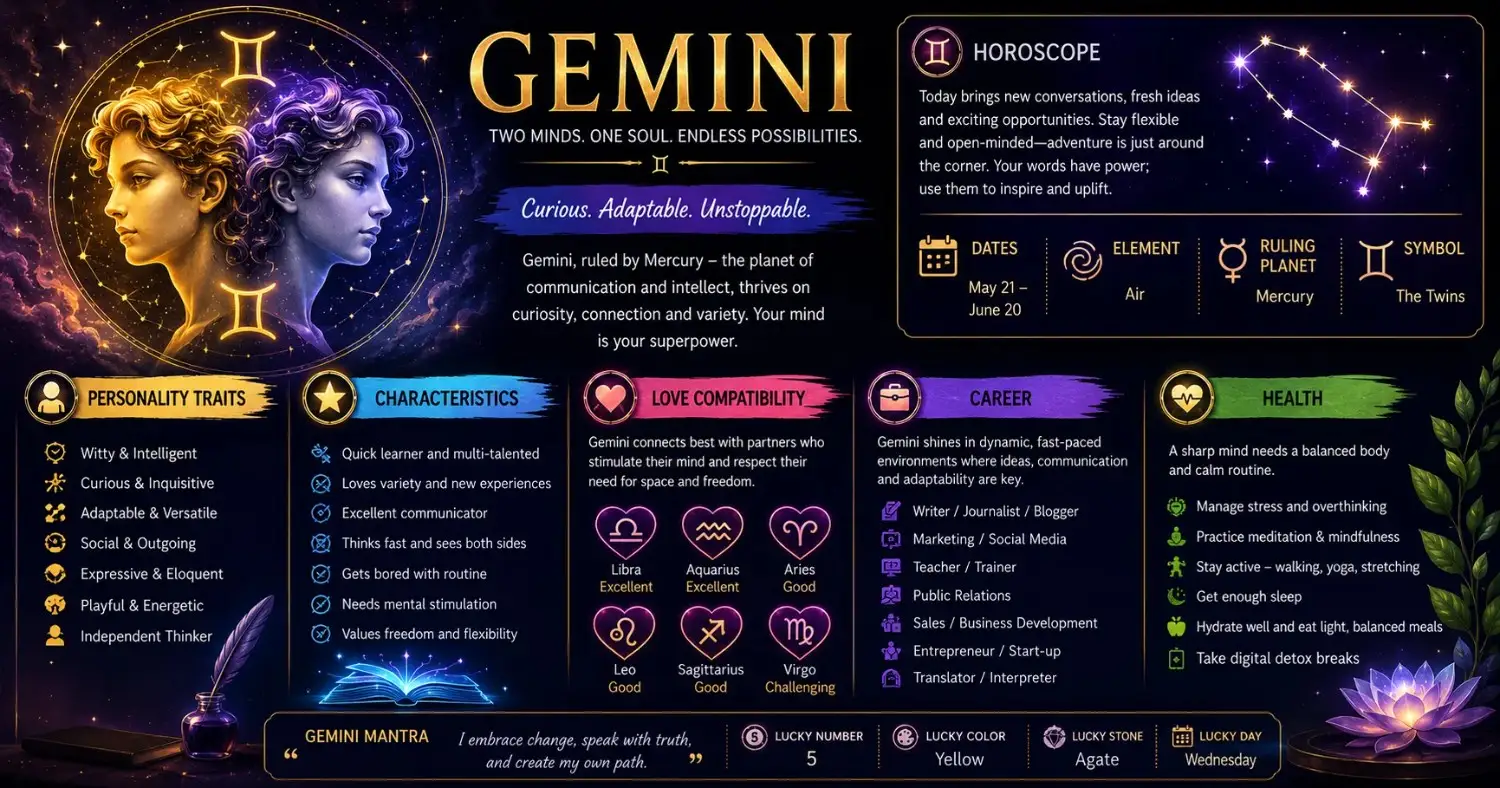
Gemini travels well. Almost every culture that watched the night sky noticed the same two bright stars sitting side by side, and almost every culture named them the same thing: a pair. Twins. A couple. Two figures walking together.
That shared instinct makes Gemini one of the most linguistically consistent signs in the zodiac. But the consistency hides real differences. The Sanskrit Mithuna does not mean quite what the Latin Gemini means. The Arabic Al-Jawzāʾ points to an older, stranger sky than the Greek Dídymoi. And in half a dozen South and Southeast Asian languages, the word for Gemini is also the name of a month.
I’ve spent years working with clients who come to astrology through their grandmother’s language, not through English. A Tamil speaker asks about Mithunam. A Brazilian client asks about Gêmeos. A Korean student asks why her app says 쌍둥이자리 when her family calls it something else. The word changes. The sign does not.
This guide covers what Gemini means in more than 90 languages. It covers the original meanings, the pronunciations, the mythologies behind each name, and the places where translation quietly goes wrong.
Quick Answer: What Does “Gemini” Mean?
Gemini means “the twins.” The word comes from Latin, where gemini is the plural of geminus, meaning “twin” or “double.” Gemini is the third astrological sign in the zodiac, and under the tropical zodiac the Sun transits it from roughly May 21 to June 21. The Greek name is Δίδυμοι (Dídymoi), which also means “twins.” The Sanskrit name is मिथुन (Mithuna), which means “a pair” or “a couple.”
Here is the fast version for the world’s most-searched languages:
| Language | Name | Script | Literal meaning |
|---|---|---|---|
| English | Gemini | Latin | The Twins |
| Spanish | Géminis | Latin | The Twins |
| French | Gémeaux | Latin | The Twins |
| German | Zwillinge | Latin | The Twins |
| Italian | Gemelli | Latin | The Twins |
| Portuguese | Gêmeos / Gémeos | Latin | The Twins |
| Hindi | मिथुन (Mithun) | Devanagari | The Pair |
| Arabic | الجوزاء (Al-Jawzāʾ) | Arabic | The Central One |
| Chinese | 双子座 (Shuāngzǐ zuò) | Han | Twin-Children Constellation |
| Japanese | 双子座 (Futago-za) | Kanji | Twins Constellation |
| Korean | 쌍둥이자리 (Ssangdungi-jari) | Hangul | Twins’ Place |
| Russian | Близнецы (Bliznetsy) | Cyrillic | The Twins |
| Hebrew | תאומים (Te’omim) | Hebrew | The Twins |
| Persian | دوپیکر (Dopeykar) | Perso-Arabic | Two Figures |
| Turkish | İkizler | Latin | The Twins |
Now let’s go deeper.
The Core Meaning: Why “Twins” Became the Universal Translation
Two stars anchor the constellation. Castor and Pollux sit close together, shine at similar brightness, and rise as a matched set. Ancient observers across three continents drew the same conclusion independently. They saw siblings.
That visual fact drives the vocabulary. When you scan zodiac terms across language families, you find the same three semantic strategies repeating:
Strategy one: the literal twins. Most European languages take this route. German Zwillinge, Polish Bliźnięta, Finnish Kaksoset, and Swahili Mapacha all mean exactly “twins.” No metaphor. No mythology. Just a plain noun.
Strategy two: the pair or couple. Sanskrit and its descendants prefer this. Mithuna covers twins, but it also covers a mated couple, a duo, a union of two. The nuance matters enormously in Vedic astrology, and I’ll return to it.
Strategy three: the named figures. Greek, Babylonian, and Egyptian traditions name specific beings rather than a category. The Babylonians called the pair the Great Twins and gave them personal names. In Babylonian astronomy, Pollux and Castor were known as the Great Twins, named Lugal-irra and Meslamta-ea, meaning “The Mighty King” and “The One who has arisen from the Underworld.”
Understanding these three strategies helps you read any zodiac chart in any language. Once you spot which strategy a language uses, the word decodes itself.
Gemini’s Astrological Profile at a Glance
Before the language tour, here are the fixed facts. These stay constant no matter what you call the sign.
| Attribute | Detail |
|---|---|
| Sign number | Third |
| Symbol | ♊ (Unicode U+264A) |
| Element | Air |
| Modality | Mutable |
| Polarity | Positive, masculine, yang |
| Ruling planet | Mercury |
| Tropical dates | May 21 – June 20 (approx.) |
| Sidereal dates | June 15 – July 15 (approx.) |
| Opposite sign | Sagittarius |
| Body rulership | Lungs, arms, hands, shoulders, nervous system |
| Colors | Yellow, light green, silver |
| Metal | Mercury (quicksilver) |
| Gemstones | Agate, citrine, pearl, emerald |
| Key phrase | “I think” |
| Core traits | Curious, verbal, adaptable, quick, restless, social |
The glyph ♊ deserves a note. It looks like the Roman numeral II. Some scholars trace it to two pillars. Others trace it to two figures standing side by side. Either reading works, and both carry the same message: duality held in balance.
Gemini in Ancient and Classical Languages
The oldest names carry the most information. They tell you what people actually saw before astrology systematized.
Latin: Gemini
Latin gives us the English word directly. Geminus means twin, double, or paired. Gemini is the masculine plural. Romans also used the word for doubled things generally, including doubled letters and doubled crops. The English word “geminate,” meaning to double, comes from the same root.
The Latin root reaches back further. Gemini derives from Latin gemini, the plural of geminus meaning “twin” or “double,” and it connects to Avestan yəma-, Sanskrit yamá- and yamala- meaning “twin” or “paired,” and to the Proto-Indo-European base meaning “to hold.” That connection is remarkable. The Vedic god Yama and the Latin word gemini likely share a common ancestor thousands of years old.
Ancient Greek: Δίδυμοι (Dídymoi)
The Greeks called the sign Δίδυμοι, romanized Dídymoi. The word means “twins” or “double ones.” Modern Greek keeps it unchanged: Δίδυμοι, pronounced THEE-thee-mee.
Greek myth attaches specific names. Gemini is represented by the twins Castor and Pollux, known as the Dioscuri in Greek mythology. The brothers shared a mother but not a father. Pollux was immortal. Castor was not. When Castor died, Pollux asked Zeus to share his immortality, and Zeus placed them together in the sky.
That story explains Gemini’s central psychological theme better than any personality list. The sign holds two natures that cannot fully merge and will not fully separate. Astrologers read this as the Gemini talent for holding contradictory ideas without collapsing them into one.
Babylonian and Akkadian: MUL.MAŠ.TAB.BA.GAL.GAL
The cuneiform name reads as “The Great Twins.” In Babylonian star lists, Gemini appears as MUL.MAŠ.TAB.BA.GAL.GAL, “The Great Twins,” identified with Castor and Pollux. The determinative MUL marks a star or constellation. MAŠ.TAB.BA means twins. GAL.GAL means great or large.
Babylonian astronomy fed directly into Greek astronomy, which fed into Hellenistic astrology, which produced the Western system used today. The Great Twins are the direct ancestor of your horoscope column.
Biblical and Modern Hebrew: תאומים (Te’omim)
Hebrew names the sign תאומים, Te’omim, meaning twins. The singular is ta’om. Jewish tradition links the sign to the month of Sivan, which usually falls in May and June. Sivan carries the giving of the Torah at Sinai, and some rabbinic commentary connects the twin imagery to the two tablets.
Hebrew speakers pronounce it teh-oh-MEEM. The word appears in Genesis to describe Jacob and Esau, the Bible’s most famous twins, which gives the astrological term a strong native resonance.
Sanskrit: मिथुन (Mithuna)
Sanskrit is where the translation gets genuinely interesting. Mithuna does not primarily mean “twins.” Mithuna means paired or forming a pair, and as a noun it denotes a couple, a brace, or a male-and-female pair; it also names the zodiac sign Gemini.
That difference reshapes the symbolism. Western Gemini shows two brothers. Vedic Mithuna often shows a man and a woman, frequently depicted with a club and a lute or veena. The Western sign emphasizes siblinghood and mirrored identity. The Vedic sign emphasizes union, complementarity, and the creative tension between two different natures.
Both readings produce the same practical traits. Both produce a mind that works in dialogue with itself. But if you study Vedic astrology and Western astrology side by side, this distinction explains why the interpretations diverge in tone.
Mithuna also names a month in the Indian solar calendar, corresponding to the zodiacal sign of Gemini and overlapping roughly with the second half of June and the first half of July. Remember that. It causes real confusion in Kerala, Odisha, Cambodia, and Laos, where the same word means both a sign and a calendar month.
Avestan and Old Persian
Avestan yəma- means twin and connects to the mythic first man, Yima. The Persian tradition later developed its own term. In Persian astronomy, Gemini is دوپیکر (dopeykar), built from do, meaning two, and peykar, meaning figure or form. The name translates as “two figures” rather than “two twins,” a subtle but meaningful shift toward image and shape.
Gemini in European Languages
Europe splits into clean families. Learn the family pattern and you predict the word.
Romance Languages
All of these descend from Latin gemini, so the family resemblance is obvious.
| Language | Name | Pronunciation guide |
|---|---|---|
| Spanish | Géminis | HEH-mee-nees |
| French | Gémeaux | zhay-MOH |
| Italian | Gemelli | jeh-MEL-lee |
| Portuguese (Brazil) | Gêmeos | ZHEH-mee-oosh |
| Portuguese (Europe) | Gémeos | ZHEH-mee-oosh |
| Romanian | Gemeni | JEH-men |
| Catalan | Bessons | beh-SONS |
| Galician | Xémeos | SHEH-meh-os |
| Occitan | Bessons | beh-SOONS |
| Sardinian | Gemellos | jeh-MEL-los |
| Corsican | Gemelli | jeh-MEL-lee |
| Romansh | Schmelins | SHMEH-leens |
Catalan and Occitan break the pattern. Bessons comes from a different root meaning twin, likely from Vulgar Latin bissus, related to “twice.” The word feels more homegrown and less scholarly than Géminis.
Spanish keeps the accent on the first syllable. Many English speakers say heh-MEE-nees, which sounds wrong to native ears. The stress falls on Gé.
Germanic Languages
Germanic languages abandon the Latin root entirely and use their own word for twins.
| Language | Name | Pronunciation guide |
|---|---|---|
| German | Zwillinge | TSVIL-ing-uh |
| Dutch | Tweelingen | TVAY-ling-un |
| Afrikaans | Tweeling | TFAY-ling |
| Swedish | Tvillingarna | TVIL-ing-ar-na |
| Norwegian | Tvillingene | TVIL-ing-eh-neh |
| Danish | Tvillingerne | TVIL-ing-er-neh |
| Icelandic | Tvíburarnir | TVEE-boo-rar-nir |
| Faroese | Tvíburarnir | TVEE-boo-rar-nir |
| Frisian | Twillingen | TVIL-ing-un |
| Luxembourgish | Zwilling | TSVIL-ing |
Notice the shared tw- and zw- element. It comes from the Proto-Germanic root for “two.” English “twin” belongs to the same family. So if English had kept its native word, your horoscope would say “The Twins” instead of “Gemini,” exactly as German does.
Icelandic Tvíburarnir is built from tví (two) and burðr (birth). It literally means “the two-births.” That is arguably the most precise word for twins in any European language.
Slavic Languages
Slavic languages share a root meaning “near” or “close,” which produced their word for twin.
| Language | Name | Pronunciation guide |
|---|---|---|
| Russian | Близнецы (Bliznetsy) | bleez-net-SIH |
| Ukrainian | Близнюки (Blyznyuky) | bleez-nyoo-KEE |
| Belarusian | Блізняты (Bliznyaty) | bleez-NYAH-tih |
| Polish | Bliźnięta | bleezh-NYEN-ta |
| Czech | Blíženci | BLEE-zhen-tsee |
| Slovak | Blíženci | BLEE-zhen-tsee |
| Bulgarian | Близнаци (Bliznatsi) | bleez-NAH-tsee |
| Serbian | Близанци (Blizanci) | blee-ZAHN-tsee |
| Croatian | Blizanci | blee-ZAHN-tsee |
| Bosnian | Blizanci | blee-ZAHN-tsee |
| Macedonian | Близнаци (Bliznaci) | bleez-NAH-tsee |
| Slovenian | Dvojčka | DVOY-chka |
Slovenian goes its own way with Dvojčka, built from dvoje, meaning “two.” Slovenian also preserves the dual grammatical number, a rare feature that gives the language a built-in way to talk about exactly two things. A Gemini in Slovenian is grammatically a pair, not a plural.
Baltic Languages
| Language | Name | Pronunciation guide |
|---|---|---|
| Lithuanian | Dvyniai | DVIH-nyai |
| Latvian | Dvīņi | DVEE-nyee |
Both derive from the root for “two.” Lithuanian is among the most archaic living Indo-European languages, and dvyniai sits close to the reconstructed ancestor form.
Finno-Ugric and Other Non-Indo-European European Languages
| Language | Name | Pronunciation guide |
|---|---|---|
| Finnish | Kaksoset | KAHK-soh-set |
| Estonian | Kaksikud | KAHK-see-kud |
| Hungarian | Ikrek | EEK-rek |
| Basque | Bikiak | bee-KEE-ak |
| Maltese | Tewmin | TEW-min |
Finnish Kaksoset comes from kaksi, meaning two. Estonian Kaksikud works the same way. Hungarian Ikrek is unrelated to any neighbor, which fits Hungarian’s isolated position in Europe.
Maltese is fascinating here. Maltese is a Semitic language written in the Latin alphabet, and Tewmin shares a root with Hebrew Te’omim and Arabic taw’am. A Maltese horoscope column preserves a Semitic word inside a European media landscape.
Celtic Languages
| Language | Name | Pronunciation guide |
|---|---|---|
| Irish | Na Cúpla | nah KOOP-la |
| Scottish Gaelic | Na Càraid | nah KAH-rij |
| Welsh | Y Gefeilliaid | uh geh-VAIL-yaid |
| Breton | An Daougevell | an dow-GEH-vel |
| Cornish | An Evelli | an eh-VEL-ee |
Irish Cúpla means a couple or a pair, and it borrowed from Latin copula. Modern Irish speakers use cúpla casually to mean “a few,” so the astrological sense needs context. Breton Daougevell combines daou (two) with a twin root.
Greek, Albanian, and Armenian
| Language | Name | Pronunciation guide |
|---|---|---|
| Modern Greek | Δίδυμοι (Dídymoi) | THEE-thee-mee |
| Albanian | Binjakët | bee-NYAH-kut |
| Armenian | Երկվորյակներ (Yerkvoryakner) | yerk-vor-yak-NER |
Armenian Yerkvoryakner builds from yerku, meaning two. Armenian preserves ancient astrological vocabulary because of its long manuscript tradition, and medieval Armenian astronomical texts used the term consistently.
Gemini in Indian Languages: The Mithuna Family
India uses a sidereal zodiac, and the dates differ from the Western tropical system. But the vocabulary stays remarkably unified. Nearly every Indian language uses a form of Sanskrit Mithuna.
| Language | Name | Script | Romanization |
|---|---|---|---|
| Sanskrit | मिथुन | Devanagari | Mithuna |
| Hindi | मिथुन राशि | Devanagari | Mithun Rashi |
| Marathi | मिथुन | Devanagari | Mithun |
| Nepali | मिथुन | Devanagari | Mithun |
| Bengali | মিথুন | Bengali | Mithun |
| Assamese | মিথুন | Assamese | Mithun |
| Odia | ମିଥୁନ | Odia | Mithuna |
| Gujarati | મિથુન | Gujarati | Mithun |
| Punjabi | ਮਿਥੁਨ | Gurmukhi | Mithun |
| Tamil | மிதுனம் | Tamil | Mithunam |
| Telugu | మిథునం | Telugu | Mithunam |
| Kannada | ಮಿಥುನ | Kannada | Mithuna |
| Malayalam | മിഥുനം | Malayalam | Mithunam |
| Sinhala | මිථුන | Sinhala | Mithuna |
| Kashmiri | मिथुन | Devanagari | Mithun |
| Konkani | मिथुन | Devanagari | Mithun |
| Urdu | جوزا | Perso-Arabic | Jauzā |
Urdu is the outlier. Urdu draws astrological vocabulary from Persian and Arabic rather than Sanskrit, so Urdu speakers say Jauzā, matching Arabic Al-Jawzāʾ. Urdu poetry also uses do-paikar, the Persian term. Rekhta’s dictionary defines do-paikar as the zodiac sign Gemini, and also as a two-edged sword or something in two pieces.
That double meaning is a gift to poets. A do-paikar person is two-formed and double-edged at once.
What Rashi Means
Indian astrology uses rashi to mean a zodiac sign. A full reference is Mithuna Rashi, meaning “the Gemini sign.” In most Indian usage, your rashi means your Moon sign, not your Sun sign. That single difference creates enormous confusion.
A woman born on June 5 is a Gemini in a Western magazine. Her Indian astrologer may call her a Taurus, a Cancer, or anything else, depending on where the Moon sat at her birth. Neither system is wrong. They measure different things.
The Calendar Overlap
In Malayalam, Odia, and Tamil-influenced calendars, Mithunam is a solar month. The Kerala month of Mithunam runs roughly mid-June to mid-July and coincides with the monsoon. Malayalam speakers say “Mithunam” and mean the rainy season as often as they mean the zodiac sign.
If you search in Malayalam and get results about rainfall and agricultural festivals, that is why.
Gemini in Middle Eastern and Central Asian Languages
Arabic: الجوزاء (Al-Jawzāʾ)
Arabic names the sign الجوزاء, Al-Jawzāʾ. The etymology is contested and genuinely interesting. The root j-w-z relates to the middle or the center. Classical Arab astronomers applied Al-Jawzāʾ to a figure standing in the middle of the sky.
Here is the complication. Pre-Islamic Arab astronomy used Al-Jawzāʾ for the region we now call Orion, not for the Greek Twins. When Greek astronomy arrived through translation, the name transferred to the zodiacal Gemini. Both uses survive. Modern Arabic still calls Orion’s Belt region by related terms, and the star Betelgeuse takes its name from a phrase involving al-jawzāʾ.
For everyday purposes, Arabic speakers reading horoscopes understand burj al-jawzāʾ (برج الجوزاء) as Gemini without ambiguity. Burj means tower or sign.
Persian and Dari: دوپیکر / جوزا
Persian offers two words. The technical astronomical term is دوپیکر (dopeykar), “two figures.” The popular term borrowed from Arabic is جوزا (Jowzā). Iranian newspapers and apps typically use Jowzā or the Latin-script Gemini. Scholarly and classical texts prefer Dopeykar.
Persian miniature painting depicts the sign in several distinct ways, and Iranian visual tradition sometimes shows two separate human figures rather than an embracing pair.
Turkish and Turkic Languages
| Language | Name | Pronunciation guide |
|---|---|---|
| Turkish | İkizler | ee-KEEZ-ler |
| Azerbaijani | Əkizlər | uh-KEEZ-lar |
| Kazakh | Егіздер (Egizder) | yeh-GEEZ-der |
| Uzbek | Egizaklar | eh-gee-ZAK-lar |
| Turkmen | Ekizler | eh-KEEZ-ler |
| Kyrgyz | Эгиздер (Egizder) | eh-GEEZ-der |
| Uyghur | قوشكېزەك | qosh-kay-ZAK |
The Turkic root ikiz / egiz means twin and connects to iki, meaning two. The pattern holds across the entire family from Istanbul to Xinjiang.
Other Regional Languages
| Language | Name | Notes |
|---|---|---|
| Kurdish (Kurmanji) | Cêwî | From the word for twin |
| Pashto | جوزا (Jawzā) | Borrowed from Arabic |
| Georgian | ტყუპები (Tqupebi) | Native root for twin |
| Hebrew | תאומים (Te’omim) | Semitic twin root |
| Amharic | መንታ (Menta) | Means twin |
Georgian Tqupebi is completely unrelated to its neighbors. Georgian belongs to the Kartvelian family and shares no ancestry with Indo-European or Turkic languages, which shows in nearly every astrological term.
Gemini in East Asian Languages
Chinese: 双子座 (Shuāngzǐ zuò)
Chinese uses 双子 (shuāngzǐ) for Gemini, and 双子座 (shuāngzǐzuò) for the constellation and zodiac sign. The characters break down cleanly. 双 means double or pair. 子 means child. 座 means seat or constellation. The whole phrase means “the twin-children constellation.”
Traditional characters write it 雙子座. Pronunciation is shwahng-dzuh dzwaw.
A Chinese speaker says 他属双子座 to mean “He’s a Gemini,” and 双子座是十二宫的第三个星座 to mean “Gemini is the third sign of the zodiac.” The phrase 十二宫 means “the twelve palaces,” which is the standard Chinese term for the Western zodiac.
Important distinction: Western astrology in China is called 星座 (xīngzuò), meaning constellations. The traditional Chinese twelve-animal zodiac is called 生肖 (shēngxiào). They are separate systems and Chinese speakers keep them separate. If someone asks for your 生肖, they want your birth-year animal, not your Gemini status.
Classical Chinese astronomy divided the ecliptic into twelve stations called 十二次. The station overlapping Gemini’s region is 实沈 (Shíchén). That term appears in historical texts but not in modern horoscope writing.
Japanese: 双子座 (Futago-za)
Japanese writes the sign with the same kanji as Chinese but reads it with native Japanese sounds: 双子座, futago-za. 双子 (futago) means twins. 座 (za) means constellation.
Japanese writing also uses katakana ジェミニ (Jemini) for branding, fashion, and product names, but astrology columns use 双子座 almost exclusively.
To say “I’m a Gemini,” a Japanese speaker says 私は双子座です (Watashi wa futago-za desu).
Korean: 쌍둥이자리 (Ssangdungi-jari)
Korean builds the term from native Korean words. 쌍둥이 (ssangdungi) means twins. 자리 (jari) means place or seat. Together they mean “the twins’ place.”
Korean also accepts 쌍자궁 in older texts and 제미니 (Jemini) as a loanword in commercial contexts. Horoscope media uses 쌍둥이자리.
Korean astrology culture is strong, and 별자리 (byeoljari), meaning “star place,” is the general term for a Western zodiac sign.
Mongolian and Tibetan
| Language | Name | Meaning |
|---|---|---|
| Mongolian | Ихэр (Ikher) | Twin |
| Tibetan | འཁྲིག་པ་ (Trikpa) | Pair, union |
Tibetan astrology absorbed the Indian system through Buddhist transmission, so the Tibetan term translates the Sanskrit Mithuna concept of union rather than the Latin concept of twins. Tibetan astrology also blends Chinese elements, creating a genuinely hybrid system.
Gemini in Southeast Asian Languages
Southeast Asia received astrology primarily from India, so Sanskrit vocabulary dominates.
| Language | Name | Romanization | Source |
|---|---|---|---|
| Thai | ราศีเมถุน | Rasi Methun | Sanskrit |
| Khmer | មិថុន | Mithun | Sanskrit |
| Lao | ມິຖຸນ | Mithun | Sanskrit |
| Burmese | မေထုန် | Methun | Sanskrit |
| Vietnamese | Song Tử | Song Tu | Chinese |
| Indonesian | Gemini / Kembar | — | Latin / Malay |
| Malay | Gemini / Kembar | — | Latin / Malay |
| Filipino (Tagalog) | Kambal | — | Native |
| Javanese | Kembar | — | Native |
Thai ราศี (rasi) comes straight from Sanskrit rashi, and เมถุน (methun) from mithuna. Thai astrology retains substantial Indian structure while adding local practice.
Khmer and Lao carry the same calendar overlap as Malayalam. In Khmer, មិថុនា (Mithona) names the month of June. In Lao, ມິຖຸນາ (Mithuna) does the same. A Cambodian saying “Mithona” usually means June, not Gemini.
Vietnamese takes the Chinese route instead. Song Tử uses Sino-Vietnamese readings of 雙子, meaning “twin children.” Vietnamese astrology media uses Song Tử consistently.
Tagalog Kambal is the native Filipino word for twins, though Philippine media frequently just writes “Gemini” in English.
Gemini in African Languages
African languages tend to use native words for twins, which carry deep cultural weight in many traditions.
| Language | Name | Region |
|---|---|---|
| Swahili | Mapacha | East Africa |
| Amharic | መንታ (Menta) | Ethiopia |
| Tigrinya | ማንታ (Manta) | Eritrea, Ethiopia |
| Somali | Mataano | Horn of Africa |
| Yoruba | Ìbejì | Nigeria, Benin |
| Igbo | Ejima | Nigeria |
| Hausa | Tagwaye | West Africa |
| Zulu | Amawele | South Africa |
| Xhosa | Amawele | South Africa |
| Shona | Mapatya | Zimbabwe |
| Afrikaans | Tweeling | South Africa |
| Malagasy | Kambana | Madagascar |
Yoruba Ìbejì deserves special attention. Twins hold sacred status in Yoruba culture, and Ìbejì names both the twins themselves and the associated orisha. The Yoruba people have one of the highest twinning rates in the world, and the culture built an entire religious practice around it, including the carved ère ìbejì figures.
When a Yoruba speaker translates “Gemini” as Ìbejì, the word arrives loaded with meaning that the Latin word never carried. That is a translation gain, not a loss.
Swahili Mapacha is the plural of pacha, meaning twin. Swahili astrology columns in Kenya and Tanzania generally write “Gemini” in Latin script but explain it as Mapacha.
Gemini in Constructed and Minority Languages
| Language | Name |
|---|---|
| Esperanto | Ĝemeloj |
| Latin (modern usage) | Gemini |
| Interlingua | Geminos |
| Hawaiian | Māhoe |
| Māori | Ngā Māhanga |
| Samoan | Masaga |
| Quechua | Iskay Wawqi |
| Nahuatl | Cōātl ōme (regional) |
| Greenlandic | Marlussuk |
| Inuktitut | ᒪᓕᕈᐊᒃ |
Hawaiian Māhoe means twins, and Polynesian navigational astronomy tracked Castor and Pollux carefully as a rising pair. Māori Ngā Māhanga uses the same Polynesian root. These traditions did not use the twelve-sign zodiac, but they named the same stars and used them for wayfinding.
Esperanto Ĝemeloj follows the Romance pattern, pronounced jeh-MEH-loy.
How to Say “I’m a Gemini” in 25 Languages
This is the phrase people actually need. Here it is, ready to use.
| Language | Phrase |
|---|---|
| Spanish | Soy Géminis |
| French | Je suis Gémeaux |
| German | Ich bin Zwilling |
| Italian | Sono dei Gemelli |
| Portuguese | Eu sou de Gêmeos |
| Dutch | Ik ben Tweelingen |
| Russian | Я Близнецы (Ya Bliznetsy) |
| Polish | Jestem Bliźniakiem |
| Turkish | Ben İkizler burcuyum |
| Arabic | أنا برج الجوزاء (Ana burj al-jawzāʾ) |
| Hebrew | אני תאומים (Ani Te’omim) |
| Persian | من متولد جوزا هستم |
| Hindi | मेरी राशि मिथुन है (Meri rashi Mithun hai) |
| Tamil | என் ராசி மிதுனம் (En rasi Mithunam) |
| Telugu | నా రాశి మిథునం |
| Bengali | আমার রাশি মিথুন |
| Chinese | 我是双子座 (Wǒ shì shuāngzǐzuò) |
| Japanese | 私は双子座です (Watashi wa futago-za desu) |
| Korean | 저는 쌍둥이자리예요 (Jeoneun ssangdungi-jari-yeyo) |
| Thai | ฉันเป็นราศีเมถุน |
| Vietnamese | Tôi là cung Song Tử |
| Indonesian | Saya Gemini |
| Swahili | Mimi ni Mapacha |
| Greek | Είμαι Δίδυμος (Eimai Didymos) |
| Swedish | Jag är Tvillingarna |
Note the Greek singular. A single Gemini person is Δίδυμος (Dídymos, masculine) or Δίδυμη (Dídymi, feminine). The sign itself stays plural.
Romance languages handle this differently too. In Italian you say sono dei Gemelli, literally “I am of the Twins.” In French, je suis Gémeaux uses the plural sign name directly.
Where Translation Goes Wrong: Six Common Errors
I see the same mistakes repeatedly. Here is how to avoid them.
Error one: Confusing Mithuna the sign with Mithunam the month
A Malayalam or Khmer speaker searching “Mithunam” gets calendar results. Add the word rashi or zodiac to clarify. In Malayalam, say മിഥുനം രാശി. In Khmer, specify រាសី.
Error two: Treating rashi and Sun sign as identical
Indian rashi almost always means Moon sign. Western “sign” almost always means Sun sign. A person can be Gemini in one system and something entirely different in the other. Always ask which system someone means before you answer.
Error three: Mixing up 星座 and 生肖 in Chinese
星座 is the Western zodiac. 生肖 is the Chinese animal zodiac. The two have no overlap. Gemini has no animal equivalent, despite countless websites claiming otherwise. Any chart that pairs Gemini with a specific Chinese animal is making an arbitrary modern association, not reporting a traditional correspondence.
Error four: Assuming Arabic Al-Jawzāʾ always means Gemini
In classical Arabic astronomy, Al-Jawzāʾ often referred to Orion. Star names like Betelgeuse preserve that older usage. In modern horoscope contexts, burj al-jawzāʾ means Gemini without ambiguity. Context decides.
Error five: Using machine translation for the sign name
Automatic translators frequently render “Gemini” as a generic word for twins in a language that actually uses a different astrological term. Machine translation also now confuses the zodiac sign with a well-known AI product, producing nonsense in several languages. Verify with a native astrology source.
Error six: Ignoring grammatical gender and number
German Zwilling is singular for a person, Zwillinge plural for the sign. Russian Близнецы is always plural. Slovenian uses the dual. Getting this wrong marks your text as translated. Native readers notice immediately.
The Gemini Personality: Does It Change by Culture?
The traits do not change. The emphasis does.
Western interpretation
Western astrology reads Gemini through Mercury as the messenger. The keywords are curiosity, communication, versatility, wit, and restlessness. The shadow side is scattered focus and inconsistency. The image is a bright, fast, socially fluid person who knows a little about everything.
Vedic interpretation
Vedic astrology treats Mithuna Rashi as the third sign of the sidereal zodiac, ruled by Mercury, carried on the Air element, with a dual or mutable quality, symbolized by a pair of twins often shown holding a musical instrument and a club. The dual quality, dwiswabhava, positions the sign between initiating and fixed energies.
The practical reading emphasizes learning, speech, trade, and scriptural knowledge. Classical Sanskrit verses describe the Gemini native as eloquent, restless, and versed in many branches of knowledge. The Vedic tradition gives more weight to Mercury’s condition in the chart than to the sign alone.
Arabic and Persian tradition
Medieval Islamic astrology inherited the Hellenistic reading and refined it. Astrologers like Abu Ma’shar described Gemini as a human sign, airy, hot and moist, associated with scribes, merchants, translators, and messengers. Islamic astrology influenced European medicine and astronomy for centuries.
East Asian adaptation
Chinese, Japanese, and Korean cultures adopted Western astrology in the twentieth century, mainly through popular media. The interpretation follows Western sources closely. However, East Asian horoscope culture emphasizes compatibility charts and blood-type pairings far more than Western media does. A Japanese Gemini article will usually discuss 相性 (aishō, compatibility) at length.
African and Indigenous perspectives
Most traditional African cosmologies did not use the twelve-sign zodiac. Where Gemini appears, it arrives through colonial-era and modern media. The native twin vocabulary, though, carries indigenous meaning that enriches the reading. Yoruba Ìbejì connects Gemini to ideas of sacred doubling, spiritual protection, and ancestral presence that Western astrology never developed.
Gemini Dates Around the World: Tropical vs Sidereal
This confuses more people than any translation issue.
Tropical zodiac (Western): May 21 to June 20, approximately. The tropical system anchors to the equinoxes, not to the visible stars.
Sidereal zodiac (Vedic, Jyotisha): Roughly June 15 to July 16. The sidereal system anchors to the actual star positions and drifts slowly against the tropical system.
The gap between the two is currently about 24 degrees, called the ayanamsa. It grows by about one degree every 72 years due to the precession of the equinoxes.
Practical consequence: someone born May 25 is a Sun-sign Gemini in Western astrology and a Sun-sign Taurus in Vedic astrology. Neither system made an error. They measure from different starting points.
Constellation boundaries (astronomical): The Sun actually passes through the star pattern of Gemini from about June 21 to July 20. Astronomy uses official IAU constellation boundaries, which are unequal in size. This is a third framework again, and it is not used for astrology in any tradition.
The Gemini Symbol ♊ Across Writing Systems
The glyph ♊ is universal. It renders the same in every script and every language. Unicode assigns it code point U+264A under the name GEMINI.
Designers and tattoo artists should know a few variants:
- The standard glyph: two vertical strokes joined by curved bars at top and bottom.
- The Roman numeral reading: identical to II, which Renaissance manuscripts used interchangeably.
- The Egyptian reading: two sprouting plants or two figures, seen in Dendera zodiac reproductions.
- The Vedic pictorial: a man and a woman, often with veena and club, used in South Indian temple art and traditional chart illustrations.
- The Arabic pictorial: two seated or standing human figures, common in Islamic astronomical manuscripts such as the Book of Fixed Stars.
If you want a culturally grounded Gemini tattoo, the glyph works everywhere. The pictorial versions carry specific traditions, so choose deliberately.
Frequently Asked Questions
What does Gemini literally mean?
Gemini means “twins” in Latin. It is the plural of geminus, meaning twin or double.
What is Gemini called in Hindi?
Gemini is मिथुन राशि (Mithun Rashi) in Hindi. Mithun means pair or couple, and rashi means zodiac sign.
What is Gemini in Arabic?
Gemini is الجوزاء (Al-Jawzāʾ) in Arabic. The full phrase is برج الجوزاء (burj al-jawzāʾ), meaning the sign of Gemini.
What is Gemini in Chinese?
Gemini is 双子座 (Shuāngzǐ zuò) in Chinese, literally “the twin-children constellation.”
What is Gemini in Japanese?
Gemini is 双子座 (Futago-za) in Japanese. The kanji match Chinese, but the pronunciation is native Japanese.
Is Mithuna the same as Gemini?
Yes and no. Mithuna is the Vedic equivalent of Gemini and occupies the same position in the zodiac. However, Vedic astrology uses the sidereal zodiac, so the date range differs by about three weeks.
Why does Gemini mean twins in almost every language?
Because the constellation contains two prominent, closely spaced bright stars, Castor and Pollux. Observers in different regions independently interpreted them as a pair.
What is the Gemini symbol and what does it mean?
The symbol is ♊. It shows two parallel forms joined at top and bottom. It represents duality, partnership, and the union of two natures within one person.
Who are the Gemini twins in mythology?
In Greek and Roman myth, they are Castor and Pollux, the Dioscuri. Pollux was immortal and Castor was not. Zeus placed them together in the sky so they would never be separated.
What is Gemini called in Korean?
Gemini is 쌍둥이자리 (Ssangdungi-jari), meaning “the twins’ place.”
What is Gemini called in Tamil?
Gemini is மிதுனம் (Mithunam) in Tamil.
What is Gemini in Hebrew?
Gemini is תאומים (Te’omim), meaning twins. It corresponds to the Hebrew month of Sivan.
Does Gemini exist in Chinese astrology?
No. The traditional Chinese zodiac uses twelve animals assigned by birth year, not twelve signs assigned by birth date. Gemini belongs to the Western system, which Chinese speakers call 星座. Any chart claiming Gemini equals a specific Chinese animal is presenting a modern invention.
What planet rules Gemini in every tradition?
Mercury rules Gemini in Western, Hellenistic, Vedic, and Islamic astrology. Vedic astrology calls Mercury Budha. The rulership is consistent across all major systems.
Why do some languages call June “Mithuna”?
Indian solar calendars name months after the zodiac sign the Sun occupies. The Mithuna month runs roughly mid-June to mid-July. Cambodian and Lao calendars borrowed the system, so the words for June in Khmer and Lao derive from Mithuna.
Key Takeaways
Gemini is the Latin word for twins, and nearly every language on earth translates it the same way. The visual evidence in the sky is simply too clear to interpret differently.
Three naming strategies dominate. European languages use a literal word for twins. Indian and Southeast Asian languages use Mithuna, meaning a pair or couple. Semitic and Persian traditions use figure-based or center-based names like Al-Jawzāʾ and Dopeykar.
The Sanskrit route carries a different emphasis than the Latin one. Mithuna points toward union and complementarity. Gemini points toward mirrored siblings. Both produce the same sign, but the flavor of interpretation shifts.
Dates differ by system, not by language. Tropical astrology gives Gemini roughly May 21 to June 20. Sidereal astrology gives Mithuna roughly June 15 to July 16. Check which system a source uses before comparing.
The symbol ♊ needs no translation. It carries across every script and every tradition without modification, which makes it the single most portable piece of astrological vocabulary in the world.
And the underlying meaning holds everywhere. Gemini describes a mind that moves, a voice that connects, and a self that comfortably contains more than one truth at a time. Whether you call it Mithuna, Zwillinge, Al-Jawzāʾ, or 双子座, you are describing the same restless, brilliant, two-sided intelligence.
Astrology offers a framework for reflection and self-understanding. It is not a substitute for professional guidance on health, legal, or financial matters.