
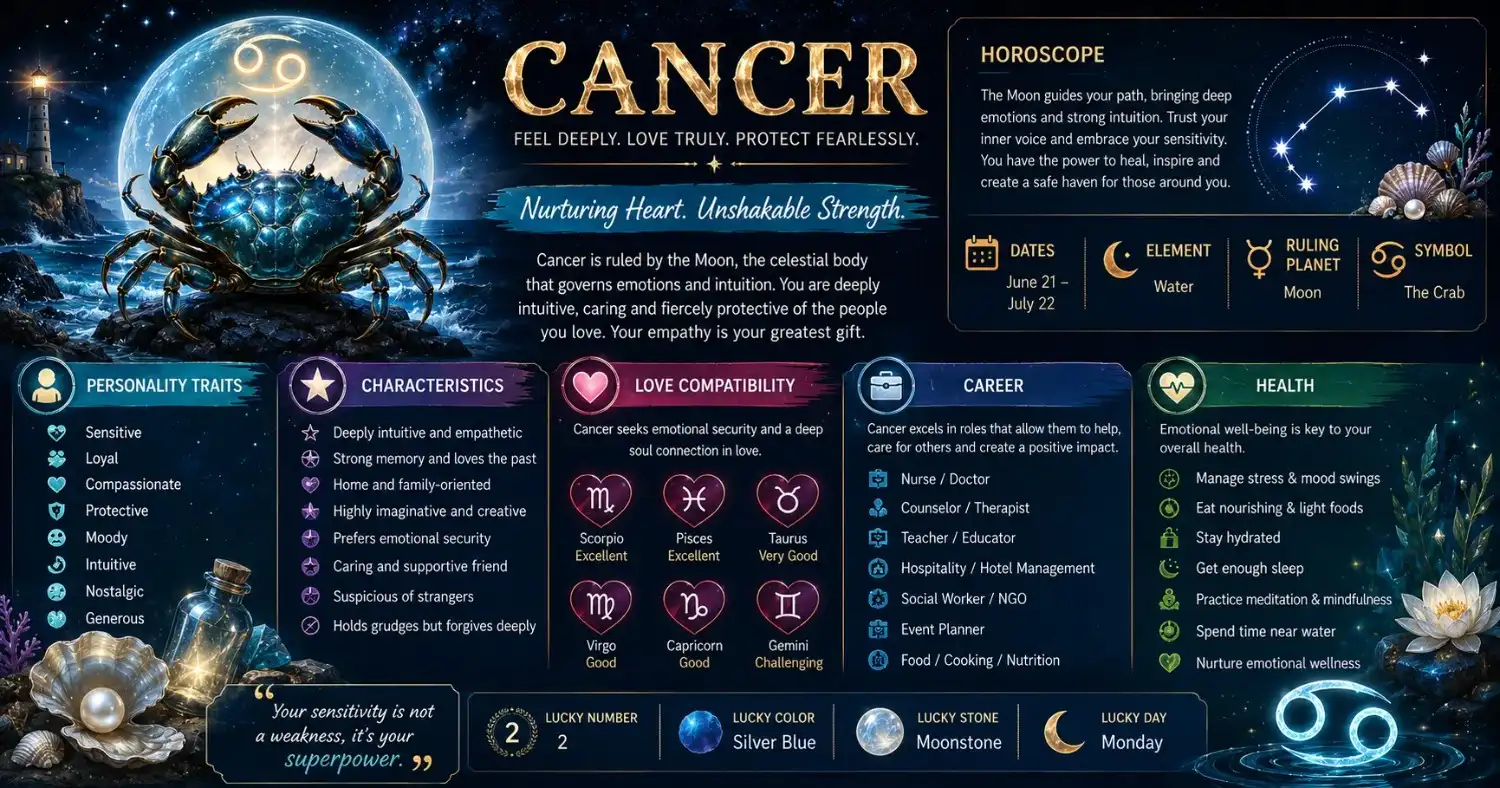
Cancer is the strange one in this exercise. Ask a hundred people around the world what animal the fourth sign of the zodiac represents, and you will not get one answer — you will get a crab, a crayfish, a lobster, and in a few places, no arthropod at all. Where Taurus travels the globe as a single, unmistakable bull, Cancer travels as a small family of related sea creatures, each language picking whichever local claw-bearing animal it knew best.
That inconsistency is not a translation failure. It is a clue to how this sign actually works. Cancer is the zodiac’s most private, most water-bound, most emotionally coded symbol, and the words for it reflect that — soft-shelled, protective, a little evasive, exactly like the sign itself.
This guide walks through every major name for Cancer, how to say each one, what it literally means, and the astrology sitting underneath all of it.
Quick Answer: What Does Cancer Mean in Other Languages?
Cancer means “crab” in Latin. Most languages follow that meaning, though the exact creature shifts by region. Four naming patterns show up again and again:
- They keep the Latin word. Spanish Cáncer, Italian Cancro, Portuguese Câncer, Romanian Rac (a partial exception, see below).
- They translate “crab” (or a close cousin) into their own word. German Krebs, Polish Rak, Turkish Yengeç, Hebrew Sartan.
- They borrow the Sanskrit term. Hindi Kark, Thai Kraka, Khmer Kork, Sinhala Kataka.
- They build a compound with a “constellation” suffix. Chinese Jùxiè zuò, Japanese Kani-za, Korean Ge-jari.
One wrinkle runs through all four patterns: several languages name the sign after a crayfish or a freshwater crab rather than an ocean crab, because that was the animal people actually knew. Keep an eye out for it below.
The Western dates stay fixed: roughly June 21 to July 22. Vedic dates run later: roughly June 15 to July 15. The ruling planet is the Moon everywhere. The element is Water everywhere. The quality is Cardinal everywhere.
Now for the detail.
The Root Meaning of Cancer: Where the Word Comes From
Cancer is the ordinary Latin word for crab. Latin likely borrowed the shape of the word, directly or through an intermediate form, from Ancient Greek καρκίνος (karkínos), also meaning crab. Both words are thought to descend from a very old, echoic root — one of those cases where a language reduplicates a syllable to imitate something, in this case possibly the scuttling, side-clicking motion the animal makes.
English keeps the Latin root in ordinary vocabulary that has nothing to do with astrology: the disease cancer was named because tumors, to ancient physicians, looked like a crab’s body with veins branching outward like legs. Chancre, the medical term for a sore, comes from the same French-filtered root. Cancroid and cancrine both preserve it too.
Sanskrit took a separate route. Karka (कर्क) and Karkaṭa (कर्कट) are the Sanskrit words for crab, and most Indian-language names for the sign trace back to one of those two forms — a parallel inheritance rather than a borrowing from Latin.
So when an astrologer in Chennai says Kadagam and one in Chicago says Cancer, neither one is translating the other. Both are pulling from ancient, independent words that happen to describe the same small, hard-shelled animal.
Why a Crab? The Origin Story Behind the Symbol
Astronomy fixed the constellation. Mythology gave it a story, and the story is smaller and stranger than the tales behind most other signs.
Mesopotamia saw something different
Babylonian astronomers mapped this stretch of sky as MUL.AL.LUL, a name usually translated as “the Crayfish” or sometimes rendered as a turtle-like creature in the older tablets. The identification wasn’t as fixed here as it was for, say, the Bull. Babylonian records show some uncertainty about exactly which small creature belonged in this patch of dim stars, which makes sense: this is one of the faintest constellations in the zodiac, with no bright star to anchor it.
Greece gave it a minor, almost pitiable role
Greek myth ties Cancer to the labors of Heracles. While Heracles fought the multi-headed Hydra in the swamps of Lerna, the goddess Hera — no friend of Heracles — sent a crab named Karkinos to distract him by pinching at his foot. Heracles crushed it without much effort. Hera, appreciating the gesture even in defeat, placed the crab among the stars.
That is, by the standards of Greek mythology, an unusually humble origin. Most zodiac signs get transformed heroes, gods in disguise, or slain monsters worth remembering. Cancer gets a small crustacean that tried, failed instantly, and was rewarded anyway for trying.
Astrologers who lean into this origin point out that it fits the sign surprisingly well. Cancer is not about conquest. It is about persistence in the face of something much larger than itself, and about a kind of loyalty — Hera’s, in this case — that rewards effort rather than results.
Egypt read the sky differently here
Egyptian star charts placed a scarab beetle in roughly this region of the sky rather than a crab. The scarab carried enormous religious weight in Egyptian cosmology — a symbol of the rising sun, transformation, and rebirth, tied to the god Khepri. Some historians argue this scarab imagery is one root of the crab symbol elsewhere in the ancient Mediterranean, since scarab and crab share a hard shell and a sideways, scuttling gait.
India saw Karkataka, guardian of the threshold
Vedic astrology calls the sign Karkataka, and assigns it to the Moon just as Western astrology does. Indian tradition reads Karkataka as the sign of the home, the mother, and emotional memory — a threshold the soul crosses between the outer world and the inner one, the way a crab crosses between water and shore.
Four traditions, four different small creatures or symbols — crab, crayfish, scarab, a Sanskrit crab-cousin — and yet the underlying meaning barely shifts: a soft, vulnerable thing that survives by carrying its shelter with it.
Cancer in Indian Languages: The Vedic Family
The master table for Indian languages
| Language | Native Script | Romanization | Literal Sense |
|---|---|---|---|
| Sanskrit | कर्क / कर्कट | Karka / Karkaṭa | Crab |
| Hindi | कर्क राशि | Kark Rashi | Crab sign |
| Marathi | कर्क रास | Kark Raas | Crab sign |
| Gujarati | કર્ક રાશિ | Kark Rashi | Crab sign |
| Bengali | কর্কট রাশি | Karkat Rashi | Crab sign |
| Odia | କର୍କଟ ରାଶି | Karkat Rashi | Crab sign |
| Punjabi | ਕਰਕ | Kark | Crab sign |
| Nepali | कर्कट राशि | Karkat Rashi | Crab sign |
| Tamil | கடகம் | Kadagam | Crab |
| Telugu | కర్కాటకం | Karkatakam | Crab |
| Kannada | ಕರ್ಕಾಟಕ | Karkataka | Crab |
| Malayalam | കര്ക്കടകം | Karkkidakam | Crab, also fourth month |
| Sinhala | කටක | Kataka | Crab |
| Urdu | برج سرطان | Burj-e-Saratan | House of the Crab |
Sanskrit: Karkataka, the threshold-keeper
Karkaṭa names an ordinary crab, but Sanskrit commentary on the sign leans heavily on the animal’s behavior rather than its shape: a creature that moves sideways, retreats into a shell at the first sign of threat, and lives at the boundary between land and water. Vedic astrologers read Karkataka as the sign of the fourth house of the natural zodiac — home, mother, roots, emotional foundation — a placement the crab’s amphibious, boundary-dwelling nature reflects almost too neatly.
Tamil: Kadagam and the sidereal gap
Tamil astrology, Jothidam, calls the sign கடகம் (Kadagam) and, like all Tamil zodiac terms, runs on the sidereal calendar rather than the Western tropical one. A Tamil speaker born in mid-July through mid-August is the one calling herself Kadagam, not someone born in the Western Cancer window. The gap is the same one that separates Vedic Vrishabha from Western Taurus, and it applies to every sign, Cancer included.
Malayalam: a month as well as a sign
Malayalam calls the sign കര്ക്കടകം (Karkkidakam), and in Kerala that word does double duty: it also names the last month of the Malayalam calendar, a month traditionally associated with monsoon rains, austerity, and the reading of the Ramayana aloud in households. Kerala treats Karkkidakam as a season of retreat and renewal, which lines up closely with how astrologers everywhere describe the sign’s emotional, inward-turning temperament.
Urdu and the Perso-Arabic route
Urdu again splits from Hindi’s Sanskrit lineage and borrows from Arabic through Persian: برج سرطان (Burj-e-Saratan). Saratan is the same root that gives Arabic and Hebrew their words for the sign, discussed below — and, in Arabic medical vocabulary, the same root that names the disease cancer, exactly as in Latin-derived languages.
The nakshatras inside Karkataka
Vedic astrology divides Cancer among three lunar mansions:
- Punarvasu (final quarter) — ruled by Jupiter, symbol a bow and quiver, associated with renewal and return
- Pushya (all four quarters) — ruled by Saturn, symbol a cow’s udder or lotus, widely considered the most auspicious of all twenty-seven nakshatras
- Ashlesha (all four quarters) — ruled by Mercury, symbol a coiled serpent, associated with intensity, cunning, and hidden depths
Pushya sitting fully inside Cancer is worth pausing on. It is the nakshatra most associated with nourishment, care, and steady accumulation — themes that map directly onto how every tradition, Vedic or Western, describes the sign’s emotional and domestic instincts.
Cancer in European Languages
Romance languages
| Language | Name | Pronunciation |
|---|---|---|
| Latin | Cancer | KAN-ker |
| Italian | Cancro | KAN-kroh |
| Spanish | Cáncer | KAN-ser |
| Portuguese | Câncer | KAN-ser |
| French | Cancer | kahn-SEHR |
| Romanian | Rac | rahk |
| Catalan | Cranc | krank |
| Galician | Cangrexo / Cáncer | kan-GREH-shoh |
Romanian breaks the Romance pattern outright. Where its neighbors keep the Latin Cancer for the sign, Romanian says Rac, a plain Slavic-influenced word for crayfish, showing the same instinct that shows up again in the Slavic table below: name the sign after the freshwater animal people actually saw in local rivers, not the seaside animal the Romans had in mind.
Germanic languages
| Language | Name | Literal Meaning |
|---|---|---|
| German | Krebs | Crab, crayfish |
| Dutch | Kreeft | Crayfish, lobster |
| Danish | Krebsen | The Crab |
| Norwegian | Krepsen | The Crab |
| Swedish | Kräftan | The Crayfish |
| Icelandic | Krabbinn | The Crab |
| Afrikaans | Kreef | Crayfish |
This branch is where the crab-versus-crayfish split is sharpest. German Krebs covers both crabs and crayfish without much distinction, but Dutch Kreeft and Swedish Kräftan point specifically at the freshwater crayfish or even the lobster — animals far more familiar in Northern European rivers and coastal waters than a true crab. Ask a Swedish astrologer what animal rules the sign, and you may get an answer closer to “crayfish” than “crab,” and that answer is not a mistranslation; it is the correct native word.
Slavic languages
| Language | Name | Romanization |
|---|---|---|
| Russian | Рак | Rak |
| Ukrainian | Рак | Rak |
| Belarusian | Рак | Rak |
| Bulgarian | Рак | Rak |
| Polish | Rak | Rak |
| Czech | Rak | Rahk |
| Slovak | Rak | Rahk |
| Serbian | Рак / Rak | Rak |
| Croatian | Rak | Rak |
| Slovenian | Rak | Rak |
| Macedonian | Рак | Rak |
Every Slavic language on this list uses some form of Rak, and in nearly all of them, that same word doubles as the ordinary term for crayfish rather than crab, and, unfortunately, also as the everyday word for the disease cancer. A Polish or Russian speaker discussing “Rak” in a medical context and an astrological context is using the identical word, which occasionally makes headlines translate a horoscope column strangely if machine-translated without care.
Baltic, Celtic, and other European branches
| Language | Name | Notes |
|---|---|---|
| Lithuanian | Vėžys | Crayfish |
| Latvian | Vēzis | Crayfish |
| Estonian | Vähk | Crayfish, crab |
| Finnish | Rapu | Crayfish |
| Hungarian | Rák | Crab, crayfish |
| Greek | Καρκίνος (Karkínos) | Crab, the original |
| Albanian | Gaforrja | The crab |
| Basque | Karramarroa | The crab |
| Irish | An Portán | The crab |
| Scottish Gaelic | An Crùbag | The crab |
| Welsh | Y Cranc | The crab |
| Maltese | Kanċer / Granċ | Crab |
| Armenian | Խեցգետին (Khetsgetin) | Crab, crayfish |
| Georgian | კიბო (Kibo) | Crab |
| Turkish | Yengeç | Crab |
Finnish and Estonian, both Finno-Ugric rather than Indo-European, again land on the crayfish rather than the crab — Finnish rapu is the same word Finns use for the crayfish caught and eaten at the country’s traditional summer crayfish parties. Hungarian, also Finno-Ugric, keeps closer to the ambiguous “crab-or-crayfish” middle ground with Rák.
Cancer in Middle Eastern and Semitic Languages
| Language | Native Script | Romanization | Meaning |
|---|---|---|---|
| Arabic | برج السرطان | Burj al-Saratan | House of the Crab |
| Hebrew | מזל סרטן | Mazal Sartan | Constellation of the Crab |
| Persian (Farsi) | سرطان / خرچنگ | Saratan / Kharchang | Crab |
| Turkish | Yengeç Burcu | Yengeç Burjoo | Crab sign |
| Kurdish | Kevjal | Crab | |
| Pashto | سرطان | Saratan | Crab |
| Azerbaijani | Xərçəng | Crayfish, crab | |
| Aramaic | סרטנא | Sartana | Crab |
| Amharic | ጤለ / ካንሰር | Tele / Kanser | Crab |
Arabic and Hebrew: the shared Saratan root
Arabic سرطان (saratan) and Hebrew סרטן (sartan) both trace to a common Semitic root, and both languages use the identical word for the zodiac sign, the star-map constellation, and the medical disease. This is not a coincidence of translation — the disease got its name in these languages for exactly the same ancient reason it did in Latin: the visual resemblance early physicians saw between a spreading tumor and a crab’s outstretched legs was noticed independently across several ancient medical traditions, not only the Greek one.
Hebrew tradition links Cancer to the month of Tammuz and, in some rabbinic sources, to the tribe of Reuben. Kabbalistic writing associates the sign with the qualities of sight, memory, and the protective instinct — themes that map onto the Moon’s rulership almost exactly as they do in Western astrology.
Persian: crab in two vocabularies
Persian formal astrology often uses سرطان (Saratan), the Arabic-derived term, while everyday Persian also recognizes خرچنگ (Kharchang), a native Iranian word for crab used in ordinary speech and on restaurant menus. The pattern echoes Persian’s handling of Taurus, where a native word sits alongside a formal, Arabic-derived astrological term.
Cancer in East Asian Languages
| Language | Native Script | Romanization | Literal Translation |
|---|---|---|---|
| Chinese (Mandarin) | 巨蟹座 | Jùxiè zuò | Giant Crab constellation |
| Chinese (Cantonese) | 巨蟹座 | Geoi6 haai5 zo6 | Giant Crab constellation |
| Japanese | 蟹座 / かに座 | Kani-za | Crab constellation |
| Korean | 게자리 | Ge-jari | Crab seat, Crab place |
| Vietnamese | Cự Giải | Cự Giải | Giant Crab |
| Mongolian | Мэлхий | Melkhii | (Frog-associated regional variant) |
Chinese: the Giant Crab
Mandarin’s 巨蟹座 (Jùxiè zuò) breaks down cleanly: 巨 (jù) means giant or enormous, 蟹 (xiè) means crab, and 座 (zuò) is the same “constellation/seat” suffix used across the whole twelve-sign Western system in Chinese. The “giant” isn’t poetic license — Chinese astrology writers use it simply to distinguish the constellation-scale crab from an ordinary edible one, the same way “Golden Ox” distinguishes the Taurus constellation from a farmyard animal.
As with Taurus and the Chinese zodiac Ox year, it’s worth flagging clearly: 巨蟹座 has nothing to do with any year-based Chinese zodiac animal. The twelve-year Chinese zodiac cycle has no crab in it at all. Jùxiè zuò is purely the imported Western sign, based on birth month.
Traditional Chinese astronomy, working from an entirely separate older system, placed this region of sky under different constellations tied to different lunar mansions, with no crab imagery involved — the crab reading arrived later, alongside the wider import of Western zodiac vocabulary.
Japanese: Kani-za
Japanese writes 蟹座, read かに座 (Kani-za). 蟹 (kani) is the ordinary word for crab — the same character that shows up on the menu at a crab restaurant — and 座 (za) is the constellation suffix, matching Chinese usage. Japanese magazines commonly print the hiragana form かに座 for easy reading, exactly as they do with Taurus.
Korean: Ge-jari
Korean says 게자리 (Ge-jari). 게 (ge) is the native Korean word for crab, and 자리 (jari) is the native “seat/place” suffix Korean attaches to every constellation name in its system, rather than borrowing a Chinese-derived suffix.
Vietnamese: Cự Giải
Vietnamese uses Cự Giải, a Sino-Vietnamese reading that closely mirrors the Chinese “Giant Crab” sense, dropping the constellation suffix the way Vietnamese does across the whole zodiac list.
Cancer in Southeast Asian Languages
| Language | Native Script | Romanization | Source |
|---|---|---|---|
| Thai | ราศีกรกฎ | Rasi Kraka | Sanskrit Karkata |
| Khmer | រាសីកក្កដា | Reasei Kâkda | Sanskrit Karkata |
| Lao | ລາສີກໍລະກົດ | Lasi Kolakot | Sanskrit Karkata |
| Burmese | ကရကဋ်ရာသီ | Karakat Yathi | Sanskrit Karkata |
| Indonesian | Cancer / Kepiting | Cancer | Latin / native “crab” |
| Malay | Cancer / Ketam | Cancer | Latin / native “crab” |
| Filipino (Tagalog) | Cancer / Alimango | Cancer | Latin via Spanish |
Thai and the calendar connection
Thai’s ราศีกรกฎ (Rasi Kraka) borrows rashi from Sanskrit exactly as it does for Taurus, and Kraka is Thai phonology working on Sanskrit Karkata. The same root shows up in the Thai name for the month of July, กรกฎาคม (Karakadakhom) — another case, alongside Malayalam’s Karkkidakam, where a zodiac name and a calendar month are the same word. Khmer follows an identical pattern, and Cambodia’s month of July, កក្កដា (Kâkda), comes from the same source.
Indonesian, Malay, and Filipino
All three largely keep the Latin Cancer, arriving through Dutch, English, or Spanish colonial contact respectively. Native words for crab — Indonesian Kepiting, Malay Ketam, Tagalog Alimango — occasionally appear in casual or descriptive writing but are not the standard astrological terms.
Cancer in African Languages
| Language | Name | Literal Meaning |
|---|---|---|
| Swahili | Saratani / Kaa | Crab |
| Amharic | ካንሰር | Kanser |
| Zulu | Inkalankala | Crab |
| Xhosa | Inkalankala | Crab |
| Yoruba | Akan | Crab |
| Hausa | Kaguwa | Crab |
| Shona | Gakanje | Crab |
| Somali | Qolof | Shellfish, crab |
| Wolof | Sompat | Crab |
Swahili shows the same dual-root pattern seen with Taurus: Saratani, absorbed from Arabic saratan, appears in more formal astrological writing, while Kaa, the everyday Swahili word for crab, shows up in casual references. As with the Taurus list, several African languages lack one single fixed, standardized astrological term for the sign, and writers reach for a descriptive local word rather than an inherited one — check regional usage before publishing rather than assuming a universal form.
Cancer in Symbols and Constructed Languages
The astrological glyph
Cancer uses the symbol ♋, Unicode U+264B. Read plainly, the glyph is usually described as two curled shapes facing each other — often interpreted as a stylized pair of crab claws, or, in a more esoteric reading, as two circles representing the breasts, tying the glyph to the sign’s association with nurture and the maternal body.
Esperanto and constructed languages
Esperanto says Kankro. Interlingua uses Cancer, unmodified from Latin. Both constructed languages keep close to the international scientific root rather than reaching for a native word.
American Sign Language
As with Taurus, ASL has no single codified sign recognized as a universal standard for Cancer. Deaf astrology communities commonly use a handshape suggesting pincers or claws near the chest, sometimes combined with fingerspelling for clarity, with regional variation.
How to Say “I Am a Cancer” in Different Languages
| Language | Phrase |
|---|---|
| Spanish | Soy Cáncer |
| French | Je suis Cancer |
| German | Ich bin Krebs |
| Italian | Sono del Cancro |
| Portuguese | Sou de Câncer |
| Dutch | Ik ben Kreeft |
| Russian | Я Рак (Ya Rak) |
| Polish | Jestem Rakiem |
| Greek | Είμαι Καρκίνος (Eímai Karkínos) |
| Turkish | Ben Yengeç burcuyum |
| Arabic | أنا برج السرطان (Ana burj al-saratan) |
| Hebrew | אני מזל סרטן (Ani mazal sartan) |
| Persian | من متولد سرطان هستم (Man motavalled-e saratan hastam) |
| Hindi | मेरी राशि कर्क है (Meri rashi Kark hai) |
| Tamil | என் ராசி கடகம் (En rasi Kadagam) |
| Telugu | నా రాశి కర్కాటకం (Naa rasi Karkatakam) |
| Malayalam | എന്റെ രാശി കര്ക്കടകം (Ente rashi Karkkidakam) |
| Urdu | میرا برج سرطان ہے (Mera burj Saratan hai) |
| Chinese | 我是巨蟹座 (Wǒ shì jùxiè zuò) |
| Japanese | 私は蟹座です (Watashi wa kani-za desu) |
| Korean | 저는 게자리예요 (Jeoneun ge-jari-yeyo) |
| Thai | ฉันเป็นราศีกรกฎ (Chan pen rasi kraka) |
| Vietnamese | Tôi là cung Cự Giải |
| Swahili | Mimi ni Saratani |
The Date Problem: Why Cancer Starts on Different Days
Western (tropical) astrology
Tropical astrology, anchored to the seasons, puts Cancer at roughly June 21 to July 22, beginning with the summer solstice in the northern hemisphere — the sun’s highest point, its turning point, right at the start of the sign named for a creature that walks sideways and doubles back.
Vedic (sidereal) astrology
Sidereal Karkataka runs later, roughly June 15 to July 15, shifted by the same accumulated precession gap — about 24 degrees over two millennia — that separates every sidereal sign from its tropical counterpart.
The constellation boundaries
Under the modern, astronomically fixed constellation boundaries drawn by the International Astronomical Union in 1930, the sun actually passes through the faint stars of the Cancer constellation from roughly July 21 to August 10 — later still, and briefer, since Cancer is one of the least conspicuous constellations along the ecliptic. This astronomical fact, again, is not an astrology change; it simply reflects that the twelve equal thirty-degree divisions astrologers use have never lined up neatly with the constellations’ real, uneven boundaries.
What Cancer Actually Means: The Astrology Underneath the Words
The core signature
- Element: Water
- Modality: Cardinal
- Ruling planet: The Moon (Chandra in Vedic astrology)
- Symbol: The Crab
- Polarity: Receptive, yin, feminine
- House correspondence: Fourth house
- Exaltation: Jupiter, exalted at 15 degrees Cancer
- Detriment: Saturn
- Body rulership: Chest, breasts, stomach, digestive system
- Tarot correspondence: The Chariot
- Colors: Silver, white, sea green
- Stones: Moonstone, pearl, opal
- Season: The start of summer in the northern hemisphere
Cardinal Water, explained properly
Cardinal signs initiate. Water signs feel first and think second. Put the two together, and Cancer becomes the sign that starts things through emotion — the one that acts on instinct, protects on instinct, and commits on instinct, long before logic gets a vote.
That combination is the source of nearly every trait attributed to Cancer in every tradition: nurturing, moodiness, defensiveness, deep loyalty, and an unusually strong pull toward home.
The Moon rules through mood, not mind
The Moon governs Cancer alone — no other sign shares its rulership, unlike Venus splitting duty between Taurus and Libra. That singularity matters. Every lunar theme concentrates in one place: memory, habit, the body’s rhythms, the need for safety, the pull of the past.
Vedic astrology names the same body Chandra, and assigns it near-identical territory: mind, mother, emotional receptivity, and the tides of feeling that rise and fall like the ocean the Moon itself governs.
Jupiter’s exaltation adds abundance to the shell
Jupiter reaches exaltation in Cancer, a placement both Western and Vedic astrology recognize. Practically, this pairs the sign’s protective instinct with generosity — Cancer doesn’t just guard what it has, it tends to want to grow the household, feed the family, expand the nest.
Core strengths
Cancer reads a room before it speaks. Emotional intelligence comes naturally here, along with an instinct for when someone nearby is struggling before that person says a word.
Cancer builds home like a life’s work. Fourth-house energy, personal foundations, family, and root all belong to Cancer, and the sign treats domestic life as seriously as an ambitious Capricorn treats a career.
Cancer remembers everything. The Moon governs memory, and Cancer carries the emotional history of every relationship it has ever had, for better and for worse.
Cancer protects fiercely. Once something is inside the shell — a person, a project, a cause — Cancer will defend it well past the point most other signs would have given up.
Core challenges
Cancer retreats instead of confronting. The shell exists for a reason, and sometimes that reason is avoidance rather than genuine danger.
Cancer takes things personally that were never personal. A moody, receptive nature reads slights into ordinary events more often than it should.
Cancer clings to the past. Emotional memory is a strength until it becomes an inability to let go of an old hurt, an old relationship, or an old version of a person who has since changed.
Cancer can smother the people it loves most. Nurturing, unchecked, tips into overprotection or guilt-driven control.
Does the meaning change by culture?
The tone shifts. The substance holds.
Western pop astrology emphasizes Cancer’s moodiness and homebody instincts, often reading the sign as the zodiac’s emotional caretaker.
Vedic astrology reads Karkataka through planetary periods and house placement, with particular attention to the mother, property, and emotional security across a lifetime.
Chinese-language horoscope writing, working from the “Giant Crab” name, sometimes emphasizes protectiveness and territorial instinct over pure emotion.
Arabic and Hebrew traditions, sharing the saratan/sartan root with the word for the disease, occasionally lean into imagery of tenacity and holding on — a crab’s grip is proverbially hard to break in both language traditions.
Different emphasis. Same crab. The instinct to protect what’s inside the shell doesn’t change when the word for the shell changes.
Star Names Inside Cancer Across Cultures
Cancer has no bright anchor star the way Taurus has Aldebaran — it is one of the faintest constellations along the zodiac. What it does have is a striking naked-eye star cluster, and that cluster carries a rich set of names across cultures.
The Beehive Cluster, Praesepe
| Culture | Name | Meaning |
|---|---|---|
| Latin | Praesepe | The manger, crib, or stall |
| Greek (Aratus) | Nephelion | Little Cloud |
| Greek (Ptolemy) | — | “The nebulous mass in the breast of Cancer” |
| Arabic | Al Ma’laf | The Stall |
| Chinese | 積屍氣 (Jīshī qì) | Exhalation of the Piled-up Corpses |
| Modern popular name | Beehive Cluster | — |
Ancient Greek and Roman skywatchers pictured this hazy patch as a manger, flanked by two donkeys — the stars Asellus Borealis and Asellus Australis, the Northern and Southern Ass — feeding from it. One version of the myth holds that these were the donkeys ridden by Dionysus and Silenus into battle against the Titans; their braying so startled the Titans that the gods won, and the donkeys were placed in the sky as thanks.
Chinese astronomy, working from an entirely separate observational tradition, saw the same faint smudge and read it as something closer to a graveyard haze — a genuinely unrelated, much darker interpretation of the identical patch of sky, which says less about the stars than about how differently two traditions can read the exact same faint object.
Galileo was the first to resolve Praesepe into individual stars through a telescope in 1609, ending nearly two thousand years of it being described only as a nebulous cloud.
Common Mistakes and Mistranslations to Avoid
Mistake 1: Assuming every language means the same animal. German, Dutch, and Swedish speakers may genuinely mean crayfish, not ocean crab. That is not sloppy translation — it is the correct native term.
Mistake 2: Confusing the sign with the disease. Arabic saratan, Hebrew sartan, and several Slavic forms of rak are the identical word for the zodiac sign and for the illness. Context, not spelling, tells you which is meant.
Mistake 3: Assuming Karkataka and Cancer share dates. They don’t. The sidereal and tropical zodiacs are roughly three and a half weeks apart, exactly as with every other sign.
Mistake 4: Mixing up 巨蟹座 with any year-based Chinese zodiac animal. There is no crab in the twelve-year Chinese zodiac cycle. Jùxiè zuò is purely the imported Western sign.
Mistake 5: Treating Romanian “Rac” as an error. It isn’t. Romanian genuinely names the sign after the crayfish, matching its Slavic neighbors rather than its Romance-language cousins.
Mistake 6: Machine-translating without checking context. Automatic translation tools can render “Cancer” as the disease by default in many languages, since that is usually the far more common use of the word. Always verify with a native speaker for anything published.
Frequently Asked Questions
What does Cancer mean in English?
Cancer means “the Crab.” English borrowed the word directly from Latin cancer, the ordinary Latin word for a crab, and uses it for the constellation, the zodiac sign, and, separately, the unrelated medical condition named for a visual resemblance ancient physicians noticed.
What is Cancer called in Hindi?
Hindi calls Cancer कर्क राशि (Kark Rashi), “crab sign,” from Sanskrit Karka, meaning crab.
What is Cancer in Tamil?
Tamil calls Cancer கடகம் (Kadagam), meaning crab, and follows the sidereal calendar rather than the Western tropical one.
What is Cancer called in Malayalam?
Malayalam calls Cancer കര്ക്കടകം (Karkkidakam). The same word names the final month of the Malayalam calendar, traditionally a season of monsoon rains and quiet renewal.
What is Cancer in Arabic?
Arabic calls Cancer برج السرطان (Burj al-Saratan), “house of the crab.” The root saratan is shared with the Arabic word for the disease cancer.
What is Cancer in Chinese?
Chinese calls Cancer 巨蟹座 (Jùxiè zuò), “Giant Crab constellation.” It has no connection to any animal year in the twelve-year Chinese zodiac cycle.
What is Cancer in Japanese?
Japanese calls Cancer 蟹座, read かに座 (Kani-za), “crab constellation.”
What is Cancer in Korean?
Korean calls Cancer 게자리 (Ge-jari), using the native Korean words for crab and place/seat.
What is the Urdu name for Cancer?
Urdu calls Cancer برج سرطان (Burj-e-Saratan), borrowed from Arabic through Persian, in contrast to Hindi’s Sanskrit-derived Kark.
Does Cancer mean the same thing in every language?
Broadly yes, though the exact creature varies — crab in most languages, crayfish in several Germanic, Baltic, and Finno-Ugric ones. The astrological meaning stays far more consistent: cardinal water, ruled by the Moon, tied to home, emotion, and protection.
Why do Vedic and Western Cancer dates differ?
Western tropical astrology anchors to the solstice, giving roughly June 21 to July 22. Vedic sidereal astrology anchors to the fixed stars, giving roughly June 15 to July 15, a gap caused by the precession of the equinoxes over about two thousand years.
What is the Cancer symbol called?
The symbol is ♋, Unicode U+264B, usually read as a pair of curled crab claws facing each other.
Which planet rules Cancer in every tradition?
The Moon rules Cancer in Western astrology, and Chandra, its Vedic equivalent, rules Karkataka in Indian astrology. No other planet shares the rulership in either system.
What does Karkataka mean in Sanskrit?
Karkaṭa simply means crab. Vedic commentary emphasizes the animal’s sideways movement and its life at the boundary between land and water as a metaphor for the sign’s role governing home and emotional threshold.
Is Cancer the same as any animal in the Chinese zodiac?
No. The twelve-year Chinese zodiac cycle has no crab. 巨蟹座 is purely the imported Western sign, based on birth month rather than birth year.
What is Cancer in Thai?
Thai calls Cancer ราศีกรกฎ (Rasi Kraka), from Sanskrit Karkata. The Thai word for July, กรกฎาคม, comes from the same root.
What star cluster sits inside Cancer?
The Beehive Cluster, also called Praesepe, Latin for “manger.” Ancient Greek and Roman skywatchers pictured two donkeys feeding from it; Chinese tradition read the same hazy patch very differently, as an “exhalation of piled-up corpses.”
Key Takeaways
Cancer resists tidy translation in a way Taurus never does, and that resistance says something true about the sign. A bull is a bull everywhere. A crab is sometimes a crayfish, sometimes a lobster, sometimes, in Egypt’s older sky-charts, a scarab beetle entirely. The sign that rules home, memory, and the soft parts people keep hidden under a hard shell turns out to be the hardest of all twelve to pin down with one universal image — which feels, on reflection, exactly right for a sign this private.
Remember these essentials:
- Cancer means “crab” in Latin, though many languages substitute a local crayfish, lobster, or related creature.
- Four naming patterns recur: Latin borrowing, native translation, Sanskrit borrowing, and constellation compounds.
- India, Southeast Asia, and Sri Lanka use forms of Sanskrit Karkata.
- Several Germanic, Baltic, and Finno-Ugric languages name the sign after a crayfish rather than an ocean crab.
- Arabic and Hebrew share the saratan/sartan root with their own word for the disease cancer.
- East Asia built descriptive “crab constellation” compounds, unconnected to any year-based Chinese zodiac animal.
- The Moon rules the sign alone, in every tradition, without sharing rulership.
- Jupiter reaches exaltation here in both Western and Vedic systems.
- Western dates run roughly June 21 to July 22. Vedic dates run roughly June 15 to July 15.
Whatever word your language uses, the sign describes the same instinct. Build a shell. Protect what’s inside it. Retreat when the world gets sharp, and come out again once it’s safe. The crab doesn’t fight the tide. The crab waits it out.
This article covers astrological tradition and comparative linguistics. Astrology is a symbolic and cultural system, not a science, and should be used for reflection rather than medical, financial, or legal decisions.