
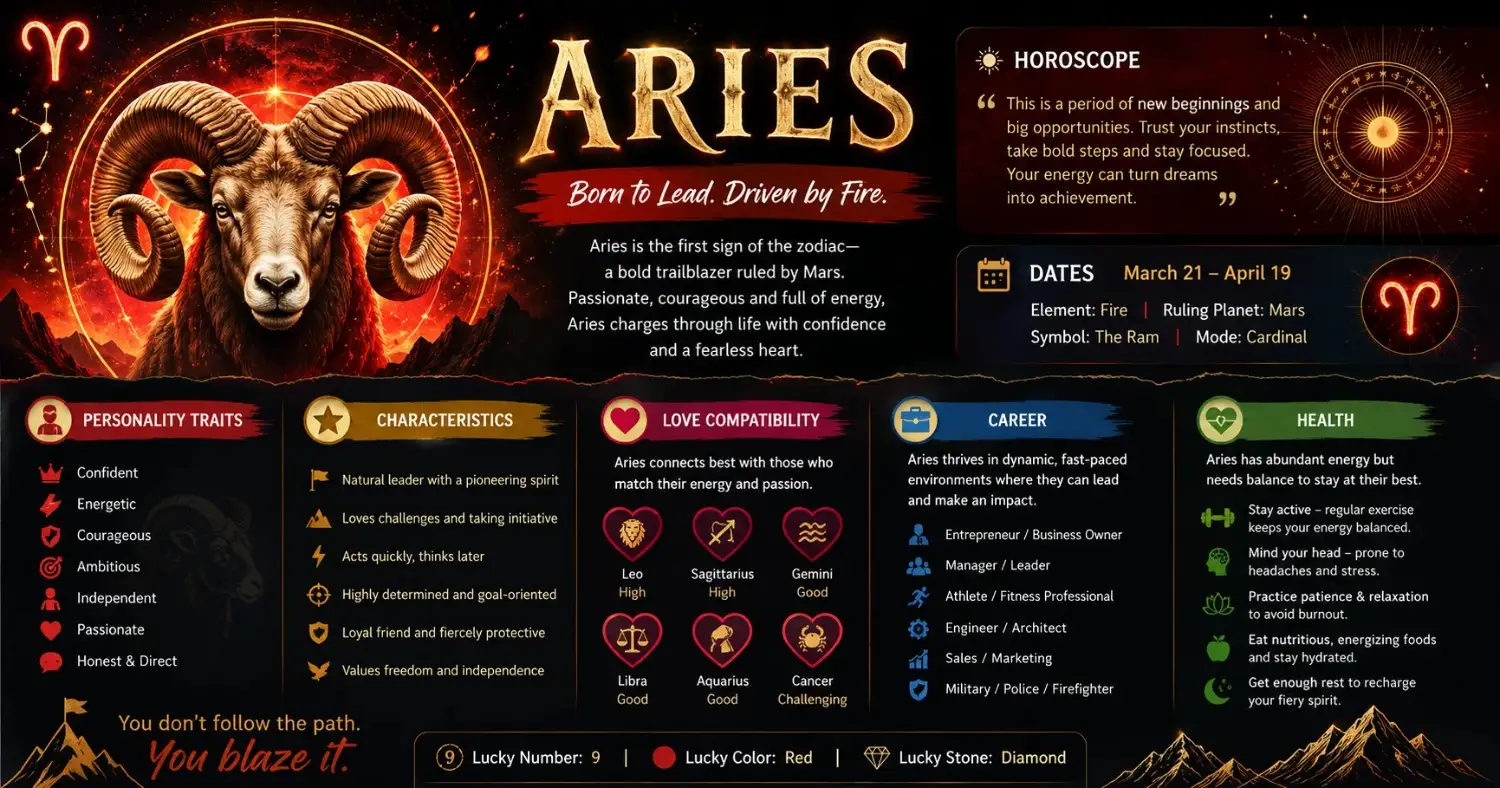
Aries opens the zodiac. It also opens a fascinating linguistic puzzle. Travel from Lisbon to Lucknow to Luoyang, and the sign keeps its meaning but changes its name at almost every border. A Spaniard says Aries. A German says Widder. A Hindi speaker says मेष (Mesh). A Japanese speaker says 牡羊座 (Ohitsuji-za). All four people mean the same 30-degree slice of sky. All four picture the same animal.
This guide maps that entire landscape. I have spent years reading charts across both Western and Vedic systems, and the language question comes up constantly. Clients ask why their Indian horoscope calls them Mesh while their app calls them Aries. Students ask how to pronounce Овен or Κριός. Travelers want to introduce their sign in a new language without sounding awkward.
You will find every answer below. I cover 100+ languages, the etymology behind each name, the pronunciation, the date differences between systems, the mythology, and the personality meaning that stays constant no matter what you call it.
Quick Answer: What Does Aries Mean in Other Languages?
Aries means “the Ram” in almost every language on earth. The Latin word aries literally translates to “ram,” a male sheep. Most languages either borrow the Latin word directly or translate the animal into their own vocabulary.
Here are the most searched translations at a glance:
| Language | Name for Aries | Literal Meaning |
|---|---|---|
| Latin | Ariēs | Ram |
| Greek | Κριός (Kriós) | Ram |
| Sanskrit | मेष (Meṣa) | Ram |
| Arabic | الحمل (Al-Hamal) | The Lamb / Ram |
| Hindi | मेष (Mesh) | Ram |
| Spanish | Aries | Ram (borrowed) |
| French | Bélier | Ram |
| German | Widder | Ram |
| Chinese | 白羊座 (Báiyáng zuò) | White Sheep Constellation |
| Japanese | 牡羊座 (Ohitsuji-za) | Male Sheep Constellation |
| Russian | Овен (Oven) | Ram |
| Hebrew | טלה (Taleh) | Lamb |
| Turkish | Koç | Ram |
| Korean | 양자리 (Yangjari) | Sheep Place |
The pattern holds worldwide. Cultures separated by oceans and millennia looked at the same faint cluster of stars and saw a horned sheep charging forward.
Why the Name Changes but the Meaning Never Does
Language shifts. Symbolism sticks.
The Aries constellation carries one of the oldest continuous identities in the sky. Babylonian astronomers recorded it as the “Agrarian Worker” in early records. By the late Babylonian period, they had already recast it as a ram or hired laborer tied to sheep. The Greeks inherited the image and called it Krios. The Romans translated Krios into Aries. Indian astronomers, working through their own long tradition and later in dialogue with Hellenistic sources, used Meṣa, the Sanskrit word for ram.
Every later translation followed that chain. A translator in Warsaw or Tokyo or Nairobi faced a simple task: find the local word for “ram.” That is why you see Baran in Polish, Oinas in Finnish, Kondoo in Swahili, and Hrútur in Icelandic. The linguistic surface changes. The horned animal underneath never moves.
Two exceptions matter. First, some languages skipped translation entirely and adopted the Latin word as an international term. Spanish, Portuguese, Indonesian, Filipino, and Catalan all fall into this group. Second, Arabic-influenced traditions preserved Al-Hamal, which passed into Swahili, Persian, Urdu, and Amharic as a religious and scientific loanword.
The Four Root Traditions Behind Every Aries Name
Understanding four source languages unlocks the entire global list.
1. Akkadian: The Oldest Layer
Mesopotamian sky-watchers laid the foundation. Their star lists named this region with terms tied to sheep and hired hands. Scholars trace the Greek Krios back through this Akkadian layer. When you say “Aries,” you echo a naming decision made in Mesopotamia roughly 3,000 years ago.
2. Ancient Greek: Κριός (Kriós)
Greek astronomers formalized the zodiac we recognize today. Krios means ram. Modern Greek still uses the exact same word. A Greek speaker born in early April says Κριός with no translation needed. Pronounce it “kree-OS,” with stress on the second syllable.
3. Latin: Ariēs
Rome translated Greek astronomy wholesale. Aries became the standard scientific label, and it survives in astronomical notation to this day. The constellation abbreviation is Ari. The genitive form is Arietis, which appears in star names like Alpha Arietis (Hamal) and Beta Arietis (Sheratan).
Notice something important. Aries connects to Ares, the Greek war god, only through the planet Mars. The words share a rough sound, not a root. The ram, not the god, gives Aries its name. Astrologers still associate the sign with martial energy, but that link runs through Mars as ruling planet.
4. Sanskrit: मेष (Meṣa)
India developed a parallel and equally ancient system. Meṣa means ram. From Sanskrit, the name spread across the subcontinent and into Southeast Asia. Thai, Khmer, Lao, Burmese, and Sinhala versions all descend from Meṣa. Burmese texts record it as မိဿ (Meittha), a direct adaptation of the Sanskrit term.
Aries in All Languages: Complete Reference Tables
I have organized this master list by language family. That grouping makes the patterns visible. You will notice how neighboring languages share roots, and how the “ram” concept survives every jump.
Aries in Romance Languages
Romance languages descend from Latin. Some kept Aries untouched. Others translated it into their everyday word for ram.
| Language | Aries Name | Pronunciation Guide | Notes |
|---|---|---|---|
| Spanish | Aries | AH-ree-es | Direct Latin borrowing |
| Portuguese | Áries | AH-ree-ish | Accent marks the stress |
| Italian | Ariete | ah-ree-EH-teh | From Latin arietem |
| French | Bélier | bay-LYAY | Native French word for ram |
| Romanian | Berbec | ber-BEK | Native word for ram |
| Catalan | Àries | AH-ree-es | Latin borrowing |
| Galician | Aries | AH-ree-es | Matches Spanish |
| Occitan | Aret | ah-RET | Related to ariete |
| Sardinian | Arieti | ah-ree-EH-tee | Regional variant |
| Corsican | Ariete | ah-ree-EH-teh | Matches Italian |
| Latin | Ariēs | AH-ree-ays | The source word |
French stands out. Bélier comes from Old French and has no visible Latin trace. A French horoscope column runs under the heading Bélier, never Aries. If you tell a Parisian “je suis Aries,” they will understand but correct you gently. Say “Je suis Bélier.”
Aries in Germanic Languages
Germanic languages translated aggressively. Almost none borrowed the Latin.
| Language | Aries Name | Pronunciation Guide | Literal Meaning |
|---|---|---|---|
| German | Widder | VID-der | Ram |
| Dutch | Ram | rahm | Ram |
| Afrikaans | Ram | rahm | Ram |
| Swedish | Väduren | VEH-doo-ren | The Ram |
| Norwegian | Væren | VEH-ren | The Ram |
| Danish | Vædderen | VEH-the-ren | The Ram |
| Icelandic | Hrútur | HROO-tur | Ram |
| Faroese | Veðrurin | VEH-ru-rin | The Ram |
| Yiddish | ווידער (Vider) | VEE-der | Ram |
| English | Aries | AIR-eez | Ram (Latin borrowing) |
English is the odd one out in its own family. Old English did have the word ramm, and medieval texts sometimes used “the Ram.” Modern English settled on the Latin form instead. Scandinavian languages all attach a definite article as a suffix, which is why Swedish gives you Väduren rather than plain Vädur.
Aries in Slavic Languages
Slavic languages show remarkable consistency. Two root words dominate: oven and baran.
| Language | Aries Name | Pronunciation Guide | Literal Meaning |
|---|---|---|---|
| Russian | Овен (Oven) | OH-ven | Ram |
| Ukrainian | Овен (Oven) | OH-ven | Ram |
| Belarusian | Авен (Aven) | AH-ven | Ram |
| Polish | Baran | BAH-ran | Ram |
| Czech | Beran | BEH-ran | Ram |
| Slovak | Baran | BAH-ran | Ram |
| Slovenian | Oven | OH-ven | Ram |
| Croatian | Ovan | OH-van | Ram |
| Serbian | Ован (Ovan) | OH-van | Ram |
| Bosnian | Ovan | OH-van | Ram |
| Bulgarian | Овен (Oven) | OH-ven | Ram |
| Macedonian | Овен (Oven) | OH-ven | Ram |
Russian speakers rarely write “Aries” at all. Horoscope sections in Russian newspapers list Овен first, followed by Телец for Taurus. If you study Russian, learning this single word unlocks the whole zodiac column.
Aries in Baltic, Uralic, and Celtic Languages
These families sit outside the Romance-Germanic-Slavic mainstream, yet the ram survives intact.
| Language | Aries Name | Pronunciation Guide | Literal Meaning |
|---|---|---|---|
| Lithuanian | Avinas | AH-vee-nas | Ram |
| Latvian | Auns | OWNS | Ram |
| Estonian | Jäär | YAAR | Ram |
| Finnish | Oinas | OY-nas | Ram |
| Hungarian | Kos | KOSH | Ram |
| Irish | An Reithe | un REH-heh | The Ram |
| Scottish Gaelic | An Reithe | un REH-heh | The Ram |
| Welsh | Yr Hwrdd | ur HOORTH | The Ram |
| Breton | Ar Maout | ar MAH-oot | The Ram |
| Basque | Aries / Ahari | AH-ree-es | Ram |
| Maltese | Muntun | mun-TOON | Ram |
| Albanian | Dashi | DAH-shee | The Ram |
| Greek (Modern) | Κριός (Krios) | kree-OS | Ram |
Hungarian deserves a note. Kos sounds nothing like any neighbor, because Hungarian belongs to the Uralic family, not the Indo-European one. Finnish and Estonian share that background. All three still chose the ram.
Aries in Indian Languages: The Mesha Family
India presents the richest variety. Every major Indian language carries its own form of Meṣa, and the sign appears constantly in daily life through newspapers, matchmaking, and festival calendars.
| Language | Aries Name | Romanization | Notes |
|---|---|---|---|
| Sanskrit | मेष | Meṣa | The source form |
| Hindi | मेष | Mesh | Also “Mesh Rashi” |
| Marathi | मेष | Mesh | Same script as Hindi |
| Nepali | मेष | Mesh | Same script as Hindi |
| Bengali | মেষ | Mesh | Bengali script |
| Assamese | মেষ | Mekh | Assamese script |
| Gujarati | મેષ | Mesh | Gujarati script |
| Punjabi | ਮੇਖ | Mekh | Gurmukhi script |
| Odia | ମେଷ | Mesha | Odia script |
| Tamil | மேஷம் | Mesham | Also “Mesha Raasi” |
| Telugu | మేషం | Mesham | Telugu script |
| Kannada | ಮೇಷ | Mesha | Kannada script |
| Malayalam | മേടം | Medam | Distinct local form |
| Konkani | मेष | Mesh | Devanagari script |
| Sindhi | ميخ | Mekh | Arabic script |
| Kashmiri | میٖکھ | Mekh | Perso-Arabic script |
| Urdu | حمل | Hamal | Arabic-derived, not Sanskrit |
| Tulu | ಮೇಷ | Mesha | Kannada script |
| Bhojpuri | मेष | Mesh | Devanagari script |
| Manipuri | ꯃꯦꯁ | Mesha | Meitei script |
Two entries break the pattern in useful ways.
Malayalam uses മേടം (Medam) rather than a direct Mesha form. Kerala’s solar calendar names its first month Medam, and it begins around April 14 with the Vishu festival. That calendar link makes Medam a living civil term, not just an astrological one.
Urdu uses حمل (Hamal), drawn from Arabic rather than Sanskrit. This split reflects Urdu’s Perso-Arabic scholarly heritage. A Pakistani newspaper horoscope prints Hamal. An Indian Hindi newspaper prints Mesh. The same sky, two different intellectual lineages.
Aries in Middle Eastern and Central Asian Languages
The Arabic term Al-Hamal traveled as far as the Latin term did. It survives in the star name Hamal, the brightest star in the Aries constellation.
| Language | Aries Name | Romanization | Literal Meaning |
|---|---|---|---|
| Arabic | الحمل | Al-Hamal | The Lamb / Ram |
| Hebrew | טלה | Taleh | Lamb |
| Persian (Farsi) | حمل / بره | Hamal / Barre | Lamb |
| Turkish | Koç | Koch | Ram |
| Azerbaijani | Qoç | Goch | Ram |
| Kurdish | Beran | Beran | Ram |
| Pashto | وری | Wray | Lamb |
| Armenian | Խոյ | Khoy | Ram |
| Georgian | ვერძი | Verdzi | Ram |
| Kazakh | Тоқты | Toqty | Young Ram |
| Uzbek | Qoʻchqor | Qochqor | Ram |
| Kyrgyz | Кой | Koy | Sheep |
| Tajik | Ҳамал | Hamal | Lamb |
| Turkmen | Guzy | Guzy | Lamb |
Hebrew טלה (Taleh) means lamb specifically. The Hebrew zodiac tradition, documented in medieval Jewish astrological works and visible in ancient synagogue mosaics, uses Taleh as the first sign. The Hebrew month Nisan aligns with this period.
Persian keeps both options. Classical astronomical texts use حمل (Hamal), borrowed from Arabic. Everyday modern usage often prefers بره (Barre), the ordinary Persian word for lamb. The Afghan solar calendar still names its first month Hamal, starting at the spring equinox.
Aries in East Asian Languages
East Asia received Western astrology relatively late, mostly through translation in the modern era. The results are beautifully literal.
| Language | Aries Name | Romanization | Literal Meaning |
|---|---|---|---|
| Mandarin Chinese | 白羊座 | Báiyáng zuò | White Sheep Constellation |
| Traditional Chinese | 牡羊座 | Mǔyáng zuò | Male Sheep Constellation |
| Cantonese | 白羊座 | Baak-joeng-zo | White Sheep Constellation |
| Japanese | 牡羊座 / おひつじ座 | Ohitsuji-za | Male Sheep Constellation |
| Korean | 양자리 | Yangjari | Sheep Place |
| Mongolian | Хонь | Khoni | Sheep |
| Tibetan | ལུག | Luk | Sheep |
| Vietnamese | Bạch Dương | Bak Yuong | White Sheep |
A critical point for learners: East Asian languages distinguish the Western zodiac from their own animal zodiac. Chinese speakers use 星座 (xīngzuò) for the twelve Western sun signs and 生肖 (shēngxiào) for the twelve-year animal cycle. Asking a Chinese friend “what’s your sign” produces different answers depending on which system you name.
Japanese uses two written forms. 牡羊座 appears in print and formal writing. おひつじ座 uses hiragana for readability, common in magazines and apps. Both read as Ohitsuji-za.
Mainland Chinese usage favors 白羊座 (white sheep). Taiwanese usage favors 牡羊座 (male sheep). Both mean Aries and both are correct in their regions.
Aries in Southeast Asian Languages
Southeast Asia sits at the crossroads. Indian influence dominates the older layer, while English influence shapes newer vocabulary.
| Language | Aries Name | Romanization | Root Source |
|---|---|---|---|
| Thai | ราศีเมษ | Rasi Met | Sanskrit Meṣa |
| Khmer | រាសីមេស | Reasey Mes | Sanskrit Meṣa |
| Lao | ລາສີເມດ | Lasi Met | Sanskrit Meṣa |
| Burmese | မိဿ | Meittha | Sanskrit Meṣa |
| Sinhala | මේෂ | Mesha | Sanskrit Meṣa |
| Indonesian | Aries | Aries | Latin |
| Malay | Aries | Aries | Latin |
| Filipino / Tagalog | Aries | Aries | Latin |
| Javanese | Aries | Aries | Latin |
| Cebuano | Aries | Aries | Latin |
Thai adds the prefix ราศี (rasi), meaning “zodiac sign,” borrowed directly from Sanskrit rāśi. That same word appears in Hindi as rashi and in Tamil as raasi. One Sanskrit term binds astrology from Chennai to Bangkok.
Aries in African Languages
African naming reflects trade routes, Islamic scholarship, and colonial language contact.
| Language | Aries Name | Region | Literal Meaning |
|---|---|---|---|
| Swahili | Hamali / Kondoo | East Africa | Lamb / Sheep |
| Amharic | ሐመል (Hamal) | Ethiopia | Lamb |
| Somali | Hamal / Wan | Horn of Africa | Lamb / Ram |
| Hausa | Rago | West Africa | Ram |
| Yoruba | Àgbò | Nigeria | Ram |
| Igbo | Ebune | Nigeria | Ram |
| Zulu | Inqama | South Africa | Ram |
| Xhosa | Inkunzi yegusha | South Africa | Male Sheep |
| Shona | Gondohwe | Zimbabwe | Ram |
| Malagasy | Alahamady | Madagascar | From Arabic Al-Hamal |
Swahili preserves both layers at once. Hamali comes straight from Arabic through centuries of Indian Ocean trade. Kondoo is the native Swahili word for sheep. Astrological columns in Swahili often print both.
Malagasy is a linguistic marvel. Alahamady is the first month of the traditional Malagasy calendar, and its name descends from Arabic Al-Hamal despite Madagascar sitting thousands of miles from the Arabian Peninsula. Arab traders carried the astrological calendar down the East African coast, and Malagasy absorbed it.
The Igbo term Ebune carries a cultural weight worth noting. Ram ceremonies among Igbo communities historically marked seasonal renewal, and the ram symbolized a blend of ferocity and humility. That mirrors the Aries archetype almost exactly, despite developing independently.
Aries in Other Notable Languages
| Language | Aries Name | Notes |
|---|---|---|
| Esperanto | Ŝafo / Arieso | Constructed language |
| Hawaiian | Hipa Kāne | Male sheep |
| Maori | Aries | Borrowed term |
| Samoan | Aries | Borrowed term |
| Quechua | Aries | Borrowed term |
| Haitian Creole | Belye | From French Bélier |
| Papiamento | Aries | Caribbean creole |
| Interlingua | Ariete | Constructed language |
How to Pronounce Aries Around the World
Reading a word is one thing. Saying it correctly builds real connection. Here are the pronunciations people most often get wrong.
German — Widder. Say “VID-der.” The W sounds like an English V. The double D stays short and crisp.
French — Bélier. Say “bay-LYAY.” Skip the final R sound entirely. The accent on the first E gives it an “ay” quality.
Russian — Овен. Say “OH-ven.” Stress lands on the first syllable. Many learners stress the second by mistake.
Greek — Κριός. Say “kree-OS.” Stress lands on the second syllable. The R gets a light tap.
Japanese — 牡羊座. Say “oh-hee-tsu-jee-zah.” Keep every syllable equal in length. Japanese does not stress syllables the way English does.
Chinese — 白羊座. Say “bye-yahng-dzwaw.” The tones run second, second, fourth. Tone accuracy matters here.
Turkish — Koç. Say “koch.” The Ç carries a “ch” sound like in “church.”
Hebrew — טלה. Say “tah-LEH.” Stress falls on the final syllable, as in most Hebrew nouns.
Tamil — மேஷம். Say “MAY-sham.” The final M is soft and nearly swallowed.
Icelandic — Hrútur. Say “HROO-tur.” The HR blend gets a breathy start unfamiliar to English speakers.
Hungarian — Kos. Say “kosh.” The S in Hungarian always sounds like English SH.
Mesha vs. Aries: Why Your Birth Sign May Differ
This causes more confusion than any translation question. Two people can share a birthday and receive different signs. Both readings are internally correct.
The Tropical Zodiac (Western System)
Western astrology uses the tropical zodiac, anchored to the seasons. Aries begins at the spring equinox. The Sun moves through Aries from roughly March 21 to April 19 every year.
This system measures the Sun’s position relative to Earth’s seasonal cycle. It ignores the slow drift of the background stars.
The Sidereal Zodiac (Vedic System)
Indian astrology uses the sidereal zodiac, anchored to the actual fixed stars. Because of the precession of the equinoxes, this system has drifted roughly 24 degrees from the tropical one over the last two millennia. Under the sidereal calculation, Mesha runs from approximately April 14 to May 14.
That single difference explains a common experience. A person born on April 10 is an Aries in a Western app and a Pisces (Meena) in a Vedic chart. Nothing is broken. The two systems simply measure from different reference points.
Which System Should You Use?
Use the one that matches your tradition and your practitioner. Western astrologers work tropically and read psychological themes. Vedic astrologers work sidereally and read timing, karma, and prediction through dashas. Neither invalidates the other.
If you follow both, treat your tropical sign as your seasonal signature and your sidereal sign as your stellar placement. Many serious students keep both charts side by side.
Mesha Sankranti: The Solar New Year
The moment the Sun enters sidereal Mesha carries huge cultural weight in India. That day, called Mesha Sankranti, falls on April 14 in most years and April 13 in leap years. It marks the solar New Year across multiple calendars: Vishu in Kerala, Puthandu in Tamil Nadu, Bohag Bihu in Assam, Pohela Boishakh in Bengal, Vaisakhi in Punjab, and Maha Vishuba Sankranti in Odisha.
That fact reframes the whole topic. In much of South Asia, Aries is not just a personality label. It is the beginning of the year itself.
The Ruling Planet: Mars in Every Language
You cannot discuss Aries fully without Mars. The red planet rules the sign in both Western and Vedic systems. Learn the local name for Mars, and horoscope columns worldwide become readable.
| Language | Mars | Cultural Note |
|---|---|---|
| Latin | Mars | Roman god of war |
| Greek | Άρης (Aris) | Ares, god of war |
| Sanskrit / Hindi | मंगल (Mangal) | The auspicious one |
| Tamil | செவ்வாய் (Chevvai) | The red one |
| Telugu | కుజుడు (Kuja) | Son of the Earth |
| Arabic | المريخ (Al-Mirrikh) | Classical astronomy term |
| Hebrew | מאדים (Ma’adim) | The reddening one |
| Chinese | 火星 (Huǒxīng) | Fire Star |
| Japanese | 火星 (Kasei) | Fire Star |
| Korean | 화성 (Hwaseong) | Fire Star |
| Russian | Марс (Mars) | Latin borrowing |
| German | Mars | Latin borrowing |
| Persian | بهرام (Bahram) | Warrior deity |
| Turkish | Merih | From Arabic |
Notice the convergence again. Sanskrit Mangal, Tamil Chevvai, Hebrew Ma’adim, and Chinese Huǒxīng all point to redness, heat, or fire. Cultures with no contact reached the same conclusion by looking up.
Vedic astrology treats Mangal with particular seriousness. A difficult Mars placement creates the condition called Mangal Dosha or Manglik, which still influences marriage matching across India. That gives Mesha a practical, everyday relevance in Indian life that goes far beyond horoscope entertainment.
How to Say “I’m an Aries” in 30 Languages
Use these phrases naturally in conversation. I have kept them simple and idiomatic.
| Language | Phrase |
|---|---|
| Spanish | Soy Aries. |
| French | Je suis Bélier. |
| German | Ich bin Widder. |
| Italian | Sono dell’Ariete. |
| Portuguese | Eu sou de Áries. |
| Dutch | Ik ben Ram. |
| Swedish | Jag är Väduren. |
| Norwegian | Jeg er Væren. |
| Danish | Jeg er Vædderen. |
| Polish | Jestem Baranem. |
| Russian | Я Овен. (Ya Oven) |
| Ukrainian | Я Овен. (Ya Oven) |
| Czech | Jsem Beran. |
| Croatian | Ja sam Ovan. |
| Greek | Είμαι Κριός. (Eimai Krios) |
| Turkish | Ben Koç burcuyum. |
| Hebrew | אני מזל טלה. (Ani mazal Taleh) |
| Arabic | أنا برج الحمل. (Ana burj Al-Hamal) |
| Persian | من متولد حمل هستم. |
| Hindi | मेरी राशि मेष है. (Meri rashi Mesh hai) |
| Bengali | আমার রাশি মেষ. (Amar rashi Mesh) |
| Tamil | என் ராசி மேஷம். (En raasi Mesham) |
| Telugu | నా రాశి మేషం. (Naa raasi Mesham) |
| Malayalam | എന്റെ രാശി മേടം. (Ente rashi Medam) |
| Urdu | میرا برج حمل ہے۔ |
| Chinese | 我是白羊座。(Wǒ shì báiyáng zuò) |
| Japanese | 私は牡羊座です。(Watashi wa ohitsuji-za desu) |
| Korean | 저는 양자리예요. (Jeoneun yangjari-yeyo) |
| Thai | ฉันเป็นราศีเมษ. (Chan pen rasi met) |
| Vietnamese | Tôi là cung Bạch Dương. |
| Indonesian | Saya Aries. |
| Swahili | Mimi ni Kondoo. |
One tip from experience: in Arabic and Turkish, include the word for “sign” (burj / burç). Dropping it sounds abrupt. In Indian languages, include rashi or raasi for the same reason.
The Aries Symbol ♈ and Its Global Recognition
The glyph ♈ crosses every language barrier. No translation required.
The symbol shows two curved horns meeting at a central stem. Astrologers read it three ways, and all three carry weight.
The ram’s horns. The most direct reading. Two spirals sweeping outward from a face.
The sprouting seed. A shoot breaking upward and splitting into first leaves. This ties Aries to spring germination and new growth.
The eyebrows and nose. Aries rules the head in medical astrology. Some traditions read the glyph as a simplified human brow line, reinforcing that connection.
Unicode encodes the symbol at U+2648. That means ♈ renders identically on a Brazilian phone, a Korean laptop, and a Nigerian tablet. In a fragmented linguistic world, the glyph functions as a universal shorthand. Social media bios across dozens of languages use it exactly that way.
Aries Mythology Across Cultures
Names differ. Stories differ too. But the themes rhyme.
Greek: The Golden Ram
The most famous Aries myth centers on Chrysomallus, the flying golden-fleeced ram. The creature rescued the children Phrixus and Helle from a murderous plot and carried them across the sea. Helle fell during the journey, giving her name to the Hellespont. Phrixus survived, and the ram’s fleece became the Golden Fleece that Jason later pursued. Zeus placed the ram among the stars.
That story sets the Aries tone permanently. Rescue. Speed. Sacrifice. Forward motion at all costs.
Egyptian: Amun-Ra
Egypt worshipped Amun, often depicted with a ram’s head and curved horns. Amun merged with the sun god to become Amun-Ra, a supreme creator deity. The great temple avenues at Karnak lined the approach with ram-headed sphinxes. Egyptian priests linked this ram imagery to the spring sun and to kingship.
Mesopotamian: The Hired Worker
Babylonian records list the constellation with agricultural labor imagery before settling on the ram. This grounds Aries in practical spring work rather than pure myth. Sowing. Shearing. The first sweat of the new season.
Vedic: Mesha and Ashwini
In Vedic astrology, Mesha contains the nakshatra Ashwini, ruled by the Ashwini Kumaras, twin celestial physicians associated with horses, speed, and healing. Mesha also holds Bharani and the first quarter of Krittika. Those star clusters give Vedic Aries a layered, specific character that Western sun-sign astrology does not attempt.
Chinese: The Lou Mansion
Traditional Chinese astronomy places the Aries stars within the 婁 (Lóu) mansion, part of the White Tiger of the West. Chinese astronomers built an entirely independent framework of 28 lunar mansions. Modern Chinese simply adopted 白羊座 as the Western label without disturbing the older system.
Marshall Islands: The Porpoise
Navigators in the Marshall Islands read the same stars as a porpoise. This reminds us of something important. The ram is not written into the sky. Humans wrote it there, and other humans wrote something else.
Aries Personality Meaning: Consistent in Every Language
Translate the name, and the character description barely shifts. Astrologers in Moscow, Mumbai, and Mexico City describe the same core traits.
Core Strengths
Initiative. Aries starts things. The sign opens the zodiac, and it behaves accordingly. Give an Aries a blank page and they fill it fast.
Courage. Aries confronts problems directly. Avoidance feels worse to them than conflict.
Honesty. Aries says what they think. Diplomacy takes effort. Directness comes free.
Energy. Physical vitality runs high. Aries people gravitate toward sport, movement, and competition.
Leadership. Aries prefers to lead rather than follow. They volunteer first and ask questions later.
Core Challenges
Impatience. Aries wants results now. Long projects test them.
Impulsiveness. Quick decisions sometimes outrun good judgment.
Temper. The fire flares fast. It also passes fast, which surprises people who hold grudges.
Restlessness. Once the challenge ends, interest drops. Follow-through requires conscious effort.
Self-focus. Aries leads from personal conviction, and can forget to check whether anyone agreed to follow.
The Classical Framework
Traditional astrology classifies Aries with precision:
- Element: Fire
- Modality: Cardinal (initiating)
- Polarity: Masculine / Yang / Active
- Ruling planet: Mars
- Exaltation: The Sun
- Opposite sign: Libra
- Body rulership: Head and face
- Classical humor: Choleric (yellow bile)
Vedic astrology adds its own layer. Mesha is a chara (movable) rashi, an agni (fire) rashi, and the natural first house of the zodiac. Mars owns it. The Sun reaches exaltation at 10 degrees Mesha. Saturn falls there. Those technical details appear in Sanskrit texts and match the Hellenistic framework closely, which tells you the two traditions exchanged ideas.
Common Mistakes When Translating Aries
I see these errors constantly. Avoid them.
Mistake 1: Using “Aries” in French or German. Native speakers use Bélier and Widder. The Latin form reads as foreign.
Mistake 2: Confusing the Chinese zodiac with the Western one. Asking a Chinese speaker about their 生肖 (shēngxiào) gets you a rat, ox, or tiger. Ask about 星座 (xīngzuò) to get Aries.
Mistake 3: Assuming Aries dates are universal. Vedic Mesha runs about three weeks later than tropical Aries. Always specify which system you mean.
Mistake 4: Treating Aries as connected to Ares the god. The link runs through Mars, not through etymology. The word means ram.
Mistake 5: Translating “ram” too literally in East Asian languages. Chinese 羊 (yáng) covers both sheep and goats. Saying “male goat” instead of 白羊座 will confuse people.
Mistake 6: Dropping the classifier word. Turkish needs burç. Arabic needs burj. Hindi needs rashi. Thai needs rasi. These words carry the meaning “zodiac sign,” and native speakers expect them.
Mistake 7: Mixing up Urdu and Hindi terms. Hindi uses Mesh. Urdu uses Hamal. They are not interchangeable despite the languages’ shared spoken base.
Aries in Astronomy: Star Names Across Languages
The constellation itself carries Arabic-derived star names in every modern language. This is a quiet monument to medieval Islamic astronomy.
| Star | Designation | Name Origin | Meaning |
|---|---|---|---|
| Hamal | Alpha Arietis | Arabic | Head of the ram |
| Sheratan | Beta Arietis | Arabic | The two signs |
| Mesarthim | Gamma Arietis | Uncertain | Possibly Hebrew or Arabic |
| Botein | Delta Arietis | Arabic | The little belly |
| Bharani | 41 Arietis | Sanskrit | Vedic nakshatra name |
An astronomer in Tokyo, São Paulo, or Cairo calls the brightest star Hamal. That single word links Arabic, the Aries constellation, and the Swahili and Amharic zodiac terms into one chain.
Aries is faint. Only a handful of stars shine above magnitude three. Northern hemisphere observers see it best around December evenings, high in the sky by about 9 p.m.
Frequently Asked Questions
What is the meaning of Aries in English?
Aries means “ram” in English, borrowed directly from Latin. It refers to the first sign of the zodiac, symbolized by a male sheep, ruled by Mars, and associated with the period from March 21 to April 19 in Western astrology.
What is Aries called in Hindi?
Aries is called मेष (Mesh) in Hindi, often written as मेष राशि (Mesh Rashi). The word comes from Sanskrit Meṣa, meaning ram. In Vedic astrology, Mesh Rashi spans April 14 to May 14 approximately.
What is Aries in Japanese?
Aries is 牡羊座 (Ohitsuji-za) in Japanese, written in hiragana as おひつじ座. It literally means “male sheep constellation.” The suffix 座 (za) marks a constellation or zodiac sign.
What is Aries in Chinese?
Aries is 白羊座 (Báiyáng zuò) in Mainland Chinese, meaning “white sheep constellation.” Taiwan typically uses 牡羊座 (Mǔyáng zuò), meaning “male sheep constellation.” Both refer to the Western zodiac sign, not the Chinese animal zodiac.
What is Aries in Arabic?
Aries is الحمل (Al-Hamal) in Arabic, meaning “the lamb.” The full phrase for the sign is برج الحمل (Burj Al-Hamal). This term also gave the brightest star in Aries its name, Hamal.
What is Aries in Tamil?
Aries is மேஷம் (Mesham) in Tamil, commonly called மேஷ ராசி (Mesha Raasi). Tamil astrology associates it with the nakshatras Ashwini, Bharani, and the first quarter of Krittika, and with Mars, known in Tamil as Chevvai.
Why do some languages use “Aries” while others translate it?
Languages with strong Latin influence, like Spanish and Portuguese, kept the original Latin word. Languages that built their own astronomical vocabulary, like German and Russian, translated the meaning instead. Both approaches preserve the ram.
Is Mesha the same as Aries?
Mesha and Aries refer to the same constellation and the same archetype. The date ranges differ because Vedic astrology uses the sidereal zodiac and Western astrology uses the tropical zodiac. That creates roughly a 24-degree offset, or about three weeks on the calendar.
What does the Aries symbol ♈ mean?
The ♈ glyph depicts a ram’s curved horns. Astrologers also read it as a sprouting seed representing spring growth, or as the human eyebrow line, since Aries rules the head. Unicode assigns it the code point U+2648.
Does Aries mean the same thing in every culture?
The core meaning stays remarkably stable. Nearly every tradition ties this sign to a ram or lamb, to spring, to fire, to Mars, and to qualities of courage and initiative. Some Pacific island traditions read the stars differently, which shows the pattern is cultural rather than inevitable.
What is Aries in Spanish?
Aries stays Aries in Spanish, pronounced “AH-ree-es.” Spanish retained the Latin term for all twelve signs. The phrase for the sign is el signo de Aries.
What is Aries in German?
Aries is Widder in German, pronounced “VID-der.” It is the ordinary German word for a male sheep. German horoscopes always use Widder, never Aries.
What is Aries in Korean?
Aries is 양자리 (Yangjari) in Korean. The word combines 양 (yang, sheep) and 자리 (jari, place or seat). Korean uses this same 자리 suffix for all Western zodiac signs.
What is Aries in Russian?
Aries is Овен (Oven) in Russian, pronounced “OH-ven.” It is an older Slavic word for ram. Russian horoscope sections list Овен as the first sign.
What is the Aries sign called in Urdu?
Aries is حمل (Hamal) in Urdu, borrowed from Arabic rather than Sanskrit. This differs from Hindi, which uses मेष (Mesh), and reflects Urdu’s Perso-Arabic scholarly heritage.
What month is Aries in the Indian calendar?
The sidereal Mesha month begins around April 14, the day of Mesha Sankranti. That date launches the solar New Year in Kerala (Vishu), Tamil Nadu (Puthandu), Assam (Bohag Bihu), Bengal (Pohela Boishakh), Punjab (Vaisakhi), and Odisha.
Key Takeaways
Here is what the global picture tells us.
The ram is nearly universal. From Icelandic Hrútur to Yoruba Àgbò to Japanese Ohitsuji, the same horned animal shows up again and again.
Four source languages explain everything. Akkadian, Greek, Latin, and Sanskrit seeded every later name. Trace any modern term back, and you land on one of them.
Arabic carried the sign across three continents. Al-Hamal reached Persian, Urdu, Swahili, Amharic, and Malagasy, and it lives on in the star name Hamal.
Two zodiac systems coexist. Tropical Aries runs March 21 to April 19. Sidereal Mesha runs April 14 to May 14. Both are valid within their own frameworks.
The symbol ♈ transcends language. When words fail, the glyph works everywhere.
The personality reading holds steady. Courage, initiative, impatience, and fire appear in astrological writing across every language surveyed here. Translators changed the label. They never changed the character.
Learning these names does more than build vocabulary. It shows how a single idea survived thousands of years and hundreds of translations without losing its shape. The ram still charges forward. Only the accent changes.
Note on transliteration: romanized spellings are approximate guides for English speakers. Regional pronunciation varies, and several languages accept more than one valid spelling. Astrological content is offered for cultural and reflective purposes, not as a substitute for professional advice.