
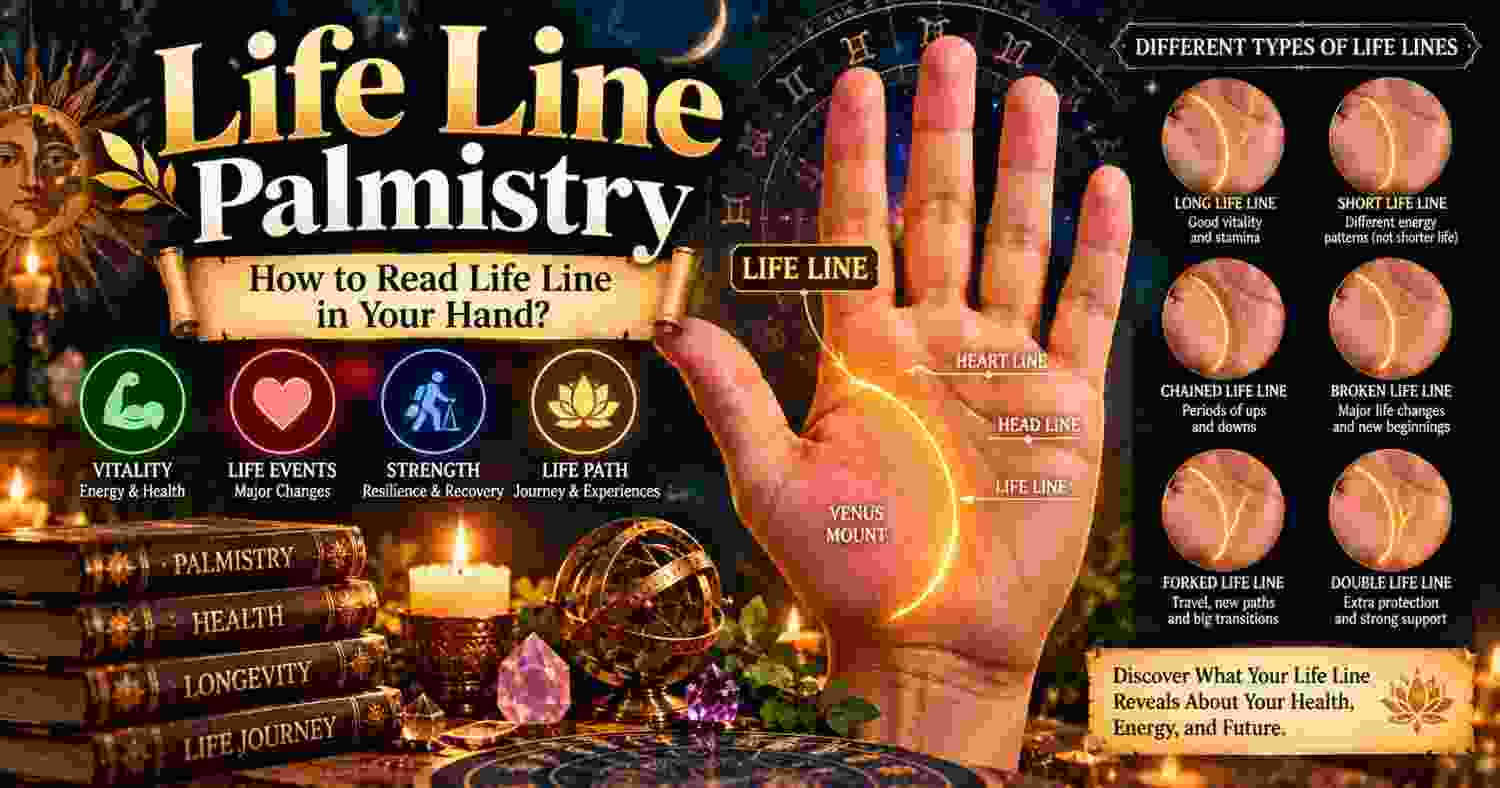
The life line is the curved line that starts between your thumb and index finger. It arcs around the base of your thumb and ends near your wrist. In palmistry, it shows your vitality, your energy, and the way you move through major life changes. It does not predict how long you will live.
You can read it in minutes. You only need good light, your dominant hand, and a calm eye. This guide shows you how.
I have studied hands for many years. I have read for nurses, athletes, retirees, and students. I have also read for skeptics. Almost every person asks me the same first question: “How long will I live?” I always give the same answer. The life line does not measure that. It measures something more useful. It shows how you carry your energy, how you recover, and how you meet change.
Read on, and you will learn to find the line, judge it, and describe it with care.
Key Takeaways
- The life line wraps around the Mount of Venus, the fleshy pad at the base of your thumb.
- A deep, clear line points to steady energy and strong recovery.
- A short line does not mean a short life.
- Breaks, chains, and islands mark periods of change, strain, or low energy.
- A double life line suggests extra protection and reserve strength.
- You must read the whole palm, not one line alone.
- Palmistry offers reflection and entertainment. It does not replace medical advice.
What Is the Life Line in Palmistry?
Palmistry, also called palm reading or chiromancy, studies the lines, shapes, and mounts of the hand. Readers use it to describe character, habits, and possible life paths. Most traditions name three or four major lines. These are the heart line, the head line, the life line, and the fate line.
The life line ranks first in most teaching systems. Many palmists say everything in life depends on life itself. That idea explains why the line gets so much attention.
Where Is the Life Line on Your Palm?
Hold your hand open and face the palm toward you. Look at the space between your thumb and your index finger. The life line begins on the edge of the palm in that space. From there, it curves downward. It sweeps around the thumb’s base. It usually ends near the wrist.
The line often forms a gentle arc. Some lines start high and sweep wide. Others start low and stay tight. Both patterns are normal.
You can find the line fast with this trick. Fold your thumb toward your palm. A crease appears around the thumb’s base. The deepest crease in that area is usually your life line.
What the Life Line Measures
The life line measures quality, not quantity. It describes:
- Your physical vitality
- Your stamina and drive
- Your resilience after stress or illness
- Your enthusiasm for daily life
- The number and size of major changes you face
Think of the line as a gauge for your inner battery. A strong line suggests a full battery and quick recharging. A faint or broken line suggests that you may need more rest, more structure, or more support at certain times.
What the Life Line Does Not Measure
The life line does not predict your date of death. It does not diagnose disease. It does not promise good luck or bad luck. Modern palmists agree on this point, and I teach it in every class.
Older books once claimed that a long line meant a long life. They said a short line meant an early end. Careful readers dropped that idea long ago. It frightened people, and it rarely matched real life. I have met many people with short lines who lived into their nineties. I have also met people with long, deep lines who faced early health problems. The line describes energy, not a calendar.
Why So Many People Misread the Life Line
Most people learn about the life line from pop culture. Movies show a gypsy peering at a palm and gasping at a short line. That scene sticks in the mind. It also spreads a myth.
Here are the most common errors:
- Reading length as lifespan. Length shows how strongly you project your energy. It does not show your age at death.
- Judging one line in isolation. Every line reacts to the others. A weak life line next to a strong head line tells a different story than a weak life line alone.
- Ignoring the mount. The Mount of Venus shapes the whole reading. A full mount adds warmth and vitality. A flat mount suggests a more reserved energy.
- Reading only one hand. Each hand adds a layer of meaning.
- Fearing every mark. Nearly every palm has small breaks, islands, or chains. Minor marks rarely matter.
Avoid these errors, and your readings will improve at once.
Set Up Your Reading the Right Way
Good readings start with good preparation. Take two minutes to set up. You will see more detail and make fewer mistakes.
Choose the Right Hand
Traditions disagree on which hand to read first. Most modern readers use this rule:
- Dominant hand: the hand you write with. It shows your present path and the choices you have made.
- Non-dominant hand: it shows your inborn traits, your potential, and your family patterns.
Some older systems link the left hand to birth and the right hand to action. Others use different rules for men and women. Pick one system and stay consistent. I recommend the dominant versus non-dominant method. It fits modern life well.
Always compare both hands. If the lines match, your path stays steady. If the lines differ, you have changed in important ways. A stronger line on the dominant hand means you have built energy over time. A weaker line on the dominant hand means you may have spent more than you have restored.
Use Good Light and a Relaxed Hand
Palm lines change with tension. A tight, flexed hand squeezes the lines and hides detail. A limp, loose hand flattens them. Hold your hand open and comfortable. Let your fingers rest slightly apart.
Use natural daylight when you can. Sit near a window. Avoid harsh overhead lights, which wash out fine lines. A small magnifying glass helps you see islands and tiny forks.
Gather a Few Simple Tools
You do not need much:
- A magnifying glass
- A clear photo of each palm
- A notebook
- A soft pencil
- A piece of string, if you want to measure line length
A photo helps more than you might expect. You can zoom in. You can also compare it with future photos and track change over the years.
Find the Mount of Venus
The Mount of Venus is the fleshy pad at the base of your thumb. The life line wraps around it. The mount’s size and firmness affect how you read the line.
- Full, firm mount: high energy, warmth, and strong appetite for life.
- Flat mount: calmer energy and a more selective social life.
- Very high, soft mount: strong drive, sometimes with a tendency toward excess.
Press the mount gently. Notice how it feels. Then look at the line again.
How to Read the Life Line Step by Step
Follow this simple process. You can complete it in about ten minutes.
Step 1: Trace the Full Path
Use your finger or the pencil’s eraser. Start at the line’s origin between thumb and index finger. Follow it around the thumb. Stop where it ends. Note the total path. Does it look smooth? Does it wander? Does it split?
Step 2: Judge the Starting Point
Look at where the line begins. Check whether it starts high on the palm, close to the index finger. Check whether it starts low, nearer the thumb. Then see whether it joins the head line or stays separate. You will find detailed meanings below.
Step 3: Judge Length
Compare the line’s length with the size of your palm. A line that reaches the wrist crease or curves toward it counts as long. A line that fades before the midpoint of the thumb’s base counts as short.
Step 4: Judge Depth and Clarity
A clear, even line shows steady energy. A thin or fuzzy line suggests a lighter, more variable energy. Look at the line under magnification. Does it keep a constant depth? Or does it shift from deep to faint?
Step 5: Judge the Curve
Notice how wide the arc sweeps. A broad arc that includes much of the Mount of Venus suggests warmth and zest. A narrow arc that hugs the thumb suggests reserve and caution.
Step 6: Search for Breaks and Marks
Scan the entire line. Mark every break, chain, island, fork, cross, star, and branch. Number them from the start to the end. Write down each one in your notebook.
Step 7: Compare Both Hands
Repeat steps one through six on the other hand. Note every difference. Differences often tell the best stories.
Step 8: Connect the Life Line to the Other Lines
Check the head line, the heart line, and the fate line. See how each one touches or avoids the life line. A reading needs this context.
Step 9: Write a Balanced Summary
Describe strengths first. Then describe challenges. Then offer a simple suggestion. Keep your tone calm. Never predict death or disease.
Life Line Length: Short, Medium, and Long
Length draws the most attention. It also draws the most fear. Read it with care.
Long Life Line
A long life line runs far around the thumb and often reaches the wrist. It suggests:
- Strong stamina
- Steady health habits
- A long view of life
- Quick recovery after setbacks
People with long lines often take on large projects. They plan well. They pace themselves. They bounce back after illness or stress.
Medium Life Line
A medium line ends around the middle or lower middle of the Mount of Venus. It suggests balanced energy. You can sprint and rest in good measure. You also manage your effort with care.
Short Life Line
A short life line ends early. It may stop near the top of the mount. It does not predict an early death. Instead, it suggests that you do not rely on raw stamina. You may need to guard your energy more closely.
Many people with short lines have strong minds. They compensate with focus. They plan their days well. They avoid waste. They often thrive because they respect their limits.
I once read for a retired teacher in her late eighties. Her life line stopped halfway around the thumb. She laughed when I told her what many books once claimed. “I outlived them all,” she said. Her story proves a point. The line describes style, not a countdown.
Life Line Depth and Clarity
Depth tells you about the quality of your energy.
Deep and Clear Line
A deep, clean line suggests strong vitality. You feel steady most days. You handle stress with a clear mind. You recover from illness at a healthy pace.
Thin and Light Line
A thin line suggests lighter, more sensitive energy. You may feel drained by crowds, noise, or long work hours. You may need more rest and more quiet. A thin line does not signal weakness. It signals sensitivity.
Wide and Shallow Line
A wide, shallow line sometimes looks flat and spread out. It can suggest scattered energy. You may start many tasks and finish few. You can improve this pattern with routine and clear goals.
Faint or Fading Line
A faint line often reflects a quiet or unfocused phase. It may also reflect a person who prefers a gentle pace. Some traditions link a faint line to a wandering mind or weak memory. I read it more broadly. I say the person needs a stronger anchor, such as a regular schedule, a hobby, or a trusted routine.
The Curve of the Life Line
The curve shows how you spread your energy through the world.
Wide, Sweeping Curve
A broad arc suggests a warm, active nature. You like people. You enjoy movement and travel. You often feel enthusiastic about new ideas. The line includes most of the Mount of Venus, and so it reflects abundant energy.
Narrow, Tight Curve
A narrow arc hugs the thumb. It suggests a careful, reserved nature. You prefer a small circle of close friends. You think before you act. You may feel more comfortable at home than in crowds.
Straight Line
A mostly straight life line cuts across the palm with little curve. It suggests a practical person who values order. You may dislike risk. You may also resist change. This pattern can feel stable, but it can also feel limiting.
Wavy Line
A wavy line suggests variable energy. You may feel high one week and low the next. Your health habits may swing as well. Regular sleep, meals, and exercise can calm the pattern.
Where the Life Line Starts
The starting point shapes your early life and your basic temperament.
Starts High, Near the Index Finger
A high start suggests ambition. You want to lead. You often aim for achievement and status. You may push hard, especially in your younger years. Learn to rest, and your drive will serve you well.
Starts Low, Near the Thumb
A low start suggests a gentler, more private nature. You may take longer to find your direction. You may focus on home and family more than status. Many artists and caregivers show this pattern.
Starts Where It Meets the Head Line
Many hands show the life line and head line sharing a short starting stretch. This pattern suggests caution. You think before you move. You value safety and structure. You often show good judgment in childhood and youth.
A long shared stretch suggests extra caution. A short shared stretch suggests healthy balance. Some old texts call the pattern limiting. I prefer to call it careful.
Starts Separate from the Head Line
A gap between the life line and the head line suggests independence. You act on your own ideas. You may leave home early. You may take risks. Some people with this pattern feel restless. Others feel free. A very wide gap suggests impulsiveness.
Starts Under the Mount of Jupiter
When the line begins right under the index finger, readers link it to leadership and confidence. You may feel at ease with responsibility.
Starts at the Same Point as Other Lines
If the heart line, head line, and life line all start from one point, the pattern suggests intense energy. Some traditions call it a warning sign. I call it a call for balance. Such a person feels everything strongly and needs healthy outlets.
Where the Life Line Ends
The end of the line shows how your energy settles in later life.
Ends Near the Wrist
A line that curves toward the wrist suggests stable energy in later years. You build comfort and routine. You may enjoy a strong sense of home.
Ends in a Fork
A fork at the end suggests two energy paths. You may split your attention between two interests, two places, or two lifestyles. Some readers link a fork with travel or relocation later in life.
Ends Abruptly
A sudden end can scare people. Do not panic. It often means a major shift in direction or lifestyle. A career may end. A home may change. A phase of life may close. Read the rest of the palm for context.
Curves Toward the Mount of Luna
When the line sweeps toward the outer edge of the palm at the wrist, it suggests a love of travel and imagination. You may feel drawn to far places. You may spend part of your life far from your birthplace.
Fades Out
A line that fades slowly suggests a gentle decline of drive. You may slow your pace. You may focus more on quiet pursuits. Many happy retirees show this pattern.
Breaks in the Life Line
Breaks attract attention. Most people notice them first. They worry. They should not.
What a Break Means
A break marks a change. It can show a move, a new job, a loss, a health event, or a change of identity. The break does not decide whether the change feels good or bad. You decide that through your response.
Size and Location Matter
- Small break: a short, minor shift.
- Large gap: a bigger life change, often with a long adjustment.
- Early break: a change in childhood or youth.
- Late break: a change in midlife or later.
Overlap After a Break
Sometimes the line breaks and then restarts nearby. The new segment overlaps the old one. Palmists read this pattern as recovery. The overlap shows a fresh start with a safety net. The longer the overlap, the longer the adjustment.
Short Parallel Line Near the Break
A short line next to the break supports you through the change. It often signals help from friends, family, or a lucky turn. Many readers call it a bridge. I like that word.
Breaks in Both Hands
If both hands show a break at a similar point, the change likely carries more weight. If only one hand shows the break, the event may stay private or lighter in effect.
What to Say About Breaks
Never frame a break as a disaster. Say instead: “This line shows a big shift. Here is how you can prepare.” That wording respects the person and keeps the reading useful.
Chains, Islands, and Other Marks on the Life Line
Marks add detail. Look at each one with a magnifying glass.
Chain Pattern
A chain looks like small linked loops along the line. It suggests a stretch of tension, stress, or uneven health. Chains often appear in childhood or in times of heavy strain. When the chain ends and the line clears, the stress eases.
Island
An island looks like a tiny oval in the line. It suggests a period of lowered energy. You may feel tired, anxious, or run down. You may need rest. An island often marks a time when you handle too much.
Fork Upward
A branch rising toward the index finger suggests growth, ambition, and success. You push forward with hope. You may gain a promotion or a new title.
Fork Downward
A branch falling toward the wrist suggests a loss of energy or a period of withdrawal. You may feel pulled inward. Some readers link it to retirement or to a major move.
Branches Along the Line
Small branches sprouting from the line show new interests and new energy. Upward branches often mean gain. Downward branches often mean drain. Count them. Place each one on the timeline.
Cross
A small cross on or near the life line suggests an obstacle or a decision point. Do not read it as doom. Read it as a moment that needs thought.
Star
A star can mark a sudden event. It may bring surprise, shock, or a sharp turn. The effect can feel good or bad. Check nearby lines for context.
Square
A square near a break protects the line. Readers call it a sign of safety. It suggests that help arrives when you need it most.
Dot
A dot suggests a brief setback. It may mark a small illness or an injury. Most dots fade in meaning quickly.
Bar
A short bar crossing the line shows an obstacle. It may slow you down. It rarely stops you.
Tassel at the End
Tiny frayed lines at the line’s end suggest scattered energy in later years. Rest and routine help.
The Double Life Line
Some people carry a second line that runs beside the main life line. Palmists call it a double life line, a sister line, or a Mars line.
What the Double Life Line Means
The second line adds strength. It suggests reserve energy and extra protection. Many readers say the person has a guardian figure, such as a mentor, parent, or spiritual guide. Others read it as a sign of two strong energy channels.
Where It Appears
The sister line usually runs inside the main line, closer to the thumb. Sometimes it covers the whole line. Sometimes it covers only part. A partial line protects a specific period of life.
How to Read It
- Full double line: strong protection and strong recovery.
- Partial double line: extra help during the covered years.
- Very close double line: deep reserves of calm and resilience.
- Separate, distant line: two life paths or two strong interests.
People with a double life line often look back and say, “I should not have gotten through that, but I did.” The line explains why.
When the Life Line Looks Faint or Seems Missing
Some people see almost no life line at all. They panic. Please do not.
Faint Line
A faint line suggests a light, quiet energy. You may live more in your mind than in your body. You may feel sensitive to stress. Many calm, thoughtful people show this pattern.
No Visible Line
A palm with no clear life line is rare. When it appears, it does not predict early death. Most palmists read it as a sign of nervous energy or mental intensity. The person may live mostly in thought. Other lines often compensate. The health line, the fate line, or a strong Mount of Venus may carry the story instead.
If you cannot find your life line, try these steps:
- Open your hand fully in good light.
- Fold your thumb inward to bring out creases.
- Look at the other hand.
- Take a photo and zoom in.
- Ask a trained palmist to check your reading.
Do not draw conclusions until you finish all five steps.
How the Life Line Interacts with Other Lines
A life line never works alone. Always read it with its neighbors.
Life Line and Head Line
The head line shows how you think. The life line shows how you act. When they connect early, you think before you act. When they split wide, you act on instinct. A long shared stretch suggests deep caution. A wide gap suggests bold, fast choices.
Life Line and Heart Line
The heart line shows how you feel and love. When the heart line touches the life line, emotion affects energy. You may feel strong feelings in your body. A strong heart line next to a weak life line suggests that emotions drain you. A strong life line next to a weak heart line suggests that you protect your energy by staying reserved.
Life Line and Fate Line
The fate line runs up the center of the palm. It shows career and direction. When the fate line starts from the life line, you build your direction through personal effort. When it starts elsewhere, outside forces may shape your path more. A fate line that joins the life line in midlife often marks a time when you take charge of your direction.
Life Line and Health Line
The health line runs from the base of the little finger toward the wrist. Not everyone has one. When it appears, it adds detail about stress and habits. A clear health line next to a steady life line suggests a body that responds well to care.
Life Line and the Girdle of Venus
The Girdle of Venus is a curved line above the heart line. It suggests emotional sensitivity. When it appears with a thin life line, you may need extra rest after emotional events.
Reading the Mounts Around the Life Line
The mounts add flavor to the reading. The life line touches the Mount of Venus. It also relates to the Mount of Luna, the Mount of Mars, and the Mount of Jupiter.
Mount of Venus
This mount holds vitality, passion, warmth, and sensual enjoyment. A plump mount adds energy. A flat mount calms it.
Mount of Jupiter
This mount sits under the index finger. It shows leadership, ambition, and confidence. A life line that starts here carries those traits.
Mount of Mars
This area sits inside the life line, near the center of the palm. It shows courage and resilience. A firm Mars area suggests a fighter’s heart.
Mount of Luna
This mount sits on the outer edge of the palm, across from the thumb. It shows imagination, intuition, and dreams. A life line that sweeps toward it suggests creativity and travel.
Timing Events on the Life Line
Many readers ask how to date events on the line. The topic needs care. Different schools use different scales. No method works as precisely as people hope. Treat every date as an estimate.
A Simple Timing Method
Follow these steps:
- Mark the start of the life line as birth.
- Mark the end of the line at the wrist as roughly age 70 to 80.
- Divide the line into equal parts, such as decades.
- Place each mark or break on the scale.
- Compare both hands.
Another method uses the fingers. Draw an imaginary line down from the gap between the index and middle fingers. Where that line meets the life line, you find a rough marker for the late twenties or early thirties. A line from the middle finger gives a later marker. A line from the ring finger gives a still later marker.
Why Timing Stays Uncertain
Several things blur the scale. Hands vary in size. Lines vary in curve. Traditions differ. Your own habits also shape the lines. For these reasons, say “around” and “roughly.” Do not say “exactly.”
What Timing Can Do for You
Timing helps you reflect. You may look at a break and say, “That looks like my move at age twenty-two.” You may see a chain and recall a hard year. These matches give the practice its charm. They help you tell your story. They do not prove the future.
Differences Between Palmistry Traditions
Palmistry grew in many places. Each culture added its own ideas.
Western Palmistry
Western readers focus on personality and psychology. They treat the life line as a vitality gauge. Modern Western palmists warn against fatalistic claims.
Indian Palmistry (Hast Rekha Shastra)
Indian palmistry links closely with astrology and Ayurveda. Readers study the mounts in detail. Many classic texts connect the life line to health and long life. Some of these texts still claim that a short line means a short life. Many modern Indian palmists soften the claim and focus on health habits.
Chinese Palm Reading
Chinese readers also treat the life line as a sign of vitality. Many sources stress that length does not predict lifespan. They look closely at depth, arc, and breaks. They also treat a short line parallel to a break as a sign of recovery.
Why the Differences Matter
You will meet conflicting advice in books and online. Do not worry. Most traditions agree on the core idea: the life line reflects vitality and change. Pick one framework. Learn it well. Add others as you grow.
What Science Says About Palm Lines
Palmistry belongs to tradition, not laboratory science. No study has shown that palm lines predict personality or future events. Researchers who study the field call it a belief system.
Still, the hand carries real information. Palm creases form before birth. They develop as the fetal hand flexes in the womb. Doctors sometimes notice unusual crease patterns in people with certain genetic conditions. For example, a single deep crease across the palm can appear in some people with Down syndrome. These patterns help doctors only as a clue, not as a diagnosis.
Your lines also change slightly over a lifetime. Heavy manual work, aging, and skin condition can all affect them. That change is one reason many palmists rescan their hands every few years.
I use palmistry as a tool for reflection. It prompts me to ask questions about my habits, my energy, and my choices. That value stands on its own. It does not require scientific proof.
Life Line and Health: Read with Care
Many people ask whether the life line can reveal illness. The honest answer is no. A palm cannot diagnose disease. A life line cannot replace a doctor.
You can, however, use the line as a gentle reminder. Say you notice chains in your line. They may remind you that stress has weighed on you. You can then take simple steps:
- Sleep more.
- Walk daily.
- Eat balanced meals.
- Take breaks from screens.
- Visit your doctor for regular checkups.
If you feel unwell, call a medical professional. Never delay care because of a palm reading. Never tell another person that their palm shows a disease. Doing so harms people and breaks the trust that readers must protect.
Common Life Line Patterns and What They Suggest
Here are a few patterns I see often, with careful readings.
Pattern One: Deep, Long, Wide Arc
This hand shows high energy and a warm nature. The person thrives in groups. The person enjoys work and play. The risk is overload. The advice is to rest before exhaustion hits.
Pattern Two: Thin, Short, Narrow Arc
This hand shows a quiet, careful nature. The person values calm and solitude. The risk is burnout in busy settings. The advice is to protect time alone and to avoid overcommitting.
Pattern Three: Chain in Early Years, Clear Later
This hand shows a tough childhood or a shaky start. The person has grown stronger with time. The advice is to give credit to that growth.
Pattern Four: Clear Line with One Large Break and Overlap
This hand shows a major change that the person survived well. The overlap suggests a strong recovery. The advice is to trust past resilience.
Pattern Five: Double Life Line
This hand shows strong reserves and protection. The person often finds help at key moments. The advice is to accept help and to give it in return.
Pattern Six: Life Line Joined to Head Line for a Long Stretch
This hand shows a careful, thoughtful mind. The person may hesitate before bold moves. The advice is to practice small risks and to build confidence.
Three Sample Readings
Real examples help. These readings combine common features. They protect privacy and show the method in action.
Sample Reading One: The Steady Builder
What I see: A long, deep life line with a wide arc. A short shared start with the head line. A small island in the late thirties. A clear finish near the wrist.
What I say: “You carry strong energy and steady habits. You think before you act, yet you enjoy a full life. Your late thirties show a period of lower energy. You may recall a year of heavy stress. The line clears after that. You recovered well. Keep resting before you hit your limits.”
Sample Reading Two: The Quiet Thinker
What I see: A medium line with a narrow arc. A thin, light line. A wide gap from the head line at the start. A small break in the early twenties with a short parallel line.
What I say: “You value calm and independence. Your energy runs lighter than some people’s, so you guard it well. Your early twenties show a significant shift, probably a move or a change of direction. A support line runs beside the break. Someone helped you then. You can trust that pattern to repeat.”
Sample Reading Three: The Restless Traveler
What I see: A long line that sweeps toward the Mount of Luna. A fork at the end. A star near the midpoint. Several upward branches.
What I say: “You have a bold spirit. You love new places and new ideas. You may move more than once. Your midlife shows a sudden event or surprise. Your upward branches suggest that you gain from change. Keep a stable home base even as you roam.”
How to Give a Respectful Palm Reading
A good reader balances honesty with kindness. Follow these guidelines.
- Ask permission. Let the person choose to share their hand.
- Start with strengths. People listen better after they feel seen.
- Avoid fear. Never predict death, illness, or disaster.
- Use “may” and “suggests.” These words show humility.
- Invite questions. A reading works best as a conversation.
- Recommend professional help when needed. If someone shares serious worries, point them to a doctor or counselor.
- Protect privacy. Never repeat what you learn.
Common Mistakes to Avoid When Reading the Life Line
Even skilled readers slip. Watch for these errors.
- Over-reading small marks. Not every tiny line carries meaning.
- Ignoring the hand’s overall shape. Fingers, mounts, and skin texture add context.
- Forgetting the age of the person. A child’s palm and an elder’s palm differ.
- Ignoring recent injuries. Scars and cuts can mimic real marks.
- Trusting a single book. Compare sources and use judgment.
- Giving medical or legal advice. You do not have that authority.
- Making definite predictions. Hands show tendencies, not fixed outcomes.
Can the Life Line Change?
Yes, it can. Palm lines shift slowly over the years. They deepen, fade, or sprout branches. Studies of tradition suggest that lifestyle, health, and mindset can all affect the lines. Many palmists report that lines strengthen after people make major changes, such as moving, recovering from illness, or switching careers.
You can test this idea. Photograph your palm now. Photograph it again in two or three years. Compare the images. You may spot new branches or clearer patches. The change can feel inspiring. It reminds you that your story stays open.
Life Line Palmistry for Beginners: A Short Practice Plan
You learn palmistry through practice. Try this simple plan.
Week one: Study your own life line daily for five minutes. Note every detail in your notebook.
Week two: Compare both hands. Write down every difference.
Week three: Look at the hands of two friends who agree to help. Describe only the shape, depth, and curve. Do not interpret yet.
Week four: Offer light readings. Focus on strengths. Ask for feedback.
Month two and beyond: Read more hands. Study the other lines. Keep learning.
Patience pays off. Within a few months, you will spot patterns quickly.
Frequently Asked Questions About the Life Line
What does the life line represent in palmistry?
The life line represents your vitality, energy, and major life changes. It also reflects how you recover from stress. It does not predict how long you will live.
Does a short life line mean a short life?
No. A short life line suggests that you may rely less on raw stamina and more on focus and planning. Many people with short lines live long, healthy lives.
Which hand should I read for the life line?
Start with your dominant hand. It shows your present path. Then compare it with your non-dominant hand, which shows your inborn traits. Some traditions use the left or right hand by gender. Choose one method and stay consistent.
What does a broken life line mean?
A broken life line marks a change. It may show a move, a new job, a health event, or a shift in identity. A short parallel line or an overlap suggests recovery and support.
What does a double life line mean?
A double life line suggests extra reserve energy and protection. Many readers link it to strong support from people around you.
What does a chained life line mean?
A chain suggests a period of stress, tension, or uneven energy. When the chain ends and the line clears, the stress usually fades.
What if I cannot find my life line?
Open your hand in good light. Fold your thumb inward to reveal the creases. Compare both hands and zoom in on a photo. If you still see no line, do not worry. A missing line does not predict early death.
Can the life line show my health problems?
No. A palm reading cannot diagnose disease. Use the line for reflection only. See a doctor for any health concern.
How do I find the age of an event on my life line?
Divide the line into equal parts, such as decades. Mark the start as birth. Mark the end as roughly age seventy to eighty. Then place each mark on the scale. Treat every date as an estimate.
Do life lines change over time?
Yes. Lines can deepen, fade, or grow new branches. Photograph your palm every few years and compare.
Is palm reading accurate?
Science has not confirmed palmistry. Many people enjoy it as a tool for reflection and conversation. Treat it as a guide for thought, not as proof of the future.
What is the difference between the life line and the fate line?
The life line shows vitality and personal energy. The fate line shows career and life direction. The two often interact.
What does it mean if my life line starts under my index finger?
It suggests ambition, leadership, and confidence. You may feel comfortable taking charge.
What does a fork at the end of the life line mean?
A fork suggests that you split your energy between two paths, interests, or places. Some readers link it to travel or relocation in later life.
What does the Mount of Venus tell me?
The Mount of Venus shows warmth, passion, and vitality. A full, firm mount suggests strong energy. A flat mount suggests a calmer approach.
Final Thoughts: Read Your Life Line with Curiosity
Your life line tells a story about your energy, your resilience, and your changes. It does not tell your final chapter. It does not set your limits. It invites you to look closely at how you live.
Use what you learn with care. Notice your strengths. Respect your limits. Treat every break as a turning point and every chain as a reminder to rest. Compare both hands. Watch how your lines change. Above all, keep your curiosity.
Palmistry rewards patience. Each hand you study teaches you something new. Start with your own palm tonight. Open your hand, find the arc around your thumb, and read the story it holds. You may surprise yourself.
Disclaimer: This article offers information for education and entertainment. It does not provide medical, legal, or financial advice. Consult qualified professionals for those needs.