
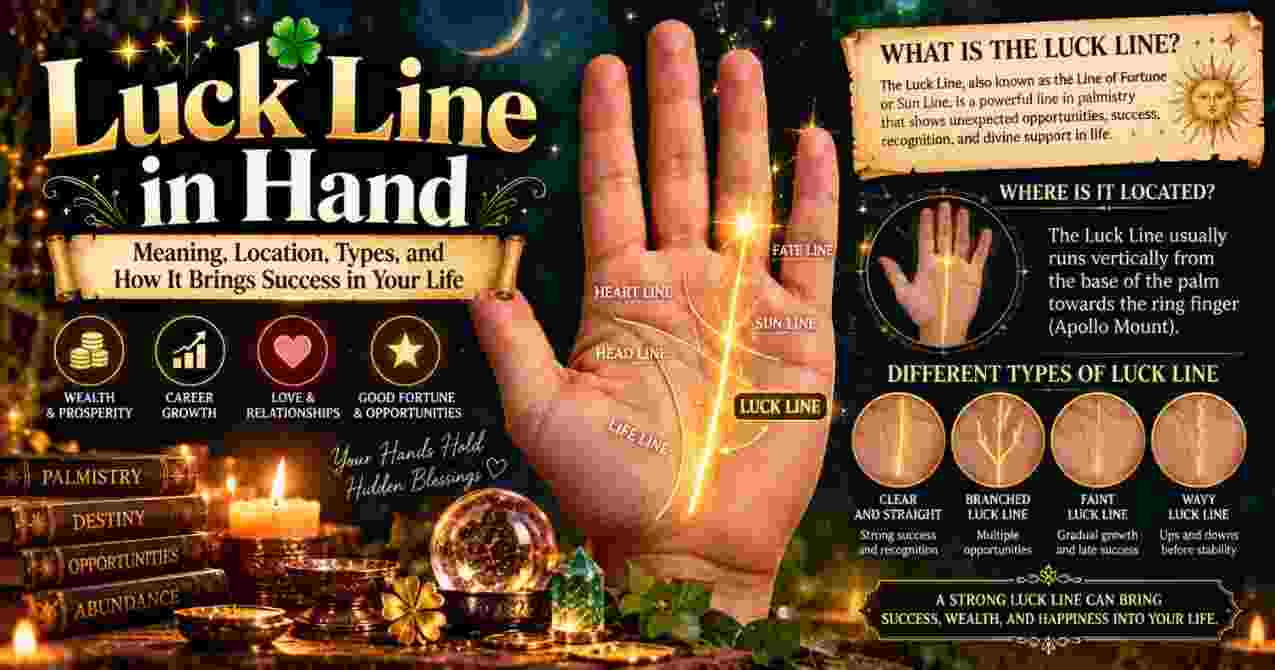
The luck line is a vertical line on your palm. It usually rises from the wrist toward the base of your middle finger. Indian palmists call it Bhagya Rekha. Western palmists call it the fate line, destiny line, or Saturn line.
Palmists read this line to study career, money, and life direction. They also use it to judge how much outside events shape your path. A deep, clear, unbroken line often signals steady progress. A faint, broken, or missing line does not signal failure. It simply points to a path with more turns, more choices, and more self-direction.
This guide explains every part of the luck line. You will learn how to find it, how to read it, and how to use what you learn. You will also see where palmistry ends and personal responsibility begins.
What Is the Luck Line in Palmistry?
The luck line sits at the center of the palm. It travels upward between the life line and the Mount of Apollo (the Sun mount). It aims at the Mount of Saturn, which lies under the middle finger.
Palmists link this line to four big themes:
- Career and professional status
- Wealth and financial gain
- Responsibility and discipline
- Outside forces such as family, timing, and circumstance
Unlike the life line, heart line, and head line, the luck line does not appear on every hand. Some people carry a bold one. Others carry a faint trace. Some carry none at all. Palmists treat all three cases as normal.
Other Names for the Luck Line
Different traditions use different names. The line stays the same. The table below lists the most common ones.
| Name | Tradition | Meaning |
|---|---|---|
| Bhagya Rekha | Indian (Hindi, Sanskrit) | Line of fortune |
| Bhagyashali Rekha | Indian | Line of the fortunate |
| Shani Rekha | Indian | Line of Saturn |
| Karma Rekha | Indian | Line of action |
| Fate line | Western | Line of fate |
| Destiny line | Western | Line of destiny |
| Career line | Modern | Line of profession |
| Line of Saturn | Classical Western | Saturn’s line |
Why People Search for This Line
Most people search for the luck line because they want answers. They ask four main questions:
- Will I succeed in my career?
- Will I earn good money?
- Why does my life feel unstable?
- Do I have luck on my side?
This guide answers all four. It also adds a fifth answer that many articles skip: what you can do next.
What Does Bhagyashali Hast Rekha Mean?
Bhagyashali means “fortunate” or “blessed with good fortune.” Hast means “hand.” Rekha means “line.” Together, the phrase points to the hand line that shows fortune.
Indian palmistry belongs to the broader system of Hast Rekha Shastra. Some scholars also connect it to Samudrika Shastra, the ancient Indian study of body marks and signs. The tradition reads the body as a map of character and destiny.
In this system, the Bhagya Rekha links directly to Shani (Saturn). Saturn rules karma, discipline, patience, and hard work. So the line does more than show luck. It shows how your effort meets your fate.
Luck Versus Fate Versus Effort
Many readers mix up these three ideas. Let us separate them.
- Luck means events you do not control.
- Fate means the larger pattern your life seems to follow.
- Effort means the work you choose to do.
The luck line touches all three. Good palmists never treat it as a verdict. They treat it as a mirror. It shows tendencies. It does not lock your future.
The Indian View: Karma and Dharma
Indian tradition ties the Bhagya Rekha to karma and dharma. Karma means action and its results. Dharma means your duty and life purpose. Under this view, a strong line shows that your actions and your purpose align. A weak line shows that you may still search for that alignment.
This view gives the line a hopeful tone. You can act. You can adjust. You can grow.
Where to Find the Luck Line on Your Palm
You need a clear view of your palm. Follow these steps.
- Open your hand fully. Spread your fingers a little. Keep the palm flat but relaxed.
- Find the center. Look at the middle of your palm. The luck line runs through this zone.
- Look near the wrist. Check the base of your palm. The line often starts here.
- Trace upward. Follow any vertical line toward the middle finger.
- Find the Saturn mount. Locate the small pad under your middle finger. The line often ends near it.
- Check both hands. Compare the left and right palms.
Use Good Light and a Calm Hand
Natural daylight works best. Avoid harsh shadows. Relax your hand. A tense palm creates extra creases. Those creases can confuse you. Take a photo if you want a closer look. A phone camera helps you zoom in on faint lines.
Do Not Confuse It With Other Lines
New readers often mistake other vertical lines for the luck line. Watch for these look-alikes:
- Life line: It curves around the thumb. It does not run straight up the center.
- Mercury line (health line): It runs diagonally toward the little finger.
- Sun line: It runs toward the ring finger.
- Wrist bracelets: These horizontal lines sit at the wrist base. They are not the luck line.
If you see a straight vertical line near the center, you likely found it. If you see nothing, do not worry. Many hands lack a clear luck line.
Which Hand Should You Read?
Palmists disagree on this point. Most agree on a simple method.
The Common Rule
- Dominant hand: It shows what you do with your life now.
- Non-dominant hand: It shows what you brought with you at birth.
Right-handed people usually treat the right hand as the working hand. Left-handed people usually treat the left hand that way.
The Indian Rule
Many Indian palmists use a gender-based rule. They read the right hand for men and the left hand for women. Other palmists reject this rule. They prefer the dominant and non-dominant method. Both approaches exist. Pick one and stay consistent.
Compare Both Hands
The best reading compares both palms. Look at differences. If your non-dominant hand shows a faint line and your dominant hand shows a bold one, your choices may have strengthened your path. Many palmists love this story. It shows growth.
Why the Luck Line Matters
The luck line matters because it speaks to the questions people care about most. These include work, money, status, and purpose.
The Saturn Connection
In Vedic thought, Saturn teaches through time and effort. It rewards patience. It punishes shortcuts. Saturn also governs structure, such as careers, institutions, and long projects.
Because the luck line points toward Saturn’s mount, palmists connect it to these themes. A clear line suggests that structure supports you. A messy line suggests that you may build structure on your own.
The Line Changes
Here is a key fact. The luck line often changes over time. The life line, heart line, and head line usually stay more stable. The luck line shifts as your life shifts. A new job, a move, a loss, or a big decision can change its look.
This idea makes the line useful. You can study it today, then study it again in five years. You may see real change.
The Line Does Not Rule You
Smart palmists repeat this point often. The line describes tendencies. It does not hand down sentences. You still choose your actions. Your education, health, relationships, and habits all matter. A palm line cannot replace them.
Also read: Marriage Line on the Palm
How Palmists Read the Luck Line: Seven Factors
Expert readers study seven factors. Learn them in this order.
- Origin (where the line starts)
- Length and ending (where the line stops)
- Depth and clarity
- Direction and shape
- Breaks, forks, and islands
- Special marks (stars, squares, crosses)
- Relationship to other lines and mounts
The sections below cover each factor in depth.
Factor 1: Where the Luck Line Starts
The starting point shows the early source of your drive and support. It tells a story about where your path begins.
Starting From the Wrist
A line that begins at the base of the palm, near the wrist, often signals early ambition. Palmists say these people find direction young. They often receive early responsibility. They may start working in their field early.
If the line also runs long and clear, many readers call it a sign of a strong, steady rise. This pattern matches the old idea of a “king’s line.”
Starting From the Life Line
A line that rises from the life line suggests self-made success. Palmists say these people build their own careers. They often work hard in the first half of life. They rely on their own energy more than on outside help.
Some readers add a family angle. They say the person may break from family expectations. They may create a new path instead of following the old one.
Starting From the Mount of Moon
A line that begins on the outer, lower edge of the palm, near the Mount of Moon, links to imagination and public appeal. Palmists say these people may gain support from the public, fans, clients, or crowds. Writers, performers, and creative workers often show this pattern in palmistry lore.
This origin also suggests that other people may shape your path. Opportunity may arrive through strangers, networks, or timing.
Starting From the Mount of Venus
A line that starts from the thumb-side zone, near the Mount of Venus, points to family help. Palmists say relatives, partners, or close friends may support your career. Emotional bonds may play a big role in your success.
Some readers see a warning here too. You may feel torn between loyalty and ambition. You may need to balance both.
Starting From the Head Line
A line that begins at the head line often signals later success. Palmists say these people build their careers after they gain skill, education, or clarity. They often peak after their mid-thirties.
This pattern suits late bloomers. It tells you to stay patient. It also tells you to invest in knowledge.
Starting From the Heart Line
A line that starts at the heart line is rare. Palmists link it to very late success. They say it often shows a mature, rewarding second act. Many readers also tie it to work you love, since the heart line governs emotion.
Starting Mid-Palm
A line that appears only in the middle of the palm suggests a delayed career direction. Palmists say these people find their path later. They may try many things first. Then they settle on one field.
This pattern does not mean wasted time. It means your focus arrives later.
Quick Origin Table
| Starting point | Common reading |
|---|---|
| Wrist | Early ambition and steady rise |
| Life line | Self-made success |
| Mount of Moon | Public support and creative paths |
| Mount of Venus | Family and partner support |
| Head line | Late success after skill building |
| Heart line | Very late success, passion-led work |
| Mid-palm | Delayed direction, later focus |
Factor 2: Where the Luck Line Ends
The ending shows where your energy goes. It shows your long-term target.
Ending at the Mount of Saturn
This is the classic ending. A line that reaches the Saturn mount shows discipline, responsibility, and serious career focus. Palmists say these people stay committed. They finish what they start. They often reach positions of trust.
If the line runs smooth and deep all the way, many readers call it a mark of lasting stability.
Ending at the Mount of Jupiter
A line that bends toward the index finger suggests leadership. Palmists say these people aim for authority, teaching, or public influence. They often seek respect. They may become managers, advisors, or community leaders.
Ending at the Mount of Apollo (Sun)
A line that heads toward the ring finger suggests fame, creativity, and recognition. Palmists say these people may shine in art, media, design, or any visible field. They may enjoy applause. They also may prize beauty and style.
Ending at the Mount of Mercury
A line that heads toward the little finger suggests business skill. Palmists say these people trade, negotiate, communicate, and think fast. They often do well in sales, finance, writing, and entrepreneurship.
Stopping at the Head Line
A line that stops at the head line suggests that thinking may block action. Palmists say these people may overanalyze. They may doubt a big move. They may also change course after a mistaken judgment.
Stopping at the Heart Line
A line that stops at the heart line suggests that emotion may redirect your career. Palmists say a relationship, a loss, or a passion may change your plans. Some people take this as a sign to protect their focus during emotional storms.
Short Lines
A short line does not mean a small life. Palmists say it can point to focused effort in one season. Some readers see a short line as a sign of intense work in a single field.
Quick Ending Table
| Ending point | Common reading |
|---|---|
| Saturn mount | Discipline, stability, long-term success |
| Jupiter mount | Leadership, authority, teaching |
| Apollo mount | Fame, creativity, recognition |
| Mercury mount | Business, speech, trade |
| Head line | Overthinking, mental blocks |
| Heart line | Emotion-driven career shifts |
Factor 3: Depth and Clarity
Depth shows strength. Clarity shows focus.
Deep and Clear Luck Line
A deep, well-drawn line suggests strong determination. Palmists say these people stay on track. They face fewer wild swings. They often build steady careers and gain steady income.
Many Indian palmists view a deep, unbroken line from the wrist to the Saturn mount as a sign of great fortune. Some old texts compare it to a royal life. Modern readers soften this claim. They prefer to say it shows strong direction and strong follow-through.
Shallow or Faint Luck Line
A faint line suggests that outside forces may shape your path more than your own plan. Palmists say these people may work in jobs they did not plan. They may drift before they find a calling.
Do not fear a faint line. It simply asks you to define your own direction. You can do that with goals, mentors, and learning.
Thick or Heavy Line
A thick line can suggest intense pressure. Palmists say these people may carry heavy responsibility. They may work long hours. They may also tie their identity to their job.
Chained or Beaded Line
A line that looks like a chain suggests a stretch of struggle. Palmists say these people may face tension, doubt, or stress. The pattern may last for a period, not a lifetime. If the line clears later, readers say the struggle ends.
Factor 4: Direction and Shape
The line’s path tells you about the style of your journey.
Straight Line
A straight line suggests a direct path. Palmists say these people choose one field and stay in it. They like clear plans. They dislike chaos.
Curved Line
A curved line suggests flexibility. Palmists say these people adapt. They may switch fields. They may follow opportunities as they appear.
Wavy Line
A wavy line suggests change and uncertainty. Palmists say these people may switch jobs or cities. They may try new ventures. Some readers link this pattern with restless energy.
Line Bending Left or Right
Some readers watch the bend. A bend toward the thumb side suggests more focus on family and home. A bend toward the little finger side suggests more focus on business and outside work. Treat this as a light clue, not a rule.
Factor 5: Breaks, Forks, Islands, and Chains
Marks along the line tell stories about turning points.
Broken Luck Line
A break suggests a career change or disruption. Palmists say the break may reflect a job loss, a relocation, a retraining, or a life shift.
Look at the lines around the break. If one part overlaps the next, palmists say you recover smoothly. If the pieces sit far apart, they say the shift feels bigger.
Multiple Breaks
Several small breaks suggest an active, changing career. Palmists say these people may work in many roles. They may explore. They may freelance. They may build a portfolio career.
Fork at the Top
A fork near the end of the line splits energy into two paths. Palmists read forks in different ways:
- A fork toward Jupiter and Saturn suggests leadership with stability.
- A fork toward Saturn and Apollo suggests career plus recognition.
- A fork toward Saturn and Mercury suggests career plus business skill.
Many readers say a fork shows versatility and rich opportunity. Others warn that it may scatter your focus.
Fork at the Start
A fork at the base can show two sources of early support. For example, one branch may rise from the wrist while another rises from the life line. Palmists say this pattern blends family help with self-reliance.
Island on the Line
An island looks like a small oval on the line. Palmists say it marks a hard season. It may reflect stress, financial strain, or a loss of direction. When the line returns to normal after the island, readers say the hard season ends.
Downward Branches
Branches that drop away from the main line suggest setbacks or energy loss. Palmists say these show worry, wasted effort, or drains on money.
Upward Branches
Branches that rise from the main line suggest growth. Palmists call them rising lines. They say each one marks a gain in the area the branch points to.
Factor 6: Special Marks on or Near the Line
Small signs add detail. Do not read them alone. Always combine them with the whole hand.
Star
A star on the luck line, or near the Saturn mount, suggests a major event. Some readers see sudden success. Others see sudden disruption. Context decides.
Square
A square suggests protection. Palmists say a square around a break guards you from harm. It may show that help arrives when you need it.
Cross
A cross suggests a hurdle or a test. Palmists say you may face a challenge at that point in life. A cross can also warn you to review your plans.
Triangle
A triangle suggests skill and cleverness. Palmists say it shows strong planning ability.
Grille or Net
A grille suggests scattered energy. It may point to confusion or heavy distraction. Palmists say these people need focus.
Dots
A dark dot suggests a sudden shock. A pale dot suggests a minor delay. Palmists keep this reading light.
Double Luck Line: A Rare and Hopeful Sign
Some hands show two luck lines. They may run side by side or close together.
What Palmists Say
Many palmists treat a double luck line as a very auspicious sign. They say it suggests two strong streams of income or two careers. It may also suggest a second chance, a backup plan, or a rich blend of talents.
A popular Indian saying claims that two fate lines bring success with little effort. Modern readers soften that claim. They say the person has more options and more resilience.
How to Read the Two Lines
- Both lines clear: You may succeed in two fields.
- One strong, one faint: You may have a main career and a side path.
- Lines that cross or tangle: You may face a conflict between two goals.
Real-Life Link
Many people today run two careers. They hold a day job and a creative or business project. A double line fits this modern pattern well.
No Luck Line: What It Means
Many people have no clear luck line. Palmists see this often. It does not mean bad fortune.
Common Readings
- Freedom: You may follow no fixed track.
- Self-direction: You may shape your own path.
- Flexibility: You may adapt well to change.
- Unstructured life: You may dislike rigid schedules.
Some palmists add a caution. They say a missing line may point to less structure. If you lack structure, you may drift without clear goals. The fix is simple. Create your own structure.
Not a Sign of Failure
Plenty of successful people have faint or missing luck lines. Success comes from skill, timing, work, and support. A palm line does not create any of these.
What to Do If You Have No Luck Line
- Set clear goals.
- Build a daily routine.
- Find a mentor.
- Review your progress each month.
- Learn one valuable skill each year.
Structure replaces what the palm does not show. You can build it yourself.
The Luck Line and Other Palm Lines
Palmists never read one line alone. They read the whole hand. Here is how the luck line interacts with its neighbors.
Luck Line and Life Line
The life line shows vitality and energy. A strong life line supports a strong luck line. Palmists say a person with a robust life line has the stamina to chase big goals.
When the luck line merges with the life line for a stretch, readers see a period where your career and your personal life blend closely. Family business and shared ventures often fit this pattern.
An old palmistry idea says that a strong luck line can support a weaker life line. In this view, good fortune adds strength where vitality runs low. Treat this as tradition, not medical fact. Never use palm reading to judge your health. See a doctor for health concerns.
Luck Line and Head Line
The head line shows thinking style. A clear head line plus a clear luck line suggests smart decisions and steady growth. Where the luck line crosses the head line, many palmists mark a turning point in thought, often in the mid-thirties.
Luck Line and Heart Line
The heart line shows emotion. Where the luck line crosses the heart line, many palmists mark a shift tied to feelings, relationships, or values. Traditional timing places this crossing near age fifty.
Luck Line and Sun Line
The Sun line (Surya Rekha) runs toward the ring finger. It shows fame, talent, and recognition. A strong Sun line next to a strong luck line suggests success plus public respect. Palmists treat this pairing as a classic sign of achievement.
Luck Line and Mercury Line
The Mercury line shows health, communication, and business sense. Together with a strong luck line, it suggests business success. Palmists say the pair favors entrepreneurs.
Luck Line and Fate-Related Lines
Some hands show small lines that cross the luck line. These cross-lines can mark obstacles. Palmists read each one as a short test. If the luck line keeps running after the cross-line, they say you overcome the obstacle.
The Mounts Around the Luck Line
Mounts are the fleshy pads on the palm. Each mount links to a planet. The luck line passes near several.
Mount of Saturn (Shani Parvat)
This mount sits below the middle finger. A full, firm mount suggests discipline and seriousness. A flat mount suggests a lighter, less structured outlook. An overdeveloped mount can suggest gloom or heavy self-doubt.
Mount of Jupiter (Guru Parvat)
This mount sits below the index finger. A strong Jupiter mount suggests ambition, leadership, and wisdom. It supports the luck line well when the line bends this way.
Mount of Apollo (Surya Parvat)
This mount sits below the ring finger. A strong mount suggests creativity and charm. It adds public appeal to the luck line.
Mount of Mercury (Budh Parvat)
This mount sits below the little finger. A strong mount suggests wit, business sense, and strong speech.
Mount of Moon (Chandra Parvat)
This mount sits at the outer, lower edge of the palm. A strong mount suggests imagination and emotional depth. It adds creative and public energy to a luck line that starts here.
Mount of Venus (Shukra Parvat)
This mount sits at the base of the thumb. A strong mount suggests warmth, love, and vitality. It supports luck lines that start from this region with family strength.
Timing Events on the Luck Line
Many readers ask the same question. “When will my luck change?” Palmists use the luck line as a rough timeline. Treat the timing as approximate. Methods differ across schools.
The Basic Method
Think of the line as a ladder of years. The wrist represents early life. The Saturn mount represents later life.
- Near the wrist: childhood and teen years
- Middle of the palm: the working prime
- Near the middle finger: later life
Common Age Markers
Many palmists use the crossing points as anchors:
- Where the luck line meets the head line, many readers place age 35.
- Where it meets the heart line, many readers place age 50.
Some traditions use other numbers. Others measure from the wrist in equal steps. Because methods vary, treat any age estimate as a loose guide.
Why You Should Not Fixate on Dates
Dates make a reading feel exciting. They also cause stress. Avoid planning big life choices around palm-based dates. Use dates for reflection only. Ask yourself, “What changed around that age?” Then use the answer to understand your own pattern.
Hand Shape, Fingers, and the Luck Line
The whole hand gives context. Palmists study shape before they read lines.
Earth Hand
An earth hand has a square palm and short fingers. Palmists say these people are practical. A clear luck line on an earth hand suggests steady, reliable work.
Air Hand
An air hand has a square palm and long fingers. Palmists say these people are thinkers and communicators. A luck line here often links to writing, teaching, and technology.
Fire Hand
A fire hand has a long palm and short fingers. Palmists say these people are bold and energetic. A luck line here often suggests leadership, risk, and action.
Water Hand
A water hand has a long palm and long fingers. Palmists say these people are sensitive and intuitive. A luck line here often links to care work, art, and healing fields.
The Middle Finger
The middle finger links to Saturn. A long, straight finger suggests responsibility. A short or crooked finger suggests a less serious or more uneven approach. Do not judge a person by finger length alone.
Does Gender Change the Reading?
Some blogs claim that women and men show different luck lines. They say women often have curved lines and men have straight ones. This claim has no solid base in palmistry texts. Treat it as a myth.
Most serious palmists read men’s and women’s hands with the same rules. Individual hands vary too much for gender-based shortcuts. Read the line in front of you. Ignore the stereotype.
Can the Luck Line Change?
Yes. Palmists often say it can.
Why Palmists Think It Changes
Your hand changes as you age. Skin, creases, and pressure patterns shift. Palmists link these shifts to life events. A new direction may deepen a line. A long drift may fade one.
What Science Says
Science does not support palmistry as a way to predict the future. Researchers have found no reliable link between palm lines and life outcomes. Palm creases form before birth. They form when the hand folds and moves in the womb. Medical geneticists do study certain palm patterns, but they do so for clinical reasons, not for fortune telling.
Be honest about this. Palmistry works best as a tool for reflection, conversation, and cultural interest. It does not replace planning, education, or professional advice.
The Healthy Way to Use Palmistry
- Use it to start self-reflection.
- Use it to talk with friends or family.
- Use it to explore a cultural tradition.
- Do not use it to make major financial or medical decisions.
- Do not let a reading lower your confidence.
Traditional Remedies for a Weak Luck Line
Many Indian astrologers and palmists suggest remedies to “strengthen” a weak Bhagya Rekha. These remedies come from tradition. They do not come from science. Treat them as spiritual or lifestyle practices. They carry no guarantee.
Saturn-Based Practices
Because the luck line links to Saturn, many traditions recommend Saturn-focused habits:
- Observe Saturdays: Some people fast, pray, or practice quiet reflection on Saturdays.
- Help workers: Some people give food, clothing, or fair pay to laborers. Tradition says Saturn favors fair treatment of workers.
- Respect elders: Many traditions tie Saturn to respect for older people.
- Practice discipline: Daily routines honor Saturn’s lessons.
Gemstones
Some astrologers suggest a blue sapphire (Neelam) for Saturn. This stone is expensive and strong. Experts warn that it may not suit everyone. Never buy a gemstone without careful advice from a trusted, qualified astrologer. Do not buy one out of fear. Never spend money you cannot spare.
Mantras and Prayer
Some people recite Saturn mantras or devotional texts. They use these practices for focus and peace. Even if you view them as purely contemplative, a calm daily practice can help you stay steady.
Use Remedies With Care
Avoid anyone who pushes costly rituals or guarantees results. Reputable readers never pressure you. They never promise to fix your fate for a fee.
Practical Steps to Build Your Own Luck
You cannot rewrite a palm line with a pen. You can shape your life with action. Use the luck line as a prompt to ask better questions.
Step 1: Define Your Direction
Write down where you want to be in five years. Keep the goal specific. A clear aim replaces a faint line.
Step 2: Build Skills
Choose one skill that raises your value. Practice it weekly. Skills create opportunities.
Step 3: Grow Your Network
Most opportunities arrive through people. Join groups in your field. Offer help. Ask questions. Stay in touch.
Step 4: Create Structure
Plan your week. Block time for key tasks. Track your progress. Saturn rewards routine.
Step 5: Save and Invest Wisely
Luck often meets prepared people. Build an emergency fund. Learn basic investing. Avoid get-rich-quick schemes.
Step 6: Protect Your Health
Sleep, exercise, and nutrition fuel every career. Your energy shapes your results.
Step 7: Review and Adjust
Check your plan every quarter. Drop what fails. Double down on what works. Treat your career as an ongoing experiment.
Common Myths About the Luck Line
Misinformation spreads fast online. Clear up these common myths.
Myth 1: No Luck Line Means Bad Luck
Fact: Many people lack a clear luck line. Palmists see this as a sign of self-direction, not doom.
Myth 2: A Deep Line Guarantees Wealth
Fact: A deep line suggests strong drive. It does not create money. Wealth needs action, timing, and often support.
Myth 3: A Broken Line Means Failure
Fact: A break marks change. Many people grow after a career shift.
Myth 4: Palm Lines Never Change
Fact: Palmists teach that the luck line often changes with life choices.
Myth 5: One Line Tells the Whole Story
Fact: Skilled palmists read the whole hand. They study lines, mounts, fingers, skin, and shape together.
Myth 6: Remedies Always Work
Fact: Remedies do not guarantee outcomes. Use them for comfort and discipline, not as a substitute for effort.
Myth 7: A Palmist Can Predict the Exact Date of Your Success
Fact: Honest palmists speak in tendencies and ranges. Anyone who promises exact dates deserves your doubt.
Common Mistakes When Reading the Luck Line
Avoid these errors when you read your own hand.
- Reading only one hand. Compare both.
- Judging in poor light. Use daylight.
- Confusing the Sun line with the luck line. Check the line’s path.
- Ignoring the whole hand. Always add context.
- Taking marks too literally. Small marks need careful reading.
- Reading when stressed. Tension changes the look of your palm.
- Treating a reading as a promise. Stay open and skeptical.
How to Choose a Good Palmist
If you want a professional reading, choose with care.
Look for These Signs
- Clear explanations. A good reader tells you why they say what they say.
- Balanced language. They avoid doom and avoid wild promises.
- Respect for your choices. They treat you as the decision maker.
- Fair pricing. They quote a clear fee up front.
- Willingness to say “I don’t know.” Honest readers admit limits.
Avoid These Red Flags
- Fear tactics (“A curse follows you”)
- Demands for large sums to “remove” bad luck
- Guaranteed outcomes
- Pressure to buy expensive gemstones
- Requests for private financial details
A trustworthy palmist offers insight, not fear.
A Sample Reading Walkthrough
Let us practice with a made-up example. This case helps you see how the factors work together.
The hand: A right palm shows a luck line that begins at the life line. It runs upward, grows deeper at mid-palm, and forks near the middle finger. One branch reaches the Saturn mount. The other points toward the ring finger. A small break appears near the head line. A square sits around the break.
The reading:
- Origin (life line): The person builds a career through their own effort.
- Deepening at mid-palm: The person gains focus and strength during the main working years.
- Fork (Saturn and Apollo): The person combines steady work with creative or public success.
- Break near the head line: A career change likely happens around the mid-thirties.
- Square around the break: The change brings protection and support.
The takeaway: This person likely starts independent, grows into a stable career, and later adds a public or creative side. A mid-career shift looks safe.
Notice the tone. The reading describes tendencies. It does not promise outcomes.
Luck Line Reading Checklist
Use this quick list when you study your own palm.
- [ ] I checked both hands.
- [ ] I used natural light.
- [ ] I found the line’s starting point.
- [ ] I found the line’s ending point.
- [ ] I noted depth and clarity.
- [ ] I looked for breaks, forks, and islands.
- [ ] I scanned for stars, squares, and crosses.
- [ ] I compared the line to the life, head, and heart lines.
- [ ] I looked at the mounts.
- [ ] I wrote down my questions for reflection.
Frequently Asked Questions About the Luck Line
What is the luck line in hand?
The luck line is a vertical palm line that runs from near the wrist toward the middle finger. Palmists call it Bhagya Rekha or the fate line. They use it to study career, wealth, and life direction.
Where is the Bhagya Rekha located?
The Bhagya Rekha runs up the center of the palm. It often begins near the wrist and ends near the Mount of Saturn under the middle finger. Some lines start from the life line, the Mount of Moon, or the head line.
What does a long, deep luck line mean?
Palmists say a long, deep line suggests strong determination and steady career growth. They link it to stability and good follow-through. It does not guarantee wealth.
What does a broken luck line mean?
A broken line suggests a career shift or life change. Palmists say it marks a turning point, not a failure. A square near the break suggests protection.
What does it mean if I have no luck line?
Palmists say a missing luck line suggests a self-directed, flexible life. Many successful people have no clear luck line. You can create structure through goals and habits.
Is a double luck line lucky?
Palmists often view a double luck line as a positive sign. They say it points to two strong paths, such as two careers or two income streams. Treat it as a hint of options, not a guarantee.
Which hand shows the luck line?
Read both hands. The dominant hand shows what you build. The non-dominant hand shows what you inherited. Some Indian traditions read the right hand for men and the left hand for women.
Can the luck line change over time?
Palmists say it can. They link changes to life events and choices. Science does not support this claim, but many people enjoy tracking their palms over the years.
Is palmistry scientifically proven?
No. Researchers have found no reliable link between palm lines and life events. Palmistry works best as a cultural tradition and a reflection tool.
What is the Saturn line?
The Saturn line is another name for the luck line. It links to Saturn because it points toward the Mount of Saturn under the middle finger.
Can I strengthen my luck line?
You cannot change your palm lines by will. You can strengthen your life direction through skills, habits, and goals. Many traditions also suggest Saturn-focused practices, but they carry no guarantee.
At what age does the luck line show results?
Palmists use rough age markers. Many place age 35 where the line crosses the head line. Many place age 50 where it crosses the heart line. Methods vary, so treat the numbers as loose guides.
Final Thoughts: Use the Luck Line as a Mirror
The luck line is one of the most popular lines in Indian and Western palmistry. It speaks to career, money, and purpose. It also invites you to think about the role of fate and effort in your life.
Remember the main lessons from this guide:
- The luck line is also called Bhagya Rekha, fate line, or Saturn line.
- It usually runs from the wrist toward the middle finger.
- Its origin, ending, depth, and marks all add meaning.
- A faint, broken, or missing line does not mean failure.
- A double line often points to rich options.
- Palmistry offers reflection, not proof.
- Your actions shape your future more than any line.
Take a moment tonight. Open your palm. Study the line in the light. Ask yourself what story you want your life to tell. Then take one small action toward it. That step carries more power than any line on your hand.