
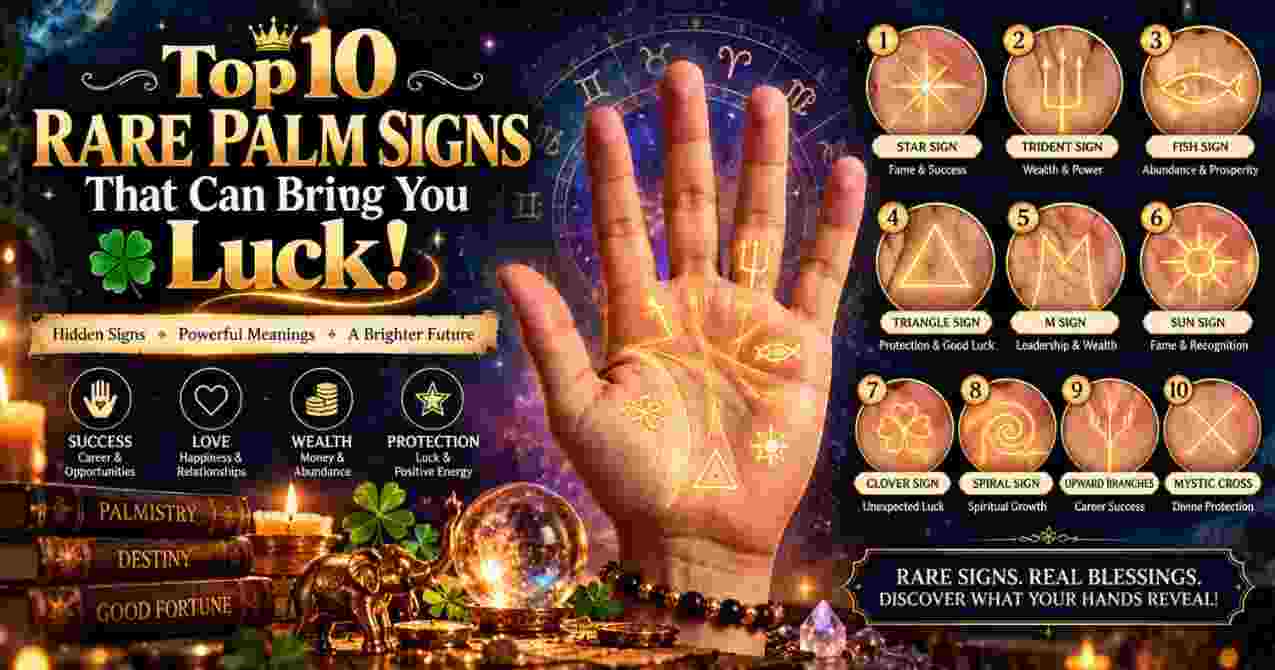
Your palm holds more than lines. It also holds small shapes, and palmists have studied those shapes for centuries. A fish, a star, a cross, or a trident can change how a reader sees your whole hand.
Most people never notice these marks. A few people carry one. Fewer still carry two or three. That rarity explains why palmists treat these signs as special.
This guide covers the ten rare palm signs that traditional palmistry links with good luck. You will learn where each sign appears, what it looks like, and what it means. You will also learn how to read the sign with care, how to avoid common mistakes, and how to keep a healthy view of the whole practice.
Palmistry is a traditional belief system. It does not predict the future with scientific proof. Read this guide as cultural knowledge and personal reflection. Enjoy it, test it, and keep your own judgment in charge.
Quick Answer: The 10 Rare Palm Signs That Bring Luck
Palmists name these ten signs as the most fortunate marks on the hand:
- Fish sign (Matsya): Wealth, travel, and protection.
- Star sign: Sudden breakthroughs, fame, and recognition.
- Mystic cross: Intuition, spiritual insight, and inner protection.
- Trident: Success, honor, and strong support from others.
- Lotus sign: Comfort, grace, and a refined life.
- Swastika sign: Prosperity, talent, and a blessed path.
- Triangle sign: Sharp thinking and smart money sense.
- Temple sign: Respect, charity, and lasting reputation.
- Flag sign: Public recognition and rising status.
- Chakra (wheel) sign: Authority, leadership, and drive.
Each sign carries more weight when it appears clear, deep, and well placed. A faint or broken mark carries less weight. Keep that rule in mind as you read.
What Are Palm Signs in Palmistry?
Palm signs are small marks and shapes on your hand. They differ from the major lines. Lines run across the palm and show broad themes. Signs appear on top of lines or on mounts and add detail.
Think of the major lines as the main roads on a map. Think of signs as landmarks. A landmark tells you something special about that stretch of road.
Signs, Lines, and Mounts: The Three Layers of a Reading
A full palm reading uses three layers. Each layer answers a different question.
- Lines show your main life themes. The life line, head line, heart line, and fate line lead the list.
- Mounts are the soft raised pads on your palm. Each mount links to a planet and a set of traits.
- Signs are the small shapes. They sharpen or change the story that lines and mounts tell.
Palmists never read a sign alone. They read the sign, then the line or mount that carries it. The same star can mean fame on one mount and a warning on another line.
The Seven Mounts You Need to Know
Before you hunt for signs, learn the mounts. Location drives meaning in palmistry.
- Mount of Jupiter sits below the index finger. It governs ambition, leadership, and confidence.
- Mount of Saturn sits below the middle finger. It governs discipline, patience, and responsibility.
- Mount of the Sun (Apollo) sits below the ring finger. It governs creativity, charm, and fame.
- Mount of Mercury sits below the little finger. It governs speech, trade, and quick thinking.
- Mount of Venus sits at the base of the thumb. It governs love, vitality, and comfort.
- Mount of the Moon (Luna) sits on the outer edge, opposite the thumb. It governs imagination, intuition, and travel.
- Mounts of Mars sit in two spots, above and below the center of the palm. They govern courage and resilience.
Keep this list nearby. Every sign in this guide ties back to one or more of these mounts.
Why Rare Signs Matter
Almost every hand has crease lines. Fewer hands show clean, distinct shapes like a fish or a trident. Palmists therefore treat a clear shape as a highlight.
Rarity does not equal destiny. A rare sign suggests potential. Your choices, work, and timing still decide the outcome. Treat each sign as a hint, not a promise.
How to Read a Palm Sign Correctly
Good readers follow a method. You can follow it too. Use these steps before you decide that you carry a lucky sign.
Step 1: Choose the Right Hand
Traditions differ on this point. Many palmists read the dominant hand for what you do with your life. They read the non-dominant hand for what you inherited. Others use the left hand for men and the right hand for women. Read both hands and compare them. A sign that appears on both hands carries more weight.
Step 2: Use Good Light and a Clean Palm
Sit near a window in natural daylight. Open your hand and relax your fingers. A tense hand hides marks and bends lines. Use a magnifying glass if you wish. A phone camera with the flash off also helps, since you can zoom in on a photo.
Step 3: Look for Clarity
A true sign shows clear edges. The lines that form it should look distinct, not blurry. Faint scratches and tiny skin folds rarely count. Palmists look for a mark that stands out at a glance.
Step 4: Check Depth and Color
Deep, even lines carry strength. Pale, thin lines carry less. A line that looks red or pink and healthy usually reads as vital. A very pale line reads as weak.
Step 5: Confirm the Location
Find the mount or line that holds the sign. Then check the meaning for that exact spot. A star on the mount of Jupiter reads very differently from a star on the head line. This step matters more than any other.
Step 6: Check for Support
Look at the rest of the hand. A lucky sign on a hand with a strong fate line and a clear sun line makes a stronger case. A lucky sign on a hand with weak, broken lines needs more caution.
Step 7: Watch Your Own Bias
Everyone wants to find a fish or a star. That wish can trick your eyes. Ask a friend to look at your palm without telling them what you hope to see. Compare your results.
Also read: What Lines on the Palm Are Responsible for Love and Marriage?
The Top 10 Rare Palm Signs That Can Bring You Luck
Now the main event. Each sign below follows the same pattern. You will see the shape, the location, the meaning, and a short note on how to confirm it.
1. The Fish Sign (Matsya): The Mark of Wealth and Protection
Palmists often rank the fish as the luckiest sign on the hand. Many call it the rarest too.
What the Fish Sign Looks Like
The fish forms when two short curved lines cross and create a shape like a fish. One curve forms the back. The other forms the belly. The lines meet at the head and the tail. Some fish look sharp and complete. Others look slightly open, like a leaf.
Where the Fish Sign Appears
The fish can appear in several places. Palmists report it most often near the wrist, near the base of the palm, or on a mount.
- Near the wrist or lower palm: Palmists link this spot with travel, foreign lands, and steady comfort.
- On the mount of Jupiter: This spot points to success in leadership, teaching, and spiritual growth.
- On the mount of the Sun: This spot points to wealth that grows from talent and public respect.
- On the mount of Mercury: This spot points to a gift for business and trade.
- Near the thumb or on the mount of Venus: This spot points to comfort, family happiness, and a warm home life.
What the Fish Sign Means
The fish carries deep symbolism. In Hindu tradition, the fish links to Matsya, the first avatar of Lord Vishnu. Matsya saved the world from a great flood. That story explains why palmists connect the fish with protection and rescue.
In practical terms, palmists read the fish as a sign of three things:
- Financial stability: Money tends to come in steadily, even after hard seasons.
- Travel and foreign ties: The owner may live, work, or settle abroad.
- Inner contentment: The owner finds a sense of ease and happiness.
Some Indian palmists also call the fish the “happiness mark.” They say it hints that success and joy wait close by.
How to Confirm a Fish Sign
Look for two clean curves that cross at both ends. Rule out random creases. A true fish has a clear belly space between the curves. Check the mount below it. A full, firm mount adds strength. A flat mount weakens the reading.
2. The Star Sign: The Mark of Sudden Breakthroughs
The star ranks among the most powerful signs in palmistry. It also ranks among the most misunderstood. Location decides everything.
What the Star Sign Looks Like
A star forms where three or more short lines cross at one point. The result looks like a tiny asterisk. Some stars have six rays. Others have eight. The lines should cross cleanly at a single center.
Where the Star Sign Appears
A star on a mount usually brings good news. A star on a major line usually brings a warning. Study the difference.
- Star on the mount of Jupiter: Palmists call this the best spot. It points to leadership, honor, and ambition that bears fruit. Many readers say it hints at a position of real authority.
- Star on the mount of the Sun: This spot points to fame, creative success, and public praise. Artists, performers, and speakers often hold this sign in palmistry lore.
- Star on the mount of Mercury: This spot points to a gift for commerce, speech, and persuasion. Palmists link it with strong business results.
- Star on the mount of Venus: This spot points to deep love and strong charm. It sometimes points to a very fortunate romance.
- Star on the mount of the Moon: This spot points to a rich imagination and wide popularity. Palmists sometimes link it with success through writing, music, or travel.
- Star on the mount of Saturn: This spot gets mixed readings. Some palmists call it a warning of sudden change. Others call it a sign of dramatic fortune after hardship.
A star on the life line, head line, or heart line carries a different message. Most palmists treat it as a caution about health or emotional strain. Do not mistake those stars for lucky ones.
What the Star Sign Means
The star signals intensity. It makes the trait of its mount shine brighter. It also brings events that arrive quickly and without warning. A star on the sun mount does not promise a slow climb. It points to a sudden rise.
Palmists also warn that stars bring fame and stress together. Bright attention carries pressure. The best readings pair a star with a calm, steady head line.
How to Confirm a Star Sign
Count the lines. You need at least three. Check that they cross at one point. Rule out a spot where two lines simply touch. Then confirm the mount location with care.
3. The Mystic Cross: The Mark of Inner Protection
The mystic cross looks small. Its meaning runs deep. Palmists tie it to intuition, faith, and quiet protection.
What the Mystic Cross Looks Like
The mystic cross forms as a clear “X” or “+” shape. It sits in a very specific spot. It lives in the gap between the head line and the heart line. Palmists call that gap the quadrangle.
Where the Mystic Cross Appears
Look in the middle of your palm. Find the head line, which runs across the center. Find the heart line above it. The space between them holds the mystic cross. It usually sits under the mount of Saturn or Jupiter, close to the center of that space.
Not every cross counts. A cross on a mount often reads as an obstacle. A cross in the quadrangle between the head and heart lines reads as a mystic sign.
What the Mystic Cross Means
Palmists link the mystic cross to several traits:
- Strong intuition: The owner senses danger and opportunity early.
- Spiritual interest: The owner often studies faith, mysticism, or healing.
- Protective instincts: Many palmists say the sign hints at luck in avoiding trouble.
- Interest in the unseen: The owner often feels drawn to dreams, symbols, or meditation.
Palmists call this a sign of “lucky escape.” They say the owner often steps away from harm at the right moment. That reading explains why people value it.
How to Confirm a Mystic Cross
Look for a distinct cross with crisp lines. Make sure it lies between the head and heart lines. A messy tangle does not qualify. A tiny cross that hides inside a thick bundle of creases needs a second look.
4. The Trident: The Mark of Honor and Strong Support
The trident looks like a three-pronged fork. Palmists admire it because it multiplies the power of any line it touches.
What the Trident Looks Like
A trident appears at the end of a line. The line splits into three short branches. Each branch spreads a bit. The shape resembles a small fork or the weapon of Lord Shiva.
Where the Trident Appears
Palmists name three prime spots.
- At the end of the sun line: This spot offers the strongest reading. It points to fame, wealth, and lasting respect.
- At the end of the fate line: This spot points to a successful career and a well-supported life.
- On the mount of Jupiter: This spot points to leadership, honor, and a high position.
A trident at the end of a weak line carries less force. A trident at the end of a long, deep line carries a lot.
What the Trident Means
The trident signals completion. A line that ends in three strong branches ends in triumph. Palmists read this as success that lasts into later life.
Many palmists also tie the trident to support from others. They say the owner receives help from mentors, partners, and family. That support often turns a good plan into a great result.
In Hindu tradition, the trident belongs to Lord Shiva. Palmists use that link to add a sense of divine strength to the sign.
How to Confirm a Trident
Check that the three branches grow from one stem. Check that the stem forms a true line, not a random crease. Make sure the branches spread outward instead of crossing. A tidy, open trident reads best.
5. The Lotus Sign: The Mark of Grace and Comfort
The lotus ranks among the rarest signs. Palmists treat it with great respect.
What the Lotus Sign Looks Like
The lotus forms when small curved lines open outward like petals. The petals gather around a central point. The overall shape resembles a flower in bloom. Few hands show a complete lotus. Most readers accept a clear, flower-like cluster.
Where the Lotus Sign Appears
Palmists report this sign most often near the center of the palm or on a major mount. Some also report it near the base of the fingers. Location varies more here than with other signs. Always read the nearby lines for context.
What the Lotus Sign Means
The lotus carries strong spiritual weight in Indian tradition. It serves as the seat of Goddess Lakshmi, who stands for wealth and good fortune. The flower also grows from muddy water and still stays clean. That image gives the sign a second meaning: purity that rises above hardship.
Palmists read the lotus as a sign of:
- A comfortable life: The owner tends to enjoy good homes, good food, and fine things.
- Good marriage prospects: Many readers link the sign with a supportive spouse or a well-off family.
- Refined taste: The owner often loves art, music, and beauty.
- Grace under pressure: The owner keeps a calm, kind manner even in tough times.
Readers also link the lotus with both Lakshmi and Vishnu. They treat it as a sign of double blessing.
How to Confirm a Lotus Sign
Look for petal-like curves that radiate from one point. Do not confuse the lotus with a random cluster of creases. Compare both hands. A lotus that shows on both hands carries more meaning.
6. The Swastika Sign: The Mark of Prosperity and Talent
This sign needs a careful introduction. The swastika is an ancient symbol of well-being. Hindus, Buddhists, and Jains have used it for thousands of years. The word comes from Sanskrit and means “good fortune” or “well-being.”
The same shape later appeared in a very different, hateful form in twentieth-century Europe. That use has nothing to do with palmistry. Palm readers use the older meaning only.
What the Swastika Sign Looks Like
On the palm, the swastika forms from short lines that cross at right angles. Each arm bends at the end. Few hands show a perfect version. Palmists accept a clear plus shape with small bent arms.
Where the Swastika Sign Appears
Palmists name these spots as the best:
- Mount of Jupiter: This spot points to honor, a strong career, and respect in society.
- Mount of the Sun: This spot points to creative fame and public admiration.
- On the fate line: This spot points to great talent and a well-guided life path.
- Center of the palm: Readers disagree on this spot, so treat it with caution.
What the Swastika Sign Means
Palmists say the swastika brings blessing and success. They link it with these traits:
- Sharp intelligence: The owner learns fast and does well in school or training.
- Steady prosperity: Wealth tends to arrive without constant struggle.
- Social respect: Others trust and honor the owner.
- A strong sense of purpose: The owner tends to find a clear calling.
Indian readers often connect the sign to Goddess Lakshmi. They say it marks a person who rarely faces lasting poverty.
How to Confirm a Swastika Sign
Look for crossing lines with bent ends. Rule out a simple cross or a star. The bent arms make the swastika unique. Photograph the area and zoom in to check.
7. The Triangle Sign: The Mark of Smart Money Sense
Triangles appear more often than fish or lotus signs. Still, a clean, well-formed triangle counts as rare. Palmists praise it for its link to intelligence and financial skill.
What the Triangle Sign Looks Like
A triangle forms when three short lines meet and enclose a small space. The shape should close fully. An open or broken triangle loses power.
Where the Triangle Sign Appears
Triangles can appear in several places.
- On the mount of Jupiter: This spot points to a gift for leadership and diplomacy.
- On the mount of Saturn: This spot points to research skill and deep study.
- On the mount of the Sun: This spot points to a talent for the arts that earns real income.
- On the mount of Mercury: This spot points to excellent business and science ability.
- In the middle of the palm: Many Indian readers speak of a “money triangle” here. They describe a triangle built from the fate line, head line, and a cross line. Sources differ on the exact shape, so treat this one as a traditional idea rather than a rule.
What the Triangle Sign Means
A triangle sharpens the mind. Palmists say it gives the owner a gift for planning, calculating, and spotting profit. The owner tends to weigh a deal with care and then act with confidence.
Triangles on mounts add skill in the matching field. A triangle on Mercury, for example, helps with trade and speech. A triangle on Jupiter helps with leading groups.
How to Confirm a Triangle Sign
Trace the three sides with your eye. Check that all three corners close. Make sure the triangle sits on a mount or line you can name. Do not count the natural triangle that forms where major lines happen to meet unless the shape looks clean and distinct.
8. The Temple Sign: The Mark of Respect and Charity
The temple sign ranks among the rarest and most admired. Few palmists claim to see it often.
What the Temple Sign Looks Like
The temple combines a triangle with vertical lines. The lines rise from the triangle like pillars or a spire. Some palmists also describe a cross beneath a triangle. The overall shape suggests a small building or shrine.
Where the Temple Sign Appears
Palmists most often report the temple on the mount of Jupiter or the mount of the Sun. Some also report it in the center of the palm. Placement on a raised, healthy mount adds strength.
What the Temple Sign Means
The temple stands for reverence. Palmists link it with:
- Strong moral character: The owner values honesty and fairness.
- Generosity: The owner gives time and money to others.
- Lasting reputation: People remember the owner with respect long after a project ends.
- Spiritual leadership: The owner often guides others in faith or community work.
Palmists also say this sign supports luck that grows from goodwill. The owner does not just receive fortune. The owner earns it through kind acts and steady service.
How to Confirm a Temple Sign
Look for a triangle with vertical lines. Check that the lines rise in a clear, orderly way. Rule out a random group of creases. Ask a second person to view the area with fresh eyes.
9. The Flag Sign: The Mark of Public Recognition
The flag looks simple. Palmists treat it as a sign of rising status and public attention.
What the Flag Sign Looks Like
A flag forms from a short vertical line with a small branch at the top. The branch points sideways. The shape resembles a flag on a pole. Some flags show a small triangle at the top instead of a branch.
Where the Flag Sign Appears
Palmists name the mount of Saturn as the classic spot. Some readers also accept the flag on the mount of Jupiter or the mount of the Sun. Each location shapes the meaning.
- On the mount of Saturn: This spot points to fame earned through discipline and hard work.
- On the mount of Jupiter: This spot points to a public role with real authority.
- On the mount of the Sun: This spot points to praise for creative or performing talent.
What the Flag Sign Means
The flag signals visibility. The owner steps into the public eye and earns attention. Palmists connect it with political life, public service, teaching, entertainment, and leadership roles.
The flag also signals victory. A flag marks a place that a person has reached. Palmists read it as a symbol of achievement after effort.
How to Confirm a Flag Sign
Look for a clean vertical stem with a clear branch at the top. Check that the stem stands upright. A line that simply wanders across the mount does not count. Compare the shape with a simple drawing of a flag.
10. The Chakra (Wheel) Sign: The Mark of Authority and Drive
The chakra sign closes our list. Palmists treat it as a mark of leadership and strong will.
What the Chakra Sign Looks Like
The chakra forms a circle with lines that radiate outward or inward. It resembles a small wheel or a disc. In Indian tradition, the Sudarshana Chakra serves as the discus weapon of Lord Vishnu. That image gives the sign its name.
Palmists also use the word “chakra” for circular fingerprint patterns called whorls. Some readers count a full set of whorl fingerprints as a related sign. Keep the two ideas separate when you read.
Where the Chakra Sign Appears
Readers report the sign on the palm itself, on a mount, or at the pad of a finger. A clear circle on a mount points to a high position. A circle at the fingertip points to a strong, independent mind.
What the Chakra Sign Means
Palmists link the chakra with:
- Command and authority: The owner leads easily and holds firm under pressure.
- Determination: The owner finishes what they starts.
- Protection: Because the sign ties to Vishnu, readers also link it with guarding and defending others.
- Rising fortune: The owner tends to climb to a position of real influence.
Some palmists warn that the chakra can also point to a stubborn streak. A strong will brings both strengths and risks. The owner should balance firmness with listening.
How to Confirm a Chakra Sign
Look for a distinct circle with radiating lines. A plain round freckle or a worn spot does not qualify. A true chakra shows structure. Check it in strong light.
A Bonus Mark: The Letter “M” on the Palm
Many people search for the letter “M” on their palms. It forms when the heart line, head line, life line, and fate line join in a way that resembles the letter. Some palmists link the “M” with sharp intuition, a talent for judging people, and good fortune.
Treat this one with realism. Skeptics point out that many hands show an “M” if you look closely enough. Believers say a clear, deep “M” still carries meaning. Either way, an “M” works best as a conversation starter, not as proof of luck.
How Lucky Signs Work Together
A single sign rarely tells the full story. Palmists weigh signs together with lines, mounts, and hand shape.
Signs on the Same Mount Add Up
Two lucky signs on one mount strengthen each other. A star and a triangle on the mount of the Sun, for example, suggest creative fame backed by smart planning.
Strong Lines Back Up Lucky Signs
A clear fate line and a clear sun line support almost every lucky sign. These two lines carry the themes of career and recognition. A lucky sign on a hand with weak lines reads as potential that still needs work.
Mount Strength Matters
A full, firm mount boosts the sign on it. A flat mount mutes the sign. Press gently on each mount to feel its shape. A rounded pad suggests strong energy.
Conflicting Signs Need Balance
Some hands show both lucky and unlucky marks. A star on Jupiter and a cross on the head line can appear together. Palmists do not cancel one with the other. They describe both and look for the balance.
Which Lucky Sign Matches Your Goal?
Different signs speak to different life goals. Use this short guide to match them. Treat it as a reading aid, not a rule.
Signs Linked With Money and Business
The fish, the triangle, and a star on the mount of Mercury lead this group. Palmists link them with steady income and smart trade. A trident on the fate line also fits here, since it points to a strong career.
Signs Linked With Fame and Public Life
A star on the mount of the Sun, a flag, and a trident on the sun line lead this group. Palmists link them with recognition, applause, and visible success.
Signs Linked With Wisdom and Spiritual Growth
The mystic cross, the temple, and the lotus lead this group. Palmists link them with insight, charity, and inner calm.
Signs Linked With Leadership and Power
The chakra, a star on the mount of Jupiter, and the swastika on Jupiter lead this group. Palmists link them with command, honor, and high office.
Many people carry signs from more than one group. That mix often describes a person with several talents. Read the whole hand before you decide which goal fits you best.
Signs That Look Lucky but Are Not
Not every pretty shape brings luck. Learn to spot a few common traps.
- Stars on major lines: Palmists treat these as warnings, not blessings.
- Crosses on mounts: Readers often see these as obstacles or tests.
- Dots and spots: Palmists often read dark dots as setbacks, especially on a major line.
- Islands on lines: These oval shapes usually show a period of weakness or strain.
- Broken or faded signs: A faint mark loses most of its meaning.
Remember that even a warning sign does not seal your fate. It points to a theme you can handle with care.
Common Mistakes When Reading Lucky Palm Signs
Beginners often make the same errors. Avoid these.
- Seeing what you want to see. Hope shapes perception. Ask someone else to look.
- Ignoring location. The same shape changes meaning on a new mount.
- Treating tiny creases as signs. Skin folds create many random marks.
- Reading only one hand. Compare both hands for a fuller view.
- Reading a hand tense with effort. Relax your fingers first.
- Chasing luck without action. A sign never replaces effort and wise choices.
- Skipping the big picture. Always read signs together with lines and mounts.
- Relying on photos with poor light. Shadows can fake lines.
Palmistry and Science: An Honest View
Palmistry is a belief tradition. It has no scientific proof that palm signs predict luck, money, or fame. Researchers have not found a reliable link between palm patterns and life outcomes.
Science does explain how palm lines form. Palm creases develop in the womb as the hand folds and flexes. Fingerprint patterns form around the same stage of development. Lines can also change over time with age, health, and daily use.
Why, then, do people still enjoy palmistry? Several reasons stand out.
- It offers a reflective ritual. Looking at your hand slows you down and invites self-thought.
- It carries cultural depth. Palmistry draws on Indian, Chinese, Greek, and European traditions.
- It starts good conversations. People love to compare hands and share stories.
- It encourages hope. A positive reading can lift your mood and motivate action.
You can honor the tradition and still keep a clear head. Enjoy the symbols. Make big decisions with facts, advice, and your own judgment.
How to Use Your Palm Signs in Real Life
Suppose you find a lucky sign. What should you do next? Use it as a prompt, not a promise.
Treat the Sign as a Strength Report
Read the meaning as a hint about your natural strengths. A star on the sun mount may suggest a creative streak. A trident may suggest that you work well with mentors. Ask yourself whether those traits match your life.
Build the Skills the Sign Highlights
If the sign points to leadership, practice leading. If it points to business sense, study finance. The sign suggests an opening. Your effort walks through it.
Stay Humble and Grounded
A lucky sign does not excuse risky choices. Never gamble money because of a mark on your hand. Keep savings, insurance, and sound planning in place.
Seek a Qualified Reader for Fun, Not for Fear
If you visit a palmist, choose someone who speaks kindly and honestly. Avoid anyone who pressures you to buy costly remedies, gems, or rituals. A good reader explains, listens, and never uses fear to sell.
Frequently Asked Questions About Lucky Palm Signs
Which palm sign is the luckiest?
Palmists most often name the fish sign as the luckiest mark. They link it with wealth, travel, and protection. Stars on the mount of Jupiter or the Sun also rank very high.
Which hand shows lucky signs more clearly?
Many palmists check the dominant hand first. They read it as the story of what you do with your life. Others check the non-dominant hand for inherited traits. The best approach is to read both and compare.
Can palm signs change over time?
Yes. Small marks can fade, appear, or shift as your hands age or change with work and health. Palmists often say that signs reflect your current path. They may change as your habits and life events change.
Is it rare to have a fish sign on the palm?
Palmists describe the fish as very rare. Many people report only a vague, fish-like shape. A clean, complete fish appears much less often.
What does a star on the palm mean?
A star usually signals intense, sudden events. On a mount, it often brings good news such as fame or leadership. On a major line, palmists often read it as a caution.
Does a cross on the palm always mean bad luck?
No. A cross between the head and heart lines forms the mystic cross, which palmists read as lucky. A cross on a mount or line often reads as an obstacle. Location decides the meaning.
What is the money triangle in palmistry?
Indian palmists use the phrase for a triangle in the center of the palm. They link it with business skill and financial gain. Sources describe the exact shape in slightly different ways, so read it as a tradition, not a rule.
Does the letter “M” on the palm bring luck?
Palmists link the “M” with intuition and fortune. Skeptics note that many hands show some form of “M.” Treat it as a fun sign rather than a promise.
Can I have more than one lucky sign?
Yes. Some hands show two or three. Palmists say that several clear, well-placed signs make a stronger case. They still weigh the lines and mounts.
Is palmistry scientifically proven?
No. Palmistry is a traditional belief practice. Science has not shown that palm signs predict luck, wealth, or fame. People enjoy it for culture, reflection, and fun.
How accurate is a palm reading?
Accuracy varies with the reader and the person. No reading can promise a specific result. Use it for insight and conversation, and keep your own judgment in charge.
How can I check my palm at home?
Sit in daylight with a relaxed hand. Look at each mount and line. Use a magnifier or a zoomed photo. Compare your results with a friend. Note only clear, distinct shapes.
Final Thoughts: Read the Signs, Then Write Your Own Luck
Your palm holds a rich map of symbols. The fish, star, mystic cross, trident, lotus, swastika, triangle, temple, flag, and chakra each carry a message in palmistry. Each one points to a different kind of fortune. Some point to wealth. Some point to fame. Some point to wisdom, protection, or respect.
Remember the key rules. Look for clear shapes. Check the exact location. Read both hands. Weigh signs together with lines and mounts. Stay honest about what palmistry can and cannot do.
Most of all, remember that luck grows from action. A sign on your hand may encourage you. Your habits, choices, and kindness decide what happens next. Hold your hand up to the light, enjoy what you find, and then go build the life you want.