
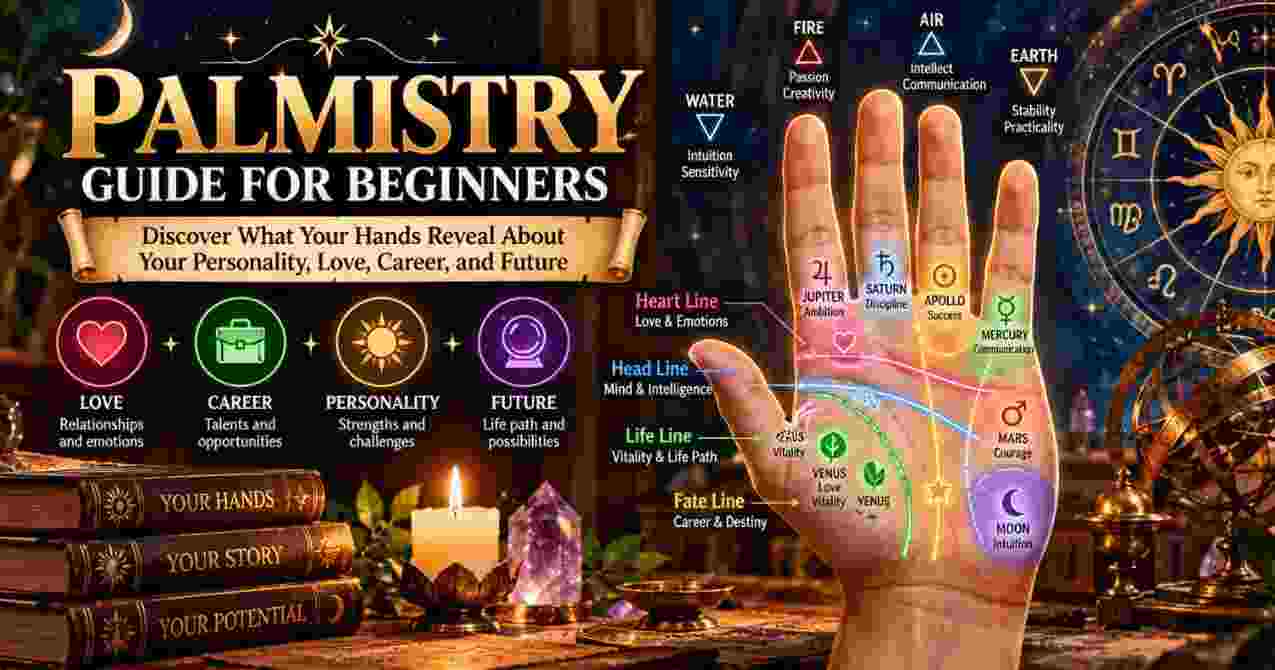
Palmistry is the practice of reading the hands to explore personality, strengths, habits, and life themes. Practitioners study the shape of the hand, the fingers, the lines, the mounts, and the marks. They combine these clues into one picture. This guide teaches you that method from the ground up.
You do not need special talent. You do not need to believe in fate. You need a clear hand, good light, and patience. Follow the steps below in order. Within a few evenings, you can read the basics of any palm.
I write this guide as a working palmist would teach a first-year student. I explain what each sign means. I also explain what palmistry cannot do. You will learn the craft and its limits together.
Key Takeaways for Beginners
- Palmistry reads the whole hand, not just one line.
- Start with the overall hand shape. Move to fingers, then lines, then mounts, then marks.
- Study both hands. Read the dominant hand as your present, and the other hand as your starting potential.
- Lines change over time. A line you read today does not lock in your future.
- Treat every reading as reflection, not prediction. Palmistry has no scientific proof behind it.
- Never use a reading to diagnose illness or to scare someone.
What Is Palmistry?
Palmistry is a symbolic system for interpreting the hands. People also call it palm reading, chirology, hand analysis, and chiromancy. The word chirology comes from the Greek word for hand. Chiromancy adds the idea of divination.
Palmists often split the field into two parts. Chirognomy covers the shape of the hand, the fingers, and the nails. Chiromancy covers the lines and marks. A complete reading uses both.
What a Palm Reading Includes
A good reading looks at six layers:
- The shape and size of the hand
- The length and shape of the fingers and thumb
- The major lines
- The minor lines
- The mounts, which are the raised pads of the palm
- The small marks, such as stars, crosses, and islands
Each layer adds detail. No single layer tells the whole story. A beginner who reads only the life line misses most of the picture.
What Palmistry Is Not
Palmistry is not a medical test. It does not replace a doctor. It does not give legal, financial, or mental health advice. It does not read a person’s mind. It does not name dates of death or disaster.
Responsible palmists say this clearly. They treat a reading as a conversation about tendencies, not a verdict.
A Short History of Palmistry
Palm reading has a long past. Many cultures developed their own versions. Each one shaped the practice in its own way.
Ancient India
Indian tradition calls hand reading Hasta Samudrika Shastra. It forms one branch of Samudrika Shastra, the broader study of bodily signs. Indian scholars described the lines and mounts in detail. They linked them to planets. Many Indian palmists still use that planetary system today.
Ancient China
Chinese hand reading developed alongside face reading and other forms of physiognomy. Chinese practitioners paid close attention to the color, texture, and firmness of the hand. They tied these traits to health and temperament.
Ancient Greece and Rome
Greek writers discussed hand reading more than two thousand years ago. Aristotle appears in old stories about the practice. Historians debate how much he wrote on the subject. Roman culture carried the practice forward. Medieval Europe then shaped it into the form many Westerners know.
The Modern Western Revival
In the nineteenth century, writers gave palmistry a more organized structure. Casimir d’Arpentigny classified hand shapes. Later, Cheiro, whose real name was William John Warner, made palm reading famous in Britain and the United States. Many modern books still build on their ideas.
Today, palmistry blends old tradition with modern psychology language. Many readers use it as a tool for self-reflection.
Does Palmistry Work? An Honest Look
You deserve a straight answer before you invest time.
No controlled study has shown that palm lines predict the future. Scientists classify palmistry as a pseudoscience. Skeptics argue that readers succeed through general statements, careful observation, and the human tendency to see ourselves in vague descriptions.
Some facts are real, though.
- Hands do reveal some physical information. Calluses show how a person works. Swollen joints can hint at joint problems. Nail changes can signal certain health conditions, which is why doctors do look at nails.
- A few medical researchers have studied certain palm patterns in connection with genetic conditions. For example, a single crease across the palm appears more often in some chromosomal conditions. A doctor, not a palmist, must interpret such findings.
- Reflection has value. Many people enjoy a reading because it prompts them to think about their choices.
Here is the practical view. Treat palmistry as a symbolic language. It gives you a structured way to observe, ask questions, and talk. It does not give you a crystal ball.
If you hold that view, you can enjoy the craft without harm.
Before You Start: Tools and Setup
You need very little. Prepare your space, and your reading will go better.
What You Need
- Bright, natural light, or a clear white lamp
- A magnifying glass, if you want to see fine lines
- A notebook for sketches and observations
- A clean, dry hand
- A camera or scanner, if you want to compare changes over time
Take Clear Hand Prints or Photos
You can read a live hand. You can also read a photo. For a good photo, follow these rules:
- Hold the hand flat, with fingers slightly apart.
- Place the hand on a plain, dark surface.
- Shoot from directly above the palm.
- Avoid shadows across the lines.
- Take one photo of each hand.
For a simple ink print, press a lightly inked hand onto paper. Do this gently. Too much ink blurs the fine lines.
Choose Which Hand to Read
Traditions differ. Most Western palmists use this method:
- The dominant hand (the hand you write with) shows your present life, your choices, and how you use your gifts.
- The non-dominant hand shows your inherited traits and starting potential.
Many Indian palmists use a different rule. They read the right hand for men and the left hand for women. Others read both hands for everyone. Pick one method and use it consistently. Beginners often do best by comparing both hands.
Set Your Mindset
Slow down. Look before you judge. Describe what you see in plain words first. Then interpret. This habit keeps you honest.
Also ask for permission. Never read a stranger’s hand without a clear yes.
Step 1: Read the Overall Hand
Always begin with the whole hand. Step back and observe. The overall form sets the tone for everything else.
Hand Shapes: The Four Types
Many palmists group hands into four types. They borrow the names of the four classical elements: earth, air, fire, and water. Judge the shape by comparing the length of the palm to the length of the fingers.
Earth Hands
Earth hands have a square palm, thick skin, and short fingers. The palm looks about as wide as it is long. The skin often looks firm and ruddy.
Palmists link earth hands with practical, steady, and reliable people. These people value routine. They work with their hands. They dislike risky plans. They can also act stubborn.
Air Hands
Air hands also have a square palm. The fingers run long. The skin looks thinner and drier.
Palmists link air hands with curious, talkative, and analytical people. These people love ideas, words, and puzzles. They adapt fast. They can also overthink.
Fire Hands
Fire hands have a rectangular palm with short fingers. The skin often looks warm and pink.
Palmists link fire hands with energetic, bold, and spontaneous people. These people take initiative. They inspire others. They can also act impatient.
Water Hands
Water hands have a long, oval palm and long, flexible fingers. The skin often looks soft, and the palm often carries many fine lines.
Palmists link water hands with sensitive, imaginative, and empathic people. These people feel moods deeply. They value harmony and creativity. They can also absorb stress from others.
A Note on Mixed Types
Few hands match a single type perfectly. Most people show a blend. Name the strongest type, then note the second. Treat the result as a starting hint, not a label.
Palm Texture, Color, and Flexibility
Touch the hand lightly, if the person agrees. Note these points:
- Fine, soft skin often suggests sensitivity.
- Coarse, firm skin often suggests a robust, practical nature.
- Pale color can suggest low energy at that moment.
- Deep pink color can suggest warmth and vitality.
- A stiff hand can suggest caution and resistance to change.
- A very flexible hand can suggest adaptability.
Remember that temperature, weather, and recent activity change the skin. Do not over-read a single visit.
The Size of the Hand
Judge the hand against the person’s body. A large hand on a small frame stands out. A small hand on a large frame stands out too.
Palmists often say people with larger hands notice details and enjoy fine work. They say people with smaller hands think in big pictures and act quickly. Treat these ideas as light hints.
Step 2: Read the Fingers and Thumb
Fingers add rich detail. Each finger carries a name and a planetary link in traditional palmistry.
The Five Digits and Their Meanings
| Digit | Traditional Name | Theme |
|---|---|---|
| Index | Jupiter finger | Ambition, leadership, confidence |
| Middle | Saturn finger | Responsibility, discipline, caution |
| Ring | Apollo (Sun) finger | Creativity, expression, recognition |
| Little | Mercury finger | Communication, wit, business sense |
| Thumb | Venus and Mars link | Will, logic, drive |
Finger Length
Compare each finger to its neighbors. Use the base of each finger, where it meets the palm, as your starting point.
- A long Jupiter finger points to a strong need to lead.
- A short Jupiter finger can point to modesty or self-doubt.
- A long Saturn finger points to seriousness and focus.
- A long Apollo finger points to artistic flair and a love of attention.
- A long Mercury finger points to strong speech and persuasion.
- A short Mercury finger can point to a plain-spoken, direct style.
The ring finger and index finger comparison draws special interest. If the ring finger runs longer, palmists often link the person to risk-taking and competitive drive. If the index finger runs longer, they link the person to caution and social awareness. Treat this as one clue among many.
Finger Shape
Look at the tip of each finger.
- Square tips suggest order and practicality.
- Conic (rounded) tips suggest charm and creativity.
- Pointed tips suggest sensitivity and idealism.
- Spatulate (flared) tips suggest energy and invention.
Finger Spacing
Ask the person to spread the fingers naturally. Notice the gaps.
- Wide gaps often suggest independence and openness.
- Tight fingers often suggest caution and thrift.
- A wide gap between the little finger and ring finger often suggests a need for freedom.
- A wide gap between the index finger and middle finger often suggests independent thought.
The Thumb
The thumb carries great weight in a reading. Palmists call it the signature of will.
Look at three things:
- Length. A long thumb suggests strong willpower and leadership. A short thumb suggests a flexible, easygoing approach.
- Angle. A thumb that opens wide suggests generosity and openness. A thumb that stays close to the hand suggests caution and self-control.
- Flexibility. A thumb that bends far back suggests adaptability. A stiff thumb suggests determination, and sometimes stubbornness.
Also check the two thumb sections. The upper section shows will. The lower section shows logic. If the upper section runs longer, the person leans on drive. If the lower section runs longer, the person leans on reason.
A Quick Look at Nails
Nail reading, sometimes called onychomancy, adds a few clues. Keep in mind that health changes nails, and doctors take them seriously. Do not diagnose.
- Wide, short nails often suggest a direct, spirited person.
- Long, narrow nails often suggest a quiet, careful person.
- Ridged nails can reflect stress or other factors. Suggest a doctor’s visit if the person worries about them.
Step 3: Read the Major Lines
Now you reach the heart of palmistry. Most beginners start here, but you will read better after the steps above.
Learn four principles first:
- Depth. A deep, clear line suggests strong, steady energy in that area of life.
- Length. A long line suggests a strong theme. A short line does not mean a weak life.
- Clarity. A clean line suggests smooth flow. Breaks, chains, and islands suggest interruptions or stress.
- Color. Pink lines suggest balance. Red lines suggest intensity. Pale lines suggest low energy.
Read lines with a calm eye. Do not panic over a break or a cross. Almost every hand has some.
The Life Line
The life line curves around the base of the thumb. It starts between the thumb and index finger. It sweeps down toward the wrist.
What it shows: vitality, energy, and major life changes. It does not show how long you will live. This is the most common myth in palmistry. A short life line does not predict early death.
How to read it:
- A deep, long, clean line suggests strong stamina and resilience.
- A faint line suggests a quieter energy style.
- A line with a wide curve suggests warmth, enthusiasm, and a love of activity.
- A line that hugs the thumb suggests caution and lower energy reserves.
- A break in the line suggests a major change, such as a move or career shift.
- A chain of small links suggests a period of stress or scattered energy.
- A fork at the end suggests a person who may split time between two places or two roles.
- Small branches rising upward suggest bursts of ambition and effort.
- Small branches dropping downward suggest times of drained energy.
The Head Line
The head line runs across the palm. It begins near the life line, above the thumb, and travels toward the outer edge of the hand.
What it shows: thinking style, focus, learning, and mental habits. It does not measure intelligence.
How to read it:
- A long, straight line suggests logical, practical thinking.
- A gently sloping line suggests creative and flexible thinking.
- A steep slope toward the wrist suggests a vivid imagination and a love of art or story.
- A short line suggests quick, focused thinking. It does not suggest low intelligence.
- A deep line suggests clear concentration.
- A faint line suggests a more scattered, easily distracted style.
- A curved or wavy line suggests restless thought.
- A break in the line suggests a shift in thinking or a change in direction.
- A fork at the end palmists call the writer’s fork. It suggests a person who sees both sides of an issue and expresses ideas well.
- A head line joined to the life line at the start suggests a careful person who thinks before acting.
- A head line separated from the life line suggests an independent person who acts boldly.
The Heart Line
The heart line sits highest on the palm. It runs across the top, under the fingers. It usually starts near the little finger edge and travels toward the index or middle finger.
What it shows: emotional style, approach to love, and the way a person gives and receives affection. Many palmists consider it a clue to emotional health, not a prediction of marriage.
How to read it:
- A long, curved line suggests an open, expressive heart.
- A short, straight line suggests a reserved or practical approach to feelings.
- A line that ends under the index finger suggests a person who sets high standards in love.
- A line that ends under the middle finger suggests a person who puts their own needs first, at least at times.
- A line that ends between the two fingers suggests balance and a warm, steady heart.
- A deep line suggests strong feelings.
- A faint line suggests a quiet emotional style.
- A chain of links suggests emotional ups and downs.
- A break suggests a significant emotional change or a period of healing.
- Small lines that drop from the heart line suggest moments of disappointment.
- A fork at the end suggests an ability to see love from more than one angle.
The Fate Line
The fate line, also called the line of destiny, runs up the center of the palm toward the middle finger. Not every hand carries one.
What it shows: career path, sense of direction, and the influence of outside forces on one’s work and choices.
How to read it:
- A strong, deep line suggests a clear sense of purpose.
- No line does not mean no direction. It can suggest a person who follows a flexible, self-made path.
- A line that starts at the base of the palm suggests early clarity about life goals.
- A line that starts from the life line suggests a person who builds a career through their own effort.
- A line that starts from the moon mount suggests a career shaped by the public or by other people’s support.
- A line that starts late, near the middle of the palm suggests a later-in-life calling.
- A break or shift suggests a career change.
- Several parallel lines suggest more than one career focus.
The Sun Line
The sun line, also called the Apollo line, runs vertically toward the ring finger. Many hands lack it.
What it shows: creativity, recognition, and satisfaction. It points to the way a person shines.
How to read it:
- A clear line suggests a talent for expression and a chance at recognition.
- A faint line suggests a quiet, private path to fulfillment.
- A line that starts low in the palm suggests early talent.
- Several short lines suggest many interests.
The Mercury Line
The Mercury line, also called the health line, runs from near the base of the palm toward the little finger. Many people do not have one.
What it shows: communication skill, business sense, and general wellbeing themes.
Be careful here. Never use this line to diagnose illness. A smooth line, palmists say, suggests steady energy. A broken or wavy line suggests periods of stress. Encourage anyone with health worries to see a doctor.
Step 4: Read the Minor Lines
Minor lines add shading to the picture. Not every hand shows them. Do not hunt for them. Note them if they appear clearly.
The Girdle of Venus
The girdle of Venus is a curved line above the heart line. It sits under the ring and middle fingers.
Palmists link it to high sensitivity, strong emotion, and an artistic temperament. A clear girdle suggests deep feelings and a need for emotional safety. Many palmists note it more often in people who absorb the moods around them.
The Relationship Lines
Small horizontal lines on the outer edge of the palm, under the little finger, are the relationship lines. Some palmists call them marriage lines.
Do not count them as the number of marriages. Modern palmists read them as significant bonds.
- A long, deep line suggests a deep, lasting bond.
- A short line suggests a shorter or lighter connection.
- A faint line suggests a mild or private bond.
- A fork at the end suggests a bond that changes shape.
The Travel Lines
Fine lines on the outer edge of the palm, near the wrist, are travel lines. They run horizontally. Palmists link them to journeys, moves, and a love of exploration. They do not predict specific trips.
The Intuition Line
The intuition line is a curved line on the outer palm that sweeps from the base toward the little finger side. It appears rarely. Palmists link it to strong gut feeling and sensitivity to subtle cues.
The Bracelets
Lines across the wrist, called bracelets or rascettes, mark the base of the palm. Traditional palmists once counted them for lifespan. Modern readers treat them as a sign of general vitality and stability. A clear, unbroken top bracelet suggests a steady foundation.
The Simian Crease
Sometimes the head line and heart line merge into one line across the palm. People call this a simian crease. Palmists link it to intense focus and a strong, single-minded nature.
Be careful, though. Doctors also notice this feature, since it appears more often in certain genetic conditions. Many healthy people have it. Do not comment on health. If the person asks, suggest they speak with a doctor.
Step 5: Read the Mounts
Mounts are the soft, raised pads of the palm. Each one carries the name of a planet or a celestial body. A full mount stands out. A flat mount lies low. An overly large mount suggests the trait appears in excess. A missing mount suggests the trait appears faintly.
Mount of Jupiter
Jupiter sits below the index finger. A full mount suggests ambition, confidence, and leadership. A flat one suggests modesty. An overly full one suggests pride.
Mount of Saturn
Saturn sits below the middle finger. A full mount suggests discipline, depth, and a love of solitude. A flat one suggests a lighter, more carefree style. An overly full one suggests moodiness.
Mount of Apollo (Sun)
Apollo sits below the ring finger. A full mount suggests creativity, charm, and optimism. A flat one suggests a plainer, more private approach to life. An overly full one suggests vanity.
Mount of Mercury
Mercury sits below the little finger. A full mount suggests wit, strong speech, and business sense. A flat one suggests a quiet approach to communication. An overly full one suggests talk that tips into spin.
Mount of Venus
Venus sits at the base of the thumb, inside the life line. A full mount suggests warmth, sensuality, and a love of beauty. A flat one suggests a cooler, more reserved style. An overly full one suggests indulgence.
Mount of Mars
Palmists describe two Mars mounts.
- Lower Mars sits inside the life line, above Venus. It relates to courage and the ability to fight for your needs.
- Upper Mars sits on the outer palm, between Mercury and the moon. It relates to resilience and self-control.
A full mount suggests bravery and persistence. A flat one suggests a gentler approach. An overly full one suggests aggression.
Mount of the Moon (Luna)
The moon sits on the outer palm, opposite the thumb, near the wrist. A full mount suggests imagination, intuition, and a love of dreams and stories. A flat one suggests a practical, literal mind. An overly full one suggests restlessness or escapism.
The Plain of Mars
The central hollow of the palm, between the mounts, is the plain of Mars. A firm, balanced plain suggests steadiness. A deep hollow suggests a person who tends to feel drained.
Step 6: Read the Marks and Symbols
Small marks add detail. Treat them gently. Many palms contain random marks. A symbol matters only when it stands out clearly and sits in a meaningful spot.
| Mark | Common Meaning |
|---|---|
| Star | A moment of intensity, luck, or sudden change |
| Cross | An obstacle or a test, often a minor one |
| Triangle | Skill, talent, and good use of energy |
| Square | Protection and stability, especially over a break |
| Island | A period of strain or reduced energy |
| Grille (crossed lines) | Scattered energy or heightened sensitivity |
| Circle | Rare. Palmists link it to intensity or a unique experience |
| Dot | A short stress point |
| Trident | A positive sign of strength at the end of a line |
A square placed around a break is a favorite sign among palmists. They read it as a sign of recovery and support.
Do not read a single cross as a doom sign. Instead, ask: what pressure did this person face at that stage of life?
Step 7: Read Timing on the Lines
Beginners love timing. They ask: when will it happen? Many palmists mark approximate ages on the life line and fate line. Methods vary. Most systems divide the line into equal parts.
Here is the honest warning. Timing methods differ from school to school. They carry the least reliability of any part of palmistry. Use timing as a guide for reflection only. Use phrases like “around your late twenties” and “a period of change.” Avoid precise dates.
A simple approach:
- Start the fate line at the base of the palm. That point represents early life.
- Treat the middle of the line as early adulthood.
- Treat the point near the middle finger as later life.
Always add context. A change in a line marks a theme, not a promise.
Step 8: Put the Reading Together
A reading does not list features. It tells a story. Here is a simple method you can follow.
The Seven-Part Method
- Greet and set the frame. Say, “This reading looks at tendencies, not fixed outcomes.”
- Name the hand type. Describe the overall character.
- Note the fingers and thumb. Highlight two or three striking traits.
- Read the four major lines. Cover the heart, head, life, and fate lines.
- Check the mounts. Look for the fullest and flattest areas.
- Add marks and minor lines. Include only the clear ones.
- Close with a summary. Name three strengths and one area of growth.
A Sample Mini-Reading
Imagine a hand with a rectangular palm and short fingers. The skin looks warm. The thumb stands long and firm. The head line runs long and straight. The heart line curves gently and ends between the index and middle fingers. The life line sweeps wide. The fate line begins late, in the center of the palm.
A reading might sound like this:
“Your hand shows fire energy. You act quickly, and you enjoy leading. Your strong thumb says you follow through on your plans. Your long head line shows a clear, logical mind. Your gentle heart line shows warmth, with a good balance between your needs and others’ needs. Your wide life line shows energy and love of activity. Your fate line begins late. That often suggests a calling that grows clearer in adult life. As a growth area, you might practice patience when others move slower than you.”
Notice the pattern. The reader describes. The reader links. The reader ends with a gentle suggestion.
Cross-Check Before You Conclude
Never trust one sign alone. Look for agreement across layers. A person with a long thumb, a strong head line, and a full Jupiter mount points clearly toward leadership. A single sign in isolation proves little.
If two signs contradict each other, say so. Humans hold contradictions. A shy person can have a strong thumb. A bold person can have a faint heart line. Explore the tension. It often makes a reading more truthful.
Left Hand vs. Right Hand
Compare both hands in every reading. Note the differences.
- Large differences suggest a person who has changed a great deal from their starting point.
- Small differences suggest steady character over time.
Ask the person about the difference. Many people share a story of growth or change. This conversation often makes a reading feel real and useful.
Palmistry Traditions Around the World
Different traditions emphasize different details. Knowing them helps you read with an open mind.
Western Palmistry
Western palmistry stresses psychology, personality, and life themes. It uses the four-element hand types and the planetary mounts.
Indian Palmistry
Indian palmistry ties the hand closely to the nine planets and to astrology. It pays close attention to specific signs, such as the fish, the conch, and the lotus. Many Indian readers also study the soles of the feet and the body as a whole.
Chinese Palmistry
Chinese palmistry blends hand reading with themes of balance, energy, and health. It studies the color and firmness of the hand with care.
Which One Should You Learn?
Start with one system. Learn its logic well. Branch out later. Mixing systems too early causes confusion.
Common Beginner Mistakes
Avoid these traps.
- Reading only one line. Always read the whole hand.
- Treating the life line as lifespan. It does not measure years.
- Panicking over breaks and crosses. Almost everyone has them.
- Predicting dates of events. Timing methods stay unreliable.
- Making medical claims. Leave diagnosis to doctors.
- Skipping the hand shape and fingers. These steps give you context.
- Reading with poor light. Fine lines vanish in shadow.
- Ignoring the person. Ask questions. Watch reactions. Adjust.
- Over-trusting a single book. Compare sources.
- Telling frightening stories. A reading should leave a person calmer, not afraid.
Ethics: How to Read Responsibly
Ethical practice protects both reader and client. Follow these principles.
- Get consent. Read only willing people.
- Respect privacy. Never share a person’s reading without permission.
- Speak with care. Choose words that support rather than scare.
- Stay in your lane. Do not give medical, legal, or financial advice.
- Be honest about limits. Say that palmistry cannot predict the future with certainty.
- Avoid dependency. Never encourage anyone to make major life choices based only on a reading.
- Never charge for fear. Do not claim that a curse or danger needs a paid cure.
If someone appears upset or in crisis, pause the reading. Encourage them to talk with a trusted friend, a doctor, or a mental health professional.
How to Practice: A 30-Day Beginner Plan
Skill grows through repetition. Use this plan to build confidence.
Week 1: Learn the Hand
- Day 1 to 2: Study hand shapes. Sketch the four types.
- Day 3 to 4: Study finger length and shape on five different people.
- Day 5 to 7: Study the thumb. Compare thumb angle and flexibility in family and friends.
Week 2: Learn the Major Lines
- Day 8 to 9: Trace the life line on your own hand.
- Day 10 to 11: Trace the head line.
- Day 12 to 13: Trace the heart line.
- Day 14: Trace the fate line, if present.
Week 3: Learn Mounts and Marks
- Day 15 to 18: Identify each mount on your own hand. Note which ones look full.
- Day 19 to 21: Search for marks and note their positions.
Week 4: Read and Reflect
- Day 22 to 25: Complete a full written reading of your own hands.
- Day 26 to 28: Read three willing friends. Ask for feedback.
- Day 29 to 30: Review your notes. Identify what you still find confusing.
Keep a Reading Journal
Record each reading with a date, a sketch, and your notes. Revisit your own hands every six months. Lines shift. You will see your own reading evolve.
Do Palm Lines Change?
Yes. Lines can deepen, fade, branch, or break over time. Habits, health, stress, and age all affect the skin of the hand. Many palmists photograph their own hands every year.
This fact supports a healthy view of palmistry. If lines change as life changes, then a reading describes a moment. It does not describe a destiny carved in stone.
Tools and Resources for Learning More
Build your knowledge with reliable material.
- Classic and modern books. Look for beginner books with clear diagrams and exercises. Compare two or three authors.
- Hand diagrams. Print a labeled palm chart for quick reference.
- Local classes and workshops. Learning with a teacher speeds your progress.
- Reading groups. Practice with other beginners. Share photos and compare interpretations.
- A magnifying glass. It helps you see fine lines.
Check the author’s background before you trust any resource. Choose teachers who stress ethics and who admit the limits of the craft.
Frequently Asked Questions About Palmistry
What is palmistry in simple words?
Palmistry is the practice of reading the hands to explore personality and life themes. Readers study the hand shape, fingers, lines, mounts, and marks.
Is palm reading real?
Palm reading has no scientific support as a predictor of the future. Many people use it as a symbolic tool for self-reflection. Treat it as a form of conversation, not a proven science.
Which hand should I read first?
Start with your dominant hand. It shows your present life and choices. Then read the other hand to see your starting traits. Some traditions use a different rule, such as the right hand for men and the left for women.
What are the four major lines in the palm?
The four major lines are the life line, the head line, the heart line, and the fate line. Many readers also study the sun line and the Mercury line.
Does a short life line mean a short life?
No. The life line shows vitality and life changes. It does not measure lifespan. A short life line has no link to early death.
What does a broken line mean?
A break usually points to a change or a challenge in that part of life. Many healthy people have broken lines. Read the break in context with the rest of the hand.
Can palm lines change?
Yes. Lines can deepen, fade, or shift over the years. This change reflects age, habits, and experience.
How long does it take to learn palmistry?
You can learn the basics in a few weeks with steady practice. Mastery takes years of study and many readings.
Can I learn palmistry from a book or website?
Yes. Beginners learn well from clear books and guides. Practice on real hands, and compare what you learn across several sources.
What is the difference between palmistry and astrology?
Palmistry studies the hand. Astrology studies the position of celestial bodies. Some traditions, such as Indian palmistry, link the two. They remain separate systems.
Is palmistry the same as chiromancy?
The two terms overlap. Chiromancy often refers to the line-reading and divination side of the practice. Palmistry covers the whole practice.
What does a fate line mean?
The fate line shows career direction and the influence of outside forces on a person’s path. Many people have no fate line. That does not mean they lack direction.
Can palmistry predict marriage?
No. Palmists read the relationship lines as signs of important bonds. They do not count them as marriages. No line predicts a wedding date.
How accurate is palmistry?
No study has confirmed palmistry’s accuracy as a predictive tool. Its value comes from reflection and conversation, not from forecasts.
Should I pay for a palm reading?
You may choose to pay for a reading as a form of entertainment or reflection. Avoid anyone who uses fear to sell cures, charms, or rituals. Never pay to remove a “curse.”
Final Thoughts: Start With Your Own Hand
Palmistry rewards patience. You start with a simple look at the shape of the hand. You move to the fingers and thumb. You study the lines, the mounts, and the marks. Then you tell a gentle, honest story.
Begin tonight. Place your dominant hand under good light. Sketch what you see. Name the shape. Trace the four major lines. Write three observations. Then do the same for your other hand.
Keep your approach humble. Treat each line as a clue, not a command. Respect the people whose hands you read. Respect the limits of the craft.
If you do, palmistry will give you a thoughtful way to look at yourself and others. Your hands will keep changing. Your reading will change with them.