
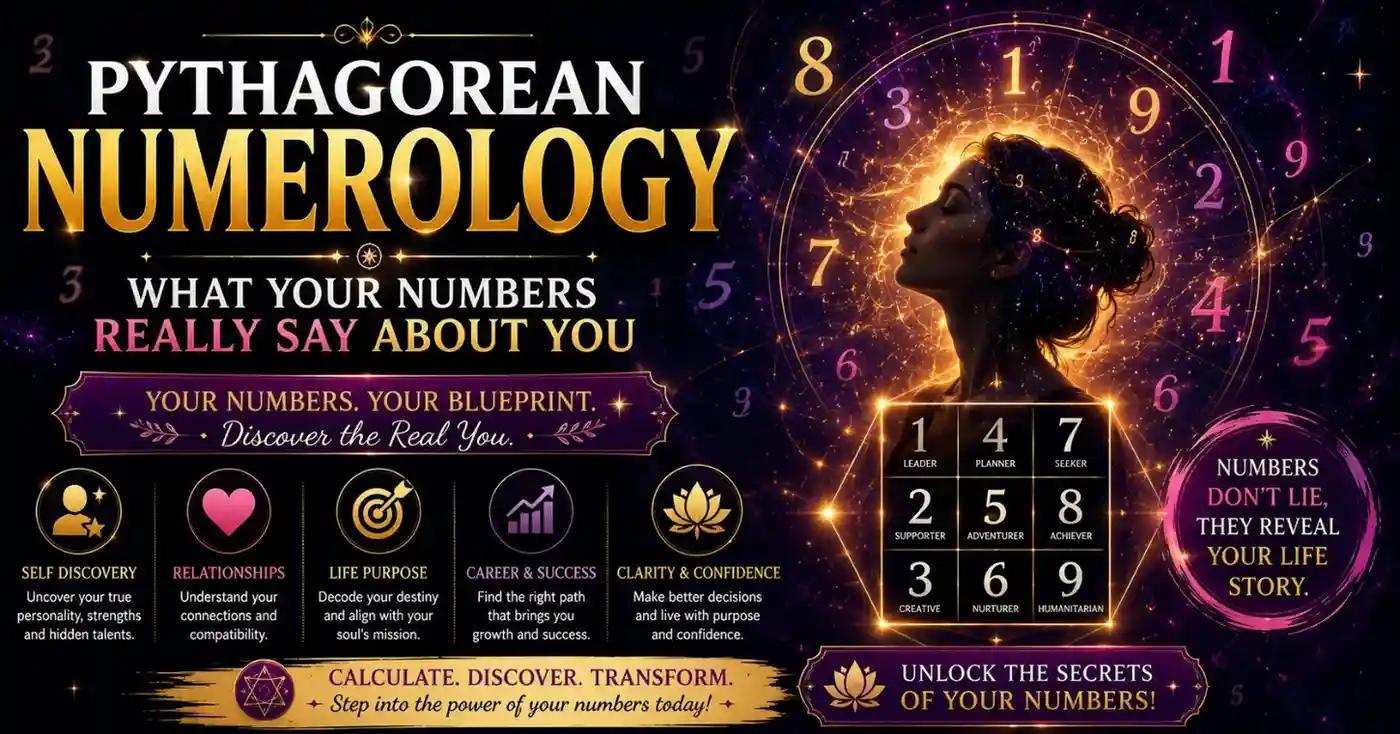
Long before “manifestation” became a buzzword and long before anyone typed a birth date into an online calculator, there was a simple, radical idea circulating through the schools of ancient Greece: that numbers weren’t just tools for counting, but a language the universe itself speaks in. That idea belongs to Pythagoras, and the system built on his teachings — Pythagorean numerology — remains, by a wide margin, the most widely practiced form of numerology in the Western world today.
If you’ve ever calculated a “Life Path Number,” typed your name into a numerology app, or heard someone say “I’m an 11” the way they might say “I’m a Gemini,” you’ve already brushed up against this system, whether you knew its name or not. This guide goes deeper than a quick calculator result. It walks through where Pythagorean numerology actually comes from, how the letter-to-number chart works, how to calculate your five core numbers by hand, what each number means, and how to start reading your own numerological blueprint with real understanding rather than guesswork.
What Is Pythagorean Numerology?
Pythagorean numerology is a system of divination and self-understanding that assigns numerical values to the letters of the alphabet and to the digits of a birth date, then interprets the resulting numbers as symbolic keys to personality, purpose, and life pattern. It’s also known as Western numerology or modern numerology, distinguishing it from older or regionally distinct systems like Chaldean numerology.
At its core, the system rests on two data points everyone already has: your full birth name and your date of birth. From these two pieces of information, Pythagorean numerology derives a small set of “core numbers,” each one illuminating a different layer of who you are — your outer purpose, your inner desires, the impression you make on others, and the overarching path your life tends to follow.
Unlike astrology, which requires an exact birth time and location to build a full chart, Pythagorean numerology needs only your name and birth date, which is part of why it has remained so accessible and enduringly popular for well over a century.
The Origins: From Pythagoras to Modern Numerology
To understand the system properly, it helps to separate historical fact from popular legend, because the two have blurred together over time.
Who Was Pythagoras?
Pythagoras was a philosopher and mathematician who lived in ancient Greece around the 6th century BCE. He’s remembered today primarily for the Pythagorean theorem, but in his own era he was equally known as a spiritual teacher who founded a school in Croton, in southern Italy, where mathematics, music, astronomy, and philosophy were treated as branches of the same sacred inquiry. His most famous maxim, often translated as “all is number,” captures the essence of his worldview: that numerical relationships underlie everything from musical harmony to the structure of the cosmos.
Pythagoras is believed to have studied under multiple teachers and to have traveled through Egypt and possibly further east before founding his own school, absorbing numerical and mystical traditions along the way. His followers, the Pythagoreans, treated numbers as living symbols rather than abstract quantities — the number one representing unity and origin, two representing duality and matter, three representing harmony, and so on.
The Chaldean Influence
Long before Pythagoras, the Chaldeans — a civilization associated with ancient Babylon — had already developed sophisticated systems linking numbers, letters, and celestial patterns to divination. Many numerologists consider Chaldean numerology, which assigns letter values based on sound and vibration rather than strict alphabetical sequence, to be the older root system from which later numerological traditions, including the Pythagorean approach, drew inspiration.
A Modern Reconstruction
Here’s the detail most popular articles skip: there’s no surviving historical evidence that Pythagoras himself created or practiced the specific letter-to-number system that bears his name today. The version of “Pythagorean numerology” widely used now — with its clean, sequential A-through-Z to 1-through-9 chart — is largely a product of the early 20th century, popularized in the West by numerologists building on Pythagorean philosophy rather than a direct, unbroken lineage back to Croton. This doesn’t make the system less meaningful to those who practice it; it simply means its name honors Pythagoras’s philosophical framework — the belief that numbers hold symbolic, vibrational significance — rather than reflecting a literal historical manual he authored.
The Pythagorean Numerology Chart: How Letters Become Numbers
The foundation of the entire system is a simple grid that assigns every letter of the alphabet a single-digit number from 1 to 9, cycling in sequence:
| 1 | 2 | 3 | 4 | 5 | 6 | 7 | 8 | 9 |
|---|---|---|---|---|---|---|---|---|
| A | B | C | D | E | F | G | H | I |
| J | K | L | M | N | O | P | Q | R |
| S | T | U | V | W | X | Y | Z |
Notice the pattern: A, J, and S all reduce to 1. B, K, and T all reduce to 2. This cycle repeats straight through the alphabet, which is what makes the Pythagorean system so easy to learn and calculate by hand compared to older systems that assign values based on phonetic sound rather than strict letter order.
To find the numerological value of a name, you convert every letter to its corresponding number, add the digits together, and then reduce the total to a single digit — unless you land on one of the three master numbers, 11, 22, or 33, which are traditionally left unreduced because they’re believed to carry a more concentrated, amplified vibration.
The Five Core Numbers in Pythagorean Numerology
While a full numerology reading can involve dozens of calculated points, five core numbers form the foundation of any Pythagorean chart. Together, they’re sometimes referred to as a person’s numerology blueprint.
1. Life Path Number
The Life Path Number is, without question, the single most important figure in Pythagorean numerology — the rough equivalent of a sun sign in astrology. It’s calculated entirely from your date of birth and is said to reveal your life’s overarching purpose, the natural talents you arrived with, and the core lessons you’re here to learn.
How to calculate it: Reduce the month, day, and year of your birth to single digits individually, then add those digits together and reduce again. For example, someone born on November 29, 1990 would calculate: month (11, kept as a master number or reduced to 2 depending on method), day (2+9=11), and year (1+9+9+0=19, then 1+9=10, then 1+0=1). These are added together and reduced to a final single digit, watching at each stage for master numbers that shouldn’t be collapsed further.
Because the calculation naturally produces master numbers fairly often, most numerologists calculate the Life Path in stages — reducing month, day, and year separately first — rather than adding every digit of the full date together at once, since the two methods can occasionally produce different results.
2. Expression Number (also called the Destiny Number)
The Expression Number, sometimes called the Destiny Number, is calculated from every letter in your full birth name — first, middle, and last, exactly as it appears on your birth certificate. It’s said to reveal your natural talents, abilities, and the broader purpose you’re equipped to fulfill in this lifetime.
How to calculate it: Convert every letter of your full birth name to its corresponding number using the chart above, add all the values together, and reduce to a single digit (preserving master numbers). Because this number draws on your complete birth name rather than the name you currently use day to day, numerologists consider it a reflection of your innate design — the blueprint you were given at birth — rather than the identity you’ve since grown into.
3. Soul Urge Number (also called the Heart’s Desire Number)
The Soul Urge Number, also known as the Heart’s Desire Number, is calculated using only the vowels in your full birth name. It’s considered the most private of the core numbers, revealing your inner motivations, what you genuinely crave beneath the surface, and what would make you feel truly fulfilled, regardless of what your outer life looks like.
How to calculate it: Isolate every vowel (A, E, I, O, U, and sometimes Y when it functions as a vowel sound) in your full birth name, convert each to its numerical value, add them together, and reduce to a single digit or master number.
4. Personality Number
The Personality Number is the mirror image of the Soul Urge — it’s calculated from the consonants only in your full birth name, and it reveals the impression you make on others, particularly people who don’t yet know you well. Where the Soul Urge describes your private inner world, the Personality Number describes the outer packaging: your mannerisms, your first-impression energy, and the traits people tend to notice about you before they get to know your depths.
How to calculate it: Take every consonant in your full birth name, convert each to its number, add them together, and reduce to a single digit or master number.
5. Birthday Number
The Birthday Number is the simplest of the five core numbers, and it’s calculated using only the day of the month you were born, without reducing across the full birth date. If you were born on the 23rd, your Birthday Number reduces from 23 (2+3=5) to 5. It’s considered a minor but meaningful number, adding a specific flavor or talent to your Life Path rather than standing as a major indicator on its own.
Master Numbers: 11, 22, and 33
No overview of Pythagorean numerology is complete without addressing master numbers — the numbers 11, 22, and 33 — which are treated differently from every other number in the system. While most calculations reduce down to a single digit between 1 and 9, master numbers are traditionally left intact, because numerologists believe they carry a more intense, amplified vibration than their reduced counterparts (11 would otherwise reduce to 2, 22 to 4, and 33 to 6).
Master Number 11 is associated with heightened intuition, spiritual insight, and inspirational leadership — often described as “the Illuminator” or “the Intuitive.” People with an unreduced 11 in a core number are said to feel life more intensely than most, both its inspiration and its anxiety, and to carry a gift for spiritual or artistic insight that others are drawn to.
Master Number 22 is associated with the ability to turn big visions into tangible reality — often described as “the Master Builder.” This number combines the intuitive sensitivity of 11 with the grounded practicality of 4, said to give those who carry it real potential for large-scale, lasting achievement, provided they can manage the pressure that comes with such potential.
Master Number 33 is the rarest and most demanding of the three, associated with profound compassion and a calling toward selfless service — often described as “the Master Teacher” or “the Master Healer.” It combines the sensitivity of 11 with the nurturing instincts of 6, and is said to appear far less frequently than 11 or 22 in most calculations.
It’s worth noting that master numbers can appear in any of the five core number calculations, not just the Life Path — and some numerologists also recognize 44 as an emerging fourth master number in modern practice, though this remains far less standardized across different schools of numerological thought.
What Each Number, 1 Through 9, Actually Means
Whichever core number you’re interpreting, the underlying meaning of each digit stays largely consistent across Pythagorean numerology. Here’s a grounded overview of what each number represents:
Number 1 — The Leader.
Independence, ambition, and originality. Ones are natural initiators, driven to forge their own path rather than follow someone else’s. The growth edge for a 1 is learning collaboration without feeling diminished by it.
Number 2 — The Diplomat.
Sensitivity, cooperation, and partnership. Twos are natural peacemakers with strong intuitive and emotional intelligence. Their growth edge is developing enough self-assurance that they don’t lose themselves trying to keep everyone else comfortable.
Number 3 — The Communicator.
Creativity, expression, and optimism. Threes are natural storytellers and artists with a gift for lifting the mood of any room. Their growth edge is channeling scattered creative energy into sustained, finished work.
Number 4 — The Builder.
Discipline, structure, and reliability. Fours are the foundation-layers of any group, valuing hard work and tangible results over shortcuts. Their growth edge is staying flexible enough that structure doesn’t calcify into rigidity.
Number 5 — The Adventurer.
Freedom, change, and sensory experience. Fives resist routine and thrive on variety, travel, and new experience. Their growth edge is developing enough follow-through that freedom doesn’t collapse into instability.
Number 6 — The Nurturer.
Responsibility, love, and service to others, especially family and community. Sixes are natural caretakers with a strong sense of justice and harmony. Their growth edge is caring for others without sacrificing their own needs entirely.
Number 7 — The Seeker.
Introspection, analysis, and spiritual or intellectual depth. Sevens are natural researchers and philosophers, most comfortable working through ideas alone before sharing conclusions. Their growth edge is staying connected to others rather than retreating into isolation.
Number 8 — The Powerhouse.
Ambition, authority, and material achievement. Eights have a natural talent for business, leadership, and manifesting tangible success. Their growth edge is balancing the drive for achievement with genuine ethical grounding and personal relationships.
Number 9 — The Humanitarian.
Compassion, idealism, and a global, big-picture perspective. Nines are natural givers who feel called toward causes larger than themselves. Their growth edge is learning to let go gracefully, since 9 represents completion and release at the end of the numerical cycle.
Pythagorean vs. Chaldean Numerology: Key Differences
Anyone researching Pythagorean numerology inevitably runs into its older sibling, Chaldean numerology, and the two are frequently confused despite meaningful differences.
Letter assignment method.
Pythagorean numerology assigns numbers strictly in alphabetical sequence (A=1, B=2, C=3, and so on, cycling through 1-9). Chaldean numerology instead assigns values based on the vibrational sound of each letter, which means the same letter can carry a different number in each system — and Chaldean numerology only uses the numbers 1 through 8, deliberately excluding 9, which it considers too sacred to assign to a letter.
Which name is used.
Pythagorean numerology calculates the Expression, Soul Urge, and Personality numbers from your full birth name exactly as given at birth. Chaldean numerology, by contrast, is typically calculated using the name you currently go by and are most commonly known by in daily life, on the belief that the name you actively use carries the vibration presently shaping your life.
Treatment of compound numbers.
Chaldean numerology places more emphasis on compound (double-digit) numbers before final reduction, treating those intermediate numbers as meaningful in themselves. Pythagorean numerology generally reduces more directly to a single digit, with the specific exception of master numbers.
Popularity and accessibility.
Because its letter-number chart is so straightforward to memorize and calculate, Pythagorean numerology has become the dominant system across the Western world, taught in the vast majority of modern numerology books, apps, and calculators. Chaldean numerology, while considered by many practitioners to be the older and more esoterically precise system, requires more specialized knowledge to calculate correctly.
Neither system is universally regarded as more “accurate” than the other — they simply rest on different foundational logic, and different numerologists have their own preferences for which framework resonates most.
How to Calculate Your Own Numbers: A Step-by-Step Walkthrough
To bring the system to life, here’s a simplified walkthrough using a sample name and birth date.
Step 1: Write out your full birth name. For this example, we’ll use “Sarah Jane Miller,” born June 14, 1988.
Step 2: Calculate the Life Path Number. Reduce month, day, and year separately. June is the 6th month (6). The day is 14 (1+4=5). The year 1988 reduces as 1+9+8+8=26, then 2+6=8. Adding these together: 6+5+8=19, then 1+9=10, then 1+0=1. Sarah’s Life Path Number is 1.
Step 3: Calculate the Expression Number. Convert every letter in “Sarah Jane Miller” to its numerical value using the chart, sum all the values, and reduce. This full-name calculation reveals her natural talents and life direction as encoded at birth.
Step 4: Calculate the Soul Urge Number. Extract only the vowels from “Sarah Jane Miller” — A, A, A, E, I, E — convert each, sum, and reduce. This number reveals what she deeply craves beneath her outward behavior.
Step 5: Calculate the Personality Number. Extract only the consonants — S, R, H, J, N, M, L, L, R — convert each, sum, and reduce. This reveals the impression she makes before people know her well.
Step 6: Calculate the Birthday Number. Her birth day is the 14th, which reduces to 1+4=5. This adds a specific flavor of independence and adaptability to her overall Life Path.
Once all five numbers are calculated, a numerologist reads them together as a complete picture rather than in isolation — looking for where numbers reinforce each other (say, a Life Path 1 paired with an Expression Number that also favors leadership) and where they create internal tension worth being aware of (a Life Path 1’s independence paired with a Soul Urge Number 6 craving deep, dependent partnership, for instance).
Karmic Debt Numbers and Other Advanced Concepts
Beyond the five core numbers, more advanced Pythagorean practice includes Karmic Debt Numbers — the numbers 13, 14, 16, and 19 — which appear as intermediate totals before final reduction in any of the core calculations. These numbers are traditionally interpreted as carrying unresolved lessons from a past pattern (whether understood literally as past-life karma or simply as recurring personal challenge patterns), each associated with a specific growth theme: 13 with discipline and follow-through, 14 with freedom used responsibly, 16 with humility and ego, and 19 with independence balanced against isolation.
Other advanced numbers sometimes calculated in a full reading include the Maturity Number (Life Path plus Expression Number, said to reveal the direction a person grows into during the second half of life) and Personal Year Numbers (a yearly cycle calculated from birth month and day combined with the current year, used to track shorter-term timing and themes).
Common Misconceptions About Pythagorean Numerology
Misconception: Pythagoras personally invented this exact system.
As covered above, the historical record doesn’t support a direct, unbroken lineage from Pythagoras himself to the modern letter-number chart. The system is better understood as a modern practice built in the spirit of Pythagorean philosophy.
Misconception: Your numbers are fixed and deterministic.
Most practicing numerologists frame core numbers as tendencies and potentials, not unchangeable fate. A Life Path Number describes a general direction and lesson set, not a scripted outcome you’re powerless to influence.
Misconception: A “difficult” number is a bad number.
Every number, including ones associated with more demanding lessons (like the intensity of master numbers, or the introspective isolation risk of a 7), comes with corresponding strengths. Numerology, at its best, is a tool for self-awareness rather than a hierarchy of “good” and “bad” numbers.
Misconception: Nicknames and legal name changes don’t matter.
In Pythagorean practice specifically, the name used to calculate Expression, Soul Urge, and Personality numbers is your full name at birth, regardless of what you currently go by, since this is considered the vibrational blueprint you arrived with. Some numerologists do calculate a separate, secondary reading based on your current name to see how it shifts your expressed vibration in daily life.
Misconception: Numerology is scientifically validated.
Like astrology, Pythagorean numerology is not empirically supported by mainstream science, and most serious practitioners describe it as a symbolic and reflective framework rather than a predictive, testable one. Its value for many people lies in the self-reflection it prompts, not in objectively measurable outcomes.
How to Use Your Numbers in Everyday Life
Understanding your Pythagorean chart is most useful when it’s treated as a mirror rather than a rulebook. Here’s how to apply it constructively:
Use your Life Path Number as a compass, not a cage.
If your Life Path points toward leadership and independence, that doesn’t mean every job or relationship must center on those themes — it simply highlights the kind of environment where you’re likely to feel most naturally energized.
Notice where your numbers agree, and where they create tension.
Internal contradictions between your Soul Urge and your Personality Number, for example, aren’t flaws to fix — they’re often the most interesting, human parts of a chart, describing the gap between your private desires and your outward presentation.
Revisit your reading as you grow.
While your core numbers themselves don’t change, your relationship to them does. A Life Path Number that felt confusing in your twenties often makes far more sense in hindsight once you’ve lived enough of its lessons to recognize the pattern.
Pair numerology with real self-reflection, not passive belief.
The most useful numerology readings function the way a good journaling prompt does — by giving you specific language to examine your own patterns, rather than replacing your own judgment and decision-making.
Frequently Asked Questions
What is the most important number in Pythagorean numerology?
The Life Path Number is generally considered the most significant, since it’s derived from your full birth date and is said to reveal your overarching life purpose and the primary lessons you’re here to learn.
Do I use my birth name or my current name for numerology calculations?
In traditional Pythagorean practice, the Expression, Soul Urge, and Personality numbers are calculated using your full name exactly as it appears on your birth certificate, since this is considered your original vibrational blueprint, regardless of any name changes since.
What are master numbers, and why aren’t they reduced?
Master numbers are 11, 22, and 33 (and less commonly 44), which are traditionally left unreduced during calculation because numerologists consider them to carry a more intense, amplified vibration than their single-digit counterparts.
Is Pythagorean numerology the same as Chaldean numerology?
No. The two systems assign different numerical values to letters, use different source names for calculation, and place different emphasis on compound numbers, even though both trace conceptual roots back to ancient numerological traditions.
Can two people share the same Life Path Number?
Yes, and it’s quite common, since the Life Path is calculated from birth date alone. Two people with the same Life Path Number can still differ significantly once their Expression, Soul Urge, Personality, and Birthday numbers are factored in.
Is Pythagorean numerology considered a science?
No. It’s best understood as a symbolic, reflective tradition rather than an empirically validated science, and most practicing numerologists frame it that way rather than presenting it as objectively predictive.
Final Thoughts
Pythagorean numerology endures not because it offers hard proof of destiny encoded in your name and birthday, but because it offers something people have always wanted: a structured, symbolic language for self-understanding. Your five core numbers won’t tell you exactly who to become or what choices to make — but they can offer a genuinely useful mirror, surfacing patterns in your personality, motivations, and life direction that you may have sensed intuitively long before you ever converted a single letter into a number.
Used thoughtfully, a Pythagorean numerology chart isn’t a fixed script handed down from Croton two and a half thousand years ago. It’s a starting point for the much more interesting work of understanding yourself — one number, one letter, one reflection at a time.
My Today’s Horoscope delivers carefully researched articles, accurate daily horoscopes, expert spiritual guidance, in-depth zodiac compatibility insights, birthday horoscopes, numerology interpretations, tarot readings, and practical astrology tools for everyone—from curious beginners to seasoned astrology enthusiasts. (See our Site Index to quickly find what we have to offer)