
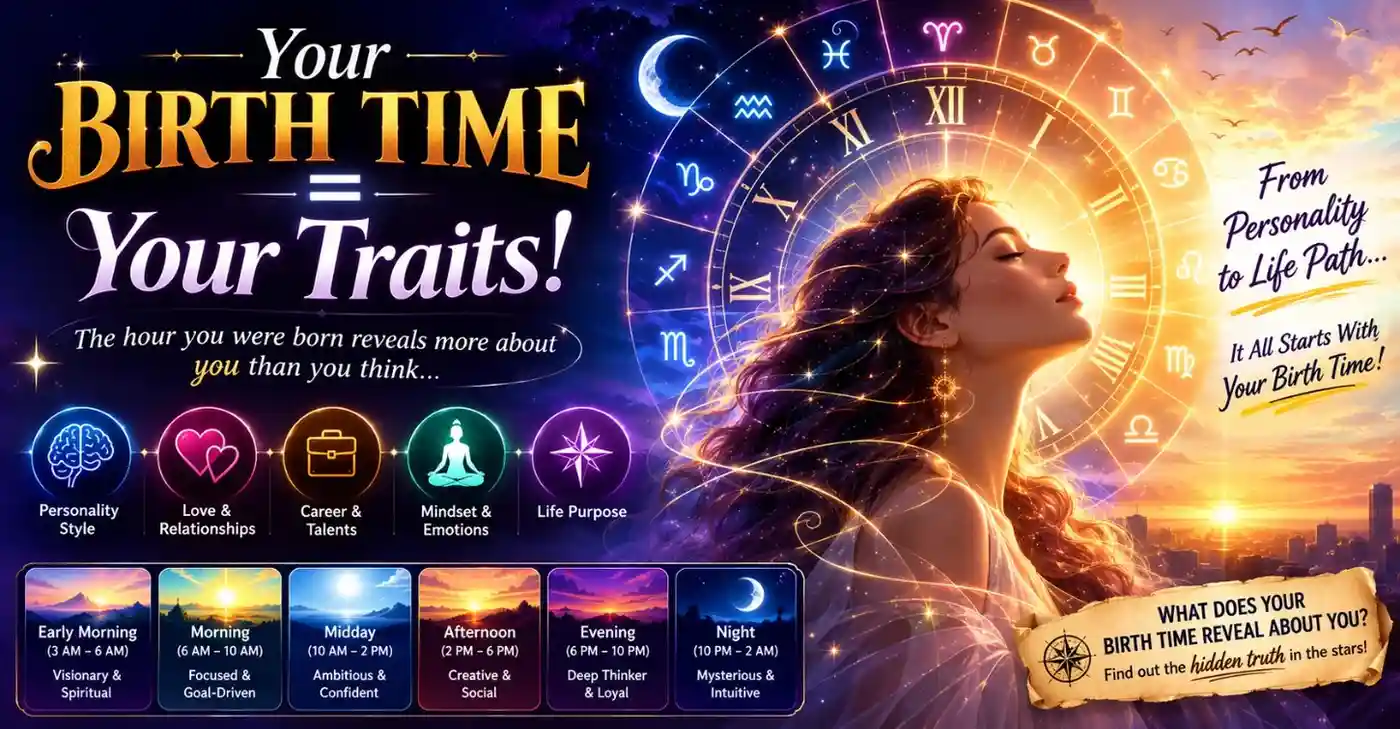
You already know your zodiac sign. You’ve probably read your horoscope more times than you’d like to admit, nodded along at some of it, and rolled your eyes at the rest. But here’s what almost nobody tells you until they’ve been studying astrology for years: your sun sign is only the headline. The real story — the one that explains why you and your same-sign best friend are nothing alike — is hidden in something far more specific than your birthday.
It’s hidden in your birth time.
Not your birth date. Not your birth year. The exact hour, and often the exact minute, that you took your first breath. As a practicing astrologer, I can tell you that of every piece of information a client brings me, birth time is the one that changes the entire reading. Two people born on the same day, in the same city, to parents with similar values, can grow into wildly different personalities — one restless and outspoken, the other quiet and methodical — simply because one arrived at 6:14 a.m. and the other at 6:14 p.m.
This article is a deep, practical, and honest look at why your birth time functions almost like a second fingerprint for your personality. We’ll walk through the astrology behind it, what the different hours of the day are traditionally associated with, why even a fifteen-minute error can shift your entire chart, and what you can actually do with this information once you have it.
Why Birth Time Matters More Than Most People Realize
Most people think of astrology as a twelve-sign system: you’re a Leo, or a Capricorn, or a Pisces, and that’s the end of the analysis. That’s a bit like judging an entire orchestra by its loudest instrument. The sun sign describes your core identity and your general life energy — the “melody” of who you are. But a real birth chart, the kind a professional astrologer draws up, is a map of where every visible planet sat in the sky at the precise moment you were born, calculated for your exact birth location.
Birth time is the one variable in that equation that moves fastest. The sun changes sign roughly once a month. The moon changes sign roughly every two and a half days. But the point that astrologers call the Ascendant, or rising sign — which is directly calculated from your birth time — shifts into a new zodiac sign approximately every two hours. That means your birth time isn’t a minor footnote to your chart. It’s the variable most responsible for making your chart yours and no one else’s.
This is why two siblings born a year apart can share a sun sign and still feel like polar opposites, while two strangers born a continent apart at the same hour can feel eerily similar when they compare notes on temperament. The date tells you the season of your personality. The time tells you the shape of it.
The Birth Chart as a Cosmic Snapshot
Think of your birth chart as a photograph of the sky taken at the exact second you arrived. Every planet has a fixed position in that photograph — the sun in one zodiac sign, the moon in another, Mercury, Venus, Mars, Jupiter, Saturn and the rest scattered across the wheel. Change the time the photo was taken, even by a few minutes, and the whole composition shifts. The horizon line moves. What was rising in the east a moment ago is no longer rising now.
That shifting horizon line is the Ascendant, and it’s the anchor point for the rest of the chart. Once your astrologer knows where the Ascendant falls, they can lay out the twelve astrological houses — the life areas that govern everything from career and money to relationships, health, and spirituality — around your unique chart. Without a birth time, none of that structure exists. You’re left with only the sun and moon signs, which is useful, but incomplete, like reading the first and last chapter of a book and skipping everything in between.
Sun, Moon, and Rising: The Trinity of Identity
If you’ve spent any time around modern astrology content, you’ve probably heard the phrase “sun, moon, and rising” tossed around as shorthand for someone’s core placements. It’s worth understanding what each one actually does, because your birth time directly determines one of the three and indirectly refines the other two.
Your sun sign represents your core self — your ego, your basic motivations, the identity you’re growing into over a lifetime. This is the sign most horoscope columns use, and it only requires your birth date.
Your moon sign represents your emotional inner world — how you process feelings, what makes you feel safe, and your instinctive reactions under stress. Because the moon moves through a zodiac sign in about two and a half days, your birth time can occasionally be the deciding factor in which moon sign is truly yours, especially if you were born on a day when the moon changed signs.
Your rising sign, or Ascendant, represents the face you show the world — your first impression, your instinctive body language, and the “operating style” you default to when you’re not consciously choosing how to behave. This placement is calculated entirely from your birth time and birth location. There is no way to know your rising sign without it.
Together, these three placements form what astrologers often call the trinity of personal identity: who you are at your core, how you feel, and how you come across. Birth time is the thread that ties the second and third pieces of that trinity together — which is exactly why it matters so much for understanding your traits.
Your Rising Sign (Ascendant): The Trait Map Hidden in Your Birth Time
Of everything birth time unlocks, the rising sign is the single most trait-defining piece of information in your entire chart. Astrologers sometimes describe it as the “mask” you wear in public, though I’d push back gently on that word — it isn’t a fake persona. It’s closer to your instinctive, first layer of personality: the version of you that shows up before someone gets to know your deeper sun-sign motivations or your moon-sign emotional world.
What the Ascendant Actually Controls
The Ascendant governs a surprising range of traits, including:
- First impressions. How people read you within the first few minutes of meeting you — confident, reserved, warm, intense, playful, guarded.
- Physical presentation. Many astrologers connect rising signs to physical demeanor, posture, and even facial structure, though this is more art than science.
- Instinctive coping style. How you react, almost reflexively, when life throws something unexpected at you.
- Personal style and aesthetic. Your default taste in clothing, home decor, and self-presentation often traces back to your rising sign more than your sun sign.
- The lens for your entire chart. The Ascendant sets the starting point for the twelve houses, meaning it effectively colors every other placement in your chart.
A Leo rising, for example, tends to walk into a room with warmth and a kind of effortless magnetism, even if their sun sign is a shy, private Cancer. A Virgo rising often comes across as precise, observant, and a little reserved, gathering information before they speak. A Pisces rising tends to feel dreamy, intuitive, and emotionally porous, absorbing the mood of a room almost immediately. None of this is visible from birth date alone — it only becomes visible once birth time enters the equation.
Why Even Minutes Change Everything
Here’s the detail that surprises most people: the Ascendant moves through roughly one degree of the zodiac every four minutes, and a full zodiac sign every two hours. That means a birth time that’s off by even fifteen to thirty minutes can, in the wrong part of the day, place you in an entirely different rising sign — with an entirely different set of instinctive traits and an entirely different house structure for your whole chart.
This is the reason experienced astrologers ask for your birth certificate or hospital record instead of a rough family estimate. “Sometime in the morning” isn’t precise enough. “6:40 a.m.” is. If you’ve ever had two different astrologers give you two different rising signs, an imprecise birth time is almost always the reason why.
The 12 Astrological Houses: How Birth Time Builds Your Life Blueprint
Once your Ascendant is set, your birth time effectively builds the rest of your chart’s architecture: the twelve houses. Each house represents a different arena of life, and every planet in your chart falls into one of them depending on where the Ascendant lands.
In broad strokes, the houses cover:
- 1st House – Self-image, identity, and how you present to the world (ruled by your Ascendant itself)
- 2nd House – Money, possessions, and personal values
- 3rd House – Communication, siblings, and everyday learning
- 4th House – Home, family, and emotional roots
- 5th House – Creativity, romance, and self-expression
- 6th House – Work, routine, and health habits
- 7th House – Partnerships and one-on-one relationships
- 8th House – Intimacy, shared resources, and transformation
- 9th House – Higher learning, travel, and belief systems
- 10th House – Career, public reputation, and life direction
- 11th House – Friendships, community, and long-term goals
- 12th House – Subconscious patterns, rest, and spirituality
Without an accurate birth time, an astrologer can still tell you where your planets sit by sign, but not which house they occupy — and house placement is often what determines whether a planet’s energy shows up in your career, your relationships, or your inner world. A Mars in Scorpio behaves differently sitting in your 10th house of career than it does in your 7th house of partnership. Birth time is what makes that distinction possible.
Morning, Afternoon, Evening, Night: What Time of Day Says About Your Traits
Beyond the technical chart mechanics, there’s a long-standing tradition in both Western and Vedic astrology of reading broad personality patterns from the general period of the day someone was born in. This isn’t a substitute for a full chart reading, but it’s a genuinely useful lens, and it’s part of why so many people find that “morning people” and “night owls” seem to carry different temperaments from birth, not just from habit.
Born in the Morning (Sunrise to Noon)
Those born in the early morning hours, close to sunrise, are traditionally associated with fresh starts, optimism, and forward motion. This is the period linked with the sun’s rising energy, and people born in this window often display natural initiative, a goal-oriented mindset, and an instinct for leadership. They tend to be early risers by temperament, not just by routine, and they often describe themselves as “morning people” whether or not their schedule actually allows for it. Confidence tends to come easily, and there’s frequently a charismatic quality that draws others toward them without much visible effort.
Born in the Afternoon (Noon to Sunset)
The midday hours are associated with peak vitality, sociability, and productivity. People born in this window often carry a grounded, practical energy — they’re doers, comfortable translating ideas into action, and often gifted at managing the everyday logistics of life. This period is frequently linked to strong communication skills and an outgoing nature; these individuals tend to build wide social circles and feel energized by being around other people rather than drained by it.
Born in the Evening (Sunset to Midnight)
As the sun sets, the traditional reading shifts toward introspection, emotional depth, and refined social instincts. People born in this window are often described as warm but selective — they value close relationships over large networks, and they tend to have a natural sensitivity to the moods and needs of the people around them. There’s frequently a diplomatic streak here, an ability to read a room and adjust accordingly, paired with a quieter, more reflective inner life than their daytime-born counterparts.
Born at Night (Midnight to Sunrise)
The deep night hours are traditionally linked with intuition, imagination, and an inward-facing curiosity. People born in this window often report vivid inner lives, strong instincts, and a comfort with solitude that daytime-born people sometimes find hard to relate to. There’s frequently an investigative, almost detective-like curiosity here — a need to understand what’s beneath the surface of things rather than accepting them at face value. Night-born individuals are also often the ones who do their best thinking, writing, or problem-solving once the world around them has gone quiet.
It’s worth saying clearly: these are broad tendencies, not rigid boxes, and they’re meant to complement — never replace — the full picture that comes from your Ascendant, houses, and planetary placements. But in my experience sitting across from clients, this simple morning/afternoon/evening/night lens is often the fastest way for someone to say, “Oh — that’s me,” before we’ve even gotten to the technical chart work.
Two-Hour Windows: Why Astrologers Break the Day into 12 Slices
If four broad time-of-day categories feel a little too general, astrologers often narrow things further by dividing the twenty-four-hour day into twelve two-hour windows, mirroring the twelve zodiac signs the Ascendant cycles through. This is where the connection between birth time and traits becomes much more precise, because each two-hour block corresponds to a specific rising sign for a person born at a given birthplace on a given day.
Someone born between roughly midnight and 2 a.m. often shows the restless curiosity and mental agility associated with an Aquarius or Gemini-flavored rising, depending on the exact date and location — a hunger to know everything about everyone, paired with a guarded reluctance to reveal too much about themselves. Someone born between 10 p.m. and midnight often carries a future-focused, image-conscious energy, balancing ambition with caution, and tends to be the reliable one who keeps promises and shows up on time. These patterns repeat, in different flavors, across all twelve two-hour windows, which is exactly why professional astrologers treat the two-hour window — not just the general time of day — as the more accurate unit for reading birth-time traits.
The practical takeaway here is simple: the more precise your birth time, the more precise the personality read. A birth certificate time is worth its weight in gold for exactly this reason.
Same Birthday, Different Person: Why Twins and Same-Day Siblings Differ
One of the most common questions I get from skeptics is a fair one: if astrology is really about the sky at your birth, why do people born on the same day turn out so differently? Birth time is usually the answer.
Consider fraternal twins born eleven minutes apart. Their sun sign is identical. Their moon sign is almost always identical. But if they happen to be born during a window when the Ascendant is shifting from one sign to the next — which happens roughly every two hours, meaning it’s a coin-flip chance on any given day — those eleven minutes can place one twin’s Ascendant in, say, late Scorpio and the other’s in early Sagittarius. One grows up more private, intense, and emotionally guarded; the other more open, adventurous, and blunt. Same parents, same womb, same birthday — different rising signs, different instinctive traits.
This is also the astrological explanation for why “twin day” birthdays among unrelated people can still produce such different personalities. Birthdate gives you the season. Birth time gives you the specific weather.
How to Find Your Exact Birth Time (and Why It’s Worth the Effort)
If you’re serious about understanding your traits through astrology, tracking down your exact birth time is worth the small amount of effort it takes. Here’s where to look:
- Your birth certificate. In most countries, birth certificates record the exact time of birth down to the minute. This is the gold standard.
- Hospital birth records. If your birth certificate doesn’t list a time, the hospital or birthing facility where you were born may still have it on file, sometimes for decades after the fact.
- Baby books and family records. Many parents jot down birth time in a baby book, journal, or even a family Bible. It’s an old-fashioned habit, but a useful one.
- Ask your parents or the person who was present. If no paperwork exists, a parent’s or midwife’s memory is better than nothing, though treat it as an estimate rather than a precise data point.
Once you have your birth time, a reputable birth chart calculator (or a professional astrologer) can generate your full chart, including your Ascendant and house placements. Just make sure whatever tool you use accounts for your exact birth location, since time zones and daylight saving adjustments can shift the calculation.
What If You Don’t Know Your Exact Birth Time?
Not knowing your birth time isn’t the end of the road — it just means working with the information you do have while being honest about its limits.
Your sun sign will always be reliable, since it only depends on your birth date. Your moon sign is usually reliable too, unless you happened to be born on a day when the moon changed signs. What becomes unreliable without a birth time is your Ascendant and your house placements, since these depend on the exact moment and location of your birth.
If you genuinely cannot find your birth time, some astrologers will build what’s called a “noon chart” or a “sunrise chart” as a rough approximation, or use a technique called chart rectification, where they work backward from major life events to estimate the most likely birth time. These methods are useful, but they’re educated approximations rather than precise readings — worth knowing about, but not a full substitute for the real thing.
Common Myths About Birth Time and Personality
Before we move to how to actually use this information, it’s worth clearing up a few misconceptions that tend to follow this topic around.
Myth: Birth time is the only thing that shapes personality. In reality, astrology has always held that free will, upbringing, culture, and personal choices matter enormously. Birth time offers a map of tendencies and instincts, not a fixed script.
Myth: If you don’t know your birth time, your whole chart is useless. As covered above, your sun and moon signs remain solid without it. You lose precision on the Ascendant and houses, not your entire astrological identity.
Myth: Two people with the same rising sign will act identically. Your rising sign is one placement among many. It shapes your first impression and instinctive style, but your sun, moon, and the rest of your planets still create meaningful individual variation.
Myth: AM births are “better” or “luckier” than PM births, or vice versa. Traditional associations link certain qualities to daytime and nighttime birth energies, but neither is superior — they simply describe different flavors of temperament, each with its own strengths.
How to Use Your Birth Time Insight in Real Life
Understanding your birth time and the traits associated with it isn’t just an interesting party fact — it can be genuinely useful when applied thoughtfully.
In self-awareness work. Knowing your Ascendant can explain a gap you’ve noticed between how you feel internally (your moon sign) and how people describe you when they first meet you (your rising sign). That gap is normal, not a contradiction, once you understand where it comes from.
In relationships. Comparing rising signs with a partner, friend, or family member can shed light on communication style mismatches that have nothing to do with how much you care about each other, and everything to do with different instinctive default settings.
In career reflection. Your 10th house — governed by your birth time — often points toward the kind of public role or reputation that feels most natural to you, which can be a useful lens when you’re stuck choosing between paths that all look good on paper.
In timing decisions. More advanced astrology, including transits and progressions, relies on your exact natal chart as a baseline. If you ever want to explore favorable timing for major life decisions, an accurate birth time is the foundation that makes that kind of forecasting meaningful rather than generic.
The bigger picture here is that birth time turns astrology from a monthly horoscope column into a genuinely personal tool — one built around the one moment in history that belongs entirely to you.
Frequently Asked Questions
Does birth time really affect personality, or is it just tradition?
Astrologically speaking, yes — birth time determines your rising sign and house placements, both of which are treated as core personality indicators across nearly every astrological tradition, Western and Vedic alike. Whether you find that convincing is, fairly, a matter of personal belief, but within the framework of astrology, it’s foundational rather than decorative.
How much does my birth time need to change before my chart changes?
The Ascendant shifts roughly one degree every four minutes and a full sign every two hours, so a difference of fifteen to thirty minutes can occasionally shift your rising sign, especially if your birth happened close to a sign changeover.
Can I trust an approximate birth time, like “sometime in the morning”?
You can use it for a rough sense of your general energy, but for an accurate rising sign and house placements, you’ll want a precise time — ideally from a birth certificate or hospital record.
Do AM and PM births really have different traits?
Traditional astrology does associate daytime and nighttime births with different general tendencies — daytime often linked to outward energy and initiative, nighttime to introspection and depth — though your full chart, not just AM/PM, tells the complete story.
What’s the difference between my sun sign and my rising sign?
Your sun sign reflects your core identity and motivations and only depends on your birth date. Your rising sign reflects your instinctive first impression and outward style, and depends entirely on your exact birth time and location.
I don’t know my birth time. Can an astrologer still help me?
Yes. A skilled astrologer can work with your sun and moon signs, use rectification techniques based on major life events, or build an approximate chart, though a precise Ascendant and house reading will require a confirmed birth time.
Final Thoughts
Your birthday tells the world what season you were born into. Your birth time tells the far more interesting story of exactly where the sky stood the moment you arrived — and that single detail is often the missing piece between a horoscope that feels generic and a chart reading that feels unmistakably, specifically you. If you’ve never tracked down your exact birth time, consider this your nudge to do it. It’s a small piece of paperwork that unlocks a surprisingly precise map of your instincts, your style, and the traits that have been quietly shaping how you move through the world since the moment you took your first breath.
My Today’s Horoscope delivers carefully researched articles, accurate daily horoscopes, expert spiritual guidance, in-depth zodiac compatibility insights, birthday horoscopes, numerology interpretations, tarot readings, and practical astrology tools for everyone—from curious beginners to seasoned astrology enthusiasts. (See our Site Index to quickly find what we have to offer)