
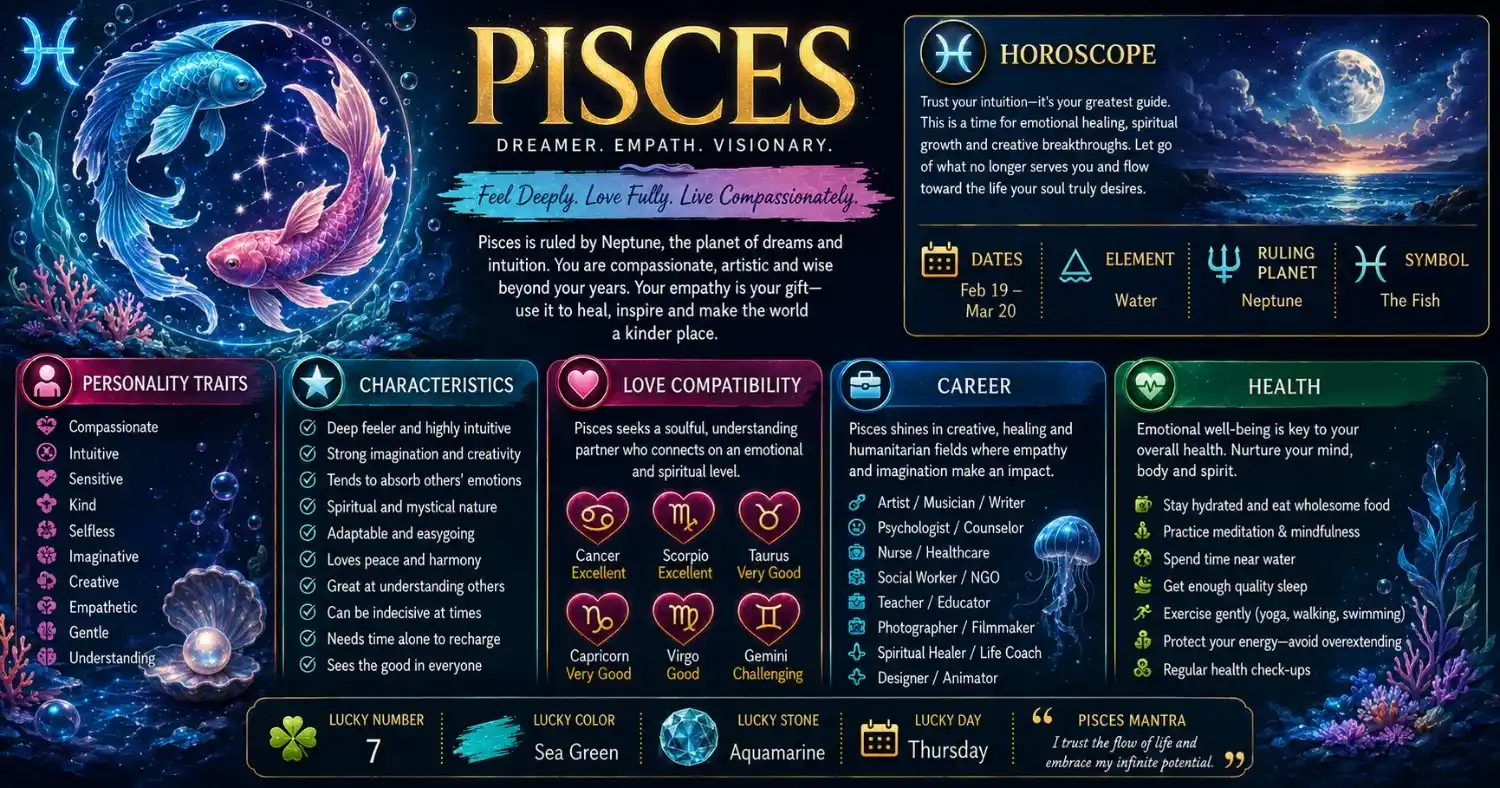
Pisces is the sign that refuses to stay in one place. It is the last of the twelve, and its two fish swim in opposite directions while tied together by a cord. The sign’s name behaves the same way. It moves between languages, borrows from one tradition, and dissolves into another, yet it always comes back to the same animal in the water.
Most people know their Sun sign in exactly one language. This guide covers many. It gives the major names for Pisces, how to say them, the cultural story behind each, and the astrology underneath. Use the tables as a reference and come back to them when you need them.
Quick Answer: What Does Pisces Mean in Other Languages?
Pisces is Latin for “fishes.” It is the plural of piscis, so the name describes two fish, not one. Most languages follow that idea, but they get there by different routes:
- They keep the Latin word. Spanish Piscis, Indonesian Pisces, Filipino Pisces, Esperanto-adjacent Interlingua Pisces.
- They translate “fishes” into their own word. German Fische, Russian Ryby, Turkish Balık, Hebrew Dagim, Finnish Kalat.
- They borrow the Sanskrit term. Hindi Meen, Thai Meen, Sinhala Meena, Tamil Meenam.
- They build a compound with a “constellation” suffix. Chinese Shuāngyú zuò (“double fish constellation”), Japanese Uo-za, Korean Mulgogi-jari.
A fifth pattern deserves a mention. Arabic and the languages it influenced use al-Ḥūt, a word that means a large sea creature and can also mean whale. It gives us Urdu Burj-e-Hoot, the Afghan month of Hut, and even Maltese Ħut.
Western dates for the sign run from about February 19 to March 20. Vedic dates run from about March 14 to April 13. Water is the element everywhere, and the quality is mutable everywhere. Jupiter is the traditional ruler, and modern Western astrology adds Neptune as a co-ruler.
Let’s go deeper.
The Root Meaning of Pisces: Where the Word Comes From
The Latin noun piscis means “fish.” Its plural, pisces, names the constellation. Latin inherited the word from Proto-Indo-European, where linguists reconstruct a root like **peysk-*. That root also gave the Germanic family its own word: English fish, German Fisch, Dutch vis, and Swedish fisk all descend from the same ancestor. The Celtic branch has related forms too, such as Irish iasc.
English keeps the Latin root in learned words. Piscine means “relating to fish.” Piscivorous means “fish-eating.” Pisciculture is fish farming. Piscatorial describes fishing. Even the everyday word piscina, which survives in Italian and Spanish for a swimming pool, began as the Roman word for a fishpond.
Greek took a different road. The Greek word for fish, ἰχθύς (ichthys), is unrelated to Latin piscis. The Greek name of the sign, Ἰχθύες (Ichthyes), is what gave English the science of ichthyology, the study of fishes.
So when you say “I’m a Pisces,” you are using a Latin plural. When a Greek speaker says the same thing, they are using an entirely different word, built from a different root, that means the same thing. The sign reached the same place by two independent linguistic paths.
Why Two Fish? The Origin Story Behind the Symbol
Pisces is one of the oldest patterns in the sky, and it carries some of the oldest stories.
Mesopotamia saw cords and tails
Babylonian sky-watchers recorded the region we now call Pisces as a group of separate figures, not a tidy pair of fish. Their star lists describe a swallow, a goddess figure, and tail-like shapes joined by cords or ribbons. The idea of fish tied together by a line seems to descend from that older picture. It is why the brightest link in the constellation is still called Alrescha, from an Arabic phrase meaning “the cord.”
Greece told the rescue story
The best-known Greek account is a story of escape. The monster Typhon, one of the most terrifying beings in Greek myth, rose against the gods. Aphrodite, the goddess of love, and her son Eros fled to the river. To hide, they turned into fish and tied themselves together with a cord so they would not be separated in the current. The gods placed the pair among the stars as a reward.
Notice what this story says about the sign. The fish are not fighting. They are protecting each other, surviving by staying connected. That is very close to how astrologers describe Pisces: devotion, mutual protection, and love that has to swim through dangerous water.
The Syrian fish goddess
Another tradition links the constellation to Atargatis, a goddess worshipped in ancient Syria and often shown with fish. Some ancient writers reported that her sanctuary kept sacred fish. The idea of a holy fish, one that connects the human world to the divine, appears again and again around the ancient Mediterranean.
The early Christian fish
The fish gained a new meaning in the first centuries of Christianity. The Greek word ichthys was read as an acrostic, with each letter standing for a word in a short Greek phrase about Jesus. The fish became a discreet symbol that believers could sketch in the dust to recognize each other. It is a strange coincidence, or perhaps not a coincidence at all, that a sign associated with faith, sacrifice, and quiet devotion shares its symbol with that tradition.
India saw Matsya
Indian tradition names the sign Meena, from the Sanskrit for fish. Its most important connection is the story of Matsya, the fish incarnation of Vishnu. In the account, a small fish asks the sage Manu for protection. Manu shelters it, and the fish grows larger and larger until it warns him of a coming flood. Manu builds a boat, and the fish tows it to safety, carrying the seeds of life and the sacred knowledge across the waters.
Matsya is regarded as the first of Vishnu’s ten major avatars. In Vedic reading, that fish is a guardian, a teacher, and a guide through dissolution. The theme is exact: Pisces closes the zodiac, and the flood ends one cycle so another can start.
China saw a pair
Chinese culture has long treated a pair of fish as a symbol of harmony, marital happiness, and abundance. The Chinese word for fish, yú (鱼), sounds like the word for surplus, which is why fish appear at New Year meals. In Buddhist art, a pair of golden fish is one of the Eight Auspicious Symbols, standing for freedom and fearlessness in the ocean of suffering. When Western astrology reached China, translators reached naturally for that image and called the sign “double fish.”
Five civilizations gave five different stories. All of them made the fish a symbol of rescue, devotion, or crossing between worlds.
Pisces in Indian Languages: The Vedic Family
India has the widest range of zodiac vocabulary in the world, because its languages belong to several families and most of them adopted the Sanskrit system.
The master table for Indian languages
| Language | Native Script | Romanization | Literal Sense |
|---|---|---|---|
| Sanskrit | मीन | Mīna | Fish |
| Hindi | मीन राशि | Meen Rashi | Fish sign |
| Marathi | मीन रास | Meen Raas | Fish sign |
| Gujarati | મીન રાશિ | Meen Rashi | Fish sign |
| Bengali | মীন রাশি | Meen Rashi | Fish sign |
| Odia | ମୀନ ରାଶି | Meena Rashi | Fish sign |
| Assamese | মীন ৰাশি | Meen Rashi | Fish sign |
| Punjabi | ਮੀਨ | Meen | Fish |
| Nepali | मीन राशि | Meen Rashi | Fish sign |
| Tamil | மீனம் / மீன ராசி | Meenam / Meena Rasi | Fish, fish sign |
| Telugu | మీన రాశి | Meena Rasi | Fish sign |
| Kannada | ಮೀನ ರಾಶಿ | Meena Rashi | Fish sign |
| Malayalam | മീനം | Meenam | Fish, twelfth month |
| Sinhala | මීන | Meena | Fish |
| Urdu | برج حوت | Burj-e-Hoot | House of the great fish |
Sanskrit: Meena and its many fish
Mīna (मीन) is the classical Sanskrit word for fish. Sanskrit has several other words for fish, including matsya, which names the avatar of Vishnu. Astrological texts use Mīna and sometimes Jhasha or Antya, “the last.” The last one is telling. Pisces is the final sign, and the Sanskrit vocabulary quietly acknowledges that.
Vedic texts often picture Meena as two fish facing opposite directions, one head to tail with the other, which mirrors the standard Western glyph. In Indian temple art, paired fish (matsya yugma) are also a symbol of good fortune.
Hindi and the northern languages
North Indian speakers say Meen Rashi (मीन राशि). Newspapers, calendars, and daily horoscope columns all use the same form. Because the Sanskrit word is short and phonetically simple, it barely changes across Hindi, Marathi, Gujarati, Bengali, Nepali, and Punjabi. The differences are mostly in script.
Rashi is the standard Sanskrit word for a zodiac sign, and it literally means a heap or a measured quantity. A rashi is a thirty-degree portion of sky.
Tamil: Meenam and the Dravidian family
Tamil says மீனம் (Meenam). The word is native Tamil and older than the astrological system. The Tamil word meen (மீன்) means fish and also means star, an old Dravidian pun in which stars are fish swimming in the sky. Tamil has more than one word that fits the sign, but the pun makes Meenam an unusually poetic name.
Tamil astrology follows the sidereal zodiac. A Tamil speaker who says “Meenam” was probably born between mid-March and mid-April, not in late February.
Telugu and Kannada
Telugu uses మీన రాశి (Meena Rasi) and Kannada uses ಮೀನ ರಾಶಿ (Meena Rashi). Both preserve the Sanskrit closely. Newspaper horoscope pages in both languages also use the shorter word Meena alone.
Malayalam: a sign that is also a month
Malayalam is the standout. Kerala’s solar calendar names its months after zodiac signs. മീനം (Meenam) is the twelfth and final month, running from about mid-March to mid-April. When a Malayali says “Meenam,” they may mean the sign, the month, or both at once.
This matters culturally. Meenam falls in the hottest stretch before the monsoon cycle turns, and it closes the year that begins with the next month, Medam, which is associated with the harvest festival of Vishu. The sign of endings sits right before a new year begins.
Urdu: the House of the Great Fish
Urdu takes the Arabic-Persian route and calls the sign برج حوت (Burj-e-Hoot). Burj means tower or house, and hoot comes from the Arabic ḥūt, a great fish or whale. A Hindi speaker and an Urdu speaker may speak nearly the same everyday language, yet they name Pisces from two entirely different vocabularies.
The nakshatras inside Meena
Vedic astrology divides each sign into lunar mansions called nakshatras. Meena holds:
- Purva Bhadrapada (final quarter) is ruled by Jupiter, with the symbol of a funeral cot or a sword.
- Uttara Bhadrapada (all four quarters) is ruled by Saturn, with the symbol of the back legs of a funeral cot, or a serpent in the depths.
- Revati (all four quarters) is ruled by Mercury, with the symbol of a fish or a drum.
Revati is the very last nakshatra, the final star-mansion of the whole zodiac. Its guardian is Pushan, the deity who protects travelers and herds and guides souls on their way. Indian tradition sees Revati as the completion of a journey, a safe arrival after a long road. That is exactly what the last sign of the zodiac promises.
Pisces in European Languages
Europe splits into clear groups. Romance languages keep the Latin. Germanic and Slavic languages use their own fish words. A few outliers go their own way.
Romance languages
| Language | Name | Pronunciation |
|---|---|---|
| Latin | Pisces | PIS-kays |
| Italian | Pesci | PEH-shee |
| Spanish | Piscis | PEES-thees (Spain) / PEES-sees (Latin America) |
| Portuguese | Peixes | PAY-shesh |
| French | Poissons | pwah-SOHN |
| Romanian | Pești | PESHT |
| Catalan | Peixos | PEH-shoos |
| Galician | Peixes | PAY-shes |
Spanish is the only major Romance language that keeps the Latin form almost untouched. Italian, Portuguese, French, Romanian, and Catalan all show sound changes that turned Latin piscis into pesce, peixe, poisson, pește, and peix. If you know one of them, you can usually decode the others.
French deserves a note for a reason that has nothing to do with astrology. The French for April 1 is poisson d’avril, “April fish.” The tradition of pranking someone by attaching a paper fish to their back is very old, and it happens to coincide with the Sun’s passage out of Pisces. Nobody agrees on the true origin, but the timing is charming.
Germanic languages
| Language | Name | Literal Meaning |
|---|---|---|
| German | Fische | Fishes |
| Dutch | Vissen | Fishes |
| Danish | Fiskene | The fishes |
| Norwegian | Fiskene | The fishes |
| Swedish | Fiskarna | The fishes |
| Icelandic | Fiskarnir | The fishes |
| Afrikaans | Visse | Fishes |
The Germanic family behaves consistently. Every language uses the plural of its own everyday word for fish. The Scandinavian forms add the definite ending (-ene, -arna, -arnir), so a Swede is literally born under “the fishes.”
Slavic languages
| Language | Name | Romanization |
|---|---|---|
| Russian | Рыбы | Ryby |
| Ukrainian | Риби | Ryby |
| Belarusian | Рыбы | Ryby |
| Bulgarian | Риби | Ribi |
| Polish | Ryby | Ryby |
| Czech | Ryby | Ryby |
| Slovak | Ryby | Ryby |
| Serbian | Рибе / Ribe | Ribe |
| Croatian | Ribe | Ribe |
| Slovenian | Ribi | Ribi |
| Macedonian | Риби | Ribi |
The Slavic family is almost boringly regular, which is useful. The word comes from the Proto-Slavic root for fish, and every language simply uses the plural. Once you know ryba, you know how to read the sign across roughly a dozen languages.
Baltic, Celtic, and other European branches
| Language | Name | Notes |
|---|---|---|
| Lithuanian | Žuvys | Fishes |
| Latvian | Zivis | Fishes |
| Estonian | Kalad | Fishes |
| Finnish | Kalat | Fishes |
| Hungarian | Halak | Fishes |
| Greek | Ιχθύες (Ichthyes) | Fishes, the original |
| Albanian | Peshqit | The fishes |
| Basque | Arrainak | The fishes |
| Irish | Na hÉisc | The fishes |
| Welsh | Y Pysgod | The fishes |
| Maltese | Ħut | Fish, from Arabic |
| Armenian | Ձկներ (Dzkner) | Fishes |
| Georgian | თევზები (Tevzebi) | Fishes |
| Turkish | Balık | Fish |
Finnish, Estonian, and Hungarian are not Indo-European languages, and Basque is unrelated to any known language family. All of them still name the sign after fish. The Maltese entry is the interesting one. Maltese is a Semitic language with heavy Italian influence, and it uses Ħut, the same Arabic word that produced Urdu Hoot. Malta’s language sits at a crossroads, and its zodiac name shows it.
Pisces in Middle Eastern and Semitic Languages
The Middle East holds one of the oldest continuous astrological traditions, and the history of the region’s vocabulary is layered.
| Language | Native Script | Romanization | Meaning |
|---|---|---|---|
| Arabic | برج الحوت | Burj al-Ḥūt | House of the great fish |
| Hebrew | מזל דגים | Mazal Dagim | Constellation of the fishes |
| Persian (Farsi) | حوت / ماهی | Ḥūt / Māhi | Great fish, fish |
| Turkish | Balık Burcu | Balık Burju | Fish sign |
| Kurdish | Masî | Masî | Fish |
| Pashto | حوت | Hūt | Great fish |
| Azerbaijani | Balıq | Balıq | Fish |
| Aramaic | נונא | Nuna | Fish |
| Amharic | ዓሣ | Asa | Fish |
Arabic: Al-Ḥūt
Arabic has an everyday word for fish, samak (سمك). It does not use it for the sign. It uses الحوت (al-Ḥūt), a word meaning a very large fish, a sea monster, or a whale. The astrological phrase is برج الحوت (burj al-ḥūt).
That choice links the sign to a famous Quranic and biblical figure. In the Quran, the prophet Yunus (Jonah) is swallowed by al-ḥūt and prays from within it. The word therefore carries a dual sense: a creature of the deep, and a place of confinement where repentance and rescue happen. Islamic astronomers and poets could not hear the word without hearing that story too.
The Afghan solar calendar keeps the link alive. Its twelfth month is called Hut (حوت), and it runs from about February 20 to March 20. The month and the sign share the same name.
Hebrew: Mazal Dagim
Hebrew says מזל דגים (Mazal Dagim). Mazal means constellation, luck, or destiny, and is also the root of mazel tov. Dagim (דגים) is the plural of dag, fish.
Jewish tradition links the sign to the Hebrew month of Adar, a month associated with joy. The Talmud says that when Adar begins, joy increases, and the festival of Purim falls in it. It is a pleasant fit for a sign often described as dreamy, festive, and generous. In Adar, a story of reversal plays out: a community facing disaster is delivered. That is the rescue theme again.
Persian: two words, two moods
Persian uses حوت (Ḥūt) in formal astrological contexts, borrowed from Arabic. The everyday Persian word for fish is ماهی (Māhi), and it appears in poetry and popular horoscope columns. Persian poets used the fish as an image of the soul swimming in a sea of longing, and the Persian New Year table, Haft-sin, traditionally includes a bowl with live goldfish. Nowruz begins at the spring equinox, the very moment when the Sun crosses out of the last sign and into the first.
Turkish
Turkish uses Balık Burcu. Balık is the native Turkic word for fish, and burç is the Arabic burj again. It is another example of a phrase that fuses two language families into a single natural expression.
Pisces in East Asian Languages
East Asia received the Western zodiac later than India or the Middle East, mostly in the last two centuries. The names read like clear, descriptive translations.
| Language | Native Script | Romanization | Literal Translation |
|---|---|---|---|
| Chinese (Mandarin) | 双鱼座 / 雙魚座 | Shuāngyú zuò | Double fish constellation |
| Chinese (Cantonese) | 雙魚座 | Soeng1 jyu4 zo6 | Double fish constellation |
| Japanese | 魚座 / うお座 | Uo-za | Fish constellation |
| Korean | 물고기자리 | Mulgogi-jari | Fish seat, fish place |
| Vietnamese | Song Ngư | Song Ngư | Double fish |
| Mongolian | Загас | Zagas | Fish |
Chinese: the Double Fish
Mandarin says 双鱼座 (Shuāngyú zuò). The pieces are simple. 双 (shuāng) means a pair, 鱼 (yú) means fish, and 座 (zuò) means seat or constellation.
As noted earlier, a pair of fish is an old Chinese image of harmony, and the word for fish sounds like the word for surplus. Modern Chinese-language horoscope media often lean on the romance and creativity angles of the sign.
Do not confuse this with the Chinese zodiac. The twelve-year cycle has no fish and no Pisces; its animals are the Rat, Ox, Tiger, Rabbit, Dragon, Snake, Horse, Goat, Monkey, Rooster, Dog, and Pig. Shuāngyú zuò is a Western sign based on birth month, not a Chinese animal year.
Traditional Chinese astronomy divided the same stars differently. The stars of Pisces are scattered across several of the twenty-eight lunar mansions, and none of those mansions is fish-shaped.
Japanese: Uo-za
Japanese writes 魚座 and reads it うお座 (Uo-za). 魚 (uo) is the formal, literary word for fish; the everyday word is sakana. That choice gives the sign a slightly elevated tone. Magazines often print the hiragana form for easy reading.
Korean: Mulgogi-jari
Korean says 물고기자리 (Mulgogi-jari). Mulgogi is the pure Korean word for fish, literally “water meat,” and jari means seat or place. Korean uses the -jari ending for every constellation, so the sign reads as naturally as any other star pattern.
Vietnamese: Song Ngư
Vietnamese uses Song Ngư, the Sino-Vietnamese reading of the characters 雙魚. The meaning is the same as in Chinese: two fish.
Pisces in Southeast Asian Languages
Southeast Asia received its astrology from India rather than from Europe, so the names come from Sanskrit and were filtered through Pali and local sound systems.
| Language | Native Script | Romanization | Source |
|---|---|---|---|
| Thai | ราศีมีน | Rasi Meen | Sanskrit Mīna |
| Khmer | រាសីមីន | Reasei Meen | Sanskrit Mīna |
| Lao | ລາສີມີນ | Lasi Meen | Sanskrit Mīna |
| Burmese | မိန်ရာသီ | Mein Yathi | Sanskrit Mīna |
| Indonesian | Pisces / Ikan | Pisces | Latin / native “fish” |
| Malay | Pisces / Ikan | Pisces | Latin / native “fish” |
| Filipino (Tagalog) | Pisces / Isda | Pisces | Latin / native “fish” |
| Javanese | Pisces | Pisces | Latin |
Thai and the calendar connection
Thai says ราศีมีน (Rasi Meen). Rasi is the Sanskrit rashi, and Meen is the Sanskrit fish. The Thai name for March, มีนาคม (Minakhom), contains the same root. Thai month names for the solar calendar are built from zodiac signs, so the sign is written on every Thai calendar.
Cambodia, Laos, and Myanmar follow a similar system, with local sound changes. In Cambodia, the word for March comes from the same Sanskrit fish. A person in Bangkok or Phnom Penh may use the word for Pisces daily without thinking about astrology at all.
Indonesian, Malay, and Filipino
Indonesia and Malaysia usually keep Pisces, borrowed through Dutch and English. Writers sometimes use Ikan, the ordinary word for fish, but it reads as a translation. Filipino also keeps Pisces from the Spanish colonial period. Casual writers may use Isda, the native word for fish.
Pisces in African Languages
African languages show the greatest variety, because astrological vocabulary arrived through different colonial and trade routes in different regions.
| Language | Name | Literal Meaning |
|---|---|---|
| Swahili | Samaki | Fish |
| Amharic | ዓሣ (Asa) | Fish |
| Zulu | Inhlanzi | Fish |
| Xhosa | Intlanzi | Fish |
| Yoruba | Ẹja | Fish |
| Hausa | Kifi | Fish |
| Shona | Hove | Fish |
| Somali | Kalluun | Fish |
| Wolof | Jën | Fish |
Swahili horoscope columns in Kenya and Tanzania usually print Samaki, and some publications also print Hoti, a form that reflects the Arabic ḥūt brought by centuries of Indian Ocean trade. Swahili has absorbed a great deal of Arabic vocabulary, and here the influence appears in the zodiac.
One caution applies across the continent. Many African languages have no fixed, standardized astrological term, and writers translate the sign descriptively. If you are preparing anything for publication, check regional usage with a native speaker rather than assuming a single accepted form.
Pisces in Sign Languages, Constructed Languages, and Symbols
The astrological glyph
Pisces uses the symbol ♓, encoded in Unicode as U+2653. The glyph shows two curved strokes, like crescents, facing away from each other and joined by a straight horizontal line. Read it literally: two fish, swimming in opposite directions, tied at the middle.
Some astrologers read the two crescents as the two halves of the self, one anchored in the material world and one in the spiritual. The line between them is the thread that keeps them from drifting apart.
Esperanto and constructed languages
Esperanto says Fiŝoj, simply the plural of fiŝo, fish. Interlingua keeps Pisces. Constructed languages diverge here: Esperanto builds from its own root, while Interlingua follows the international Latin form.
Sign languages
There is no single universal sign for Pisces. Sign languages differ by country and region, and Deaf astrology communities often combine the sign for fish, a flat hand that wiggles forward like a swimming fish, with fingerspelling. Check with local Deaf communities rather than assuming a standard.
How to Say “I Am a Pisces” in 25 Languages
This is the phrase people search for most. Here it is, ready to use.
| Language | Phrase |
|---|---|
| Spanish | Soy Piscis |
| French | Je suis Poissons |
| German | Ich bin Fische |
| Italian | Sono dei Pesci |
| Portuguese | Sou de Peixes |
| Dutch | Ik ben Vissen |
| Russian | Я Рыбы (Ya Ryby) |
| Polish | Jestem Rybą |
| Greek | Είμαι Ιχθύς (Eímai Ichthýs) |
| Turkish | Ben Balık burcuyum |
| Arabic | أنا برج الحوت (Ana burj al-ḥūt) |
| Hebrew | אני מזל דגים (Ani mazal dagim) |
| Hindi | मेरी राशि मीन है (Meri rashi Meen hai) |
| Bengali | আমার রাশি মীন (Amar rashi Meen) |
| Tamil | என் ராசி மீனம் (En rasi Meenam) |
| Telugu | నా రాశి మీనం (Naa rasi Meenam) |
| Kannada | ನನ್ನ ರಾಶಿ ಮೀನ (Nanna rashi Meena) |
| Malayalam | എന്റെ രാശി മീനം (Ente rashi Meenam) |
| Urdu | میرا برج حوت ہے (Mera burj Hoot hai) |
| Chinese | 我是双鱼座 (Wǒ shì shuāngyú zuò) |
| Japanese | 私は魚座です (Watashi wa uo-za desu) |
| Korean | 저는 물고기자리예요 (Jeoneun mulgogi-jari-yeyo) |
| Thai | ฉันเป็นราศีมีน (Chan pen rasi meen) |
| Vietnamese | Tôi thuộc cung Song Ngư |
| Swahili | Mimi ni Samaki |
The Date Problem: Why Pisces Starts on Different Days
This confuses more people than any translation question. Let’s settle it.
Western (tropical) astrology
Western astrology uses the tropical zodiac, which is anchored to the seasons. The zodiac begins at the March equinox, regardless of where the stars are. Pisces runs from about February 19 to March 20. The exact time shifts by a day or so from year to year, and it also depends on your birth time and time zone. If you were born on February 18 to 20 or March 19 to 21, check a chart made for your exact birth time.
Vedic (sidereal) astrology
Indian astrology uses the sidereal zodiac, which is anchored to the actual stars. Because of the slow wobble of Earth’s axis called precession, the two systems have drifted apart by roughly 24 degrees over about two thousand years.
Result: Vedic Pisces, or Meena, runs from about March 14 to April 13. A person born on March 25 is a Pisces in Western astrology only if the date lands before the equinox, and in this case March 25 is Aries in Western astrology and Meena in Vedic astrology. Neither system is wrong. They measure different things.
Why both systems still work
Tropical astrology measures the Sun’s relationship with the seasons. It describes patterns of temperament tied to the time of year. Sidereal astrology measures the Sun’s position against fixed stars. It anchors a predictive system built on planetary periods. If your two signs disagree, no one has misled you. You have two maps of the same territory, drawn for different purposes.
The constellation boundaries
Astronomy adds a third layer. The International Astronomical Union fixed constellation boundaries in 1930. Under those boundaries, the Sun passes through the constellation Pisces from about March 12 to April 18, which is much later than the Western sign dates. Astrologers have used twelve equal thirty-degree divisions for over two thousand years, and the constellations have never matched them precisely.
The Age of Pisces
You may also have heard of the “Age of Pisces.” It refers to a long astrological era, roughly two thousand years, that begins when the spring equinox point moves into a given constellation. The equinox point has been drifting through the constellation Pisces for a very long time, and it will not reach the boundary of Aquarius for many centuries. Astrologers disagree on exactly when the ages start and end, so treat any specific date with caution. The “Age of Aquarius” you hear about in songs is a symbolic idea, not a precise calendar event.
What Pisces Actually Means: The Astrology Underneath the Words
Names change. The astrological content does not. Here is what every tradition agrees on.
The core signature
- Element: Water
- Modality: Mutable
- Ruling planet: Jupiter (Guru in Vedic astrology), with Neptune as the modern co-ruler in Western astrology
- Symbol: Two fish swimming in opposite directions
- Polarity: Receptive, yin, feminine
- House correspondence: Twelfth house
- Exaltation: Venus, exalted at 27 degrees Pisces
- Detriment and fall: Mercury
- Body rulership: Feet, lymphatic system, the immune system’s finer functions
- Tarot correspondence: The Moon
- Colors: Sea green, aqua, lavender, soft violet
- Stones: Aquamarine, amethyst, moonstone
- Season: Late winter turning to early spring in the northern hemisphere
Mutable Water, explained properly
Mutable signs adapt. Cardinal signs start things, fixed signs hold things, and mutable signs finish things and prepare the next cycle. Water signs deal with feeling, memory, and intuition.
Combine them. Pisces is water that flows into whatever container is nearby. It senses the emotional temperature of a room and shifts to match it. That single combination produces most of the traits associated with the sign: empathy, imagination, flexibility, sensitivity, and a shaky sense of where you end and other people begin.
Why two rulers?
Jupiter is the ancient ruler. In classical astrology, Jupiter brings expansion, generosity, faith, and wisdom, and those are the qualities that show up in the more grounded expression of Pisces: the healer, the teacher, the person who helps without keeping score.
Neptune, discovered in 1846, entered Western astrology as a modern ruler. Neptune governs dreams, illusion, mysticism, music, and the dissolving of boundaries. It brings the fog and the sea-mist. Most modern Western astrologers use both, reading Jupiter as the sign’s ethical compass and Neptune as its atmosphere. Vedic astrology uses Jupiter alone.
The exaltation of Venus
Venus reaches maximum strength in Pisces. Both Western and Vedic systems agree on this, which is unusual. In practice it means that love, art, and compassion find their purest form here. Where Venus in Taurus enjoys comfort and touch, Venus in Pisces gives itself away: unconditional love, romantic idealism, and artistic devotion.
That is also why Pisces so often produces musicians, poets, filmmakers, dancers, and painters. Sensitivity is the raw material of art, and Pisces has plenty of it.
The twelfth house
The twelfth house is the last house of the chart. It covers endings, solitude, sleep, hidden things, retreat, hospitals, monasteries, and the subconscious. Pisces is its natural ruler, so the sign carries something of that quiet, back-of-the-house quality. Vedic astrology calls the twelfth house the house of moksha, liberation. Ending and freedom are, in that reading, the same thing.
Core strengths
Pisces offers compassion that is not performed. A Pisces person often notices distress before anyone has said a word and responds without being asked.
Pisces has imagination on a scale few signs can match. Stories, images, music, and metaphors arrive easily, and the sign can hold several possibilities in mind at once without needing to collapse them.
Pisces is forgiving and adaptable. Where other signs dig in, Pisces bends, and sometimes that flexibility is the difference between a broken relationship and a mended one.
Pisces has an intuitive reading of people. Ask a Pisces why they distrust someone and they may not be able to say, yet the feeling is often right.
Core challenges
Pisces absorbs too much. Empathy without boundaries becomes exhaustion, and the sign can take on other people’s moods until it forgets which feelings are its own.
Pisces escapes. When reality is painful, the sign may retreat into fantasy, sleep, screens, substances, or vague plans. The retreat feels like relief and works like avoidance.
Pisces struggles with decisions. Seeing every side is a gift in mediation and a curse in choosing a restaurant. Two fish, two directions.
Pisces can slide into martyrdom or victimhood. Giving without limit can turn into resentment, and idealizing others sets up disappointment when they turn out to be human.
Love and compatibility
In relationships, Pisces wants depth, tenderness, and a sense of shared inner life. Fellow water signs, Cancer and Scorpio, tend to understand the emotional language naturally. Earth signs, particularly Taurus and Capricorn, offer the structure that Pisces sometimes lacks. Virgo, the opposite sign, can be an unexpectedly good match, because each holds what the other is missing: Virgo brings order, and Pisces brings meaning. Gemini and Sagittarius, the other mutable signs, can be lively partners but may struggle to provide steadiness. Every chart contains far more than a Sun sign, so treat these as tendencies, not verdicts.
Careers that suit the sign
Pisces tends to do well in music, film, writing, photography, design, therapy, nursing, chaplaincy, social work, and animal care. Anything involving the ocean, from marine biology to sailing, has a natural pull. In a workplace, Pisces is the colleague who senses the tension in a meeting and quietly repairs it.
A few well-known Pisces-born people
Astrologers often point to Michelangelo, Frédéric Chopin, Albert Einstein, Elizabeth Taylor, Steve Jobs, and Rihanna as examples of the sign’s range, from visual art and music to scientific imagination and entertainment. A Sun sign is never the whole story, but the list shows how many different forms Piscean creativity can take.
Does the meaning change by culture?
The tone shifts, but the substance does not.
Western pop astrology emphasizes personality and reads Pisces as dreamy, artistic, and empathic.
Vedic astrology emphasizes timing and life outcomes. It reads Meena through planetary periods and spends more attention on Jupiter and the twelfth house.
Chinese-language horoscope media lean toward romance, emotional life, and the paired-fish image of harmony.
Arabic and Persian traditional astrology, drawing on medieval methods, relate the sign to fortune, timing, and the water triplicity, and the sea image carries strong poetic weight.
Different emphasis. The same sign. The fish don’t change when the word for them does.
Star Names Inside Pisces Across Languages
Pisces is a faint constellation. It has no brilliant star of the kind Taurus has in Aldebaran, and you need a dark sky to trace its shape. Even so, the region has a long history of names and a special role in the calendar.
Alrescha, the cord
| Culture | Name | Meaning |
|---|---|---|
| Arabic | الرشاء (al-Rishā’) | The cord or rope |
| Latin | Nodus Caelestis | The celestial knot |
| Greek | Σύνδεσμος (Syndesmos) | The bond |
Alrescha, the star that marks the knot where the two cords meet, is the sky’s version of the glyph’s central line. Every language that names it emphasizes the same idea: a tie, a bond, a link that keeps the two fish together.
The vernal equinox point
At the moment, the Sun crosses the celestial equator heading north, marking the March equinox, in the constellation Pisces. Astronomers call that spot the First Point of Aries, a name that dates from when the point lay in Aries. Precession has carried it into Pisces. It is one of the odd facts of the sky: the point that defines the start of the tropical zodiac now sits in the constellation of the last sign.
Nearby sky patterns across cultures
| Culture | Nearby Feature | Meaning |
|---|---|---|
| Greek | Pegasus and Andromeda | Winged horse and chained princess |
| Arabic | Al-Ḥūt al-Janūbī | The Southern Fish, a separate constellation |
| Sanskrit | Revati, Uttara Bhadrapada | The final lunar mansions |
| Chinese | 室宿 (Shì xiù) and 壁宿 (Bì xiù) | The Encampment and the Wall mansions |
| Polynesian | Various | Navigators used seasonal star risings to mark voyages |
The Great Square of Pegasus sits just above Pisces, and stargazers often use it as a signpost to find the faint Circlet, the ring of stars that forms the head of the western fish. The region is a popular target for autumn skywatchers in the northern hemisphere, when it rides high in the evening.
Common Mistakes and Mistranslations to Avoid
Mistake 1: Treating Pisces as a single fish
The name is plural. In Latin, Pisces means “fishes,” and most languages use a plural noun or a phrase for a pair. Writing “the Fish” in English is common but technically a shortening.
Mistake 2: Assuming Meena and Pisces cover the same dates
They do not. Sidereal and tropical zodiacs differ by more than three weeks. Always ask which system someone means.
Mistake 3: Confusing 双鱼座 with a Chinese zodiac animal
There is no fish in the twelve-year Chinese animal cycle. 双鱼座 is the Western sign and depends on your birth month.
Mistake 4: Using the wrong Arabic word
Arabic has two easy words to mix up. Samak is the ordinary word for fish, and ḥūt is the word the zodiac uses. If you write a horoscope column in Arabic, use burj al-ḥūt.
Mistake 5: Treating Japanese 魚座 as a slang term
魚 (uo) is a formal, slightly literary word for fish. It is not slang and not an error. It is simply the conventional form for constellations.
Mistake 6: Machine-translating astrological terms
Translation engines sometimes render Pisces as a scientific term, a brand name, or a general reference to the class of fishes. Always verify with a native speaker for published work.
Mistake 7: Mixing up the sign and the month
In Malayalam, Thai, Khmer, and Dari-speaking Afghanistan, the sign and the calendar month share a name. Be clear whether you mean the sign, the month, or both.
Frequently Asked Questions
What does Pisces mean in English?
Pisces means “the Fishes.” English borrowed the word directly from Latin, where pisces is the plural of piscis, fish. English uses it only for the constellation and the zodiac sign.
What is Pisces called in Hindi?
Hindi calls Pisces मीन राशि (Meen Rashi), meaning “fish sign.” The word comes from the Sanskrit Mīna, meaning fish.
What is Pisces in Tamil?
Tamil calls Pisces மீனம் (Meenam) or மீன ராசி (Meena Rasi). The Tamil word meen means both fish and star.
What is Pisces called in Malayalam?
Malayalam calls Pisces മീനം (Meenam). The same word names the twelfth month of the Malayalam calendar, which runs from about mid-March to mid-April.
What is Pisces in Arabic?
Arabic calls Pisces برج الحوت (Burj al-Ḥūt), meaning “house of the great fish.” The word ḥūt also means whale and appears in the story of Jonah in Islamic tradition.
What is Pisces in Chinese?
Chinese calls Pisces 双鱼座 (Shuāngyú zuò), “double fish constellation.” This is separate from the Chinese zodiac’s twelve animals, which do not include a fish.
What is Pisces in Japanese?
Japanese calls Pisces 魚座, read as うお座 (Uo-za). The characters mean “fish constellation.”
What is Pisces in Korean?
Korean calls Pisces 물고기자리 (Mulgogi-jari). Mulgogi means fish, and jari means seat or place.
What is the Urdu name for Pisces?
Urdu calls Pisces برج حوت (Burj-e-Hoot). It comes from Arabic through Persian, unlike Hindi, which took its word directly from Sanskrit.
What is Pisces called in Spanish?
Spanish calls the sign Piscis, which is the closest of the major languages to the original Latin.
What is Pisces in German?
German calls Pisces Fische, the plural of Fisch. The German for “I am a Pisces” is Ich bin Fische.
What is Pisces in Russian?
Russian calls Pisces Рыбы (Ryby), the plural of рыба, fish. Ukrainian, Belarusian, Polish, and Czech use almost identical forms.
Does Pisces mean the same thing in every language?
Essentially yes. Every major language names the sign after fish, usually in the plural, and the astrological meaning is consistent: mutable water, ruled by Jupiter (and Neptune in modern Western astrology), associated with empathy, imagination, intuition, and the dissolving of boundaries.
Why do Vedic and Western Pisces dates differ?
Western astrology uses the tropical zodiac, tied to the equinoxes, giving dates of about February 19 to March 20. Vedic astrology uses the sidereal zodiac, tied to the fixed stars, giving dates of about March 14 to April 13. Precession of the equinoxes created the gap over roughly two thousand years.
What is the Pisces symbol called?
The symbol is ♓, two fish or crescents joined by a line. Unicode encodes it as U+2653.
Which planet rules Pisces?
Jupiter is the traditional ruler in both Western and Vedic astrology. Modern Western astrology also assigns Neptune as a co-ruler. Venus is exalted in Pisces.
What does Meena mean in Sanskrit?
Mīna means fish. It is the root of the sign’s name across Indian and Southeast Asian languages, and it is related in myth to Matsya, the fish avatar of Vishnu.
What is Pisces in Thai?
Thai calls Pisces ราศีมีน (Rasi Meen), from Sanskrit Mīna. The Thai word for March, Minakhom, comes from the same root.
Why is Pisces the last sign?
In the tropical zodiac, the cycle begins at the March equinox with Aries, so Pisces naturally comes last. Symbolically, astrologers read it as the sign of completion, dissolution, and return, when the year’s lessons are gathered before a new beginning.
Key Takeaways
Pisces holds up well under translation, and the reasons go beyond linguistics. The image of the fish is old, portable, and emotionally clear. It appears in Mesopotamian star lists, Greek myths of escape, Indian stories of the great flood, Chinese symbols of harmony, and the earliest Christian art. Different cultures told different stories, and each one used the fish to talk about rescue, devotion, or crossing between worlds.
Remember these essentials:
- Pisces means “fishes” in Latin, and nearly every language follows that meaning, often in the plural.
- Five naming patterns exist: Latin borrowing, native translation, Sanskrit borrowing, constellation compounds, and the Arabic al-Ḥūt.
- India, Southeast Asia, and Sri Lanka use forms of Sanskrit Mīna.
- Europe splits between Latin-derived forms and native words for fish.
- East Asia built descriptive compounds ending in “constellation,” and Chinese emphasizes the pair.
- The Middle East uses ḥūt, dagim, or balık, often tied to a calendar month.
- In Malayalam, Thai, Khmer, and Afghan Dari, the sign and the month share a name.
- Jupiter rules the sign traditionally, Neptune joins it in modern Western astrology, and Venus is exalted there.
- Western dates run from about February 19 to March 20. Vedic dates run from about March 14 to April 13.
Whatever word your language uses, the sign describes the same thing: a sensitive, imaginative, endlessly adaptable spirit, one that feels the whole ocean and has to learn where its own shoreline is. When Pisces finds that balance, it is the most generous sign of the zodiac. It swims where others cannot, and it brings the rest of the cycle home.
This guide covers astrological tradition and comparative linguistics. Astrology is a symbolic and cultural system, not a science. Use it for reflection and self-understanding rather than for medical, financial, or legal decisions.