
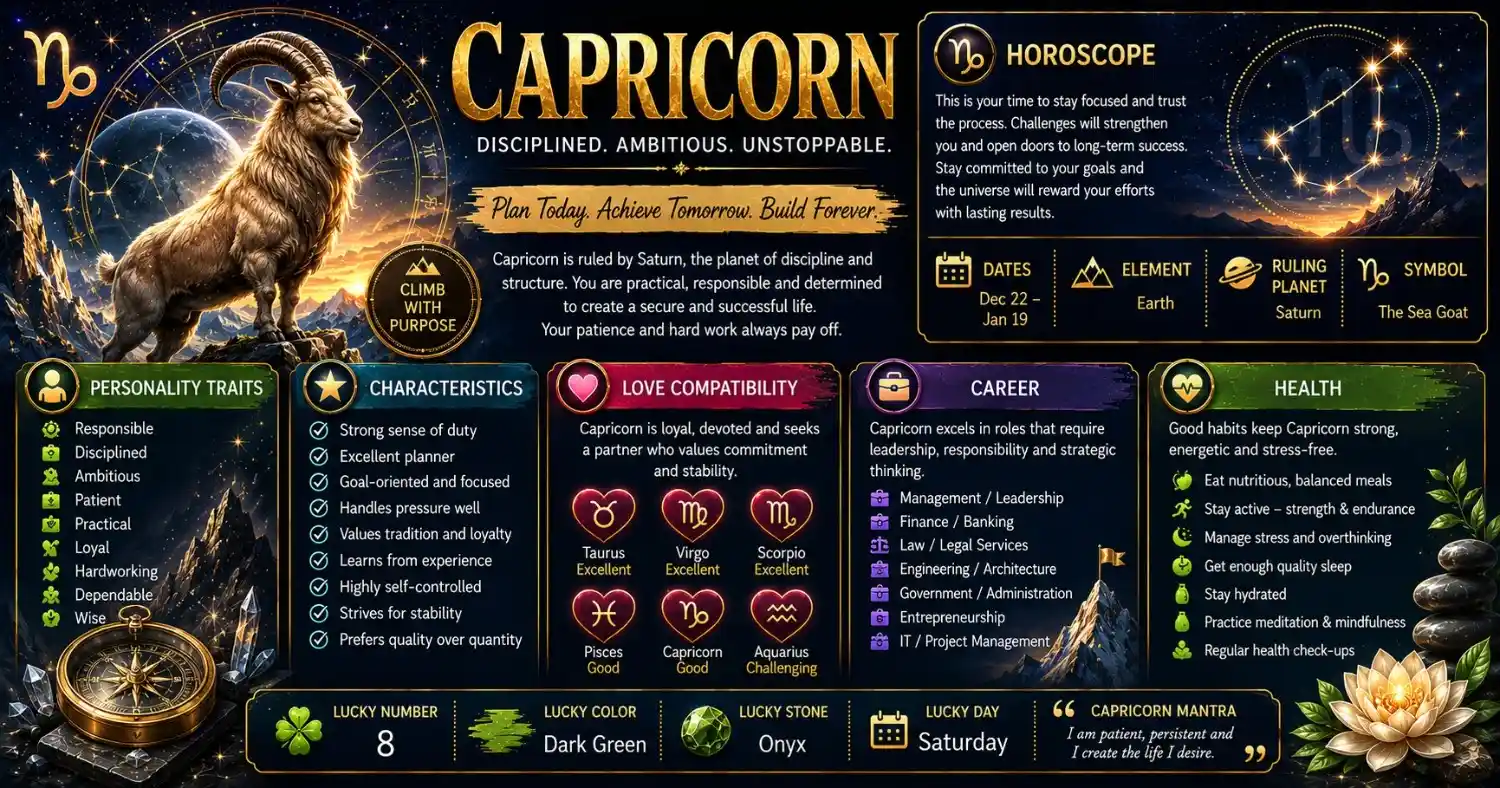
Capricorn is the sign that people picture least accurately. Ask ten people what animal it stands for and most will say “a goat.” The traditional answer is stranger. Capricorn is a sea-goat, a creature with the front of a goat and the tail of a fish, and it is one of the oldest images in the sky. Its history goes back to Mesopotamian sky-watchers, and the name changes as you move from language to language.
Some languages call the sign a horned goat. Some call it a “stone buck,” an ibex of the high cliffs. In India and much of Southeast Asia it is called Makara, a sea creature that has nothing to do with goats. Chinese and Vietnamese borrowed that Sanskrit name in the form of a sound-based transliteration, so the sign carries no animal meaning there at all.
This guide covers every major translation of Capricorn, how each is pronounced, and the cultural story behind each name. It also explains the astrology that all the names share. Use the tables as a reference and bookmark the sections you need.
Quick Answer: What Does Capricorn Mean in Other Languages?
The word Capricorn comes from Latin Capricornus, “goat-horned.” English borrowed the Latin form almost unchanged. Across the world’s languages, the sign’s name follows one of four patterns:
- They keep the Latin or Greek “horned goat.” Spanish Capricornio, French Capricorne, Italian Capricorno, Greek Aigókerōs, and Russian Kozerog, which is a Slavic word-for-word copy of the Latin.
- They use an ordinary native word for goat or kid. Arabic al-Jady, Hebrew Gedi, Turkish Oğlak, Japanese Yagi, Korean Yeomso, Serbian Jarac.
- They name the ibex, the “stone buck” of the mountains. German Steinbock, Dutch Steenbok, Swedish Stenbocken, Estonian Kaljukits, Finnish Kauris.
- They borrow the Sanskrit Makara. Hindi Makar, Tamil Magaram, Thai Makon, Khmer Makara, and by way of Buddhist transliteration, Chinese Mójié and Vietnamese Ma Kết.
Some things do not change from one tradition to the next. Western astrology places Capricorn from about December 22 to January 19. Vedic astrology places its Makara from roughly January 14 to February 12. The ruling planet is Saturn in every tradition, the element is Earth, and the quality is Cardinal, meaning it starts things.
Now the details.
The Root Meaning of Capricorn: Where the Word Comes From
English Capricorn arrives through Old French capricorne from Latin Capricornus. The Latin is a compound of two ordinary words. Caper means “he-goat” and cornu means “horn.” A Roman who said Capricornus was saying “the one with the goat’s horn.”
The Romans were translating. Their word is a close copy of the Greek Αἰγόκερως (Aigókerōs), from aix, aigós, “goat,” and keras, “horn.” Greek astronomers used that compound for the constellation long before Rome adopted it.
The Latin caper has relatives in other words that people use every day. A capriole is the leaping movement of a trained horse, borrowed through Italian from a word meaning a goat’s leap. Caper, in the sense of a playful skip, comes from the same source. Cabriolet, the name of a light, bouncy carriage and later of a convertible car, comes through French from a related idea of springing like a goat. The word capricious, describing someone whose mind jumps unpredictably, is often linked to the goat too, though etymologists debate that link.
That wordplay matters for astrology. Ancient goats were the climbers of the animal world, and the image of an animal that goes steadily up steep ground is central to the sign. English speakers who call a determined person “a mountain goat” are using the same idea the ancient name carried.
It also helps to know what the Latin name leaves out. It names only the goat half. The fish tail, the part that made the original Babylonian image unusual, does not appear in the name at all. In many languages, including the Sanskrit-derived ones, the sea creature is the whole identity.
Why a Sea-Goat? The Origin Story Behind the Symbol
Capricorn’s symbol is a hybrid. That makes it easy to draw and hard to explain, and every civilization that used it told a different story about why it exists.
Mesopotamia drew it first
The earliest ancestor of Capricorn is a Babylonian figure known as SUHUR.MASH, usually translated “goat-fish.” Sumerian and Babylonian cuneiform sky lists, including the compilation called MUL.APIN, record it as a constellation, and some of the oldest depictions of the creature appear on carved seals and boundary stones.
The goat-fish belonged to Ea, called Enki in Sumerian, the god of fresh water, craft, and wisdom. Ea’s home was the Apsu, the underground sea of sweet water that fed rivers and springs. So the sea-goat was never a random blend. It joined a mountain animal and a water animal, and both belonged to the god who governed the water that made life possible. A goat-fish is a creature that lives in two elements, and that duality, mountain and deep water, stayed with the image for four thousand years.
The turning point of the year
Early astronomers chose Capricorn for another reason, one that concerns the sun. At the time the zodiac was being standardized, the sun stood in this part of the sky at the winter solstice, the shortest day of the year in the northern hemisphere. After that day the sun begins climbing back toward the sky’s north.
That is where the modern Tropic of Capricorn gets its name. It is the line of latitude, about 23.4 degrees south, where the sun stands directly overhead at the December solstice. Precession has since moved the sun’s solstice position into Sagittarius, but the name stayed on the map. Today the Tropic of Capricorn crosses Chile, Argentina, Paraguay, Brazil, Namibia, Botswana, South Africa, Madagascar, and Australia.
An image tied to the solstice suggests a sign about slow turning points: a long dark period followed by steady, measured ascent. That is close to how astrologers describe the sign’s temperament.
Greece told the story of Pan
Greek myth gave the sea-goat a rescue narrative. When the monster Typhon attacked the gods, they scattered and hid in animal forms. The goat-footed god Pan, or in some tellings his relative Aigipan, jumped into the Nile. The part of his body below the water turned into a fish tail, and the part above stayed goat. In some versions, Zeus later set the image in the sky to honor Pan’s quick thinking.
A second Greek tradition connects the constellation to Amalthea, the goat who nursed the infant Zeus in a cave on Crete. Her broken horn became the cornucopia, the horn of plenty, and her hide is often linked with the aegis, the goatskin shield of Zeus and Athena. In this version Capricorn is a star-set thank-you to a nurse.
Rome and the gate of the gods
Rome added a philosophical layer. Late Roman and Neoplatonist writers, including Macrobius and Porphyry, described two “gates” in the sky. Cancer was the gate through which souls descended into bodies. Capricorn was the gate through which souls climbed back up to the gods. That idea places Capricorn on a threshold, a place of ascent and of ending, which fits the sign’s later reputation for ambition on one side and seriousness on the other.
The emperor Augustus put Capricorn on his coins and military standards. His reasons are connected in ancient sources to his horoscope, and the emblem worked as political branding for an emperor who claimed cosmic backing. Soldiers carried the sea-goat on their banners.
India saw the Makara
In India the image split from the goat entirely. Sanskrit calls the sign Makara (मकर), a mythical sea creature. Artists show it with a crocodile’s jaws, an elephant’s trunk or an antelope’s forequarters, and a fish’s or peacock’s tail. It is the vehicle of the river goddess Ganga and of the water god Varuna, and it appears on the banner of Kamadeva, the god of desire, who is called Makaradhwaja, “the one with the makara flag.”
Makara heads decorate temple gateways and the earrings of Vishnu. The exact origin of the word is debated among scholars, and some suggest a non-Sanskrit source. What matters here is that the Indian tradition translated the Greek sea-goat by matching it to a native water monster. The Vedic sign kept its watery half and dropped the goat.
Four civilizations, four stories, one shared shape: a climbing animal with a water tail, at the point where the year turns.
Capricorn in Indian Languages: The Vedic Family
India’s languages fall into two big families, Indo-Aryan and Dravidian, and both use the Sanskrit sign-system. For Capricorn, nearly every Indian language uses a form of Makara.
The master table for Indian languages
| Language | Native Script | Romanization | Literal Sense |
|---|---|---|---|
| Sanskrit | मकर | Makara | Sea monster, crocodile |
| Hindi | मकर राशि | Makar Rashi | Makara sign |
| Marathi | मकर रास | Makar Raas | Makara sign |
| Gujarati | મકર રાશિ | Makar Rashi | Makara sign |
| Bengali | মকর রাশি | Makar Rashi | Makara sign |
| Odia | ମକର ରାଶି | Makara Rashi | Makara sign |
| Assamese | মকৰ ৰাশি | Makor Rashi | Makara sign |
| Punjabi | ਮਕਰ | Makar | Makara |
| Nepali | मकर राशि | Makar Rashi | Makara sign |
| Tamil | மகரம் / மகர ராசி | Magaram / Magara Rasi | Makara sign |
| Telugu | మకర రాశి | Makara Rasi | Makara sign |
| Kannada | ಮಕರ ರಾಶಿ | Makara Rashi | Makara sign |
| Malayalam | മകരം | Makaram | Makara, sixth month |
| Konkani | मकर | Makar | Makara |
| Sinhala | මකර | Makara | Makara |
| Urdu | برج جدی | Burj-e-Jadi | House of the Kid |
Sanskrit: Makara and the older Greek loan
Classical Sanskrit astrology uses Makara for the tenth sign. But the story is more layered than that. The earliest Sanskrit astrological texts, such as the Yavanajataka (“Sayings of the Greeks”) and the writings of Varahamihira, borrowed Greek sign names directly. In those works Capricorn appears as Akokera (आकोकेर), a Sanskrit rendering of Greek Aigókerōs.
So India once used a Greek-derived name for the sign and later settled on Makara, a native water creature. The Sanskrit tradition absorbed the Hellenistic system and rewrote it in its own mythology.
Hindi and the northern languages
Hindi, Marathi, Gujarati, Nepali, and the Eastern Indo-Aryan languages keep the Sanskrit almost unchanged: Makar Rashi (मकर राशि). The word rashi means a heap or measured quantity in Sanskrit. It is the standard word for a zodiac sign, since a sign is a thirty-degree portion of the sky.
Pronunciation shifts slightly in each language. Hindi drops the final short a sound, giving MUH-kur. Bengali speakers say something closer to MOH-kor, and Assamese, which shifts several vowels, says MOH-kor as well. But written and spoken, these are the same word.
Tamil, Telugu, and Kannada: the Dravidian route
Tamil says மகரம் (Magaram) or மகர ராசி (Magara Rasi). Telugu says మకర రాశి (Makara Rasi), and Kannada says ಮಕರ ರಾಶಿ (Makara Rashi). All three preserve the Sanskrit shape while fitting it to local spelling.
Tamil deserves a note on the calendar. Tamil months are not named after signs, but the Tamil month of Thai begins when the sun enters Makara, around January 14. That moment is celebrated as Thai Pongal, the harvest festival, so the sun’s entry into Makara opens a new month, a harvest, and the “auspicious half” of the year.
Malayalam: sign and month share a name
Malayalam is again the language where the sign is also the calendar. മകരം (Makaram) names the sixth month of the Malayalam solar calendar, running from about January 15 to February 14. When a Malayali says Makaram, she may mean the month, the sign, or both.
Makaram in Kerala is anchored by a famous event. At the hill temple of Sabarimala, the appearance of a light called Makaravilakku on Makara Sankranti draws hundreds of thousands of pilgrims every year. That is a sign name, a month name, and a festival of light in a single word.
Makar Sankranti: the festival named for the sign
The most widely celebrated use of the name is the festival Makar Sankranti. Sankranti means “transition.” The festival marks the day the sun enters sidereal Makara, usually on January 14 or 15.
The day opens Uttarayana, the sun’s apparent journey northward, which tradition treats as a time of blessing. In the Mahabharata, the warrior Bhishma lies on a bed of arrows and waits for Uttarayana to begin before he allows himself to die, because that phase of the year is considered the favorable one for departure.
The festival goes by many names across India: Pongal in Tamil Nadu, Uttarayan in Gujarat with its kite festivals, Lohri on the eve in Punjab, Magh Bihu in Assam, and Sankranthi in Telugu-speaking states. Millions of people celebrate a festival whose name comes from the sign of Capricorn.
Urdu: a different route entirely
Urdu goes the Arabic-Persian way and says برج جدی (Burj-e-Jadi). Jadi comes from Arabic al-jady, “the kid.” A Hindi speaker in Delhi says Makar and an Urdu speaker in Lahore says Jadi. The two languages are closely related in everyday speech, but their zodiac vocabulary comes from opposite ends of history.
The nakshatras inside Makara
Vedic astrology divides each sign into lunar mansions called nakshatras. Makara holds:
- Uttara Ashadha (last three quarters), ruled by the Sun, symbolized by an elephant’s tusk
- Shravana (all four quarters), ruled by the Moon, symbolized by an ear or three footprints
- Dhanishta (first two quarters), ruled by Mars, symbolized by a drum
A curiosity here: the stars that mark these nakshatras mostly belong to neighboring constellations. Shravana is marked by Altair and nearby stars in Aquila, and Dhanishta by stars in Delphinus. The sidereal sign and the constellation of the same name overlap only loosely, and Indian astrology has always worked with the sign as a measured division of the ecliptic.
Capricorn in European Languages
Europe divides into groups that reflect its history. The Romance languages keep the Latin. The Slavic and Baltic languages translate it piece by piece. The Germanic and Finno-Ugric languages did something different and picked another animal.
Romance languages
| Language | Name | Pronunciation |
|---|---|---|
| Latin | Capricornus | kap-ree-KOR-noos |
| Italian | Capricorno | kah-pree-KOR-noh |
| Spanish | Capricornio | kah-pree-KOR-nyoh |
| Portuguese | Capricórnio | kah-pree-KOR-nyoo |
| French | Capricorne | kah-pree-KORN |
| Romanian | Capricorn | kah-pree-KORN |
| Catalan | Capricorn | kah-pree-KORN |
| Galician | Capricornio | kah-pree-KOR-nyoh |
The Romance languages leave the name nearly untouched. The one difference worth noting is the ending: French and Romanian dropped the final vowel, while Spanish and Portuguese changed -us into -io, the usual Latin-to-Iberian pattern. The Spanish speaker who says Soy Capricornio is saying a word that is barely different from the one an ancient Roman used.
Germanic languages
| Language | Name | Literal Meaning |
|---|---|---|
| German | Steinbock | Stone buck, ibex |
| Dutch | Steenbok | Stone buck, ibex |
| Danish | Stenbukken | The stone buck |
| Norwegian | Steinbukken | The stone buck |
| Swedish | Stenbocken | The stone buck |
| Icelandic | Steingeitin | The stone goat |
| Afrikaans | Steenbok | Stone buck |
The Germanic languages made the most striking choice in Europe. They did not translate “horned goat.” They named the sign after the ibex, the wild mountain goat of the Alps. Stein is stone and Bock is a male goat. A Steinbock is literally a “stone buck,” an animal that lives on bare rock faces.
That choice suits the Alpine setting. Speakers whose landscape included ibex chose a familiar wild animal, rather than a Mediterranean domestic goat. It also emphasizes stubborn climbing over the lowland farm image.
Icelandic Steingeitin has no ibex in its landscape but follows the same pattern, replacing “buck” with geit, goat.
Slavic languages
| Language | Name | Romanization |
|---|---|---|
| Russian | Козерог | Kozerog |
| Ukrainian | Козеріг | Kozerih |
| Belarusian | Казярог | Kazyarog |
| Bulgarian | Козирог | Kozirog |
| Polish | Koziorożec | Koziorożec |
| Czech | Kozoroh | Kozoroh |
| Slovak | Kozorožec | Kozorožec |
| Slovenian | Kozorog | Kozorog |
| Serbian | Јарац / Jarac | Jarac |
| Croatian | Jarac | Jarac |
| Macedonian | Јарец | Jarec |
Most Slavic languages did something linguists call a calque, a word-for-word translation. Take Russian Kozerog. It is koza, “goat,” joined to rog, “horn.” That is exactly the structure of Latin caper plus cornu and Greek aix plus keras. Polish Koziorożec, Czech Kozoroh, and the rest follow the same blueprint.
The South Slavic languages Serbian, Croatian, and Macedonian break from the group. They use jarac, an ordinary word for a billy goat, with no reference to horns.
Baltic, Finno-Ugric, and other European branches
| Language | Name | Notes |
|---|---|---|
| Lithuanian | Ožiaragis | Goat-horn, a Baltic calque |
| Estonian | Kaljukits | Rock goat |
| Finnish | Kauris | A wild goat or ibex-type animal |
| Hungarian | Bak | Buck, male goat |
| Greek | Αιγόκερως (Aigókerōs) | Goat-horned, the original |
| Armenian | Այծեղջյուր (Aytseghjyur) | Goat-horned |
| Georgian | თხის რქა (Tkhis Rka) | Goat’s horn |
| Turkish | Oğlak | Kid, young goat |
Lithuanian Ožiaragis is the Baltic version of the same calque as Russian, ožys (goat) plus ragas (horn). Estonian and Finnish, which do not belong to the Indo-European family at all, still landed on wild-goat images, with Estonian’s Kaljukits meaning “cliff goat.” Hungarian, also Finno-Ugric, chose the simple Bak.
Armenian and Georgian follow the “horned goat” pattern, and Armenian Aytseghjyur is again a close calque of the Greek.
Turkish Oğlak is worth flagging. It means a kid, a young goat, rather than an adult. It has the same soft flavor as the Arabic and Hebrew names for the sign, discussed next.
Capricorn in Middle Eastern and Semitic Languages
The Middle East saw the constellation earlier than Europe did, and the astronomy of the region transmitted the sign to both Greece and India. The Semitic languages settled on a very different word, though.
| Language | Native Script | Romanization | Meaning |
|---|---|---|---|
| Arabic | برج الجدي | Burj al-Jady | House of the Kid |
| Hebrew | מזל גדי | Mazal Gedi | Constellation of the Kid |
| Persian (Farsi) | جدی | Jaddi | The Kid |
| Turkish | Oğlak Burcu | Oğlak Burju | Kid sign |
| Azerbaijani | Oğlaq | Oghlagh | Kid |
Arabic: al-Jady
Arabic astronomers gave us many of the star names still in use today. The sign’s Arabic name is الجدي (al-Jady), “the kid,” and the full phrase is برج الجدي (burj al-jady), where burj means tower or house.
Arabic scholars placed the constellation in the same sky as their Greek predecessors, but they used their own word. That word entered Persian and Urdu as Jaddi or Jadi and reached Turkey as well. The kid, as opposed to the full-grown goat, is a small and appealing animal, and the Arabic naming shows a different sensibility from the Latin horned goat.
The Arabic tradition also left its mark on the stars inside the constellation. Several of the brightest carry names that come straight from Arabic, discussed in a later section.
Hebrew: Mazal Gedi
Hebrew calls the sign מזל גדי (Mazal Gedi). Mazal is “constellation” and also “luck,” the same word that gives us mazel tov. Gedi (גדי) is the word for a young goat, as in the biblical injunction about not boiling a kid in its mother’s milk.
Jewish tradition connects Capricorn to the Hebrew month Tevet, which falls in December and January. In the traditional scheme of correspondences, Tevet is also linked to the tribe of Dan. These associations come from medieval and Kabbalistic sources and vary between texts.
Persian and the Afghan calendar
Persian uses جدی (Jaddi) for the sign, from the Arabic. The Persian calendar has a month called Dey (دی) that roughly overlaps with Capricorn, running from about December 22 to January 20, but Dey is not a zodiac name. It comes from an older Iranian word and is not derived from the sign. Iranians also celebrate Yalda, the longest night of the year, on the eve of the solstice, which puts the story of Capricorn’s darkest moment right at the door of the Persian winter month.
Afghanistan’s solar calendar does use sign names for its months, and the tenth month is Jadi. That places Capricorn in the calendar there, in the same way the Thai and Malayalam calendars do.
Turkish: Oğlak
Turkish says Oğlak Burcu. Oğlak is a native Turkic word for a kid, and burç is borrowed from Arabic burj. Azerbaijani Oğlaq is nearly identical. Like Turkish Taurus, the Turkish name for Capricorn mixes Turkic and Arabic elements in a single phrase.
Capricorn in East Asian Languages
East Asia received Western astrology relatively recently but inherited a much older vocabulary through Buddhism. For Capricorn, that produced one of the most interesting name stories in the whole zodiac.
| Language | Native Script | Romanization | Literal Translation |
|---|---|---|---|
| Chinese (Mandarin) | 摩羯座 | Mójié zuò | Makara constellation |
| Chinese (Taiwan) | 魔羯座 | Mójié zuò | Makara constellation |
| Chinese (Cantonese) | 摩羯座 | Mo1 kit3 zo6 | Makara constellation |
| Japanese | 山羊座 | Yagi-za | Mountain goat constellation |
| Korean | 염소자리 | Yeomso-jari | Goat seat, goat place |
| Vietnamese | Ma Kết | Ma Kết | Makara (transliteration) |
Chinese: a Sanskrit word in Chinese characters
Mandarin says 摩羯座 (Mójié zuò), and the characters hide a surprise. 摩羯 (mójié) is not a Chinese description of a goat or a fish. It is a sound-based rendering of Sanskrit Makara, introduced by Buddhist translators who needed Chinese characters for the Indian word. It appears in Buddhist texts (sometimes written 摩竭) as the name of the great sea creature.
The final character 座 (zuò) means seat or constellation and is added to sign names generally. So 摩羯座 means “Makara constellation.” A Chinese speaker who says Mójié zuò is speaking a word that traveled from India along the Silk Road.
Taiwan often writes the first character as 魔 (“demon”), giving 魔羯座, a spelling that changes the appearance but not the sound or meaning. Both forms are understood.
This is easy to confuse with the Chinese zodiac animal. The Chinese year-cycle includes the Goat (羊, also translated Sheep or Ram). That is a completely separate system based on birth year. A person born under the Western sign 摩羯座 is not automatically a Goat in the Chinese cycle.
Traditional Chinese astronomy divided this part of the sky differently. The stars of Capricornus belong largely to the northern “Black Tortoise” quadrant. The mansion called 牛宿, the Ox, includes Beta and Alpha Capricorni, so the region carried an ox in one system and a sea-goat in another.
Japanese: Yagi-za
Japanese takes the zoological route: 山羊座 (Yagi-za). 山羊 (yagi) is the everyday word for goat, written with the characters for “mountain” and “sheep/goat.” The magazines often print the hiragana form やぎ座 for readability.
The Japanese distinction between 山羊 (yagi, goat) and 羊 (hitsuji, sheep) matters. Aries in Japanese is 牡羊座 (Ohitsuji-za), the “male sheep” constellation, so the language separates the two signs carefully.
Korean: Yeomso-jari
Korean says 염소자리 (Yeomso-jari). 염소 (yeomso) is a goat, and 자리 (jari) means seat or place. As with the other Korean constellation names, it uses the native ending -jari, so the language avoids the borrowed Sino-Korean characters completely.
Vietnamese: Ma Kết
Vietnamese says Ma Kết, the Sino-Vietnamese reading of 摩羯, the same Makara transliteration as Chinese. It has no animal meaning in modern Vietnamese, only the sign. A Vietnamese speaker hears it as a proper name.
Capricorn in Southeast Asian Languages
Southeast Asia took its astrology from India rather than from the West. The result is that the region preserves Sanskrit Makara more faithfully than almost anywhere outside India itself.
| Language | Native Script | Romanization | Source |
|---|---|---|---|
| Thai | ราศีมกร | Rasi Makon | Sanskrit Makara |
| Khmer | រាសីមករ | Reasei Makara | Sanskrit Makara |
| Indonesian | Capricorn | Capricorn | Latin, via Dutch/English |
| Malay | Capricorn | Capricorn | Latin, via English |
| Filipino (Tagalog) | Capricorn | Capricorn | Latin, via Spanish/English |
Thai and Khmer: a sign that is also January
Thai says ราศีมกร (Rasi Makon). Rasi is the Sanskrit rashi and Makon is Thai pronunciation of Makara. What most speakers don’t notice is that the Thai word for the month of January, มกราคม (Makarakhom), contains the same word. The Thai names for months with 31 days end in -khom, and each is built from the name of a zodiac sign. January belongs to Makara.
Cambodia does the same. The Khmer name for January is មករា (Makara), and the sign is រាសីមករ (Reasei Makara). So in Thailand and Cambodia, and in Laos where the word for January is Mangkon, Capricorn lives on the wall calendar. Millions of people say the sign’s name every time they write the date, without any astrology involved.
Indonesia and the Makara emblem
Indonesian and Malay speakers generally use Capricorn in horoscopes, borrowed through Dutch and English. But the Sanskrit word survives in the region’s culture. In Old Javanese and Balinese art, the makara appears as a temple guardian, and the Universitas Indonesia uses a stylized Makara as its emblem. The sign and the symbol belong to the same mythological creature.
The Philippines
Filipino uses Capricorn, inherited from Spanish and English. In casual Tagalog you may hear people say the word for goat, kambing, but this is not a standard astrological term.
Capricorn in African Languages
African languages show the greatest variety, and the least standardization. Astrological vocabulary arrived through different colonial and trade routes, so many languages have no single fixed term. Writers often describe the sign using the local word for goat.
| Language | Word for Goat Used | Notes |
|---|---|---|
| Afrikaans | Steenbok | From Dutch, “stone buck” |
| Swahili | Mbuzi | Goat; usage varies by publication |
| Zulu | Imbuzi | Goat |
| Xhosa | Ibhokhwe | Goat |
| Shona | Mbudzi | Goat |
| Yoruba | Ewúrẹ́ | Goat |
| Hausa | Akuya / Bunsuru | Nanny goat / male goat |
| Amharic | ፍየል (Fiyel) | Goat |
Afrikaans: a name with a local twist
Afrikaans inherited Dutch Steenbok for the sign, but in southern Africa the word steenbok is also the name of a small, real antelope, Raphicerus campestris, that lives in grasslands and scrub. So an Afrikaans speaker reading the word may picture a small antelope rather than an Alpine ibex. The zodiac name and the animal name are the same word.
Goat words and cultural weight
In the Bantu languages, the goat is a valued animal used in ceremonies, exchange, and celebration. It is not a symbol of humble labor the way it sometimes appears in European tradition. That changes the emotional tone when a Zulu or Shona speaker reads a horoscope describing a “goat” sign.
A word of caution for publishers: because many African languages have no established astrological vocabulary, a translator working on horoscope content should verify wording with native speakers in the target region instead of assuming that the word for goat is what readers expect. Regional usage differs a great deal, even within a single language.
Capricorn in Sign Languages, Constructed Languages, and Symbols
The astrological glyph
Capricorn’s symbol is ♑, encoded in Unicode as U+2651. The glyph is a V-shaped stroke that ends in a looping curl. The traditional reading is that the V shape belongs to the goat, its horn or its front half, while the loop is the coiled fish tail. Both halves of the animal appear in one continuous line.
Some astrologers read it differently, seeing a mountain path with a spiral at the top. It is a reasonable interpretation since it echoes the sign’s association with ascent.
Esperanto and constructed languages
Esperanto says Kaprikorno, and Interlingua says Capricornio. Constructed languages consistently favor the international Latin-based form, which makes the sign easy to recognize across them.
Sign languages
There is no single universal sign for Capricorn. Many signing communities use a sign resembling horns at the temples or a short beard at the chin, for goat, and pair it with the fingerspelled letters for clarity. Regional variation is common. If you need the correct sign, ask local Deaf communities in your region instead of assuming a standard.
How to Say “I Am a Capricorn” in 25 Languages
This is the phrase people actually want. Here it is, ready to use.
| Language | Phrase |
|---|---|
| Spanish | Soy Capricornio |
| French | Je suis Capricorne |
| German | Ich bin Steinbock |
| Italian | Sono del Capricorno |
| Portuguese | Sou de Capricórnio |
| Dutch | Ik ben Steenbok |
| Russian | Я Козерог (Ya Kozerog) |
| Polish | Jestem Koziorożcem |
| Greek | Είμαι Αιγόκερως (Eímai Aigókeros) |
| Turkish | Ben Oğlak burcuyum |
| Arabic | أنا برج الجدي (Ana burj al-jady) |
| Hebrew | אני מזל גדי (Ani mazal gedi) |
| Persian | من برج جدی هستم (Man burj-e jaddi hastam) |
| Hindi | मेरी राशि मकर है (Meri rashi Makar hai) |
| Bengali | আমার রাশি মকর (Amar rashi Makar) |
| Tamil | என் ராசி மகரம் (En rasi Magaram) |
| Telugu | నా రాశి మకరం (Naa rasi Makaram) |
| Kannada | ನನ್ನ ರಾಶಿ ಮಕರ (Nanna rashi Makara) |
| Malayalam | എന്റെ രാശി മകരം (Ente rashi Makaram) |
| Urdu | میرا برج جدی ہے (Mera burj Jadi hai) |
| Chinese | 我是摩羯座 (Wǒ shì mójié zuò) |
| Japanese | 私は山羊座です (Watashi wa yagi-za desu) |
| Korean | 저는 염소자리예요 (Jeoneun yeomso-jari-yeyo) |
| Thai | ฉันเป็นราศีมกร (Chan pen rasi makon) |
| Vietnamese | Tôi thuộc cung Ma Kết |
The Date Problem: Why Capricorn Starts on Different Days
More confusion about zodiac signs comes from dates than from vocabulary. Capricorn is a good case, because the sign straddles the calendar’s year-end and the two major systems disagree by nearly a month.
Western (tropical) astrology
Western astrology uses the tropical zodiac, which is anchored to the seasons rather than to the background stars. The zodiac starts at the March equinox, and Capricorn begins at the December solstice, the shortest day in the northern hemisphere. Its dates are about December 22 to January 19.
Because the exact moment of the solstice shifts from year to year and depends on time zone, a person born on December 21, 22, or 23 or on January 19 or 20 is a cusp case. Check the birth time and place against an ephemeris.
Vedic (sidereal) astrology
Indian astrology uses the sidereal zodiac, which is anchored to the fixed stars. Because of precession, a slow wobble of Earth’s axis, the two systems have separated by about 24 degrees over roughly two thousand years. That shifts everything back by nearly a month.
So Vedic Makara runs from roughly January 14 to February 12. The start of that window is precisely the festival of Makar Sankranti.
The practical effect is striking. Someone born on January 3 is a Capricorn in Western astrology but a Sagittarius (Dhanu) in Vedic astrology. Someone born on February 1 is an Aquarius in Western astrology but a Capricorn (Makara) in Vedic astrology. Neither system has made an error. They answer different questions.
Why both systems remain in use
Tropical astrology tracks the sun’s relationship to the seasons, and its interpretive tradition describes character and life-stage themes connected with the time of year. Sidereal astrology tracks the sun against the stars and supports a predictive system built on planetary periods. If your Western sign and your Vedic sign differ, you have two separate maps of the same territory.
The constellation boundaries
Astronomy adds a third layer. Under the boundaries fixed by the International Astronomical Union in 1930, the sun actually passes through the constellation Capricornus from about January 20 to February 16. Neither the tropical dates nor the sidereal dates match this exactly, because astrologers have used twelve equal thirty-degree divisions for two thousand years and the real constellations are uneven in size.
What Capricorn Actually Means: The Astrology Underneath the Words
The names differ, but the astrological content is remarkably consistent across cultures.
The core signature
- Element: Earth
- Modality: Cardinal (movable)
- Ruling planet: Saturn (Shani in Vedic astrology)
- Symbol: The Sea-Goat (Makara in India)
- Polarity: Receptive, yin, feminine
- House correspondence: Tenth house
- Exaltation: Mars, exalted at 28 degrees Capricorn
- Detriment: The Moon
- Fall: Jupiter, at 5 degrees Capricorn
- Body rulership (traditional): Knees, bones, joints, teeth, skin
- Tarot correspondence: The Devil
- Colors: Brown, charcoal, forest green, black
- Stones: Garnet, onyx, black tourmaline
- Day: Saturday
- Season: Deep winter in the northern hemisphere
Cardinal Earth, explained properly
Cardinal signs start things. Fixed signs sustain them and mutable signs adapt. Earth signs deal with material reality.
Combine the two and you have a sign that initiates in the practical world. Capricorn does not merely maintain a structure. It sets one up, plans it, and starts building. This is why the sign is associated with founders, managers, and people who take on long projects with clear stages. It is the difference between Capricorn and Taurus: Taurus enjoys what has been built, while Capricorn sets out to build the next thing.
Saturn rules through structure
Saturn rules Capricorn and its neighbor Aquarius. In Capricorn, it works through time, discipline, limits, and responsibility. Where Aquarius expresses Saturn through systems and ideas, Capricorn expresses it through institutions, careers, and concrete obligations.
The Roman connection is neat. Saturn’s festival, the Saturnalia, took place in the days around the winter solstice, when the sun was in Capricorn. Saturn’s Greek counterpart is Kronos, the god of time. In Vedic astrology, Shani is the slow planet, taking about two and a half years per sign. His influence is described as the great teacher who rewards effort that has been earned.
That is why traditional astrology says Capricorn’s rewards come late and last long. The sign builds slowly, and it is patient with its own timeline.
Mars is exalted here
Mars reaches its highest expression in Capricorn, and both Western and Vedic systems agree on this. That may look odd, because Mars is the planet of raw drive, and Capricorn looks reserved. But exaltation here describes energy that is disciplined. Mars in Capricorn is not a sudden charge but a sustained campaign. This detail explains why Capricorn’s ambition so often looks quiet and yet unstoppable.
The Moon, by contrast, is in detriment here. The Moon governs emotional expression and comfort. In Capricorn it is held in check by Saturn’s cool structure, which is why the sign is often described as guarded about feeling.
The tenth house
Capricorn corresponds to the tenth house of the chart, the house of career, public reputation, and life direction, at the top of the chart. This is where the sign gets its association with achievement, authority, and legacy. The tenth house asks what you will be known for.
Core strengths
Capricorn brings discipline. It sets goals and works toward them without needing constant motivation from outside. Long projects that exhaust other signs feel natural to it.
Capricorn is responsible. When a Capricorn says they will do something, the statement tends to be reliable, and the sign often becomes the person others rely on in a crisis.
Capricorn is strategic. It thinks in stages, resources, and consequences, and it does well in management, finance, engineering, law, and administration.
Capricorn is quietly humorous. The stereotype of the stern Capricorn misses the dry, deadpan wit that many people of this sign have.
Core challenges
Capricorn can be overly severe with itself. Saturn brings high standards, and those can turn into constant self-criticism.
Capricorn can struggle to rest. Work becomes identity, and leisure feels like wasted time.
Capricorn can be emotionally reserved. The Moon’s detriment means feelings often go unspoken, which can read as coldness to people who do not know the sign well.
Capricorn can be pessimistic. Planning for every risk is a strength until it turns into expecting the worst.
Does the meaning change by culture?
The tone changes with the culture, and the substance stays close to the same.
Western popular astrology stresses ambition, career, and reserve. Vedic astrology reads a Makara ascendant through Saturn’s periods and stresses karma, duty, and the timing of achievement. Chinese-language horoscope media, using the Makara transliteration, often describe the sign as practical and hardworking. Arabic and Persian traditional astrology, following medieval methods, treat Saturn’s rulership as a matter of fortune and elective timing.
Different emphasis, same sign. The mountain goat and the sea creature are both climbing the same slope.
Star Names Inside Capricorn Across Languages
Capricornus is one of the fainter zodiac constellations, but its brightest stars carry names from several languages, mostly Arabic.
The main stars
| Star | Origin | Meaning |
|---|---|---|
| Deneb Algedi (Delta) | Arabic dhanab al-jady | Tail of the kid |
| Dabih (Beta) | Arabic sa’d al-dhabih | Lucky star of the slaughterer |
| Algedi / Giedi (Alpha) | Arabic al-jady | The kid |
| Nashira (Gamma) | Arabic sa’d al-nashirah | Bearer of good news |
Deneb Algedi is the brightest star in the constellation and marks the fish tail. The name works as a small map: deneb is “tail” and algedi is “the kid.” Alpha Capricorni appears to the naked eye as a close pair of stars, but the two are not physically bound together, and they are simply lined up from our point of view.
Names for the region of the sky
| Culture | Name or Treatment | Meaning |
|---|---|---|
| Babylonian | SUHUR.MASH | Goat-fish |
| Greek | Αἰγόκερως (Aigókerōs) | Goat-horned |
| Roman | Capricornus | Goat-horned |
| Sanskrit | Makara / Akokera | Sea monster / Greek loanword |
| Arabic | الجدي (al-Jady) | The kid |
| Chinese | 牛宿 (Niú xiù) | The Ox mansion |
The table shows the same region of sky treated very differently. Mesopotamia saw a goat-fish, Greece and Rome a horned goat, India a sea monster, Arabia a kid, and China an ox. It took Babylon, Greece, and India together to give the sign the form we know.
Common Mistakes and Mistranslations to Avoid
Mistake 1: Confusing the Western sign with the Chinese Goat
The Chinese zodiac’s Goat (also called Sheep or Ram) is based on birth year in a twelve-year cycle. The Western sign 摩羯座 is based on birth month. They are separate systems, and a Capricorn is not automatically a Goat.
Mistake 2: Assuming Makara means goat
In India, Makara is a sea creature, usually drawn with crocodile features. Indian-language horoscopes do not describe the sign as a goat, and translating Makar Rashi as “goat sign” misrepresents the Sanskrit.
Mistake 3: Translating Chinese or Vietnamese literally
摩羯 and Ma Kết are sound-based transliterations. Breaking them into “rub” or “male” or other meanings of the individual characters will produce nonsense. They function as a foreign proper name.
Mistake 4: Mixing up Japanese goat and sheep
Japanese uses 山羊座 (Yagi-za) for Capricorn and 牡羊座 (Ohitsuji-za) for Aries. The characters 山羊 and 羊 refer to different animals, and swapping them switches the signs.
Mistake 5: Forgetting that Steenbok is also an antelope
In Afrikaans and Southern African English, steenbok is a small antelope. Readers may picture the animal rather than the ibex the zodiac name originally meant.
Mistake 6: Using the wrong date system
A person born on January 3 is a Western Capricorn and a Vedic Sagittarius (Dhanu). Always establish which system is meant before naming a sign.
Mistake 7: Treating Persian “Dey” as the sign
Dey is a calendar month name in Iran that roughly overlaps with Capricorn. It is not the sign’s name. The sign is Jaddi. In Afghanistan, the tenth month of the solar calendar is called Jadi, which does match the sign.
Mistake 8: Machine-translating astrological terms
Automated translation can turn Capricorn into a film title, a beetle, a geographic feature, or a company name. Verify published horoscope content with a native speaker.
Frequently Asked Questions
What does Capricorn mean in English?
Capricorn means “goat-horned.” It comes from Latin Capricornus, made of caper, “goat,” and cornu, “horn.” The traditional image is a sea-goat with a goat’s front half and a fish’s tail.
What is Capricorn called in Hindi?
Hindi calls Capricorn मकर राशि (Makar Rashi). Makar comes from Sanskrit Makara, a mythical sea creature. It does not mean goat.
What is Capricorn in Tamil?
Tamil calls Capricorn மகரம் (Magaram) or மகர ராசி (Magara Rasi). The Tamil month of Thai begins when the sun enters Makara, which is celebrated as Thai Pongal.
What is Capricorn called in Malayalam?
Malayalam calls Capricorn മകരം (Makaram), which is also the name of the sixth month of the Malayalam solar calendar, running from about January 15 to February 14.
What is Capricorn in Arabic?
Arabic calls Capricorn برج الجدي (Burj al-Jady), meaning “house of the kid.” Several stars in the constellation carry Arabic names derived from al-jady.
What is Capricorn in Hebrew?
Hebrew calls Capricorn מזל גדי (Mazal Gedi), where gedi means kid, a young goat. Tradition links it to the month of Tevet.
What is Capricorn in Chinese?
Chinese calls Capricorn 摩羯座 (Mójié zuò). The first two characters transliterate Sanskrit Makara and were introduced through Buddhist texts. The name has no connection to the Chinese zodiac Goat.
What is Capricorn in Japanese?
Japanese calls Capricorn 山羊座, read やぎ座 (Yagi-za). It means “goat constellation,” using the characters for mountain and goat.
What is Capricorn in Korean?
Korean calls Capricorn 염소자리 (Yeomso-jari). Yeomso means goat and jari means seat or place.
What is Capricorn in German?
German calls Capricorn Steinbock, “stone buck,” which is the German word for the Alpine ibex. The Dutch, Swedish, Danish, and Norwegian names follow the same model.
Why do the Vedic and Western Capricorn dates differ?
Western astrology uses the tropical zodiac, tied to the seasons, which gives dates of about December 22 to January 19. Vedic astrology uses the sidereal zodiac, tied to the stars, which gives roughly January 14 to February 12. Precession of the equinoxes created the difference over about two thousand years.
Which planet rules Capricorn?
Saturn rules Capricorn in Western, Hellenistic, Arabic, and Vedic astrology, where the planet is called Shani. Mars is exalted in the sign, and Jupiter is in its fall.
What does Makara mean in Sanskrit?
Makara means a sea monster, often depicted as crocodile-like with an elephant’s trunk and a fish tail. It is the vehicle of the goddess Ganga and the god Varuna, and it appears on the flag of Kamadeva.
What is the Capricorn symbol called?
The symbol is ♑, a V-shaped stroke that ends in a loop. It is often read as a goat’s horn together with a fish’s tail. Unicode encodes it as U+2651.
Is Capricorn the same as the Goat in the Chinese zodiac?
No. Capricorn belongs to the Western system and depends on your birth month. The Goat belongs to the Chinese twelve-year cycle and depends on your birth year.
What is Makar Sankranti?
Makar Sankranti is the Hindu festival that marks the sun’s entry into sidereal Makara, usually on January 14 or 15. It opens Uttarayana, the sun’s northward journey, and is celebrated as Pongal, Uttarayan, Lohri, Magh Bihu, and other regional festivals.
What is the Tropic of Capricorn?
It is the line of latitude at about 23.4 degrees south, where the sun stands directly overhead at the December solstice. It was named when the sun stood in Capricorn at the solstice, and it kept the name after precession moved the sun’s solstice position into Sagittarius.
Key Takeaways
Capricorn holds up under translation because its meaning sits in the sky and the calendar rather than in any one vocabulary. The name changes from language to language, but the sign always points to the same idea: a creature that climbs patiently and belongs to two worlds.
The image comes from Babylon’s goat-fish of Ea, was reshaped by Greek and Roman storytellers, and was translated in India into the Makara. From there it traveled along the Buddhist routes into Chinese, Vietnamese, and Thai, and across the Arabic world it became the kid.
Remember these essentials:
- Capricorn means “goat-horned” in Latin, and the traditional symbol is a sea-goat.
- Four naming patterns exist: the Latin or Greek horned goat, native goat words, the ibex or “stone buck,” and the Sanskrit Makara.
- India, Southeast Asia, and Sri Lanka use forms of Makara, a sea creature that is not a goat.
- Chinese 摩羯 and Vietnamese Ma Kết are transliterations of Makara, not descriptions.
- Germanic languages name the sign after the ibex, and Slavic and Baltic languages copy the Latin word for word.
- Arabic, Hebrew, Persian, and Turkish use words for a young goat or kid.
- Saturn rules the sign in every major tradition, and Mars is exalted in it.
- Western dates run about December 22 to January 19. Vedic dates run roughly January 14 to February 12.
Whatever word your language uses, the sign describes the same figure: someone who takes on the long climb, measures progress in years rather than days, and reaches the summit by patient effort. The sea-goat looks like a strange hybrid, but the two halves suit one another. One half climbs, the other keeps a hold on the deep.
This guide covers astrological tradition and comparative linguistics. Astrology is a symbolic and cultural system, not a science. Use it for reflection and self-understanding rather than for medical, financial, or legal decisions.