
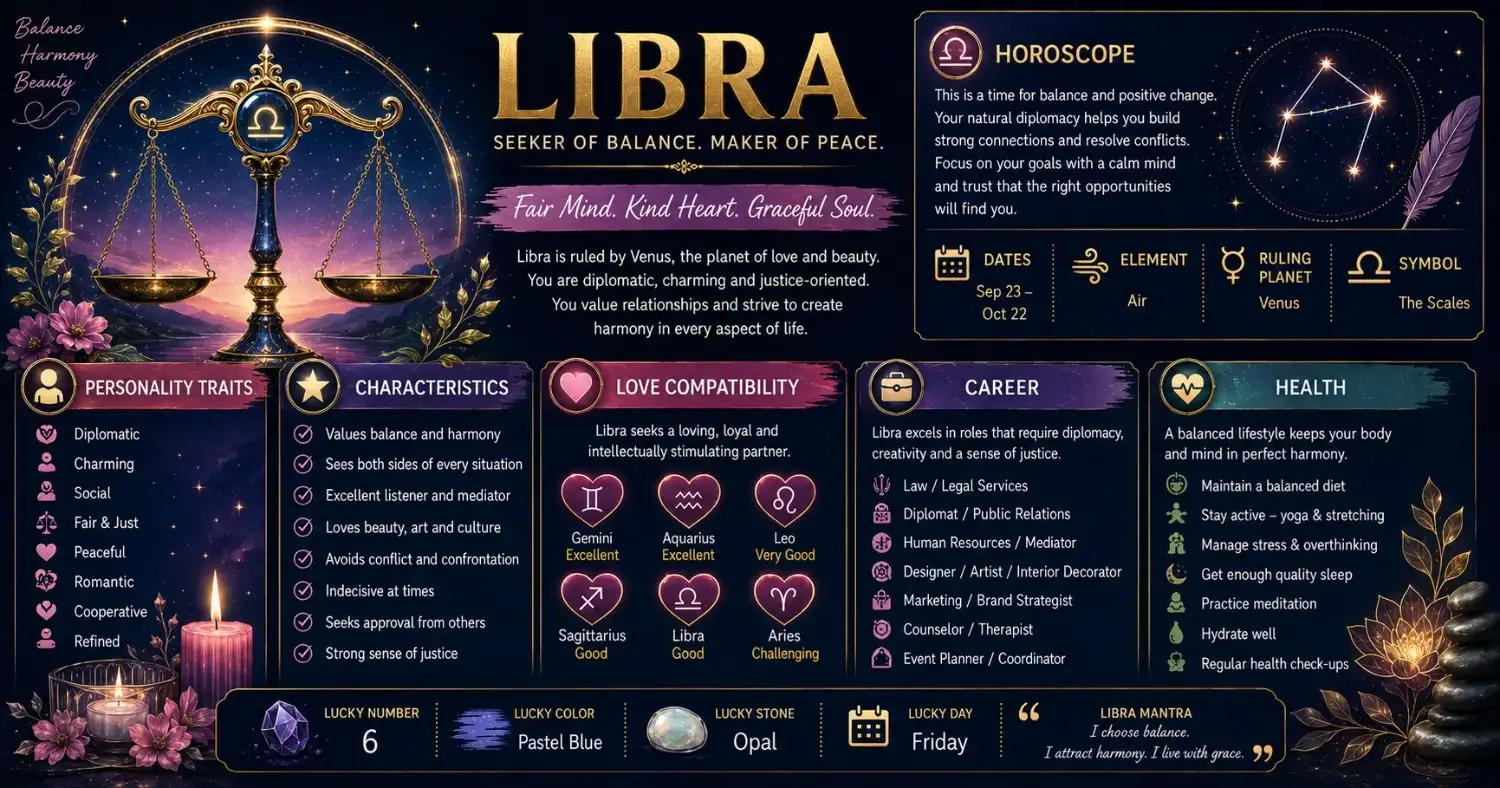
Libra is the odd one out in the zodiac wheel. Every other sign takes the shape of a creature or a person — a ram, a bull, twins, a lion, a virgin, a scorpion, an archer, a goat-fish, a water-bearer, two fish. Libra alone is an object. A tool. A pair of scales.
That single fact has shaped how nearly every language on earth talks about this sign. Where other signs borrow an animal word and move on, Libra forces each culture to reach for its own vocabulary of balance, judgment, and measurement. The result is a sign name that varies more, in flavor, than almost any other in the zodiac — even while the underlying idea, weighing, holds firm across every one of them.
I have read charts for Libra clients from Buenos Aires to Bangkok. I have watched a Delhi client light up when I called her Tula Rashi, watched a Cairo client nod at Mizan, watched a Seoul client correct my pronunciation of Cheonching-jari. The word shifts constantly. The scale never tips.
This guide walks through every major translation of Libra, how to pronounce each one, the cultural weight behind the name, and the astrology underneath all of it. Use it as a reference. Save the tables. Come back when you need them.
Quick Answer: What Does Libra Mean in Other Languages?
Libra means “scales” or “balance” in Latin. Nearly every language on earth keeps that same core idea, but the routes to it differ more than with any other sign:
- They keep the Latin word. Spanish Libra, Portuguese Libra, Romanian Balanță is actually a translation (see below), Indonesian Libra.
- They translate “scales” into their own word. German Waage, Polish Waga, Turkish Terazi, Hebrew Moznayim, Arabic Al-Mizan.
- They borrow the Sanskrit term. Hindi Tula, Thai Tula, Khmer Tolea, Sinhala Thula.
- They build a compound with a “constellation” suffix. Chinese Tiānchèng zuò, Japanese Tenbin-za, Korean Cheonching-jari.
The Western dates stay fixed: September 23 to October 23. The Vedic dates shift: roughly October 17 to November 16. The ruling planet stays Venus everywhere. The element stays Air everywhere. The quality stays Cardinal everywhere.
Now let’s go deeper.
The Root Meaning of Libra: Where the Word Comes From
The English word Libra comes directly from Latin libra, meaning “a pair of scales,” “a balance,” or, in a separate but related sense, a unit of weight — the same libra that gives English its abbreviation “lb” for pound, and gives Italian its currency name lira.
Latin libra likely descends from an earlier Italic root connected to weighing and leveling. Unlike taurus or leo, this word did not travel widely across unrelated language families as a loanword, because it names a concept — an instrument — rather than a single, universally recognized animal. Every culture already possessed a word for “a device that weighs things,” long before astrology arrived to attach a constellation to it. That is the key structural difference between Libra and almost every other sign in this series: translators were not hunting for a shared animal name. They were reaching into their own working vocabulary of trade, justice, and measurement.
English keeps the Latin root in unexpected places. “Equilibrium” carries it directly — aequus (equal) plus libra (balance). “Deliberate” arguably shares the root through a different but related sense of weighing options in the mind. “Calibrate” is unrelated by false cousin but frequently confused with it. Even the British pound sterling’s old symbol, £, descends from libra.
So when you say “I’m a Libra,” you are naming a piece of equipment, not an animal, a person, or a myth-figure. That distinction shapes everything that follows in this guide, because unlike Taurus or Leo, most of the world’s languages did not inherit one ancient word for “scales” — they each built their own, out of their own materials.
Why a Scale? The Origin Story Behind the Symbol
Libra is the newest member of the zodiac in one very specific historical sense, and understanding that history explains why its symbolism feels more abstract than its neighbors.
Babylon split a scorpion in two
Babylonian astronomers originally treated the stars we now call Libra as the outstretched claws of the neighboring constellation, Scorpio. Cuneiform tablets referred to the region as ZIB.BA.AN.NA, roughly “the balance of heaven,” and also, separately, as zibanitu, meaning scales or weighing-instrument. The Babylonians did track a genuine sense of “the scales” here — the sun crossing this stretch of sky lined up with the autumn equinox, the moment of the year when day and night balance exactly.
That equinox link is the origin of everything. The sun entering this stretch of sky meant light and dark stood equal. A scale, holding two pans level, was the most natural image a measuring, trading, tax-collecting civilization could reach for.
Rome finished the split
For centuries after Babylon, Greek astronomers still treated this region as Chelae, “the Claws” of Scorpio, rather than as its own sign. The Romans are usually credited with formalizing the independent constellation of the scales during the late Republic and early Empire, associating it with Roman ideals of justice, law, and the civic order that Rome prided itself on exporting across the Mediterranean. Some sources tie the change specifically to the reign of Augustus, whose court astrologers had reason to flatter an emperor who fashioned himself the bringer of balanced, orderly rule after a century of civil war.
That is the historical oddity worth remembering: Libra is the only sign whose symbol was consciously assigned by a political culture, rather than inherited from folk observation of animals. It is astrology’s most man-made sign.
Egypt weighed the soul
Long before Rome finished the job, Egypt had already built one of history’s most famous images of weighing. In the Egyptian Book of the Dead, the goddess Ma’at, personification of truth, order, and cosmic balance, is represented by a single ostrich feather. At death, the deceased’s heart is placed on one pan of a scale and Ma’at’s feather on the other. Anubis oversees the weighing. If the heart is lighter than the feather, unburdened by wrongdoing, the soul passes on. If it is heavier, it is devoured.
Egyptian religion did not attach this scene to the constellation directly, but the imagery is so close to Libra’s later symbolism that many astrologers treat it as a spiritual ancestor of the sign regardless of formal astronomical lineage: judgment, balance, and the weighing of a life.
Greece gave it a goddess, then took her back
Greek myth generally does not give Libra its own independent story the way it gives Taurus the tale of Europa. Instead, Libra sits in the hand of the neighboring constellation Virgo, read by many classical sources as Astraea or Dike, goddess of justice. Astraea lived among mortals during the Golden Age, holding her scales to measure right and wrong, and fled to the heavens as human wickedness increased, becoming the constellation Virgo while her scales became Libra beside her.
Read that detail again, because it matters astrologically: Libra’s scales are not held by Libra. They are held for someone else, an outside figure who judges, weighs, and administers justice. Libra, in myth, is inseparable from the idea of being evaluated by another. Many practicing astrologers point to exactly this detail to explain why Libra natives are so often described as relational rather than solitary — the symbol itself has no independent figure standing behind it.
Rome gave it Justitia
Roman civic religion later gave Western culture its most enduring image of the scales: Justitia, the blindfolded goddess of justice holding a sword in one hand and a balance in the other. That image, more than the constellation itself, is what most Western viewers picture when they hear the word Libra — and it still stands atop courthouses worldwide.
China saw it differently, twice
Traditional Chinese astronomy divided the sky along a completely separate twenty-eight mansion system and did not group these stars as scales at all. The region fell partly under the mansion Dī (氐), associated with a foundation or root, within the Azure Dragon of the East. Only with the twentieth-century importation of the Western zodiac did Chinese-language horoscope writing adopt a scales-based name for this sign, which is why, as you’ll see below, the modern Chinese term is a careful, recent translation rather than an ancient inherited word — the same pattern found across East Asia for this particular sign more than for any other.
One symbol. One idea — equilibrium, judgment, the crossing point of the year. Four civilizations reached it from different directions, and only Rome, arguably, actually settled on the version of it that survives worldwide today.
Libra in Indian Languages: The Vedic Family
India, once again, holds the deepest and most internally consistent naming tradition outside the Latin-derived world, because Indian languages inherited the concept from a single Sanskrit source and distributed it outward through two language families.
The master table for Indian languages
| Language | Native Script | Romanization | Literal Sense |
|---|---|---|---|
| Sanskrit | तुला | Tulā | Balance, scale, comparison |
| Hindi | तुला राशि | Tula Rashi | Balance sign |
| Marathi | तूळ रास | Tul Raas | Balance sign |
| Gujarati | તુલા રાશિ | Tula Rashi | Balance sign |
| Bengali | তুলা রাশি | Tula Rashi | Balance sign |
| Odia | ତୁଳା ରାଶି | Tula Rashi | Balance sign |
| Assamese | তুলা ৰাশি | Tula Rakhi | Balance sign |
| Punjabi | ਤੁਲਾ | Tula | Balance sign |
| Nepali | तुला राशि | Tula Rashi | Balance sign |
| Kashmiri | تولہٕ | Toluh | Balance sign |
| Tamil | துலாம் / துலா ராசி | Thulaam / Thula Rasi | Balance sign |
| Telugu | తుల రాశి | Tula Rasi | Balance sign |
| Kannada | ತುಲಾ ರಾಶಿ | Tula Rashi | Balance sign |
| Malayalam | തുലാം | Thulaam | Balance sign, seventh month |
| Konkani | तुळा | Tulaa | Balance sign |
| Sinhala | තුලා | Thulā | Balance sign |
| Urdu | برج میزان | Burj-e-Mīzān | House of the Scale |
Sanskrit: Tula, the measure of all things
Tulā (तुला) does not just mean “scale” in the sense of a weighing device. Sanskrit dictionaries extend it to “comparison,” “equivalence,” “resemblance,” and “a standard by which something is judged.” The verbal root tul- means “to lift, to weigh, to compare, to balance.”
Read that carefully, because it is the key to the entire sign in Vedic thought. Tula is not merely an object. It is the act of comparison itself, the process of holding two things up against one another to see which is heavier, worthier, truer. Vedic astrologers lean on precisely this etymology when reading a Tula ascendant: a native compelled, at the level of language itself, to measure, weigh, and compare before committing to anything.
Hindi and the northern languages
North Indian speakers say Tula Rashi (तुला राशि), sometimes shortened simply to Tula. Newspaper horoscope columns across Hindi-speaking India print it without variation, unlike Taurus, whose northern-language names show more phonetic drift. Tula is unusually stable across the entire Hindi-Urdu-Punjabi belt, likely because the Sanskrit word itself is short, phonetically simple, and requires no adaptation for regional pronunciation.
Bengali, Odia, and Assamese all carry the word through with only minor spelling shifts, again showing how little this particular term needed to change as it moved eastward across North India.
Tamil: Thulaam and the Dravidian route
Tamil says துலாம் (Thulaam) or, in fuller astrological phrasing, துலா ராசி (Thula Rasi). Unlike Taurus, which has a genuinely native Dravidian alternative (Idabam), Libra in Tamil does not carry a strongly attested older Dravidian synonym; the Sanskrit borrowing dominates almost completely, a sign of how thoroughly the concept of “the scale sign” entered Tamil astrology directly from northern Sanskrit texts rather than through independent Dravidian folk astronomy.
Tamil astrology, or Jothidam, runs on the sidereal zodiac, so a Tamil speaker who calls himself Thulaam was very likely born in mid-October through mid-November, not late September. The same date gap explained in the Taurus companion piece applies here with equal force, and I will walk through it in detail below.
Telugu and Kannada
Telugu uses తుల రాశి (Tula Rasi). Kannada uses ತುಲಾ ರಾಶಿ (Tula Rashi). Both preserve the Sanskrit nearly intact, with only the expected vowel-length shifts of their respective scripts. Neither language has developed a widely used native compound word for “scale sign” the way some languages developed native words for “bull,” which again reflects how comparatively recent and text-driven this particular sign’s naming history is across the subcontinent.
Malayalam: the calendar month, again
Malayalam repeats the pattern we saw with Taurus. Kerala calls the sign തുലാം (Thulaam), and that same word names the seventh month of the Malayalam solar calendar, running roughly from mid-October to mid-November. A Malayali who says “Thulaam” may mean the zodiac sign, the calendar month, or both simultaneously, exactly as with Edavam for Taurus.
Kerala’s traditional astrologers associate Thulaam with the transition from the intense monsoon season into the drier, more temperate stretch of the year, a seasonal balancing point that mirrors the sign’s core theme even at the level of local agricultural life.
Urdu and the Persian-Arabic route
Urdu diverges from Hindi here exactly as it does for Taurus. Urdu borrows from Arabic through Persian and calls the sign برج میزان (Burj-e-Mīzān). Mīzān is the Arabic word for a balance or scale, discussed further below, and it is one of the most theologically loaded words in the entire language, appearing throughout the Quran in descriptions of divine judgment.
So a Hindi speaker in Lucknow says Tula, and an Urdu speaker in the same city says Mizan, and both mean Libra — but the Urdu term arrives carrying an enormous weight of religious meaning that the Hindi term does not.
The nakshatras inside Tula
Vedic astrology divides each sign into lunar mansions. Libra holds:
- Chitra (last half) — ruled by Mars, symbol a bright jewel or pearl
- Swati (all four quarters) — ruled by Rahu, symbol a young shoot blown by the wind
- Vishakha (first three quarters) — ruled by Jupiter, symbol a decorated archway
Swati sits at the heart of Tula, its symbol a tender plant bending in the wind without breaking — a strikingly literal image of balance under pressure, and one Vedic astrologers cite constantly when describing the adaptable, socially perceptive character of a strong Tula placement.
Libra in European Languages
Europe shows a sharper split for Libra than for almost any other sign. Where Taurus mostly kept a shared bull-word across language families, Libra divides cleanly between languages that kept the Latin word outright and languages that translated the concept into their own vocabulary for scales.
Romance languages
| Language | Name | Pronunciation |
|---|---|---|
| Latin | Libra | LEE-brah |
| Italian | Bilancia | bee-LAHN-cha |
| Spanish | Libra | LEE-brah |
| Portuguese | Libra | LEE-brah |
| French | Balance | bah-LAHNSS |
| Romanian | Balanță | ba-LAHN-tsuh |
| Catalan | Balança | buh-LAHN-suh |
| Galician | Balanza | bah-LAHN-thah |
Italian and French break from Spanish and Portuguese here in a way that has no parallel in the Taurus data. Italian Bilancia and French Balance both translate the concept, deriving from Latin bilanx, literally “two-pan,” (“bi-” two, plus “lanx” a dish or plate) — a slightly different Latin root than libra itself, though closely related and often used interchangeably in classical Latin for weighing devices. Spanish and Portuguese, by contrast, kept the plain word Libra untouched. Romanian, sitting geographically between the two camps, chose the translated form, Balanță, cognate with the Italian and French.
This is worth pausing on: within the same Romance family, descended from the same Latin, three different naming strategies survive side by side. It is the clearest evidence in this entire subject that scales, unlike bulls, gave every culture a genuine choice between keeping an old word and reaching for a new one.
Germanic languages
| Language | Name | Literal Meaning |
|---|---|---|
| German | Waage | Scale, balance |
| Dutch | Weegschaal | Weighing-scale |
| Danish | Vægten | The Scale |
| Norwegian | Vekten | The Scale |
| Swedish | Vågen | The Scale |
| Icelandic | Vogin | The Scale |
| Afrikaans | Weegskaal | Weighing-scale |
Germanic languages show none of the split found in the Romance family. Every one of them independently translated the concept using their own word for a weighing scale, built from the same ancient Germanic root that gives English the verb “to weigh.” German Waage and Dutch Weegschaal both descend from Proto-Germanic *wēgan, “to move, to weigh.” Not a single Germanic language kept the bare Latin Libra as its everyday astrological term, which stands in real contrast to how several Germanic languages behave with other signs.
Slavic languages
| Language | Name | Romanization |
|---|---|---|
| Russian | Весы | Vesy |
| Ukrainian | Терези | Terezy |
| Belarusian | Шалі | Shali |
| Bulgarian | Везни | Vezni |
| Polish | Waga | Vaga |
| Czech | Váhy | VAH-hi |
| Slovak | Váhy | VAH-hi |
| Serbian | Вага / Vaga | Vaga |
| Croatian | Vaga | Vaga |
| Slovenian | Tehtnica | TEKH-tnee-tsah |
| Macedonian | Вага | Vaga |
Slavic languages, like their Germanic neighbors, translate the concept nearly universally rather than borrowing Latin. Russian Весы (Vesy) is simply the plural noun for “scales” as a household or market object. Polish, Czech, Slovak, and most South Slavic languages converge on cognates of Vaga/Váhy, from a shared Slavic root for weighing. Ukrainian’s Терези (Terezy) stands apart, drawn from a different root connected to the physical mechanism of a balance beam, closer in feeling to the Romance bilanx family than to its Slavic neighbors.
Baltic, Celtic, and other European branches
| Language | Name | Notes |
|---|---|---|
| Lithuanian | Svarstyklės | Scales, a weighing device |
| Latvian | Svari | Scales |
| Estonian | Kaalud | Scales |
| Finnish | Vaaka | Scale, balance |
| Hungarian | Mérleg | Scale, balance sheet |
| Greek | Ζυγός (Zygós) | Yoke, balance, scale |
| Albanian | Peshorja | The scale |
| Basque | Balantza | The scale (from Romance) |
| Irish | An Mheá | The scale |
| Scottish Gaelic | Am Meidh | The scale |
| Welsh | Y Fantol | The scale |
| Maltese | Il-Miżien | The scale |
| Armenian | Կշեռք (Kshery’k) | Scale, weighing beam |
| Georgian | სასწორი (Saststsori) | The scale |
| Turkish | Terazi | Scale, balance |
Greek deserves special attention, since Greek is where the astrological tradition itself passed into Latin in the first place. Modern Greek uses Ζυγός (Zygós), whose root sense is “yoke” — the wooden crossbar that joins two oxen, or, by extension, any device that joins and balances two things against each other. That same root, incidentally, gives English the scientific prefix “zygo-,” as in “zygote,” the joining of two cells.
Finnish and Estonian, both Finno-Ugric rather than Indo-European, and Hungarian alongside them, each independently arrived at their own native word for a weighing scale rather than borrowing anything from Latin — the same pattern seen with Taurus, where language family made essentially no difference to whether a culture reached for the shared image.
Libra in Middle Eastern and Semitic Languages
The Middle East gives Libra its heaviest layer of meaning, because in this region the scale is not only an astrological symbol but one of the central images of scripture and law.
| Language | Native Script | Romanization | Meaning |
|---|---|---|---|
| Arabic | برج الميزان | Burj al-Mīzān | House of the Scale |
| Hebrew | מזל מאזניים | Mazal Moznayim | Constellation of the Scales |
| Persian (Farsi) | میزان | Mizān | Scale, balance |
| Turkish | Terazi Burcu | Terazi Burjoo | Scale sign |
| Kurdish | Terazû | Terazu | Scale |
| Pashto | تله | Tala | Scale |
| Azerbaijani | Tərəzi | Tarazi | Scale |
| Aramaic | מוזניא | Mozanya | Scales |
| Amharic | ሚዛን | Mīzān | Scale, balance |
Arabic: Al-Mizan
Arabic names the sign الميزان (al-Mīzān), and the full astrological phrase is برج الميزان (burj al-mīzān), “house of the scale.”
This word carries enormous theological weight that goes far beyond astrology. Al-Mīzān appears repeatedly in the Quran as the instrument of divine justice, most directly in Surah Ar-Rahman, which describes the balance that God has set up so that people “not transgress in the balance.” An entire sura is named Al-Mizan in some classical commentaries for this reason. In Islamic eschatology, a person’s deeds are weighed on the Day of Judgment using this same word.
That means Arabic-speaking astrologers, and Arabic speakers generally, encounter the word mizan constantly outside any astrological context, in sermons, in legal writing, in everyday moral language (“adl wal mizan,” justice and balance). Few sign names in this entire twelve-sign series carry as much everyday, non-astrological cultural charge as this one.
Hebrew: Mazal Moznayim
Hebrew says מזל מאזניים (Mazal Moznayim). Mazal, as covered in the Taurus companion piece, means constellation, luck, or fortune. Moznayim (מאזניים) is the plural Hebrew word for scales — grammatically plural because a scale, by nature, has two pans, and Hebrew treats such paired objects as inherently dual, the same way it treats eyes, hands, and shoes.
Jewish tradition links Libra to the Hebrew month of Tishrei, the month that contains Rosh Hashanah and Yom Kippur — the Days of Awe, during which, in traditional teaching, a person’s deeds from the previous year are weighed and their fate for the coming year is inscribed. The astrological symbolism and the religious calendar align almost perfectly here, arguably more tightly than for any other sign in the zodiac.
Persian: Mizan
Persian uses میزان (Mizān) directly, the same root shared with Arabic and Hebrew across this ancient Semitic-adjacent vocabulary of weighing. Mizan is also the name of the seventh month of the Iranian solar calendar, running from late September to late October, mapping almost exactly onto Western Libra dates. As with Malayalam Thulaam and Thai Tula (below), Iran is another example of a culture where the zodiac sign and the calendar month are simply the same word.
Turkish: Terazi
Turkish says Terazi Burcu. Terazi is a native Turkic word for a balance scale, distinct from the Arabic mizan despite the cultural overlap between the two traditions, and it remains the ordinary word Turks use for a bathroom scale or a kitchen scale today, with no special astrological connotation required.
Libra in East Asian Languages
East Asia’s names for Libra are, without exception, careful modern compounds. As the origin-story section explained, none of these cultures inherited an ancient “scales constellation” of their own; they built these names during the nineteenth and twentieth century adoption of Western astrology, and it shows in how transparently descriptive each term is.
| Language | Native Script | Romanization | Literal Translation |
|---|---|---|---|
| Chinese (Mandarin) | 天秤座 | Tiānchèng zuò | Heavenly Scale constellation |
| Chinese (Cantonese) | 天秤座 | Tin1 ching4 zo6 | Heavenly Scale constellation |
| Japanese | 天秤座 | Tenbin-za | Balance-scale constellation |
| Korean | 천칭자리 | Cheonching-jari | Heavenly scale place |
| Vietnamese | Thiên Bình | Thiên Bình | Heavenly Balance |
| Mongolian | Жинлүүр | Jinluur | Scale, balance |
Chinese: the Heavenly Scale
Mandarin says 天秤座 (Tiānchèng zuò). Break it down: 天 (tiān) means heaven or sky, 秤 (chèng) means a steelyard balance or scale, and 座 (zuò) means seat or constellation, the same suffix used across the whole Chinese zodiac-sign system.
Unlike Taurus, where Chinese chose a culturally loaded word (“golden”), Libra’s Chinese name is almost clinically descriptive: literally, “the sky’s scale constellation.” There is no folk legend behind it, no wealth association, no borrowed mythology — a direct, functional translation, consistent with the sign’s genuinely recent astronomical formalization even in the Western tradition it was translated from.
Traditional Chinese astronomy, as noted above, covered this stretch of sky under the mansion Dī (氐) within the Azure Dragon of the East, an entirely separate conceptual system that predates the modern zodiac import by well over a thousand years and has no scale imagery in it at all.
Japanese: Tenbin-za
Japanese writes 天秤座 and reads it てんびんざ (Tenbin-za), using the same characters as Chinese but a native Japanese reading for the first two. 天秤 (tenbin) is the everyday Japanese word for a balance scale, still used today for old-fashioned two-pan kitchen and apothecary scales, and 座 (za) again marks the constellation.
The word tenbin also survives in ordinary modern Japanese idiom: てんびんにかける (tenbin ni kakeru), “to put on the scale,” meaning to weigh two options against each other — a phrase any Japanese speaker uses in daily conversation, with or without any thought of the zodiac.
Korean: Cheonching-jari
Korean says 천칭자리 (Cheonching-jari). 천칭 (cheonching) is a Sino-Korean compound for a balance scale, built from the same “heaven” and “scale” characters used in Chinese and Japanese. 자리 (jari) is the pure native Korean word for “place” or “seat,” the same suffix Korean attaches to every constellation name in its system.
Vietnamese: Thiên Bình
Vietnamese says Thiên Bình, the Sino-Vietnamese reading of characters meaning “heavenly balance” or “heavenly peace/level” — 天 (heaven) and 平/秤 depending on the specific historical spelling tradition, both converging on the sense of level, balanced, or even. Vietnamese, like Korean, drops the “constellation” suffix entirely in casual use.
Libra in Southeast Asian Languages
As with Taurus, Southeast Asia inherited its zodiac vocabulary from India rather than from Europe or China, and the Libra names show it clearly.
| Language | Native Script | Romanization | Source |
|---|---|---|---|
| Thai | ราศีตุลย์ | Rasi Tulaya | Sanskrit Tula |
| Khmer | រាសីតុលា | Reasei Tolea | Sanskrit Tula |
| Lao | ລາສີຕຸນ | Lasi Tun | Sanskrit Tula |
| Burmese | တူလာရာသီ | Tula Yathi | Sanskrit Tula |
| Indonesian | Libra / Neraca | Libra | Latin / native “scale” |
| Malay | Libra / Neraca | Libra | Latin / native “scale” |
| Filipino (Tagalog) | Libra / Timbangan | Libra | Latin via Spanish |
| Javanese | Libra | Libra | Latin |
Thai and the calendar connection
Thai says ราศีตุลย์ (Rasi Tulaya), drawing directly on the Sanskrit Tula filtered through Thai phonology. As with Phruetsopha for Taurus, this word also anchors a calendar month: the Thai word for October, ตุลาคม (Tulakhom), shares the same root, so Thai speakers use a version of “Libra” every time they write the date on a calendar in autumn.
Khmer mirrors this precisely, with Cambodian October, តុលា (Tola), sharing the same Sanskrit-derived root as the zodiac sign តុលា (Tolea).
Indonesian and Malay
Indonesia and Malaysia mostly keep Libra as borrowed directly from Dutch and English colonial contact, exactly as with Taurus. Some writers use Neraca, the Malay/Indonesian word for a weighing scale, particularly a traditional balance-beam scale still associated with traditional markets, but it functions as a plain-language gloss rather than a standard astrological term.
Filipino
Filipino keeps Libra from Spanish colonial contact, identical in spelling and pronunciation to the Spanish original, since Spanish itself kept the bare Latin word. Casual speech occasionally uses Timbangan, the Tagalog word for a weighing scale, as an explanatory gloss rather than a formal replacement.
Libra in African Languages
African-language astrology terminology, as with Taurus, shows the widest variation of any region, shaped by whichever colonial or trade language carried astrology into a given community.
| Language | Name | Literal Meaning |
|---|---|---|
| Swahili | Mizani | Scale, balance |
| Amharic | ሚዛን | Scale, balance |
| Zulu | Isikali | Scale, weighing instrument |
| Xhosa | Isikali | Scale, weighing instrument |
| Yoruba | Ìwọ̀n-Ìdíwọ̀n | Measure/weight-standard |
| Hausa | Ma’auni | Scale, balance |
| Shona | Chiyereso | Weighing device |
| Somali | Miisaan | Scale, balance |
| Wolof | Balañ | Balance, scale (from French) |
Swahili’s Mizani is a direct borrowing from Arabic mizan, reflecting centuries of Indian Ocean trade contact and Islamic influence along the East African coast — the same word, essentially, that an Arabic or Persian speaker would recognize immediately. Somali’s Miisaan follows the identical Arabic root.
Hausa’s Ma’auni likewise derives from Arabic, unsurprising given Hausa’s long history of Islamic scholarship and script. Zulu and Xhosa Isikali, by contrast, is a native Nguni-Bantu construction built from the verb root for weighing or measuring, with no Arabic or European borrowing involved, similar in spirit to how Zulu built its own native word for Taurus’s bull rather than borrowing one.
As with the Taurus article, a caution: many African languages lack a single standardized astrological term for Libra specifically. Writers frequently translate descriptively on the spot. Check regional usage before publishing rather than assuming a fixed standard exists.
Libra in Sign Languages, Constructed Languages, and Symbols
The astrological glyph
Libra uses the symbol ♎, encoded in Unicode as U+264E. The glyph shows a horizontal line resting on a base, sometimes read as a stylized scale-beam balanced on a support, and sometimes read, in an older and quite different interpretation, as a rising or setting sun on the horizon — a nod to Libra marking the autumn equinox, the point at which day and night themselves come into balance.
Both readings point to the same underlying idea. Whether you see a beam or a sunset, the glyph is the only sign symbol in the whole zodiac that depicts neither an animal nor a person, which fits everything the origin story above already told us about this sign’s unusually abstract, man-made character.
Esperanto and constructed languages
Esperanto says Pesilo, built transparently from pesi, “to weigh.” Interlingua says Balancia, following the Romance translated form rather than the bare Latin. Constructed languages consistently favor a transparent, descriptive coinage for Libra rather than reaching for the original Latin word — itself a small piece of evidence for how much less “sticky” the bare word libra is across languages compared to an animal name like taurus.
American Sign Language
As with Taurus, ASL has no single codified sign recognized universally for the zodiac symbol Libra. Deaf astrology communities commonly use a two-handed sign miming a hand-held balance scale, tipping side to side, sometimes combined with fingerspelling for clarity in formal contexts. Regional variation exists; check with local Deaf communities rather than assuming a single standard.
How to Say “I Am a Libra” in 25 Languages
Here is the phrase most people actually came here for.
| Language | Phrase |
|---|---|
| Spanish | Soy Libra |
| French | Je suis Balance |
| German | Ich bin Waage |
| Italian | Sono della Bilancia |
| Portuguese | Sou de Libra |
| Dutch | Ik ben Weegschaal |
| Russian | Я Весы (Ya Vesy) |
| Polish | Jestem Wagą |
| Greek | Είμαι Ζυγός (Eímai Zygós) |
| Turkish | Ben Terazi burcuyum |
| Arabic | أنا برج الميزان (Ana burj al-mīzān) |
| Hebrew | אני מזל מאזניים (Ani mazal moznayim) |
| Persian | من متولد میزان هستم (Man motavalled-e mizān hastam) |
| Hindi | मेरी राशि तुला है (Meri rashi Tula hai) |
| Bengali | আমার রাশি তুলা (Amar rashi Tula) |
| Tamil | என் ராசி துலாம் (En rasi Thulaam) |
| Telugu | నా రాశి తుల (Naa rasi Tula) |
| Kannada | ನನ್ನ ರಾಶಿ ತುಲಾ (Nanna rashi Tula) |
| Malayalam | എന്റെ രാശി തുലാം (Ente rashi Thulaam) |
| Urdu | میرا برج میزان ہے (Mera burj Mizan hai) |
| Chinese | 我是天秤座 (Wǒ shì tiānchèng zuò) |
| Japanese | 私は天秤座です (Watashi wa tenbin-za desu) |
| Korean | 저는 천칭자리예요 (Jeoneun cheonching-jari-yeyo) |
| Thai | ฉันเป็นราศีตุลย์ (Chan pen rasi tulaya) |
| Vietnamese | Tôi là cung Thiên Bình |
| Swahili | Mimi ni Mizani |
The Date Problem: Why Libra Starts on Different Days
This is the same structural confusion covered in the Taurus companion piece, and it applies to Libra with equal force.
Western (tropical) astrology
Western astrology uses the tropical zodiac, anchored to the seasons rather than the visible stars. The tropical zodiac places Libra at the exact point of the autumn equinox in the northern hemisphere — the sun enters Libra the moment day and night stand equal, which is a genuinely elegant, if largely coincidental, match between the sign’s symbolism and its actual astronomical placement. Western Libra runs from about September 23 to October 23 every year, shifting by a day depending on the specific year and your time zone. If you were born right at the edges of that window, check your exact birth time; those are cusp dates.
Vedic (sidereal) astrology
Indian astrology uses the sidereal zodiac, anchored to the fixed stars rather than the equinox. Because of the roughly 24-degree drift caused by the precession of the equinoxes over two thousand years, Vedic Tula runs from approximately October 17 to November 16.
So someone born on October 10 is a Libra in Western astrology and a Virgo (Kanya) in Vedic astrology. Neither calculation is wrong; the two systems are measuring genuinely different reference points in the sky.
Why both systems still work
Tropical astrology tracks the sun’s relationship to the seasons and describes psychological patterns tied to the time of year, which is precisely why Libra’s tropical placement lines up so neatly with the actual equinox. Sidereal astrology tracks the sun’s position against the fixed background stars and anchors a predictive system built on planetary periods. I use both in practice and explain both to clients. If your Western sign and your Vedic sign disagree, you have not encountered an error. You are looking at two different, equally coherent, coordinate systems layered over the same sky.
The constellation boundaries
The International Astronomical Union’s 1930 constellation boundaries add a third, purely astronomical layer to this picture. Under those boundaries, the sun actually transits the visible constellation Libra from roughly October 31 to November 23, later still than either the tropical or the sidereal astrological date ranges. This is simply a reminder that astrology’s twelve equal thirty-degree divisions have never precisely matched the visible, unevenly sized constellations; that mismatch is not a modern discovery, and it is not unique to Libra, even though headlines occasionally treat it as breaking news.
What Libra Actually Means: The Astrology Underneath the Words
Names change. The astrological substance underneath stays remarkably stable across every tradition surveyed above.
The core signature
- Element: Air
- Modality: Cardinal
- Ruling planet: Venus (Shukra in Vedic astrology)
- Symbol: The Scales
- Polarity: Active, yang, masculine
- House correspondence: Seventh house
- Exaltation: Saturn, exalted at 20 degrees Libra
- Fall (debilitation): The Sun
- Detriment: Mars
- Body rulership: Kidneys, lower back, skin, adrenal glands
- Tarot correspondence: Justice
- Colors: Pastel blue, soft pink, pale green
- Stones: Opal, lapis lazuli, jade
- Season: The start of autumn in the northern hemisphere
Cardinal Air, explained properly
Cardinal signs start things. Air signs deal in ideas, communication, and relationship rather than raw matter or feeling. Combine them, and Libra initiates through connection. Where Aries, the zodiac’s other cardinal sign most often compared to it, starts things through direct assertion of the self, Libra starts things by bringing another person into the picture. A Libra does not simply begin; a Libra begins a negotiation, a partnership, a conversation, a comparison between two possibilities.
That single combination generates nearly every trait horoscope columns attach to this sign worldwide. Diplomacy, indecision, charm, a hunger for fairness, and an instinct to see every side of an argument all flow directly from cardinal air.
Venus rules through the mind, not the body
Venus rules both Libra and Taurus, and, as the Taurus companion piece notes, the expression differs completely between the two.
Taurus runs Venus through earth: touch, taste, texture, physical comfort, and material accumulation. Libra runs Venus through air: aesthetics, ideas of beauty, social grace, fairness, and idealized partnership. Libra Venus wants to discuss the thing, frame it elegantly, and agree on its value with another person, rather than simply hold it.
Vedic astrology’s Shukra carries the identical dual character across both signs, but classical Vedic texts specifically praise a well-placed Shukra in Tula for producing diplomacy, artistic refinement, and success through partnership and negotiation, echoing the Western reading with striking precision.
Saturn’s exaltation matters enormously
Saturn reaches its point of greatest strength in Libra, and both Western and Vedic traditions agree on this placement, which is a genuinely rare point of total cross-system consensus.
Practically, that pairing means Libra tempers Venus’s love of pleasure and ease with Saturn’s demand for structure, fairness, and consequence. This is precisely why Libra, more than any air sign, gets so strongly associated with formal justice, contracts, marriage, and law: Venus wants the relationship, and exalted Saturn insists that the relationship be built on binding, durable, equitable terms. The scale itself, remember, is an instrument of law before it is anything else.
The Sun’s fall is just as telling
The Sun is traditionally placed in its fall, its weakest dignified position, in Libra. Read symbolically, that fits the sign’s entire character: Libra is the sign least comfortable asserting a single, undivided, self-centered will. Where the Sun wants to shine as one thing, Libra instinctively looks for the other person, the second pan of the scale, before deciding what it thinks.
Core strengths
Libra brings fairness into rooms that badly need it. The seventh house governs partnership, marriage, and open enemies alike — every kind of “other” a person must directly relate to — and Libra governs the seventh house naturally, giving the sign an instinctive fluency in negotiation and compromise.
Libra creates beauty through composition and arrangement rather than through Taurus’s tactile craft. Design, architecture, diplomacy, law, and the visual and social arts all suit the sign strongly.
Libra offers genuine charm without cynicism, at its best. A well-integrated Libra can disagree with someone and still leave them feeling respected, a genuinely rare social skill.
Libra pursues justice as a lived value, not an abstraction. Exalted Saturn here means a strong Libra chart often produces people who work seriously, and effectively, within legal, diplomatic, or mediating professions.
Core challenges
Libra can avoid decisions past the point of usefulness. Cardinal energy wants to start something, but the air element keeps generating additional perspectives to weigh, and the two impulses can stall each other out entirely, producing the classic “Libra can’t choose a restaurant” cliché that, like most clichés, has a real structural root.
Libra can prioritize surface harmony over honest friction. A relationship kept peaceful by constant accommodation is not the same as a relationship that has actually resolved its disagreements, and Libra sometimes confuses the two.
Libra can define itself through its partnerships rather than independently. The seventh-house emphasis on “the other” cuts both ways: taken too far, a Libra’s sense of identity becomes entirely relational, dependent on whoever currently occupies the other side of the scale.
Libra can mistake being liked for being right. Venus wants approval; the fall of the Sun here weakens the sign’s confidence in simply asserting its own singular judgment without external validation.
Does the meaning change by culture?
My honest professional answer, after two decades of cross-cultural practice, matches what I wrote for Taurus: the tone shifts, the substance does not.
Western pop astrology emphasizes personality and relationships. It reads Libra as charming, indecisive, and partnership-obsessed.
Vedic astrology emphasizes life outcomes through the lens of Saturn’s exaltation and Shukra’s rulership, reading a strong Tula lagna through marriage timing, legal success, and diplomatic career paths, often with more weight given to justice and law than Western pop astrology typically assigns.
Arabic and Persian-language traditional astrology inherits the enormous religious charge carried by the word mizan itself, so traditional writing in these languages leans unusually heavily on the sign’s connection to divine judgment and moral accounting, a layer of meaning with no exact equivalent in the English-language tradition.
Chinese-language horoscope media, given the sign’s late and purely descriptive importation, tend to treat Tiānchèng zuò with less inherited symbolic freight than they attach to a sign like Taurus, focusing instead on the straightforward Western personality-trait content translated wholesale from English-language sources.
Different emphasis. Same instrument. The scale does not stop weighing when the word for it changes.
Star Names Inside Libra Across Languages
Libra’s own stars carry a naming history that is, fittingly, almost entirely about claws rather than scales — a linguistic fossil of the sign’s Babylonian origin as part of Scorpio.
Zubeneschamali and Zubenelgenubi, the two claws
| Culture | Name | Meaning |
|---|---|---|
| Arabic | الزبانى الشمالية (al-Zubānā ash-Shamāliyyah) | The Northern Claw |
| Arabic | الزبانى الجنوبية (al-Zubānā al-Janūbiyyah) | The Southern Claw |
| Babylonian | Zibanitu | The scale, the balance |
| Chinese | 氐宿 (Dī xiù) | The Root/Foundation mansion |
| Greek | Χηλαί (Chēlai) | The Claws (of Scorpio) |
The sign’s two brightest stars, formally named Zubeneschamali and Zubenelgenubi, both preserve an Arabic phrase that literally means “claw,” a direct linguistic holdover from the era before Rome split the scales away from Scorpio, discussed in the origin-story section above. Interestingly, Zubeneschamali is one of the very few stars in the entire sky reported by some observers throughout history as having a faintly greenish tint, though modern measurement finds it to be an ordinary blue-white star; the old reports of a green star linger in astronomical folklore regardless.
The Babylonian Zibanitu, meaning “the scale” directly, is actually the older and more thematically consistent name of the two traditions layered onto this stretch of sky — proof that the balance imagery and the claw imagery coexisted for centuries before Rome finally chose the scale and let the claws fade into star-name trivia.
Common Mistakes and Mistranslations to Avoid
Mistake 1: Assuming every language kept the word “Libra” itself
Unlike Taurus’s bull, which nearly every language kept in some recognizable phonetic form, Libra’s scale concept was translated outright by the majority of the world’s languages. Do not assume a cognate of “Libra” exists in German, Russian, or Chinese; it does not.
Mistake 2: Confusing Arabic Mizan with a purely secular term
Mizan carries deep Quranic and legal weight in Arabic. Treating it as a flat, purely astronomical translation, with no acknowledgment of its religious resonance, will read as tone-deaf to many Arabic-speaking readers.
Mistake 3: Assuming Vedic Tula and Western Libra cover the same dates
They do not. The gap runs about three and a half weeks, exactly as with every other sign pair discussed in this series. Always confirm which zodiac system a person means before assuming their dates.
Mistake 4: Treating the Italian/French split as an error
Italian Bilancia and French Balance are correct, deliberate translations, not mistakes or simplifications of the “real” Latin word. Spanish and Portuguese kept the Latin term; Italian and French did not. Both choices are linguistically valid and long-established.
Mistake 5: Rendering the sign as a literal “weight” unit
Libra the Latin word can also mean a unit of weight, the ancestor of the pound. In some machine-translation contexts, “Libra” gets rendered as a currency or measurement unit rather than the zodiac sign. Always verify context, especially in financial or historical text.
Mistake 6: Machine-translating astrological terms
Translation engines routinely render Libra as the cryptocurrency project once named “Libra” (later Diem), or as the historical Roman currency, in commercial or financial contexts. Always verify with a native speaker for published astrological writing.
Frequently Asked Questions
What does Libra mean in English?
Libra means “the Scales” or “the Balance.” English borrowed the word directly from Latin, where libra names both the weighing instrument and a related unit of weight, the ancestor of the pound.
What is Libra called in Hindi?
Hindi calls Libra तुला राशि (Tula Rashi), meaning “balance sign.” The word comes from Sanskrit Tulā, which also means comparison, equivalence, and the act of weighing something against a standard.
What is Libra in Tamil?
Tamil calls Libra துலாம் (Thulaam) or, in fuller phrasing, துலா ராசி (Thula Rasi), both drawn directly from the Sanskrit Tula with no strongly attested independent Dravidian alternative.
What is Libra called in Malayalam?
Malayalam calls Libra തുലാം (Thulaam). The same word names the seventh month of the Malayalam calendar, which runs from roughly mid-October to mid-November.
What is Libra in Arabic?
Arabic calls Libra برج الميزان (Burj al-Mīzān), meaning “house of the scale.” The word mizan also appears throughout the Quran as the instrument of divine justice.
What is Libra in Chinese?
Chinese calls Libra 天秤座 (Tiānchèng zuò), which translates literally as “Heavenly Scale constellation.” Traditional Chinese astronomy, prior to the modern zodiac’s arrival, covered this part of the sky under an entirely different mansion system with no scale imagery.
What is Libra in Japanese?
Japanese calls Libra 天秤座, read as てんびんざ (Tenbin-za). Tenbin is the everyday Japanese word for a balance scale and still appears in modern idioms about weighing two choices against each other.
What is Libra in Korean?
Korean calls Libra 천칭자리 (Cheonching-jari). Cheonching is a Sino-Korean compound for a balance scale, and jari is the native Korean word for “place,” used across all Korean constellation names.
What is the Urdu name for Libra?
Urdu calls Libra برج میزان (Burj-e-Mīzān). Urdu borrowed the term from Arabic through Persian, unlike Hindi, which took its term from Sanskrit.
Does Libra mean the same thing in every language?
Broadly, yes, though the naming strategies vary more than with most signs. Some languages kept the Latin word, some translated the concept into a native word for scales, and some borrowed the Sanskrit or Arabic term. The astrological meaning stays consistent throughout: cardinal air, ruled by Venus, associated with balance, partnership, fairness, and social diplomacy.
Why do Vedic and Western Libra dates differ?
Western astrology uses the tropical zodiac, tied to the equinoxes, giving dates of September 23 to October 23. Vedic astrology uses the sidereal zodiac, tied to the fixed stars, giving dates of roughly October 17 to November 16. The gap results from the precession of the equinoxes over roughly two thousand years, exactly as with every other sign.
What is the Libra symbol called?
The symbol is ♎, a horizontal beam resting on a base. It is read either as a stylized scale-beam or, in an older interpretation, as a rising or setting sun on the horizon, tying the glyph to the sign’s placement at the autumn equinox. Unicode encodes it as U+264E.
Which planet rules Libra in every tradition?
Venus rules Libra in Western astrology. Shukra, the Vedic name for Venus, rules Tula in Indian astrology. Hellenistic, Arabic, and medieval European traditions all agree on this rulership.
What does Tula mean in Sanskrit?
Tulā means scale or balance, but it also means comparison, equivalence, and resemblance. The verbal root tul- means to lift, weigh, or compare, linking the sign linguistically to the very act of judgment rather than simply to a physical object.
Is Libra connected to the constellation Scorpio?
Historically, yes. Ancient Babylonian and early Greek astronomy treated the stars of Libra as the outstretched claws of Scorpio, and Libra’s two brightest stars, Zubeneschamali and Zubenelgenubi, still carry Arabic names meaning “the northern claw” and “the southern claw” as a linguistic fossil of that earlier arrangement.
What is Libra in Thai?
Thai calls Libra ราศีตุลย์ (Rasi Tulaya), borrowed from Sanskrit Tula. The Thai word for October, ตุลาคม (Tulakhom), comes from the same root.
Which planet is exalted in Libra?
Saturn is exalted in Libra at 20 degrees, a placement recognized in both Western and Vedic astrology. The Sun, by contrast, is traditionally considered in its fall, its weakest dignified position, in the same sign.
Key Takeaways
Libra translates less uniformly than almost any other sign in the zodiac, and that inconsistency is itself the most revealing fact about the sign.
Libra is the only member of the zodiac symbolized by an object rather than a living creature, and it is the only sign whose modern astronomical form was, by most historical accounts, deliberately assembled by a political culture rather than inherited whole from folk observation of the stars. Every other sign gave translators a shared animal to borrow, adapt, or keep. Libra gave every language only a concept, weighing, judgment, balance, and left each culture to build its own word for the instrument that performs it.
Remember these essentials:
- Libra means “scales” or “balance” in Latin, and most languages translate the concept rather than borrowing the Latin word outright.
- Naming strategies split more evenly here than for any other sign: Latin retention, native translation, Sanskrit borrowing, and constellation compounds all appear across major world languages.
- India, Southeast Asia, and Sri Lanka use forms of Sanskrit Tula.
- Europe splits sharply, even within the same language family, between keeping Latin Libra and translating it into a native scale-word.
- The Middle East uses the Semitic root mizan, one of the most religiously loaded terms in this entire twelve-sign series.
- East Asia built careful, modern descriptive compounds, reflecting the sign’s genuinely late formal arrival even in its Western homeland.
- Venus rules the sign in every tradition.
- Saturn reaches exaltation here in both Western and Vedic astrology, a rare point of full cross-system agreement.
- Western dates run September 23 to October 23. Vedic dates run roughly October 17 to November 16.
Whatever word your language uses, the sign describes the same underlying process: two things placed on two pans, and a mind, or a culture, or a legal system, deciding which side settles lower.
The scale does not rush to a verdict. The scale waits until both sides are honestly accounted for.
This guide covers astrological tradition and comparative linguistics. Astrology is a symbolic and cultural system, not a science. Use it for reflection and self-understanding rather than for medical, financial, or legal decisions.