
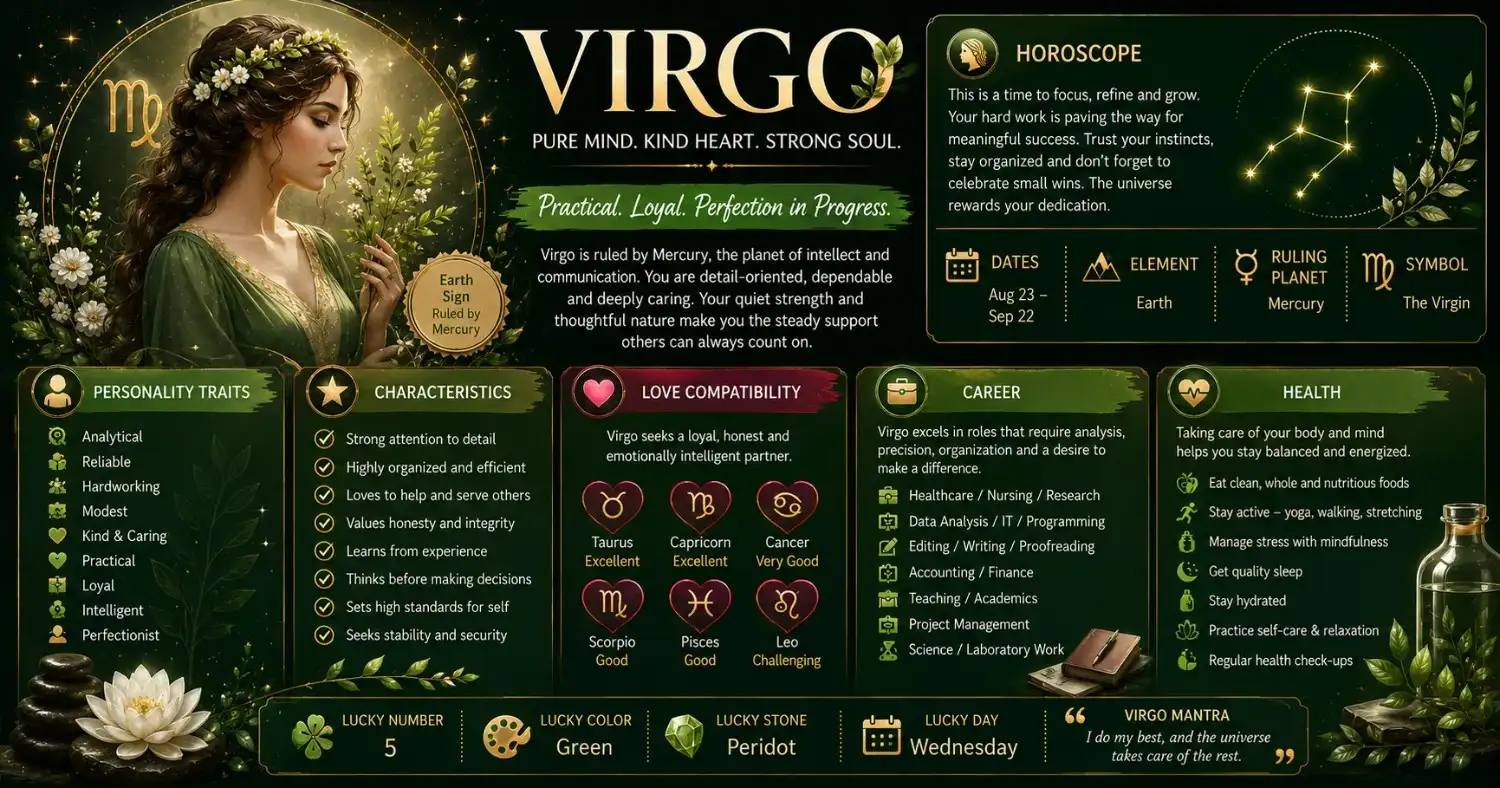
Virgo is the zodiac’s quiet worker. While other signs get named after roaring lions or armored fish, Virgo gets a woman standing in a field with a sheaf of wheat in her arms. That image has survived, almost unchanged, for four thousand years, across dozens of language families that never once compared notes.
I have explained this sign to a client in Chennai who calls it Kanni, to a colleague in Warsaw who calls it Panna, and to a student in Tokyo who calls it Otome-za. Three completely different sound systems. One completely consistent picture: a young woman, grain in her hands, standing at the edge of harvest.
This guide walks through every major translation of Virgo, how to pronounce each one, where the words came from, and what the sign actually means once you strip the language away. Use the tables as a reference. Return to them whenever you need a name, a date, or a fact you can trust.
Quick Answer: What Does Virgo Mean in Other Languages?
Virgo means “virgin” or “maiden” in Latin. Most languages preserve that core image — a young, unmarried woman — though the exact word varies by culture. Four naming patterns show up again and again:
- They keep the Latin word. Spanish and Filipino both use Virgo directly, English keeps it unchanged.
- They translate “maiden” or “virgin” into their own word. German Jungfrau, Polish Panna, Greek Parthénos, Hebrew Betulah.
- They borrow the Sanskrit term for “girl” or “daughter.” Hindi Kanya, Thai Kan, Khmer Kanha, Tamil Kanni.
- They name it after the harvest symbol instead of the woman. Turkish Başak means “ear of grain,” not “maiden” at all — the only major language that swaps the person for the object in her hands.
Western astrology fixes the dates at August 23 to September 22. Vedic astrology shifts them to roughly September 17 to October 17. The ruling planet is Mercury everywhere. The element is Earth everywhere. The modality is Mutable everywhere.
Let’s go through the details properly.
The Root Meaning of Virgo: Where the Word Comes From
The English word Virgo is unmodified Latin. In classical Latin, virgo, virginis meant a young woman who had not yet married or borne a child — not strictly a statement about sexual history, but a social and age category, closer to “maiden” than to the narrower modern sense of “virgin.”
Latin likely built the word from an old root connected to freshness or greenness — the same conceptual family that gives us virga, a green shoot or twig, and virere, to be green or vigorous. Linguists disagree on the exact derivation, but the semantic cluster is consistent: something young, unbroken, not yet used. A maiden. A green branch. Unspoiled ground.
That last sense survives directly into modern English. We still say “virgin forest,” “virgin territory,” and “virgin olive oil” — none of which have anything to do with human sexuality. They mean untouched, first-use, original condition. When you understand virgo through that wider lens, the zodiac sign makes far more sense: Virgo is not “about” chastity as a moral virtue. It is about something unspoiled, careful, exact, and not yet given away carelessly.
Greek supplies a parallel word, parthénos (παρθένος), which named unmarried women and, famously, gave Athens its Parthenon — the temple of Athena Parthenos, “Athena the Maiden.” Greek and Latin developed the concept along similar lines, though not necessarily from the same root, and both fed directly into how later European languages would talk about the sixth sign.
So when you say “I’m a Virgo,” you are invoking an idea about youth, precision, and untouched ground that predates the Roman Empire. Keep that in mind as you read the translations below — you are not looking at forty different ideas. You are looking at one very old idea, refracted forty different ways.
Why a Maiden with Wheat? The Origin Story Behind the Symbol
Astrology did not invent this image out of nowhere. Agriculture did, and mythology gave it a face.
Mesopotamia planted it first
Babylonian astronomers recorded this stretch of sky as AB.SIN, “the furrow,” in the cuneiform star catalogs of the second and first millennia BCE. The constellation sat at harvest time in the agricultural calendar, and Babylonian sky-watchers connected it to Shala, a grain goddess usually depicted holding an ear of wheat or barley in her outstretched hand.
That single detail — a goddess, standing, holding grain — is the direct ancestor of the modern zodiac glyph. Every later civilization redrew the same figure. None of them invented it independently. They inherited it from Mesopotamian sky-charting and dressed it in local myth.
Egypt saw the goddess of the harvest
Egyptian astronomy linked the region to Isis, sometimes shown holding sheaves of wheat, and to the agricultural cycle tied to the flooding of the Nile. The connection between a divine female figure and the grain harvest repeats itself in nearly every culture that farmed grain crops on a seasonal cycle — which is to say, nearly every culture that produced written astrology at all.
Greece told several competing stories
Greek myth offers at least three candidates for the woman in the sky, and ancient writers themselves argued about which one was correct.
The most agricultural version names her Demeter, goddess of the harvest, or her daughter Persephone, whose seasonal disappearance into the underworld explained why crops die in winter and return in spring. Under this reading, Virgo’s position in the late-summer sky, just before the harvest, is not decorative. It marks the exact moment the grain goddess’s work comes due.
A second, more moralized version names her Astraea, goddess of justice, who lived among mortals during a golden age of peace and abundance, then fled to the heavens in disgust as humanity grew corrupt and violent. Under this reading, Astraea sits beside Libra, the scales of justice, and Virgo becomes a story about innocence lost rather than grain harvested. This is why some older star atlases show the maiden holding a set of scales rather than wheat.
A third version, less common, ties her to Erigone, a mortal woman whose grief over her father’s death led to her transformation into the constellation.
Notice what all three versions share: a woman standing apart, connected to purity, justice, or nourishment, observing rather than acting rashly. That is Mercury behavior in earth — careful, watchful, precise — and Mercury rules Virgo.
India saw Kanya, the daughter
Vedic tradition names the sign Kanya, from Sanskrit kanyā, meaning girl, daughter, or maiden. Sanskrit astrology treats Kanya as an earth sign ruled by Budha (Mercury), associated with intelligence, discernment, service, and meticulous attention to detail — remarkably close to the Western reading, arrived at through an entirely separate mythological tradition.
Four unrelated civilizations. One consistent picture: a careful young woman, standing at the edge of abundance, neither claiming it recklessly nor letting it go to waste.
Virgo in Indian Languages: The Sanskrit Family
India again supplies the richest vocabulary for this sign, because nearly every Indian language, Indo-Aryan or Dravidian, drew its zodiac terms from Sanskrit.
The master table for Indian languages
| Language | Native Script | Romanization | Literal Sense |
|---|---|---|---|
| Sanskrit | कन्या | Kanyā | Girl, daughter, maiden |
| Hindi | कन्या राशि | Kanya Rashi | Maiden sign |
| Marathi | कन्या रास | Kanya Raas | Maiden sign |
| Gujarati | કન્યા રાશિ | Kanya Rashi | Maiden sign |
| Bengali | কন্যা রাশি | Konya Rashi | Maiden sign |
| Odia | କନ୍ୟା ରାଶି | Kanya Rashi | Maiden sign |
| Assamese | কন্যা ৰাশি | Konya Rakhi | Maiden sign |
| Punjabi | ਕੰਨਿਆ ਰਾਸ਼ੀ | Kanniya Rashi | Maiden sign |
| Nepali | कन्या राशि | Kanya Rashi | Maiden sign |
| Kashmiri | کَنیٕا | Kanya | Maiden |
| Tamil | கன்னி ராசி | Kanni Rasi | Maiden sign |
| Telugu | కన్యా రాశి | Kanya Rasi | Maiden sign |
| Kannada | ಕನ್ಯಾ ರಾಶಿ | Kanya Rashi | Maiden sign |
| Malayalam | കന്നി | Kanni | Maiden, sixth month |
| Sinhala | කන්යා | Kanya | Maiden sign |
| Urdu | برج سنبلہ | Burj-e-Sumbula | House of the Ear of Grain |
Sanskrit: Kanya, the girl who holds the grain
Kanyā (कन्या) is a plain, ordinary Sanskrit word. It means girl, daughter, unmarried young woman — the same word used in everyday speech for any daughter in any household, not a specialized religious term.
That plainness matters. Vedic astrologers I’ve worked alongside emphasize this point: Kanya is not a goddess or an abstraction. She is a household daughter, dutiful, exacting, protective of the family’s resources. Every trait Western astrology assigns to Virgo — service, precision, modesty, usefulness — sits comfortably inside that ordinary Sanskrit word.
Hindi and the northern languages
North India says Kanya Rashi (कन्या राशि). As with Taurus, rashi (राशि) means “heap” or “measured pile” — a thirty-degree wedge of sky, treated as an accumulated quantity rather than an abstract division.
Bengali, Odia, and Assamese all shift the vowel slightly to Konya Rashi, following regional phonology, but the underlying Sanskrit stays fully recognizable across the entire Indo-Aryan family.
Tamil: Kanni and the Dravidian calendar link
Tamil says கன்னி ராசி (Kanni Rasi). As with Malayalam below, this is not only an astrological term. Kanni is also the name of a month in the Tamil solar calendar, running from roughly mid-September to mid-October.
A Tamil speaker who says “naan Kanni Rasi” (I am Kanni sign) is very likely describing a birth in that same window — the sign and the season share one word, exactly as they do for Taurus in the Malayalam calendar.
Telugu and Kannada
Telugu uses కన్యా రాశి (Kanya Rasi). Kannada uses ಕನ್ಯಾ ರಾಶಿ (Kanya Rashi). Both keep the Sanskrit almost untouched, a pattern typical of the southern languages once they absorbed classical astrological vocabulary through Sanskrit learning centers.
Malayalam: Kanni, the sixth month
Malayalam calls the sign കന്നി (Kanni). As with Edavam for Taurus, this word does double duty: it names the sixth solar month of the Malayalam calendar, running from mid-September to mid-October, and it names the zodiac sign simultaneously.
Kerala’s Onam harvest festival typically falls within or just before the month of Kanni — a lovely coincidence, or perhaps not a coincidence at all, given that Virgo has represented the harvest across cultures for thousands of years.
Urdu and the Persian-Arabic route
Urdu departs from its Hindi cousin entirely and borrows through Persian from Arabic: برج سنبلہ (Burj-e-Sumbula). Sumbula means “ear of grain” — the same harvest image found at the root of the Arabic name, discussed below. So where Hindi names the woman, Urdu names what she is carrying, a split that mirrors the larger East-West divide across this entire sign.
The nakshatras inside Kanya
Vedic astrology divides Kanya into three lunar mansions:
- Uttara Phalguni (first quarter) — ruled by the Sun, symbol a bed or hammock, representing rest earned after labor
- Hasta (all four quarters) — ruled by the Moon, symbol an open hand, representing skill, craft, and dexterity
- Chitra (first two quarters) — ruled by Mars, symbol a bright jewel, representing brilliance and design
Chitra sits at the heart of Kanya and corresponds to the bright star we call Spica. Sanskrit tradition treats Chitra as the nakshatra of the architect and the craftsperson — the one who shapes raw material into something precise and beautiful. That single fact tells you almost everything about the sign: Virgo’s core star governs skilled, exacting handiwork, not abstract theorizing.
Virgo in European Languages
Europe again splits into recognizable groups: Romance languages mostly translate the Latin sense, Germanic and Slavic languages build their own native words for “maiden,” and a scattering of outliers do something else entirely.
Romance languages
| Language | Name | Pronunciation |
|---|---|---|
| Latin | Virgo | WEER-goh |
| Italian | Vergine | VER-jee-neh |
| Spanish | Virgo | BEER-goh |
| Portuguese | Virgem | VEER-zheng |
| French | Vierge | vee-AIRZH |
| Romanian | Fecioară | fe-CHOH-ah-rah |
| Catalan | Verge | VER-zheh |
| Galician | Virxe | VEER-sheh |
Spanish keeps the Latin word unchanged, which occasionally causes confusion, since Virgo in Spanish overlaps with religious language around the Virgin Mary (la Virgen). Astrologically, though, Virgo refers cleanly to the sign, and no Spanish speaker mixes up “soy Virgo” with a devotional statement.
Romanian breaks the pattern entirely with Fecioară, from Latin filiola or a related diminutive tied to “daughter,” rather than from virgo directly — a reminder that even within one language family, words drift along different tracks.
Germanic languages
| Language | Name | Literal Meaning |
|---|---|---|
| German | Jungfrau | Young woman |
| Dutch | Maagd | Maiden |
| Danish | Jomfruen | The Maiden |
| Norwegian | Jomfruen | The Maiden |
| Swedish | Jungfrun | The Maiden |
| Icelandic | Meyjan | The Maiden |
| Afrikaans | Maagd | Maiden |
German Jungfrau literally combines jung (young) and Frau (woman) — “young woman,” a compound so transparent that German speakers hear the everyday meaning every time they use the astrological one. The word is also famous outside astrology entirely: the Jungfrau mountain in the Swiss Alps carries the same name, supposedly for a nearby convent of nuns rather than for the zodiac, though the etymological family is identical.
Dutch and Afrikaans both use Maagd, a direct cognate of “maiden,” while the Scandinavian languages cluster around Jomfru- forms, all descending from a common Germanic root for a young, unmarried woman.
Slavic languages
| Language | Name | Romanization |
|---|---|---|
| Russian | Дева | Deva |
| Ukrainian | Діва | Diva |
| Belarusian | Дзева | Dzeva |
| Bulgarian | Дева | Deva |
| Polish | Panna | Panna |
| Czech | Panna | Panna |
| Slovak | Panna | Panna |
| Serbian | Девица / Devica | Devitsa |
| Croatian | Djevica | Dyevitsa |
| Slovenian | Devica | Devitsa |
| Macedonian | Девица | Devitsa |
Russian Дева (Deva) is worth pausing on, purely because of how it looks in Latin transliteration. It has no connection to the Sanskrit word deva, meaning “god” or “shining one” — the resemblance is a coincidence of sound, not shared ancestry. Russian deva descends from a Slavic root for “maiden” or “girl,” related distantly to the same broader Indo-European family that also produced the Sanskrit word, but through a completely different branch and meaning.
Polish, Czech, and Slovak all converge on Panna, a word that also means “lady” or “miss” in ordinary polite address — so a Polish speaker saying “Jestem Panną” (I am a Virgo) is, structurally, saying “I am a Miss,” a small linguistic joke that Polish astrology writers enjoy pointing out.
Baltic, Celtic, and other European branches
| Language | Name | Notes |
|---|---|---|
| Lithuanian | Mergelė | Maiden, young girl |
| Latvian | Jaunava | Young woman |
| Estonian | Neitsi | Maiden, virgin |
| Finnish | Neitsyt | Maiden, virgin |
| Hungarian | Szűz | Virgin, maiden |
| Greek | Παρθένος (Parthénos) | Maiden — the original |
| Albanian | Virgjëresha | Virgin, maiden |
| Basque | Neska | Girl |
| Irish | An Mhaighdean | The Maiden |
| Scottish Gaelic | A’ Mhaighdean | The Maiden |
| Welsh | Y Forwyn | The Maiden |
| Maltese | Verġni | Virgin |
| Armenian | Կույս (Koys) | Virgin |
| Georgian | ქალწული (Kalts’uli) | Maiden, virgin |
| Turkish | Başak | Ear of grain — not a person |
Finnish, Estonian, and Hungarian all belong to the Finno-Ugric family, unrelated to the Indo-European languages surrounding them, and all three still converged on “maiden” or “virgin” as the core sense — further evidence that the underlying image, not the specific word, is what actually travels.
Turkish is the genuine outlier here, and deserves its own callout, because it does something no other major language in this guide does.
Turkish: Başak, the ear of grain
Where every other language names the woman, Turkish names the wheat. Başak means “ear of grain” or “spike” — the very thing the maiden holds in nearly every classical depiction of the constellation. Turkish astrology simply skipped the mythological figure and named the sign after her most recognizable attribute instead.
This is directly comparable to Swedish naming Taurus “the Ox” instead of “the Bull” — a shift in emphasis rather than an error. Turkish speakers are not missing the “real” name. They chose to name the harvest object rather than the harvest goddess, and the astrological content is unaffected either way.
Virgo in Middle Eastern and Semitic Languages
As with Taurus, the Middle East holds an old and continuous astrological tradition, and the naming pattern splits cleanly between “the maiden” and “the ear of grain” — the same split visible in Turkish above.
| Language | Native Script | Romanization | Meaning |
|---|---|---|---|
| Arabic | برج السنبلة | Burj al-Sunbula | House of the Ear of Grain |
| Hebrew | מזל בתולה | Mazal Betulah | Constellation of the Virgin |
| Persian (Farsi) | سنبله | Sonbole | Ear of grain |
| Turkish | Başak Burcu | Başak Burjoo | Grain-ear sign |
| Pashto | سنبله | Sombala | Ear of grain |
| Azerbaijani | Qız | Qiz | Girl |
| Aramaic | בְּתוּלְתָּא | Betulta | Virgin, maiden |
| Amharic | ድንግል | Dingil | Virgin, maiden |
Arabic: Sunbula, the ear of grain
Arabic astronomy, like Turkish, settled on the harvest object rather than the harvest woman. السنبلة (al-Sunbula) means the ear or spike of a grain plant, and the full phrase برج السنبلة (burj al-sunbula) means “the house of the grain-spike.”
This naming choice connects directly to the brightest star in the constellation. Arab astronomers named that star السماك الأعزل (al-Simāk al-A’zal), roughly “the unarmed one” or “the undefended one” — likely distinguishing it from a nearby star associated with a spear or weapon. Medieval Arabic star catalogs, later translated into Latin, fed directly into the European star-naming tradition, which is why so many bright stars across the whole sky carry Arabic names regardless of which zodiac sign they sit in.
Hebrew: Betulah
Hebrew says מזל בתולה (Mazal Betulah). Betulah (בתולה) is the standard biblical and modern Hebrew word for a young unmarried woman or virgin, appearing throughout the Torah and later texts in contexts ranging from legal status to poetic imagery.
Jewish tradition associates Virgo with the Hebrew month of Elul, a period traditionally set aside for self-examination and repentance ahead of the High Holy Days — a striking parallel to Virgo’s astrological reputation for self-critique and refinement.
Persian: Sonbole
Persian uses سنبله (Sonbole), borrowed from the same Arabic root as sunbula. Persian solar-calendar culture keeps close ties to agricultural cycles, so a word meaning “ear of grain” sits comfortably as both an astrological term and a plain harvest reference in everyday Farsi.
Turkish: Başak Burcu
Already covered above in the European section, but worth repeating here at the crossroads: Başak Burcu uses a native Turkic word for grain-ear (başak) combined with the Arabic-derived burç (house, sign) — the same Arabic-Turkic blend seen in the Taurus entry, and typical of how Turkish astrological vocabulary formed historically.
Virgo in East Asian Languages
As with Taurus, East Asia’s zodiac vocabulary reads as careful, transparent translation rather than inherited myth — built when the Western zodiac arrived through nineteenth- and twentieth-century contact.
| Language | Native Script | Romanization | Literal Translation |
|---|---|---|---|
| Chinese (Mandarin) | 处女座 | Chǔnǚ zuò | Virgin/Maiden constellation |
| Chinese (Cantonese) | 處女座 | Cyu2 neoi5 zo6 | Virgin/Maiden constellation |
| Japanese | 乙女座 / おとめ座 | Otome-za | Maiden constellation |
| Korean | 처녀자리 | Cheonyeo-jari | Virgin/Maiden seat |
| Vietnamese | Xử Nữ | Xử Nữ | Virgin/Maiden |
| Mongolian | Охин | Okhin | Girl |
Chinese: Chǔnǚ zuò
Mandarin says 处女座 (Chǔnǚ zuò). Break it apart: 处 (chǔ) here functions within the compound word for “virgin/unmarried,” 女 (nǚ) means woman or girl, 座 (zuò) means seat or constellation — the same suffix used for every Western sign in Chinese, including Jīnniú zuò for Taurus.
Worth flagging directly: 处女座 has no connection to the twelve-animal Chinese zodiac cycle. There is no “Virgin year” the way there’s a Dragon year or an Ox year. Chinese speakers distinguish the two systems automatically — 处女座 depends on birth month under the Western system, while the animal cycle depends on birth year — but the two are unrelated systems that happen to use similar-looking vocabulary (zuò for constellations, nián for years), and mixing them up is the single most common error foreign learners make with any Chinese zodiac term.
Japanese: Otome-za
Japanese writes 乙女座 and reads it おとめ座 (Otome-za). 乙女 (otome) is a warm, slightly poetic Japanese word for “maiden” or “young girl,” widely used in literature, anime, and song titles well outside any astrological context. 座 (za) again means constellation.
Because otome carries such a soft, idealized connotation in Japanese pop culture, Japanese horoscope writing tends to lean into an image of Virgo as delicate, refined, and detail-oriented — a slightly gentler emphasis than the more clinical “perfectionist” framing common in English-language pop astrology.
Korean: Cheonyeo-jari
Korean says 처녀자리 (Cheonyeo-jari). 처녀 (cheonyeo) means virgin or unmarried woman, borrowed originally from Sino-Korean vocabulary, and 자리 (jari) is the native Korean word for “seat” or “place,” used consistently across all twelve Korean zodiac names.
Vietnamese: Xử Nữ
Vietnamese uses Xử Nữ, the Sino-Vietnamese reading of the same characters behind Chinese 处女, without the constellation suffix — matching the pattern already seen with Vietnamese Kim Ngưu for Taurus.
Virgo in Southeast Asian Languages
Southeast Asia again received its zodiac vocabulary from India, and the Sanskrit root kanyā survives almost intact across the region — sometimes as a strict astrological term, and sometimes, remarkably, as the name of a calendar month.
| Language | Native Script | Romanization | Source |
|---|---|---|---|
| Thai | ราศีกันย์ | Rasi Kan | Sanskrit Kanyā |
| Khmer | រាសីកញ្ញា | Reasei Kanha | Sanskrit Kanyā |
| Lao | ລາສີກັນຍາ | Lasi Kanya | Sanskrit Kanyā |
| Burmese | ကန်ရာသီ | Kan Yathi | Sanskrit Kanyā |
| Indonesian | Virgo / Perawan | Virgo | Latin / native “virgin” |
| Malay | Virgo / Anak Dara | Virgo | Latin / native “maiden” |
| Filipino (Tagalog) | Virgo / Birhen | Virgo | Latin via Spanish |
| Javanese | Virgo | Virgo | Latin |
Thai and the calendar connection
Thai says ราศีกันย์ (Rasi Kan), from Sanskrit Kanyā filtered through Thai phonology. The connection to the calendar is unmistakable here: the Thai word for the month of September is กันยายน (Kanyayon), built on the exact same root. Millions of Thai speakers say a version of “Kanya” every time they write the date in September, whether they are thinking about astrology or not.
Khmer mirrors this precisely. Cambodian September is កញ្ញា (Kanha), the identical word used for the zodiac sign. As with Malayalam Kanni and Tamil Kanni for the same window of the year, Southeast and South Asia repeatedly turn zodiac names into ordinary calendar vocabulary — a much deeper integration of astrology into daily language than most Western speakers ever encounter.
Indonesian, Malay, and Filipino
Indonesia and Malaysia mostly keep the Latin Virgo, arriving through Dutch and English colonial contact, though native words for “virgin” or “maiden” — Perawan in Indonesian, Anak Dara in Malay — sometimes appear in descriptive, non-technical writing.
Filipino keeps Virgo from Spanish colonial contact, with Birhen (from Spanish Virgen) occasionally used in casual speech, exactly mirroring the Toro/Tauro pattern already seen with Taurus.
Virgo in African Languages
As with Taurus, African-language astrological vocabulary shows real variation, shaped by different colonial, trade, and religious contact points across the continent, and standardization is inconsistent from one publication to the next.
| Language | Name | Literal Meaning |
|---|---|---|
| Swahili | Bikira | Virgin |
| Amharic | ድንግል (Dingil) | Virgin, maiden |
| Zulu | Intombi | Maiden, unmarried girl |
| Xhosa | Intombi | Maiden, unmarried girl |
| Yoruba | Wúndíá | Maiden |
| Hausa | Budurwa | Young unmarried woman |
| Shona | Mhandara | Maiden |
| Somali | Bikrad | Virgin |
Swahili astrology columns in East Africa most commonly print Bikira, a term with heavy Arabic influence that circulates widely in religious and secular writing alike, not only astrological contexts.
Across the Bantu languages, Intombi in Zulu and Xhosa carries strong cultural weight beyond astrology — it names a specific life stage tied to traditional coming-of-age practices, and using it for the zodiac sign borrows real cultural resonance rather than inventing a hollow astrological label.
As with the Taurus guide, one caution applies broadly here: several African languages lack a single, widely standardized astrological term for Virgo. Writers and horoscope columns sometimes translate descriptively rather than reaching for one fixed word. If you need a term for formal publication, verify current regional usage rather than assuming the words above are universally recognized.
Virgo in Sign Languages, Constructed Languages, and Symbols
The astrological glyph
Virgo uses the symbol ♍, encoded in Unicode as U+264D. The glyph resembles a stylized letter M with a looped, curling tail. Interpretations vary across astrological schools: some read it as the folded legs of a seated maiden, others as a stylized wheat stalk curling under its own weight, and still others as a serpent — an older reading tied to the sign’s occasional association with wisdom and healing through figures like the Greek Hygieia.
Whatever the exact origin, the symbol is one of the more visually distinctive glyphs in the zodiac, and unlike Taurus’s simple horned circle, Virgo’s glyph resists a single obvious reading — fitting, perhaps, for the sign most associated with careful, second-guessing analysis.
Esperanto and constructed languages
Esperanto says Virgulino, built transparently from virgo (virgin) plus the feminine suffix -ino. Interlingua says Virgine, staying even closer to the Latin original. As with Taurus, constructed languages consistently reach for the international Latin-derived form rather than inventing something new.
American Sign Language
ASL has no single standardized sign for Virgo specific to astrology. Deaf astrology communities commonly adapt signs associated with “young woman” or spell the word, sometimes incorporating a gesture evoking wheat or grain being held. As with the Taurus entry above, regional variation is real; check with local Deaf communities rather than treating any single sign as definitive.
How to Say “I Am a Virgo” in 25 Languages
| Language | Phrase |
|---|---|
| Spanish | Soy Virgo |
| French | Je suis Vierge |
| German | Ich bin Jungfrau |
| Italian | Sono della Vergine |
| Portuguese | Sou de Virgem |
| Dutch | Ik ben Maagd |
| Russian | Я Дева (Ya Deva) |
| Polish | Jestem Panną |
| Greek | Είμαι Παρθένος (Eímai Parthénos) |
| Turkish | Ben Başak burcuyum |
| Arabic | أنا برج السنبلة (Ana burj al-sunbula) |
| Hebrew | אני מזל בתולה (Ani mazal betulah) |
| Persian | من متولد سنبله هستم (Man motavalled-e sonbole hastam) |
| Hindi | मेरी राशि कन्या है (Meri rashi Kanya hai) |
| Bengali | আমার রাশি কন্যা (Amar rashi Konya) |
| Tamil | என் ராசி கன்னி (En rasi Kanni) |
| Telugu | నా రాశి కన్య (Naa rasi Kanya) |
| Kannada | ನನ್ನ ರಾಶಿ ಕನ್ಯಾ (Nanna rashi Kanya) |
| Malayalam | എന്റെ രാശി കന്നി (Ente rashi Kanni) |
| Urdu | میرا برج سنبلہ ہے (Mera burj Sumbula hai) |
| Chinese | 我是处女座 (Wǒ shì chǔnǚ zuò) |
| Japanese | 私は乙女座です (Watashi wa otome-za desu) |
| Korean | 저는 처녀자리예요 (Jeoneun cheonyeo-jari-yeyo) |
| Thai | ฉันเป็นราศีกันย์ (Chan pen rasi kan) |
| Vietnamese | Tôi là cung Xử Nữ |
| Swahili | Mimi ni Bikira |
The Date Problem: Why Virgo Starts on Different Days
Exactly the same underlying issue that splits Taurus’s dates splits Virgo’s, and it deserves a clear, direct answer here too.
Western (tropical) astrology
Western astrology uses the tropical zodiac, anchored to the equinoxes and solstices rather than to the visible stars. Virgo runs from about August 23 to September 22 every year, with the exact minute shifting slightly year to year and by time zone. Births right at the edges — late August or right around September 22 — should double-check an exact birth time, since these are cusp dates.
Vedic (sidereal) astrology
Indian astrology uses the sidereal zodiac, anchored to the fixed stars rather than the seasons. Because of the ongoing precession of the equinoxes, the tropical and sidereal zodiacs have drifted apart by roughly 24 degrees over the last two thousand years.
Result: Vedic Kanya runs from roughly September 17 to October 17.
So someone born on September 10 is a Virgo in Western tropical astrology and a Leo (Simha) in Vedic sidereal astrology. Neither calculation is wrong. They are measuring genuinely different reference points against the sun’s yearly path.
Why both systems still work
Tropical astrology tracks the sun’s relationship to the seasons and describes psychological and seasonal patterns. Sidereal astrology tracks the sun’s position against the actual backdrop of stars and anchors predictive techniques built on planetary periods (dashas) in the Vedic system. Both are internally consistent. Both have been used continuously, without interruption, for well over a thousand years.
If your Western sign and your Vedic sign disagree, nothing has gone wrong. You’re simply looking at two different, equally legitimate coordinate systems layered over the same sky.
The constellation boundaries
The International Astronomical Union’s 1930 constellation boundaries add a third data point. Under those official astronomical boundaries, the sun actually transits the visible constellation of Virgo from roughly September 16 through October 30 — the longest solar transit of any of the twelve constellations, since Virgo is unusually large on the sky. This astronomical fact is sometimes cited in “your sign is wrong” articles, but it describes constellation boundaries, not astrological convention. Western tropical astrology has always used twelve equal thirty-degree divisions of the ecliptic rather than the uneven, irregularly-shaped constellations themselves, so the two systems were never meant to match exactly.
What Virgo Actually Means: The Astrology Underneath the Words
Names shift by language. The astrological substance underneath does not. Here is what every tradition, East and West, tends to agree on.
The core signature
- Element: Earth
- Modality: Mutable
- Ruling planet: Mercury (Budha in Vedic astrology)
- Symbol: The Maiden, holding a sheaf of grain
- Polarity: Receptive, yin, feminine
- House correspondence: Sixth house
- Exaltation: Mercury, exalted at 15 degrees Virgo
- Detriment/Traditional opposition: Jupiter (ruler of the opposite sign, Pisces)
- Body rulership: Digestive system, intestines, the nervous system’s fine-motor control
- Tarot correspondence: The Hermit
- Colors: Navy, grey, beige, and other muted earth neutrals
- Stones: Sapphire, peridot, carnelian
- Season: Late summer into early autumn, the harvest window
Mutable Earth, explained properly
Cardinal signs initiate, fixed signs sustain, and mutable signs adjust and refine. Earth signs govern the material, tangible world — the body, resources, and physical process rather than abstract ideas.
Put those together and you get a sign that adjusts and improves the material world it’s given. Virgo does not build the harvest from nothing, the way a cardinal earth sign might. Virgo does not simply guard the harvest once it’s stored, the way a fixed earth sign would. Virgo processes it — sorts, sifts, refines, and puts each grain to its correct use. That single combination generates virtually every trait attributed to Virgo across every astrological tradition on this list: attention to detail, a drive toward improvement, discomfort with waste, and a chronic habit of noticing what isn’t quite finished yet.
Mercury through earth, not through air
Mercury rules two signs — Gemini and Virgo — and, exactly as with Venus ruling both Taurus and Libra, the expression is almost opposite depending on the element.
Gemini runs Mercury through air: ideas, conversation, curiosity, rapid switching between topics, a mind that samples widely rather than settling.
Virgo runs Mercury through earth: analysis applied to something real and physical. Health, diet, craft, technique, the body’s actual functioning, the correction of small errors before they compound into large ones. Where Gemini Mercury wants to discuss the idea, Virgo Mercury wants to fix the process.
Vedic astrology assigns the same planet the name Budha and gives it very similar territory: intellect, discrimination, communication, and — specifically in earth signs — a talent for detailed, practical skill. The correspondence between the two traditions here is close enough that Vedic and Western astrologers, reading the same Mercury-in-earth placement, will usually describe the same person in nearly identical terms.
Mercury’s exaltation matters
Mercury reaches its point of exaltation in Virgo, at 15 degrees, in both Western and Vedic systems — one of the clean, rare points of total agreement between the two traditions, exactly parallel to the Moon’s shared exaltation in Taurus.
Practically, this means Virgo is where Mercury operates at its sharpest and most useful. Analysis becomes genuinely productive here rather than merely restless. A well-placed Mercury in Virgo does not just notice a problem; it solves it, methodically, with minimal wasted motion.
Core strengths
Virgo delivers precision. Work gets checked, rechecked, and corrected before anyone else even notices there was an error to catch.
Virgo serves without needing the spotlight. The sixth house governs daily work, service, and health, and Virgo’s rulership of that house shows up as a genuine comfort in doing useful, unglamorous labor well.
Virgo improves systems. Where Gemini generates ideas, Virgo tests them against reality and adjusts what doesn’t hold up — an invaluable, underappreciated skill in any team, household, or organization.
Virgo pays close attention to health. Diet, routine, hygiene, and physical maintenance sit naturally within the sign’s territory, and Virgo often notices bodily signals long before anyone else in the room does.
Core challenges
Virgo can slide from discernment into pure criticism, aimed outward at others or, more often, inward at itself. The same eye that catches genuine errors can also manufacture flaws that were never really there.
Virgo can delay finishing anything, convinced that one more revision will fix what’s still wrong — a perfectionism that sometimes prevents good work from ever being called complete.
Virgo can worry chronically. The mutable earth combination that makes the sign so responsive to real problems can also generate anxiety about problems that don’t yet exist.
Virgo can undervalue its own contribution, quietly doing essential work and then declining to claim credit for it, which over time breeds resentment that rarely gets voiced directly.
Does the meaning change by culture?
My honest answer, after years of reading charts across traditions: the tone shifts; the substance holds.
Western pop astrology emphasizes personality and reads Virgo as fussy, analytical, and helpful, sometimes to the point of caricature.
Vedic astrology emphasizes outcomes over decades, reading Kanya ascendants through planetary periods for career precision, service professions, and health patterns across a whole lifetime.
Chinese- and Japanese-language horoscope media lean gently into the “delicate maiden” framing carried by the words otome and 处女, softening the sign’s edges compared to the sharper “perfectionist” label common in English media.
Arabic and Persian traditional astrology, drawing on the grain-harvest naming (Sunbula, Başak), foreground the sign’s association with productive, tangible labor and material accumulation, slightly closer to how those traditions read Taurus than to the more psychological Western pop-astrology reading.
Different emphasis. Same underlying sign. The maiden with the grain does not change simply because the word for her changes.
Star Names Inside Virgo Across Languages
The sign contains one of the sky’s brightest stars, and its name across cultures ties directly back to the harvest imagery running through this entire guide.
Spica, the ear of grain in her hand
| Culture | Name | Meaning |
|---|---|---|
| Latin | Spica | Ear of grain, spike |
| Greek | Στάχυς (Stáchys) | Ear of grain |
| Arabic | السماك الأعزل (al-Simāk al-A’zal) | The unarmed lofty one |
| Sanskrit | चित्रा (Chitrā) | The bright one, the beautifully-made |
| Chinese | 角宿一 (Jiǎo xiù yī) | First star of the Horn mansion |
Spica sits directly in the maiden’s outstretched hand in nearly every classical star chart — the literal wheat sheaf the whole figure represents. The Latin and Greek names both mean, quite plainly, “ear of grain,” making Spica one of the very few stars whose name across two major traditions matches its position in the mythological picture almost perfectly.
Sanskrit’s Chitrā takes a different angle, emphasizing brightness and fine craftsmanship rather than the grain image directly — fitting, since Chitra nakshatra governs skilled making and design rather than farming specifically.
Chinese astronomy places the star at the head of the Horn (角, Jiǎo) lunar mansion, part of the Azure Dragon of the East, an entirely separate cosmological system that happens to land its own significant marker on the same point in the sky.
Common Mistakes and Mistranslations to Avoid
Mistake 1: Confusing Chinese 处女座 with unrelated compounds
The character 处 (chǔ) appears in several compound words with different senses depending on context. Writers occasionally garble the astrological term by mixing it with unrelated idioms. Always verify 处女座 as a fixed compound rather than assembling it word by word.
Mistake 2: Assuming Kanya and Virgo cover the same dates
They do not. The sidereal and tropical zodiacs sit roughly three and a half weeks apart, exactly as with Taurus and Vrishabha. Always clarify which system a source is using before comparing dates.
Mistake 3: Reading “virgin” translations as a statement about sexual history
Nearly every translation in this guide — Jungfrau, Betulah, Panna, otome — carries the older sense of “young unmarried woman” rather than the narrower modern English sense of sexual inexperience. Treat the word the way ancient and classical writers intended: an age and social category, not a moral judgment.
Mistake 4: Assuming Turkish Başak is an error
It is not. Turkish, like Arabic and Persian, genuinely names the sign after the grain-ear rather than the woman holding it. This is a deliberate emphasis, not a mistranslation, and it matches the same object every other tradition places in the maiden’s hand.
Mistake 5: Confusing the zodiac sign with the unrelated English word “virgin” as a modern slang identity label
English speakers occasionally joke that being “a Virgo” sounds like an unrelated personal claim. Astrologically, the term inherits its meaning from the Latin sense of “unspoiled” and “precise,” discussed at the top of this guide, not from any modern colloquial usage.
Mistake 6: Machine-translating astrological terms without checking regional standardization
As with several African-language entries above, automated translation tools frequently render “Virgo” as a generic word for “girl” without checking whether that word is actually the standard astrological term in a given community. Always verify with a native speaker or a locally published horoscope source before using a translation in formal writing.
Frequently Asked Questions
What does Virgo mean in English?
Virgo means “virgin” or “maiden” in Latin, carrying the older sense of a young, unmarried woman rather than a strict statement about sexual history. English adopted the word directly from Latin, unchanged, for the constellation and the zodiac sign.
What is Virgo called in Hindi?
Hindi calls Virgo कन्या राशि (Kanya Rashi), meaning “maiden sign.” The word Kanya is ordinary Sanskrit for “girl” or “daughter,” used in everyday speech well outside astrology.
What is Virgo in Tamil?
Tamil calls Virgo கன்னி ராசி (Kanni Rasi). The same word, Kanni, also names a month in the Tamil solar calendar running from roughly mid-September to mid-October.
What is Virgo called in Malayalam?
Malayalam calls Virgo കന്നി (Kanni). This single word names both the zodiac sign and the sixth month of the Malayalam calendar, roughly mid-September to mid-October, similar to how Edavam works for Taurus.
What is Virgo in Arabic?
Arabic calls Virgo برج السنبلة (Burj al-Sunbula), meaning “house of the ear of grain.” Unlike most languages, Arabic names the harvest object the maiden carries rather than the maiden herself.
What is Virgo in Chinese?
Chinese calls Virgo 处女座 (Chǔnǚ zuò), translating literally as “Virgin/Maiden constellation.” This has no relationship to the twelve-animal Chinese zodiac cycle, which runs on birth year rather than birth month.
What is Virgo in Japanese?
Japanese calls Virgo 乙女座, read おとめ座 (Otome-za). The word otome is a soft, poetic Japanese term for “maiden,” widely used across literature and pop culture well beyond astrology.
What is Virgo in Korean?
Korean calls Virgo 처녀자리 (Cheonyeo-jari). Cheonyeo means virgin or unmarried woman, and jari means “seat” or “place,” the same native suffix used across all twelve Korean zodiac names.
What is the Urdu name for Virgo?
Urdu calls Virgo برج سنبلہ (Burj-e-Sumbula), borrowed through Persian from Arabic. Like Arabic and Persian, Urdu names the ear of grain rather than the maiden, unlike Hindi, which uses the Sanskrit word for “girl.”
Does Virgo mean the same thing in every language?
Largely, yes. Most languages preserve the image of a young maiden associated with the harvest, though a notable minority — Turkish, Arabic, Persian, and Urdu — name the ear of grain she carries instead of naming her directly. The astrological substance stays consistent everywhere: mutable earth, ruled by Mercury, associated with precision, service, and refinement.
Why do Vedic and Western Virgo dates differ?
Western astrology uses the tropical zodiac, tied to the equinoxes, giving dates of August 23 to September 22. Vedic astrology uses the sidereal zodiac, tied to the fixed stars, giving dates of roughly September 17 to October 17. The gap results from the precession of the equinoxes accumulating over roughly two thousand years.
What is the Virgo symbol called?
The symbol is ♍, a stylized letter M with a curling, looped tail. Readings vary: a seated maiden’s folded legs, a curling wheat stalk, or, in some older traditions, a serpent. Unicode encodes it as U+264D.
Which planet rules Virgo in every tradition?
Mercury rules Virgo in Western astrology. Budha, the Vedic name for Mercury, rules Kanya in Indian astrology. Both traditions also agree that Mercury reaches its point of exaltation specifically in this sign, at 15 degrees.
What does Kanya mean in Sanskrit?
Kanyā means girl, daughter, or unmarried young woman. It is an ordinary Sanskrit word used across everyday speech, not a specialized religious or mythological term.
Is Virgo the same as anything in the Chinese twelve-animal zodiac?
No. They are entirely separate systems that happen to be discussed under the same general word “zodiac” in English. Western Virgo depends on your birth month. The Chinese animal cycle depends on your birth year and has no “maiden” or “virgin” year at all.
What is Virgo in Thai?
Thai calls Virgo ราศีกันย์ (Rasi Kan), borrowed from Sanskrit Kanyā. The Thai word for September, กันยายน (Kanyayon), comes from the exact same root.
Which star sits at the heart of Virgo?
Spica, one of the brightest stars in the entire night sky, marking the ear of grain in the maiden’s outstretched hand. Its Latin and Greek names both translate directly as “ear of grain,” and Vedic astrology calls the same region Chitra, “the beautifully made.”
Key Takeaways
Virgo survives translation almost as cleanly as Taurus, and for a closely related reason. The image at its center — a careful young woman standing at the edge of the harvest, grain in hand — mattered to nearly every culture that farmed on a seasonal cycle and watched the sky to know when to reap.
Every civilization that tracked the harvest arrived, independently, at a version of the same picture. Then each named it in its own words, sometimes naming the woman, sometimes naming what she carries.
Remember these essentials:
- Virgo means “virgin” or “maiden” in Latin, in the older sense of a young, unmarried woman rather than a narrow modern one.
- Four naming patterns exist: Latin retention, native “maiden” words, Sanskrit Kanya borrowings, and — uniquely for this sign — names built on the harvest object itself rather than the woman.
- India, Southeast Asia, and Sri Lanka use forms of Sanskrit Kanyā, several of which also name a calendar month.
- Europe splits between Latin-derived forms and native “maiden” words, with Turkish standing apart as the sole major language naming the grain instead of the girl.
- East Asia built descriptive compounds ending in “constellation,” clearly separate from the unrelated twelve-animal zodiac cycle.
- The Middle East splits cleanly between Semitic “virgin” words and Arabic-Persian-Turkic “ear of grain” words.
- Mercury rules the sign in every tradition, and reaches its exaltation here in both Western and Vedic systems.
- Western dates run August 23 to September 22. Vedic dates run roughly September 17 to October 17.
Whatever word your language reaches for, the sign describes the same underlying pattern: patient refinement, earned competence, a discomfort with anything left unfinished, and a quiet talent for making things work properly when almost nobody is watching.
The maiden does not rush the harvest. She waits until it’s ready, and then she gets it exactly right.
This guide covers astrological tradition and comparative linguistics. Astrology is a symbolic and cultural system, not a science. Use it for reflection and self-understanding rather than for medical, financial, or legal decisions.