
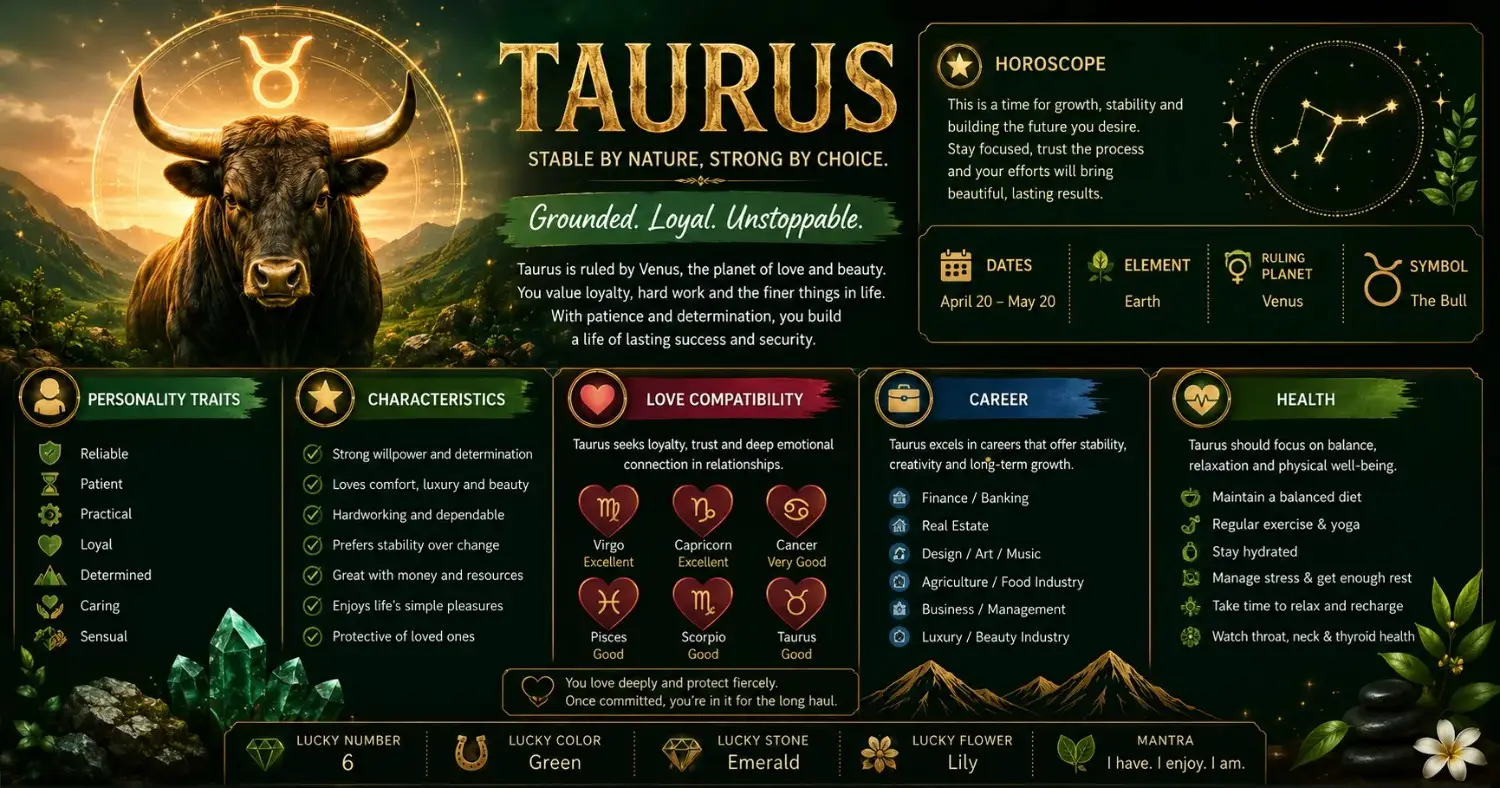
Taurus travels well. Almost every culture on earth looked at the same patch of sky, saw the same broad-shouldered animal, and gave it a name in its own tongue. That fact alone tells you something about this sign. Taurus is the zodiac’s most physical, most rooted, most universally recognized symbol.
I have spent years reading charts for clients across three continents. I have explained the second sign of the zodiac to a Tamil grandmother who called it Rishabam, to a Berlin client who called it Stier, and to a Tokyo student who called it Oushi-za. The word changes. The meaning barely moves.
This guide gives you every major translation of Taurus, the correct pronunciation, the cultural meaning behind each name, and the astrological substance underneath all of it. Use it as a reference. Bookmark the tables. Come back when you need them.
Quick Answer: What Does Taurus Mean in Other Languages?
Taurus means “bull” in Latin. Nearly every language on earth names the sign after that same animal. Languages split into four naming patterns:
- They keep the Latin word. Spanish Tauro, Portuguese Touro, Romanian Taur, Indonesian Taurus.
- They translate “bull” into their own word. German Stier, Polish Byk, Turkish Boğa, Hebrew Shor, Arabic Al-Thawr.
- They borrow the Sanskrit term. Hindi Vrishabh, Thai Phruetsopha, Khmer Ussaphea, Sinhala Vrushabha.
- They build a compound with a “constellation” suffix. Chinese Jīnniú zuò, Japanese Oushi-za, Korean Hwangso-jari.
The dates stay the same in Western astrology: April 20 to May 20. The dates shift in Vedic astrology: roughly May 15 to June 14. The ruling planet stays Venus everywhere. The element stays Earth everywhere. The quality stays Fixed everywhere.
Now let’s go deeper.
The Root Meaning of Taurus: Where the Word Comes From
The English word Taurus comes straight from Latin taurus, meaning “bull.” Latin took it from Ancient Greek ταῦρος (taûros). Both trace back to a Proto-Indo-European root, reconstructed as *tauros.
Here is the interesting part. The same sound cluster appears in Semitic languages that sit outside the Indo-European family. Aramaic gives us tor. Arabic gives us thawr. Hebrew gives us shor. Akkadian gives us šūru.
Linguists still argue about the direction of that borrowing. Some call it an ancient Wanderwort, a wandering word that moved between language families through trade. Others argue for independent development. Either way, the pattern holds across thousands of miles and thousands of years.
English keeps the root in everyday words. Steer shares the same ancestry. Toreador comes through Spanish. Tauromachy, the technical word for bullfighting, comes through Greek. Even the Taurus Mountains in southern Turkey carry the name.
So when you say “I’m a Taurus,” you speak a word older than Rome. That matters for how you read this article. You are not looking at translations. You are looking at parallel inheritances of one very old idea.
Why a Bull? The Origin Story Behind the Symbol
Astrology did not invent the bull. Astronomy did, and mythology gave it meaning.
Mesopotamia named it first
Babylonian astronomers recorded the constellation as GU.AN.NA, the “Bull of Heaven,” in cuneiform star catalogs. The MUL.APIN tablets, compiled around 1000 BCE from older material, list it clearly. In that era, the spring equinox fell in Taurus. The sun rose in the Bull at the start of the agricultural year.
Think about what that meant to a farming society. The bull pulled the plow. The bull broke the soil. The sun entered the Bull, and the planting season began. The symbol was not decorative. It was practical.
Egypt worshipped the same animal
Egypt honored the Apis bull at Memphis. The Apis served as a living god, a vessel of Ptah, and later of Osiris. Egyptian priests tracked the Bull constellation alongside the rising of the Pleiades. Fertility, kingship, and the flooding cycle all attached to that image.
Greece told the love story
Greek myth gave Taurus its most famous narrative. Zeus wanted Europa, a Phoenician princess. He transformed himself into a gentle white bull. Europa climbed onto his back. He carried her across the sea to Crete.
Notice the detail that matters astrologically. The bull in that story is gentle. He does not charge. He waits. He attracts through beauty and calm presence. That is Venus behavior, and Venus rules Taurus.
Other Greek accounts link the constellation to the Cretan Bull of the Heracles labors, or to Io transformed into a heifer. The gentle-bull version stuck because it matched the sign’s temperament.
India saw Nandi
Vedic tradition assigned the sign the name Vrishabha, from the Sanskrit for bull. The sacred bull Nandi sits before every Shiva temple in India. Nandi represents dharma, steadiness, strength held in reserve, and patient devotion.
Look at a Nandi statue. The bull never stands. He kneels, alert, facing the sanctum, waiting. Indian astrologers read Vrishabha exactly that way: enormous power that chooses stillness.
Four civilizations. One animal. One consistent meaning.
Taurus in Indian Languages: The Vedic Family
India holds more zodiac vocabulary than any other region, because Indian languages descend from two large families and both adopted the Sanskrit system.
The master table for Indian languages
| Language | Native Script | Romanization | Literal Sense |
|---|---|---|---|
| Sanskrit | वृषभ / वृष | Vṛṣabha / Vṛṣa | Bull, best, chief |
| Hindi | वृषभ राशि / वृष राशि | Vrishabh Rashi | Bull sign |
| Marathi | वृषभ रास | Vrishabh Raas | Bull sign |
| Gujarati | વૃષભ રાશિ | Vrushabh Rashi | Bull sign |
| Bengali | বৃষ রাশি | Brish Rashi | Bull sign |
| Odia | ବୃଷ ରାଶି | Brusha Rashi | Bull sign |
| Assamese | বৃষ ৰাশি | Brikh Rakhi | Bull sign |
| Punjabi | ਬ੍ਰਿਖ / ਵ੍ਰਿਸ਼ਭ | Brikh / Vrishabh | Bull sign |
| Nepali | वृष राशि | Vrish Rashi | Bull sign |
| Kashmiri | برٛکھ | Brikh | Bull sign |
| Tamil | ரிஷபம் / ரிஷப ராசி | Rishabam / Rishaba Rasi | Bull sign |
| Telugu | వృషభ రాశి | Vrushabha Rasi | Bull sign |
| Kannada | ವೃಷಭ ರಾಶಿ | Vrushabha Rashi | Bull sign |
| Malayalam | ഇടവം / വൃഷഭം | Edavam / Vrishabham | Bull sign, second month |
| Tulu | ಇರ್ವಿ | Irvi | Second sign |
| Konkani | वृषभ | Vrishabh | Bull sign |
| Sinhala | වෘෂභ | Vṛṣabha | Bull sign |
| Urdu | برج ثور | Burj-e-Saur | House of the Bull |
Sanskrit: Vrishabha, the root of them all
Vṛṣabha (वृषभ) carries more weight than “bull.” Sanskrit dictionaries list additional senses: chief, best among, most excellent, most manly. The root vṛṣ connects to raining, showering, and pouring forth abundance.
Read that again. The word that names Taurus also means “the one who showers abundance.” Every Vedic astrologer I know leans on that etymology when reading a Vrishabha chart. The sign produces. It accumulates. It gives from a full store.
Hindi and the northern languages
North Indian speakers say Vrishabh Rashi (वृषभ राशि) or the shorter Vrish Rashi (वृष राशि). Both are correct. Newspapers and horoscope columns use them interchangeably.
The word rashi (राशि) deserves attention. It means “heap,” “pile,” or “accumulated quantity.” A rashi is a measured heap of sky, thirty degrees wide. English calls it a sign. Sanskrit calls it a heap. The Sanskrit is more literal and, frankly, more accurate.
Bengali softens the pronunciation to Brish Rashi (বৃষ রাশি), because Bengali phonology drops the retroflex and shifts the vowel. Odia and Assamese follow similar patterns.
Tamil: Rishabam and the Dravidian route
Tamil says ரிஷபம் (Rishabam) or ரிஷப ராசி (Rishaba Rasi). Some older Tamil texts use இடபம் (Idabam), which comes from the native Dravidian word for a bull or ox.
Tamil astrology, called Jothidam, runs on the sidereal zodiac. A Tamil speaker who calls himself Rishabam was likely born in mid-May through mid-June, not late April. I will explain that gap in detail below, because it confuses more people than any other issue in this subject.
Telugu and Kannada
Telugu uses వృషభ రాశి (Vrushabha Rasi). Kannada uses ವೃಷಭ ರಾಶಿ (Vrushabha Rashi). Both preserve the Sanskrit almost intact. Telugu speakers sometimes say ఎద్దు రాశి (Eddu Rasi), using the native Telugu word for ox.
Malayalam: the odd one out
Malayalam breaks the pattern. Kerala calls the sign ഇടവം (Edavam). That word names the second month of the Malayalam solar calendar, which runs from about May 15 to June 14.
Malayalam speakers also recognize വൃഷഭം (Vrishabham), but Edavam dominates daily speech. If a Malayali says “Edavam,” she means Taurus, and she means the calendar month at the same time. In Kerala, the sign and the season are one word.
Kerala astrologers note that Edavam contains three-quarters of Krittika, all of Rohini, and the first half of Mrigashira. Those are the lunar mansions, or nakshatras, that sit inside the sign.
Urdu and the Persian-Arabic route
Urdu takes a completely different path. It borrows from Arabic through Persian and calls the sign برج ثور (Burj-e-Saur). Burj means tower or house. Saur is the Arabic thawr, bull.
So a Hindi speaker in Delhi says Vrishabh, and an Urdu speaker in Lahore says Saur, and both mean Taurus. The languages are close cousins. The astrological vocabulary comes from opposite directions.
The nakshatras inside Vrishabha
Vedic astrology divides each sign into lunar mansions. Taurus holds:
- Krittika (last three quarters) — ruled by Sun, symbol a blade or flame
- Rohini (all four quarters) — ruled by Moon, symbol a cart, the Moon’s favorite
- Mrigashira (first two quarters) — ruled by Mars, symbol a deer’s head
Rohini sits at the heart of Taurus. Rohini is the star we call Aldebaran. Indian tradition treats Rohini as the most beautiful and fertile of all nakshatras. The Moon reaches its exaltation point at 3 degrees of Taurus, right inside Rohini.
That single fact explains a lot about the sign. Taurus is where the Moon feels best. Comfort, nourishment, emotional security, and sensory pleasure all peak here.
Taurus in European Languages
Europe splits into clear groups. Romance languages keep Latin. Germanic languages translate to their own word for bull or ox. Slavic languages do the same. A few outliers go their own way.
Romance languages
| Language | Name | Pronunciation |
|---|---|---|
| Latin | Taurus | TOW-roos |
| Italian | Toro | TOH-roh |
| Spanish | Tauro | TOW-roh |
| Portuguese | Touro | TOH-roo |
| French | Taureau | toh-ROH |
| Romanian | Taur | TA-oor |
| Catalan | Taure | TOW-reh |
| Galician | Touro | TOH-roo |
Spanish is worth a note. Spanish uses Tauro for the astrological sign and toro for an actual bull. The distinction is deliberate. A Spaniard says “Soy Tauro” for the star sign, never “Soy toro.” Italian, by contrast, uses Toro for both.
French Taureau shows the diminutive suffix -eau, from Latin -ellus. The French literally say “little bull,” though nobody hears it that way anymore.
Germanic languages
| Language | Name | Literal Meaning |
|---|---|---|
| German | Stier | Bull |
| Dutch | Stier | Bull |
| Danish | Tyren | The Bull |
| Norwegian | Tyren | The Bull |
| Swedish | Oxen | The Ox |
| Icelandic | Nautið | The Bull, cattle |
| Afrikaans | Taurus / Stier | Bull |
Swedish makes the most interesting choice. Sweden says Oxen, the ox, not the bull. An ox is a castrated bull, trained to pull a plow. The Swedish name emphasizes labor and steadiness over raw power.
Icelandic Nautið connects to the Old Norse naut, cattle. The same root gives English “neat” in the archaic sense of cattle, as in “neatherd.”
German Stier comes from Proto-Germanic *steuraz, which is the same root that gives English “steer.” Germans write the sign as Stier and the person as Stier-Geborener, a Stier-born person.
Slavic languages
| Language | Name | Romanization |
|---|---|---|
| Russian | Телец | Telets |
| Ukrainian | Телець | Telets |
| Belarusian | Цялец | Tsyalets |
| Bulgarian | Телец | Telets |
| Polish | Byk | Byk |
| Czech | Býk | Beek |
| Slovak | Býk | Beek |
| Serbian | Бик / Bik | Bik |
| Croatian | Bik | Bik |
| Slovenian | Bik | Bik |
| Macedonian | Бик | Bik |
Russian splits from its neighbors. Телец (Telets) derives from an Old Church Slavonic word meaning “calf” or “young bull.” It carries a formal, almost liturgical tone. Russian uses бык (byk) for an ordinary bull, but never for the zodiac sign.
Polish, Czech, and the South Slavic languages all use the plain word for bull. Byk in Polish is both the animal and the sign.
Baltic, Celtic, and other European branches
| Language | Name | Notes |
|---|---|---|
| Lithuanian | Jautis | Ox, bullock |
| Latvian | Vērsis | Ox |
| Estonian | Sõnn | Bull |
| Finnish | Härkä | Ox |
| Hungarian | Bika | Bull |
| Greek | Ταύρος (Távros) | Bull, the original |
| Albanian | Demi | The bull |
| Basque | Zezena | The bull |
| Irish | An Tarbh | The bull |
| Scottish Gaelic | An Tarbh | The bull |
| Welsh | Y Tarw | The bull |
| Maltese | Barri / Taurus | Bull |
| Armenian | Ցուլ (Ts’ul) | Bull |
| Georgian | კურო (Kuro) | Bull |
| Turkish | Boğa | Bull |
Finnish and Estonian belong to the Finno-Ugric family, not Indo-European. Hungarian does too. All three still chose the bull. The symbol crossed the language barrier without difficulty.
Basque Zezena deserves special mention. Basque is a language isolate with no proven relatives anywhere. It still names the sign after the bull, and bull festivals remain central to Basque culture.
The Celtic forms — Irish An Tarbh, Welsh Y Tarw — descend from Proto-Celtic *tarwos. The Gaulish god Tarvos Trigaranus, the bull with three cranes, appears on a Roman-era pillar found under Notre-Dame in Paris. Same root as taurus, different branch.
Taurus in Middle Eastern and Semitic Languages
The Middle East holds the oldest continuous astrological tradition. Babylonian methods traveled to Greece, then to India, then back through Arabic scholarship into medieval Europe.
| Language | Native Script | Romanization | Meaning |
|---|---|---|---|
| Arabic | برج الثور | Burj al-Thawr | House of the Bull |
| Hebrew | מזל שור | Mazal Shor | Constellation of the Bull |
| Persian (Farsi) | ثور / گاو | Sowr / Gāv | Bull, ox |
| Turkish | Boğa Burcu | Boğa Burjoo | Bull sign |
| Kurdish | Ga | Ga | Ox |
| Pashto | ثور | Sawr | Bull |
| Azerbaijani | Buğa | Buga | Bull |
| Aramaic | תּוֹרָא | Tora | Bull |
| Amharic | በሬ / ታውረስ | Bere / Tawres | Bull |
Arabic: Al-Thawr
Arabic astronomy gave the world most of its star names. الثور (al-Thawr) names the constellation. The full astrological phrase is برج الثور (burj al-thawr), where burj means tower, fortress, or house.
The brightest star in the sign carries an Arabic name that English still uses: Aldebaran, from al-dabarān, “the follower.” It follows the Pleiades across the sky. Arab astronomers watched that chase every night for centuries.
The Pleiades themselves carry an Arabic name still used in the Gulf: الثريا (al-Thurayyā), “the little abundant one.” Thuraya remains a common girl’s name across the Arab world.
Hebrew: Mazal Shor
Hebrew says מזל שור (Mazal Shor). Mazal means constellation, luck, or destiny, and gives us the greeting “mazel tov,” literally “good constellation.”
Shor (שור) is the biblical word for ox or bull. It appears throughout the Torah in laws about goring oxen and sacrificial animals.
Jewish tradition connects Taurus to the Hebrew month of Iyar and, in some sources, to the tribe of Issachar. Kabbalistic texts link the sign to labor, sustenance, and the physical world.
Persian: two words, two eras
Persian uses ثور (Sowr), the Arabic borrowing, in formal astrological contexts and in the Afghan solar calendar, where Sawr is the second month.
Persian also uses گاو (Gāv), the native Iranian word for cow or bull, in older Zoroastrian cosmology. The primordial bull Gāvaēvōdāta appears in Avestan texts as the first animal, whose death seeds all life.
Turkish: Boğa
Turkish says Boğa Burcu. Boğa is a native Turkic word for bull. Burç comes from the same Arabic burj. The phrase mixes two language families in three syllables, which is very Turkish.
Taurus in East Asian Languages
East Asia imported the Western zodiac relatively late, mostly through the nineteenth and twentieth centuries. The names show it. They read like careful, descriptive translations rather than inherited words.
| Language | Native Script | Romanization | Literal Translation |
|---|---|---|---|
| Chinese (Mandarin) | 金牛座 | Jīnniú zuò | Golden Ox constellation |
| Chinese (Cantonese) | 金牛座 | Gam1 ngau4 zo6 | Golden Ox constellation |
| Japanese | 牡牛座 / おうし座 | Oushi-za | Male Cow constellation |
| Korean | 황소자리 | Hwangso-jari | Ox seat, Bull place |
| Vietnamese | Kim Ngưu | Kim Ngưu | Golden Ox |
| Mongolian | Үхэр | Ükher | Ox |
Chinese: the Golden Ox
Mandarin says 金牛座 (Jīnniú zuò). Break it down: 金 (jīn) means gold or metal, 牛 (niú) means ox or cattle, 座 (zuò) means seat or constellation.
Why gold? Two reasons circulate. The first points to the Greek myth, where Zeus appears as a radiant white bull. The second points to the association with wealth, since Chinese astrology readers quickly linked the sign to money and accumulation. The name stuck, and modern Chinese horoscope columns lean into the wealth angle heavily.
Note carefully: 金牛座 is not the same as the Chinese zodiac Ox year (牛年). The Ox year rotates on a twelve-year cycle. Jīnniú zuò is the Western sign, based on birth month. Chinese readers distinguish them without effort. Foreign learners confuse them constantly.
Traditional Chinese astronomy divided the same stars differently. The region belongs to the White Tiger of the West (西方白虎), and the mansion 畢 (Bì, the Net) covers much of Taurus. Aldebaran is 畢宿五 (Bìxiù wǔ), the fifth star of the Net mansion.
Japanese: Oushi-za
Japanese writes 牡牛座 and reads it おうし座 (Oushi-za). 牡 (o) marks a male animal. 牛 (ushi) means cow or cattle. 座 (za) means constellation, the same character as Chinese 座.
Japanese magazines usually print the hiragana form おうし座 for readability. Both are correct.
Japan also gave the world a famous Taurus word without most people noticing. The Pleiades cluster, which sits inside Taurus, is called すばる (Subaru) in Japanese, meaning “to unite” or “gathered together.” The car company took the name and put six stars in its logo, one for each of the merged companies.
Korean: Hwangso-jari
Korean says 황소자리 (Hwangso-jari). 황소 (hwangso) means a bull or ox. 자리 (jari) means seat or place, a pure native Korean word rather than a Chinese borrowing.
Korean names all eighty-eight constellations with the -jari suffix. The system reads very naturally to Korean speakers.
Vietnamese: Kim Ngưu
Vietnamese says Kim Ngưu, which is the Sino-Vietnamese reading of the same characters 金牛. Vietnamese dropped the 座 suffix. The name means Golden Ox, exactly as in Chinese.
Taurus in Southeast Asian Languages
Southeast Asia received its astrology from India, not Europe. The names come straight from Sanskrit, filtered through Pali and local phonology.
| Language | Native Script | Romanization | Source |
|---|---|---|---|
| Thai | ราศีพฤษภ | Rasi Phruetsopha | Sanskrit Vrishabha |
| Khmer | រាសីឧសភ | Reasei Ussaphea | Sanskrit Vrishabha |
| Lao | ລາສີພຶດສະພາ | Lasi Phutsapha | Sanskrit Vrishabha |
| Burmese | ပြိဿရာသီ | Pyeitsa Yathi | Sanskrit Vrishabha |
| Indonesian | Taurus / Lembu | Taurus | Latin / native “ox” |
| Malay | Taurus / Lembu | Taurus | Latin / native “ox” |
| Filipino (Tagalog) | Taurus / Toro | Taurus | Latin via Spanish |
| Javanese | Taurus | Taurus | Latin |
Thai and the calendar connection
Thai says ราศีพฤษภ (Rasi Phruetsopha). Rasi is the Sanskrit rashi. Phruetsopha is Thai phonology working on Vrishabha.
Here is the connection most people miss. The Thai word for the month of May is พฤษภาคม (Phruetsaphakhom). It contains the same root. Thai month names come directly from zodiac signs, exactly as the Malayalam months do.
Khmer works identically. Cambodian May is ឧសភា (Ussaphea), from the same Sanskrit bull.
So in Thailand, Cambodia, Laos, and Kerala, Taurus is not just a sign. It is a month on the wall calendar. Millions of people use the word every day without thinking about astrology at all.
Indonesian and Malay
Indonesia and Malaysia simply keep Taurus, borrowed through Dutch and English. Some writers use Lembu, the Malay word for ox, but it reads as a translation rather than a standard term.
Filipino
Filipino keeps Taurus from Spanish colonial contact. Casual speech sometimes uses Toro, the Spanish loanword already embedded in Filipino for a bull.
Taurus in African Languages
African languages show the most variation, because astrological vocabulary arrived through different colonial and trade routes in different regions.
| Language | Name | Literal Meaning |
|---|---|---|
| Swahili | Fahali / Ng’ombe Dume | Bull / male cattle |
| Amharic | ታውረስ / በሬ | Tawres / bull |
| Zulu | Inkunzi | Bull |
| Xhosa | Inkunzi | Bull |
| Yoruba | Akọ màlúù | Male cattle |
| Hausa | Bijimi | Bull |
| Shona | Nzombe | Bull |
| Somali | Dibi | Bull, ox |
| Wolof | Nag bu góor | Male cattle |
Swahili astrology columns in Kenya and Tanzania typically use Fahali, the word for a breeding bull. Swahili absorbed heavy Arabic influence, so some publications also print Thauri, direct from Arabic thawr.
Across Bantu languages, the pattern holds. Zulu and Xhosa Inkunzi means bull and carries strong connotations of leadership and virility. In Zulu culture, cattle represent wealth, bride price, and family standing. Taurus themes land naturally.
Note one caution. Many African languages lack a fixed, standardized astrological term. Writers translate descriptively. If you need a term for publication, check regional usage rather than assuming.
Taurus in Sign Languages, Constructed Languages, and Symbols
The astrological glyph
Taurus uses the symbol ♉, encoded in Unicode as U+2649. The glyph shows a circle with two curved horns rising from it. Read it literally: that is a bull’s head and horns, drawn in two strokes.
Some astrologers read the circle as the sun or the full self, with the crescent above representing the receptive lunar principle. That reading connects to the Moon’s exaltation in Taurus.
Esperanto and constructed languages
Esperanto says Taŭro. Interlingua says Tauro. Both follow the Latin root without modification. Constructed languages consistently chose the international form.
American Sign Language
ASL has no single universal sign for Taurus. Deaf astrology communities commonly use a two-handed sign that mimics horns at the temples, similar to the general sign for bull or cow, combined with fingerspelling for clarity. Regional variation exists. Check with local Deaf communities rather than assuming a standard.
How to Say “I Am a Taurus” in 25 Languages
This is the phrase people actually need. Here it is, ready to use.
| Language | Phrase |
|---|---|
| Spanish | Soy Tauro |
| French | Je suis Taureau |
| German | Ich bin Stier |
| Italian | Sono del Toro |
| Portuguese | Sou de Touro |
| Dutch | Ik ben Stier |
| Russian | Я Телец (Ya Telets) |
| Polish | Jestem Bykiem |
| Greek | Είμαι Ταύρος (Eímai Távros) |
| Turkish | Ben Boğa burcuyum |
| Arabic | أنا برج الثور (Ana burj al-thawr) |
| Hebrew | אני מזל שור (Ani mazal shor) |
| Persian | من متولد ثور هستم (Man motavalled-e sowr hastam) |
| Hindi | मेरी राशि वृषभ है (Meri rashi Vrishabh hai) |
| Bengali | আমার রাশি বৃষ (Amar rashi Brish) |
| Tamil | என் ராசி ரிஷபம் (En rasi Rishabam) |
| Telugu | నా రాశి వృషభం (Naa rasi Vrushabham) |
| Kannada | ನನ್ನ ರಾಶಿ ವೃಷಭ (Nanna rashi Vrushabha) |
| Malayalam | എന്റെ രാശി ഇടവം (Ente rashi Edavam) |
| Urdu | میرا برج ثور ہے (Mera burj Saur hai) |
| Chinese | 我是金牛座 (Wǒ shì jīnniú zuò) |
| Japanese | 私は牡牛座です (Watashi wa oushi-za desu) |
| Korean | 저는 황소자리예요 (Jeoneun hwangso-jari-yeyo) |
| Thai | ฉันเป็นราศีพฤษภ (Chan pen rasi phruetsopha) |
| Vietnamese | Tôi là cung Kim Ngưu |
| Swahili | Mimi ni Fahali |
The Date Problem: Why Taurus Starts on Different Days
This confuses more people than every translation question combined. Let me settle it.
Western (tropical) astrology
Western astrology uses the tropical zodiac, anchored to the seasons. The zodiac begins at the March equinox, wherever the stars happen to sit. Taurus runs from about April 20 to May 20 every year.
The exact minute shifts by a day depending on the year and your time zone. If you were born on April 20 or May 20, check your birth time. Those are cusp dates.
Vedic (sidereal) astrology
Indian astrology uses the sidereal zodiac, anchored to the actual stars. Because of the precession of the equinoxes, the two systems have drifted apart by roughly 24 degrees over two thousand years.
Result: Vedic Taurus, or Vrishabha, runs from roughly May 15 to June 14.
So a person born on May 5 is a Taurus in Western astrology and an Aries (Mesha) in Vedic astrology. Neither system is wrong. They measure different things.
Why both systems still work
Tropical astrology measures the sun’s relationship to the seasons. It describes psychological patterns tied to the time of year. Sidereal astrology measures the sun’s position against fixed stars. It anchors a predictive system built on planetary periods.
I read both. I explain both to clients. If your Western sign and your Vedic sign disagree, you have not been lied to. You have two valid maps of the same territory.
The constellation boundaries
Modern astronomy adds a third layer. The International Astronomical Union fixed constellation boundaries in 1930. Under those boundaries, the sun passes through the actual Taurus constellation from about May 14 to June 21.
The IAU boundaries also give the sun a pass through Ophiuchus. That is why the “thirteenth sign” story resurfaces every few years. It is an astronomy fact, not an astrology change. Astrologers have used twelve equal thirty-degree divisions for over two thousand years, and the constellations have never matched them exactly.
What Taurus Actually Means: The Astrology Underneath the Words
Names change. The astrological content does not. Here is the substance every tradition agrees on.
The core signature
- Element: Earth
- Modality: Fixed
- Ruling planet: Venus (Shukra in Vedic astrology)
- Symbol: The Bull
- Polarity: Receptive, yin, feminine
- House correspondence: Second house
- Exaltation: The Moon, exalted at 3 degrees Taurus
- Detriment: Mars
- Body rulership: Neck, throat, thyroid, vocal cords
- Tarot correspondence: The Hierophant
- Colors: Green, earth tones, soft pink
- Stones: Emerald, rose quartz, sapphire
- Season: Mid-spring in the northern hemisphere
Fixed Earth, explained properly
Fixed signs hold. Cardinal signs start, fixed signs sustain, mutable signs adapt. Earth signs deal with the material world.
Combine them. Taurus sustains material reality. Taurus builds things that last. Taurus does not chase novelty, and Taurus does not surrender ground.
That single combination generates every Taurus trait in every horoscope column on earth. Patience, reliability, stubbornness, sensuality, and resistance to change all flow from fixed earth.
Venus rules through the body, not the heart
Venus rules both Taurus and Libra. The expression differs completely.
Libra runs Venus through air. That gives aesthetics, social harmony, balance, and idealized relationship.
Taurus runs Venus through earth. That gives touch, taste, scent, texture, food, money, comfort, and physical affection. Taurus Venus wants to hold the thing, not discuss it.
Vedic astrology names the same planet Shukra and assigns it similar ground: wealth, beauty, pleasure, vehicles, luxury, and artistic talent. The two traditions describe the same planet with remarkably similar language.
The Moon’s exaltation matters
The Moon reaches maximum strength in Taurus. Both Western and Vedic systems agree on this, which is rare.
Practically, that means Taurus offers emotional stability. Feelings settle here. Comfort becomes achievable. A Taurus Moon person builds a nest and defends it.
That is also why Taurus connects so strongly to food, home, and the mother principle across cultures.
Core strengths
Taurus delivers reliability. A Taurus finishes what a Taurus starts. Deadlines mean something. Promises mean more.
Taurus builds wealth patiently. The second house governs personal resources, and Taurus governs the second house naturally. Slow accumulation beats fast speculation every time.
Taurus creates beauty through the hands. Cooking, gardening, pottery, woodworking, singing, and massage all suit the sign. Taurus rules the throat, so the sign produces an unusual number of strong singers.
Taurus offers loyalty that borders on immovable. Once a Taurus commits, the commitment holds.
Core challenges
Taurus resists change past the point of usefulness. Fixed energy protects, and then it traps.
Taurus overindulges. Venus in earth enjoys comfort, and comfort compounds. Food, spending, and inertia all need watching.
Taurus holds grudges. The bull forgets nothing. Forgiveness requires conscious effort.
Taurus can equate worth with possession. The second house governs values as well as money. A Taurus who confuses the two builds a beautiful cage.
Does the meaning change by culture?
Here is my honest professional answer after two decades of practice: the tone shifts, the substance does not.
Western pop astrology emphasizes personality. It reads Taurus as stubborn, sensual, and reliable.
Vedic astrology emphasizes life outcomes. It reads Vrishabha ascendants through planetary periods, predicting wealth, marriage, and career timing.
Chinese-language horoscope media emphasize money, because the name literally contains the character for gold.
Arabic-language traditional astrology emphasizes fortune and elective timing, drawing on medieval methods from al-Biruni and Abu Ma’shar.
Different emphasis. Same sign. The bull does not change when the word for it changes.
Star Names Inside Taurus Across Languages
The sign contains two of the most famous objects in the night sky. Both carry different names in different cultures, and those names are part of the Taurus story.
Aldebaran, the eye of the bull
| Culture | Name | Meaning |
|---|---|---|
| Arabic | الدبران (al-Dabarān) | The follower |
| Sanskrit | रोहिणी (Rohini) | The red one, the rising |
| Chinese | 畢宿五 (Bìxiù wǔ) | Fifth star of the Net mansion |
| Latin | Palilicium | Related to the Parilia festival |
| Persian | Tascheter | One of the four royal stars |
Aldebaran glows orange and marks the bull’s eye. Persian tradition counted it among the four royal stars guarding the sky’s quarters.
The Pleiades, the seven sisters
| Culture | Name | Meaning |
|---|---|---|
| Greek | Πλειάδες (Pleiades) | The seven sisters |
| Sanskrit | कृत्तिका (Krittika) | The cutters |
| Arabic | الثريا (al-Thurayyā) | The abundant little one |
| Japanese | すばる (Subaru) | To unite, gathered |
| Chinese | 昴宿 (Mǎo xiù) | The Hairy Head mansion |
| Māori | Matariki | Eyes of god, small eyes |
| Hawaiian | Makaliʻi | Tiny eyes |
| Aztec (Nahuatl) | Tianquiztli | The marketplace |
| Lakota | Wicíŋčala Sakówiŋ | Seven little girls |
The Pleiades appear in more cultural traditions than almost any other star group. Māori New Year, Matariki, is now a public holiday in New Zealand and begins with the cluster’s heliacal rising.
That detail matters for our topic. The stars of Taurus mark new years, planting seasons, and festivals across cultures that never traded a single astrological idea with one another.
Common Mistakes and Mistranslations to Avoid
Mistake 1: Confusing Chinese 金牛座 with the Ox year
They are different systems. 金牛座 is Western Taurus. 牛年 is the Ox year in the twelve-year Chinese cycle. Never substitute one for the other.
Mistake 2: Assuming Vrishabha and Taurus cover the same dates
They do not. The sidereal and tropical zodiacs differ by about three and a half weeks. Always ask which system someone means.
Mistake 3: Using “Toro” for the sign in Spanish
Spanish separates the animal from the sign. Say Tauro for the star sign. Say toro for a bull in a field.
Mistake 4: Translating “Taurus” as a female cow
Several languages distinguish male and female cattle sharply. Japanese uses 牡 (male) deliberately in 牡牛座. Swahili distinguishes fahali (bull) from ng’ombe (cattle generally). Choose the male form.
Mistake 5: Treating the Swedish “Oxen” as an error
It is not an error. Swedish genuinely names the sign after the ox. Lithuanian Jautis and Finnish Härkä do the same. Ox and bull overlap heavily in agricultural vocabulary.
Mistake 6: Machine-translating astrological terms
Translation engines routinely render Taurus as Ford Taurus in commercial contexts, or as the Taurus Mountains in geographic ones. Always verify with a native speaker for published work.
Frequently Asked Questions
What does Taurus mean in English?
Taurus means “the Bull.” English borrowed the word directly from Latin, where taurus is the ordinary word for a bull. English uses it only for the constellation, the zodiac sign, and derived proper nouns.
What is Taurus called in Hindi?
Hindi calls Taurus वृषभ राशि (Vrishabh Rashi) or वृष राशि (Vrish Rashi). Both mean “bull sign.” The word comes from Sanskrit Vṛṣabha, which means bull, chief, and most excellent.
What is Taurus in Tamil?
Tamil calls Taurus ரிஷபம் (Rishabam) or ரிஷப ராசி (Rishaba Rasi). Some older texts use இடபம் (Idabam), from the native Dravidian word for bull.
What is Taurus called in Malayalam?
Malayalam calls Taurus ഇടവം (Edavam). The same word names the second month of the Malayalam calendar, which runs from about May 15 to June 14. വൃഷഭം (Vrishabham) also appears in formal astrological writing.
What is Taurus in Arabic?
Arabic calls Taurus برج الثور (Burj al-Thawr), meaning “house of the bull.” The word thawr (ثور) shares an ancient root with Latin taurus and Hebrew shor.
What is Taurus in Chinese?
Chinese calls Taurus 金牛座 (Jīnniú zuò), which translates literally as “Golden Ox constellation.” This differs completely from the Ox year in the twelve-year Chinese zodiac cycle.
What is Taurus in Japanese?
Japanese calls Taurus 牡牛座, read as おうし座 (Oushi-za). The characters mean “male cow constellation.” Magazines often print the hiragana form for readability.
What is Taurus in Korean?
Korean calls Taurus 황소자리 (Hwangso-jari). Hwangso means bull, and jari means seat or place. Korean uses the -jari suffix for all constellation names.
What is the Urdu name for Taurus?
Urdu calls Taurus برج ثور (Burj-e-Saur). Urdu borrowed the term from Arabic through Persian, unlike Hindi, which took its term from Sanskrit.
Does Taurus mean the same thing in every language?
Yes, essentially. Every major language names the sign after a bull or an ox. The astrological meaning stays consistent too: fixed earth, ruled by Venus, associated with patience, stability, sensuality, and material security.
Why do Vedic and Western Taurus dates differ?
Western astrology uses the tropical zodiac, tied to the equinoxes, giving dates of April 20 to May 20. Vedic astrology uses the sidereal zodiac, tied to the fixed stars, giving dates of roughly May 15 to June 14. Precession of the equinoxes caused the gap over roughly two thousand years.
What is the Taurus symbol called?
The symbol is ♉, a circle topped by a crescent. It depicts a bull’s head with horns. Unicode encodes it as U+2649.
Which planet rules Taurus in every tradition?
Venus rules Taurus in Western astrology. Shukra, the Vedic name for Venus, rules Vrishabha in Indian astrology. Hellenistic, Arabic, and medieval European traditions all agree.
What does Vrishabha mean in Sanskrit?
Vṛṣabha means bull. It also means chief, best, and most excellent. The root vṛṣ connects to raining and showering forth, which links the word to abundance and fertility.
Is Taurus the same as the Ox in the Chinese zodiac?
No. They are separate systems that happen to share an animal. Western Taurus depends on your birth month. The Chinese Ox depends on your birth year in a twelve-year cycle.
What is Taurus in Thai?
Thai calls Taurus ราศีพฤษภ (Rasi Phruetsopha), borrowed from Sanskrit Vrishabha. The Thai word for May, พฤษภาคม, comes from the same root.
Which star sits at the heart of Taurus?
Aldebaran, the orange giant marking the bull’s eye. Arabic calls it al-Dabarān, the follower. Sanskrit calls it Rohini and treats it as the most beautiful of the lunar mansions.
Key Takeaways
Taurus survives translation better than almost any other concept in astrology. The reasons run deeper than linguistics.
The bull was the first animal humans domesticated for heavy work. The bull pulled the plow that fed the first cities. The spring equinox once rose in this constellation, marking the agricultural new year across the ancient world.
Every culture that farmed, herded, or watched the sky arrived at the same image. Then each culture named it in its own words.
Remember these essentials:
- Taurus means “bull” in Latin, and nearly every language follows that meaning.
- Four naming patterns exist: Latin borrowing, native translation, Sanskrit borrowing, and constellation compounds.
- India, Southeast Asia, and Sri Lanka use forms of Sanskrit Vrishabha.
- Europe splits between Latin forms and native bull words.
- East Asia built descriptive compounds ending in “constellation.”
- The Middle East uses the Semitic root thawr or shor.
- Venus rules the sign in every tradition.
- The Moon reaches exaltation here in every tradition.
- Western dates run April 20 to May 20. Vedic dates run roughly May 15 to June 14.
Whatever word your language uses, the sign describes the same thing. Patient strength. Earned security. Beauty you can touch. A stubbornness that looks like weakness in an argument and like courage in a crisis.
The bull does not rush. The bull arrives.
This guide covers astrological tradition and comparative linguistics. Astrology is a symbolic and cultural system, not a science. Use it for reflection and self-understanding rather than for medical, financial, or legal decisions.