
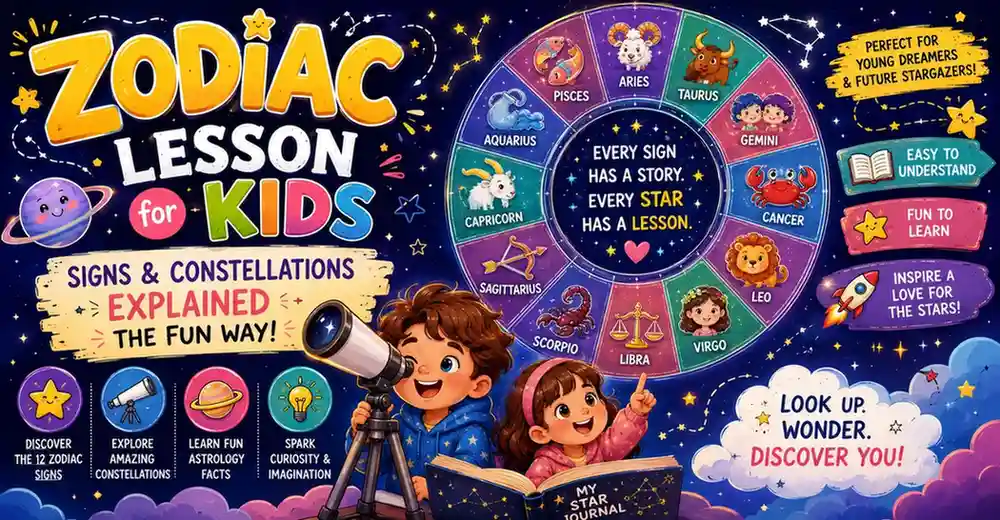
Look up at the night sky on a clear evening, far away from city lights, and you’ll see thousands of stars scattered across the darkness. To most people, they look random — just tiny dots of light. But ancient sky-watchers noticed something interesting thousands of years ago: certain groups of stars seemed to form shapes, and twelve of those shapes traced a path that the Sun, Moon, and planets appeared to follow throughout the year. That path is called the zodiac, and it’s one of the oldest “connect-the-dots” stories humans have ever told.
As an astrologer who has spent years teaching children and families about the sky, I can tell you that the zodiac is one of the most delightful gateways into astronomy, mythology, and self-reflection that a young learner can walk through. It combines science (real stars, real orbits, real physics) with storytelling (ancient myths about rams, twins, lions, and scales) and a sprinkle of personality-trait fun that kids naturally love. This lesson will walk you and your child through exactly what the zodiac is, how the twelve signs got their names, what constellations have to do with astrology, and how to use all of this as a hands-on learning adventure at home or in the classroom.
Whether you’re a parent looking for a screen-free science activity, a teacher building a unit on space and mythology, or simply a curious kid (or kid-at-heart) who wants to understand why people ask “what’s your sign?” — this guide covers it all in clear, age-appropriate language.
What Is the Zodiac, Exactly?
The word “zodiac” comes from an ancient Greek phrase meaning “circle of animals.” It describes an imaginary belt or ring in the sky, stretching all the way around Earth, through which the Sun, Moon, and planets appear to travel over the course of a year.
Here’s the easiest way to picture it for kids: imagine Earth orbiting the Sun like a car driving around a giant circular racetrack. As Earth moves along that track, the Sun appears to shift its position against the backdrop of distant stars — even though it’s really Earth that’s doing the moving. Ancient astronomers divided this circular path, called the ecliptic, into twelve equal sections. Each section lines up with a specific group of stars, or constellation, and each of those twelve constellations became a zodiac sign.
So when someone says “I’m a Leo” or “she’s a Gemini,” they’re really saying: “When I was born, the Sun appeared to be positioned in front of the part of the sky where that constellation sits.”
Why Twelve Signs?
Kids often ask why there are exactly twelve signs and not ten or fifteen. The answer connects nicely to a math lesson: the Sun takes about 365 days to travel all the way around the zodiac belt, and ancient astronomers divided that journey into twelve roughly equal chunks of about 30 days each — which lines up closely with our twelve calendar months. This is also connected to why we have twelve months in many calendar systems, and it’s a great way to show kids how ancient civilizations used the sky as a giant, rotating calendar long before clocks and calendars existed.
A Quick History Lesson for Curious Minds
The zodiac wasn’t invented all at once. It developed gradually in ancient Babylon (in the region that is now Iraq) more than 2,500 years ago, where astronomer-priests tracked the stars to predict seasons, floods, and planting times. Later, the ancient Greeks adopted the Babylonian system and added their own mythology, giving us the vivid stories of gods, heroes, and monsters that are still attached to each sign today. Understanding this history helps kids see the zodiac not just as a “fun personality quiz” but as a genuine piece of human history — a record of how people across different cultures and centuries looked at the same sky and built meaning from it.
The Difference Between Zodiac Signs and Constellations
This is one of the most important — and most commonly confused — ideas in any zodiac lesson, so it’s worth slowing down here.
A constellation is a real pattern of stars that you can actually find in the night sky with a telescope, binoculars, or sometimes just your own eyes. Constellations are astronomy — actual science involving real distances, real stars, and real physics.
A zodiac sign is the astrological label assigned to a stretch of calendar dates, based on where the Sun appeared to be positioned among the constellations thousands of years ago when the system was first created. Zodiac signs are used in astrology, which is a belief system and tradition rather than a proven science.
Here’s a fun (and slightly mind-bending) fact to share with older kids: because of a very slow wobble in Earth’s rotation called precession, the constellations have actually shifted position in the sky since the zodiac was first mapped out around 2,000+ years ago. This means the Sun isn’t always exactly in front of the constellation that matches your “official” zodiac sign anymore! Some astronomers even point out that there’s a thirteenth constellation, Ophiuchus (the “serpent bearer”), that the Sun’s path also passes through, even though it was never included as an official zodiac sign. This is a wonderful discussion point for a classroom: it shows kids the difference between an ancient tradition (astrology) and observable, changing reality (astronomy).
The Twelve Zodiac Signs and Their Constellations
Now for the fun part — meeting the twelve signs one by one. For each sign, I’ll cover the date range, the constellation and its meaning, the mythological story behind it, and the element and personality traits astrologers traditionally associate with it. Remember to remind kids that these personality descriptions are part of a fun cultural tradition, not scientific facts about a person.
Aries (The Ram) — March 21 to April 19
Aries is the first sign of the zodiac, and its constellation is shaped like a ram’s curled horns. In Greek mythology, the ram had golden wool and rescued two children before eventually becoming the constellation in the sky as a reward — the same magical Golden Fleece that heroes like Jason and the Argonauts later searched for.
- Element: Fire
- Symbol: A ram
- Personality traits: Bold, energetic, competitive, and quick to try new things. Kids born under Aries are often described as natural leaders who like to be first.
Taurus (The Bull) — April 20 to May 20
Taurus is represented by a bull, and its constellation includes a bright, reddish star called Aldebaran, which many stargazers imagine as the bull’s fiery eye. In mythology, the bull was linked to the god Zeus, who once transformed into a bull to carry Princess Europa safely across the sea.
- Element: Earth
- Symbol: A bull
- Personality traits: Steady, patient, loyal, and comfort-loving. Taurus kids are often described as reliable friends who enjoy routines and cozy activities.
Gemini (The Twins) — May 21 to June 20
Gemini‘s constellation features two bright stars, Castor and Pollux, representing twin brothers from Greek mythology. According to the myth, when one twin died, the other begged to share his own immortality so they’d never be apart — and the gods placed them together in the stars forever.
- Element: Air
- Symbol: Twins
- Personality traits: Curious, chatty, quick-thinking, and adaptable. Gemini kids are often the ones asking a hundred questions and juggling several hobbies at once.
Cancer (The Crab) — June 21 to July 22
Cancer‘s constellation is one of the dimmer ones, so it’s a fun challenge for kids to spot. In Greek mythology, the crab was sent to distract the hero Hercules during one of his famous battles; though the crab didn’t succeed, it was still honored with a place among the stars.
- Element: Water
- Symbol: A crab
- Personality traits: Caring, protective, home-loving, and emotionally sensitive. Cancer kids are often described as the ones who look out for friends and family first.
Leo (The Lion) — July 23 to August 22
Leo‘s constellation genuinely looks like a crouching lion, complete with a curved line of stars forming its mane, making it one of the easiest constellations for beginners to identify. The myth behind Leo tells of the Nemean Lion, a beast with unbreakable skin that Hercules had to defeat using nothing but his bare hands.
- Element: Fire
- Symbol: A lion
- Personality traits: Confident, generous, dramatic, and warm-hearted. Leo kids are often natural performers who love being the center of attention.
Virgo (The Maiden) — August 23 to September 22
Virgo is the second-largest constellation in the entire sky and is usually pictured as a maiden holding a stalk of wheat. In mythology, Virgo is often connected to Demeter or Persephone, goddesses associated with harvest and the changing seasons.
- Element: Earth
- Symbol: A maiden
- Personality traits: Organized, detail-oriented, thoughtful, and hardworking. Virgo kids are often the ones who love checklists, tidy desks, and getting things exactly right.
Libra (The Scales) — September 23 to October 22
Libra stands out as the only zodiac sign represented by an object instead of a person or animal: a set of balanced scales. The scales symbolize fairness and justice, and in mythology they’re connected to Astraea, the goddess of justice, who was said to weigh the good and bad deeds of humanity.
- Element: Air
- Symbol: Scales
- Personality traits: Fair-minded, social, diplomatic, and cooperative. Libra kids are often the ones who try to keep the peace and make sure everyone feels included.
Scorpio (The Scorpion) — October 23 to November 21
Scorpio‘s constellation includes a bright red star, Antares, marking the scorpion’s glowing heart. According to legend, the scorpion was sent by the goddess Gaia to stop the boastful hunter Orion — and the two were placed on opposite sides of the sky so they would never cross paths again.
- Element: Water
- Symbol: A scorpion
- Personality traits: Intense, determined, private, and deeply loyal. Scorpio kids are often described as passionate about the things — and people — they care about most.
Sagittarius (The Archer) — November 22 to December 21
Sagittarius is pictured as a centaur — half-human, half-horse — pulling back a bow and arrow, often aimed toward the heart of Scorpio nearby. Mythology usually connects this sign to Chiron, a wise and kind centaur who taught many Greek heroes and was eventually honored with a place in the stars.
- Element: Fire
- Symbol: An archer (centaur)
- Personality traits: Adventurous, optimistic, honest, and freedom-loving. Sagittarius kids are often the ones dreaming of travel and asking big philosophical questions.
Capricorn (The Sea-Goat) — December 22 to January 19
Capricorn has one of the strangest symbols in the zodiac: a goat with a fish’s tail. The myth explains that the god Pan once dove into a river to escape a monster, and in his hurry, the part of him underwater transformed into a fish tail while the rest stayed goat — a strange but memorable origin story kids tend to love.
- Element: Earth
- Symbol: A sea-goat
- Personality traits: Disciplined, ambitious, patient, and responsible. Capricorn kids are often described as old souls who take their goals seriously.
Aquarius (The Water Bearer) — January 20 to February 18
Despite its watery name, Aquarius is actually an air sign. Its constellation depicts a person pouring water from a jar, traditionally linked to Ganymede, a cupbearer to the gods in Greek mythology.
- Element: Air
- Symbol: A water bearer
- Personality traits: Independent, inventive, humanitarian, and original. Aquarius kids are often the creative thinkers who like doing things their own unique way.
Pisces (The Fish) — February 19 to March 20
Pisces closes out the zodiac cycle and is represented by two fish swimming in opposite directions, tied together by a cord. In mythology, the fish were said to be the goddess Aphrodite and her son Eros, who transformed themselves to escape a monster by diving into a river.
- Element: Water
- Symbol: Two fish
- Personality traits: Imaginative, gentle, empathetic, and dreamy. Pisces kids are often the artists and daydreamers of the group, full of compassion for others.
The Four Elements: Fire, Earth, Air, and Water
Astrologers group the twelve zodiac signs into four elemental families, and this is a fantastic way to help kids organize and remember the signs — almost like sorting trading cards into categories.
- Fire signs (Aries, Leo, Sagittarius): Known for energy, passion, and boldness. Fire sign kids tend to jump into action quickly.
- Earth signs (Taurus, Virgo, Capricorn): Known for being grounded, practical, and dependable. Earth sign kids tend to like routines and hands-on activities.
- Air signs (Gemini, Libra, Aquarius): Known for being thoughtful, social, and idea-driven. Air sign kids tend to love conversation and new concepts.
- Water signs (Cancer, Scorpio, Pisces): Known for being emotional, intuitive, and caring. Water sign kids tend to be sensitive to feelings — their own and others’.
A simple classroom or at-home activity: have kids sort a deck of zodiac cards into four piles by element, then discuss which element they think matches their own personality best.
How to Actually Find Zodiac Constellations in the Night Sky
Learning about the zodiac becomes far more memorable once kids step outside and try to spot the real constellations for themselves. Here are a few tips for a successful family stargazing night:
- Pick a clear, dark night. Constellations are much easier to see away from bright city lights, so a backyard, park, or campsite works better than a downtown street.
- Let your eyes adjust. It takes about 15–20 minutes in the dark for human eyes to adjust fully and start picking up dimmer stars.
- Start with the easy ones. Leo (the lion) and Scorpio (the scorpion) are two of the easiest zodiac constellations for beginners to recognize because their star patterns closely resemble their namesakes.
- Use a stargazing app or star chart. Many free apps let you point your phone at the sky and instantly label the constellations above you — a wonderful bridge between old-fashioned sky-watching and modern technology.
- Remember the seasons matter. You can only see the zodiac constellation that’s roughly “opposite” the Sun’s current position at that time of year, so different signs are visible in the night sky during different seasons. For example, Scorpio is easiest to spot on summer evenings in the Northern Hemisphere, while Taurus shows up better in winter.
Fun, Hands-On Zodiac Activities for Kids
Turning this lesson into a project-based activity helps the information stick far better than reading alone. Here are activity ideas organized by age and interest:
Craft Projects
- Constellation marshmallow models: Use toothpicks or cocktail sticks and mini marshmallows to build 3D versions of zodiac constellations, connecting the “stars” (marshmallows) with the “lines” (toothpicks).
- Glow-in-the-dark star jars: Poke constellation patterns into the lid of a jar with a pin, then shine a flashlight through it in a dark room to project the shape onto the ceiling.
- Zodiac symbol drawing: Have kids illustrate their own zodiac sign’s symbol and mythological creature, adding their own artistic flair to the ancient stories.
Outdoor Activities
- Sidewalk chalk constellations: Draw giant zodiac constellations on the driveway or sidewalk in chalk, connecting the dots exactly as they’d appear in the sky.
- Backyard stargazing night: Set a “mission” for the evening — find one zodiac constellation together and identify its brightest star.
Classroom or Group Activities
- Zodiac trait sorting game: Write personality traits on cards and have kids match them to the correct zodiac sign and element.
- Mythology storytelling circle: Assign each child a zodiac myth to research and retell in their own words to the group, building both reading comprehension and public speaking skills.
- Birthday zodiac wheel: Create a large classroom wheel with all twelve signs, and have each student pin their birthday onto their matching sign — a great way to visually show how the whole class is distributed across the zodiac.
Teaching the Zodiac by Age Group
Not every child is ready for the same depth of explanation, so it helps to adjust this lesson based on age. Here’s how I usually structure it when working with families and classrooms.
Ages 4–6: Keep It Visual and Playful
At this age, children respond best to pictures, shapes, and simple stories rather than dates or scientific explanations. Focus on the animals and characters: the ram, the bull, the twins, the lion. Read the myths aloud like bedtime stories rather than history lessons, and let kids draw or color their favorite zodiac symbol. Skip the personality traits and elements entirely at this stage — the goal is simply sparking wonder about the night sky.
Ages 7–9: Introduce Structure and Connections
Children in this range are ready to understand that stars form real patterns and that the zodiac connects to the calendar. This is a great age to introduce the twelve constellations by name, along with their date ranges, and to start connecting each sign to its myth in a bit more detail. Simple sorting activities — like grouping signs into the four elements — work particularly well here, since kids this age enjoy categorizing and organizing information.
Ages 10–12: Add Nuance and Critical Thinking
Older elementary and middle school kids are ready for the more complex ideas: the difference between astronomy and astrology, the phenomenon of precession that shifts constellations over time, and the existence of Ophiuchus as an unofficial thirteenth sign. This is also a good age to introduce basic ecliptic mechanics — showing with a simple diagram or a flashlight-and-globe demonstration how Earth’s orbit around the Sun creates the appearance of the Sun moving through different constellations throughout the year.
Teens: Explore History, Culture, and Skepticism
Teenagers can handle a deeper dive into how the Babylonians and Greeks developed the zodiac system, how it spread through other cultures (including comparisons to the Chinese zodiac, which is based on a 12-year cycle of animals rather than a 12-month solar cycle), and healthy discussions about the difference between enjoying astrology as a fun tradition versus treating it as scientific fact. This is also a great age to discuss confirmation bias — the psychological reason horoscope descriptions often feel accurate even though they’re written broadly enough to apply to almost anyone.
Myth vs. Science: A Teaching Moment Worth Slowing Down For
One of the most valuable parts of any good zodiac lesson is using it to model how to think critically about information — a skill that extends far beyond astronomy.
Here’s a simple way to frame it for kids: astronomy asks “What is actually out there in space, and how can we measure and observe it?” Astrology asks “What meaning or story can we build around what we see in space?” Both questions are valid and interesting, but they’re answered in very different ways. Astronomy relies on telescopes, math, physics, and evidence that can be tested and repeated by anyone, anywhere. Astrology relies on tradition, symbolism, and personal interpretation, which can be meaningful and enjoyable but isn’t something that can be proven or disproven with an experiment.
A wonderful classroom exercise: ask kids to sort a list of statements into “Things we can test and measure” (Earth orbits the Sun, constellations are made of real stars, some stars are brighter than others) versus “Things that are based on tradition and belief” (Leos are natural leaders, Pisces are especially dreamy, your sign predicts your week). This kind of sorting activity builds media literacy and scientific reasoning skills while still leaving plenty of room to enjoy the zodiac’s stories and symbolism.
Connecting the Zodiac to Other Cultures Around the World
While this lesson focuses mainly on the Western zodiac that developed in Babylon and Greece, it’s worth mentioning to kids that many cultures created their own systems for tracking the sky and the calendar using stars and cycles.
The Chinese zodiac, for example, uses a twelve-year cycle of animals — the rat, ox, tiger, rabbit, dragon, snake, horse, goat, monkey, rooster, dog, and pig — rather than a twelve-month cycle tied to constellations. A person’s Chinese zodiac animal is determined by their birth year rather than their birth month. Comparing the two systems side by side is a great way to show kids that there isn’t just one “right” zodiac — different cultures built different meaningful systems to make sense of time, the sky, and human personality.
Indian (Vedic) astrology also uses a zodiac system with the same twelve constellation names as Western astrology, but calculates the exact position of the Sun differently, due to that same precession phenomenon mentioned earlier. This means a person’s Vedic zodiac sign can sometimes differ from their Western zodiac sign, even though both use the same twelve names — a fascinating, real-world example of how the same ancient idea can evolve differently across cultures and centuries.
Common Questions Kids Ask About the Zodiac
Is My Zodiac Sign Based on My Birthday?
Yes — your Sun sign (the most commonly discussed zodiac sign) is based on where the Sun appeared to be positioned along the zodiac belt on the exact day you were born. That’s why zodiac sign date ranges are tied to the calendar rather than to anything about the person individually.
Does My Zodiac Sign Control My Personality?
This is a great point for an honest, balanced conversation. Astrology is a long-standing cultural tradition, and many people enjoy using it for reflection, storytelling, and fun — but it is not considered a proven science, and there’s no verified evidence that star positions at birth shape someone’s personality. It’s perfectly fine to enjoy zodiac personality descriptions the same way you’d enjoy a fun personality quiz, while understanding that a person’s actual character comes from many real factors — upbringing, experiences, choices, and individuality.
What’s the Difference Between My Zodiac Sign and My Moon Sign?
Advanced learners sometimes ask about this. While the Sun sign is based on the Sun’s position at birth, the Moon sign is based on where the Moon was positioned, and it changes roughly every two to three days rather than once a month. A full birth chart, used in more detailed astrology, also considers a “rising sign” and the positions of the planets — but for a kids’ introductory lesson, the Sun sign and its constellation are the perfect starting point.
Why Do Some Sources List a 13th Zodiac Sign?
As mentioned earlier, the Sun’s path technically also crosses through the constellation Ophiuchus, though it was never included in the traditional twelve-sign system used by most astrologers. This is a wonderful “critical thinking” discussion for older kids: it shows how human-made systems (like the zodiac) can differ from the messier, more complicated reality of the actual sky.
Bringing Science and Storytelling Together
What makes the zodiac such a rich topic for children is that it sits at the crossroads of multiple subjects at once. It’s an astronomy lesson, because kids learn about real constellations, the ecliptic, and how Earth’s orbit creates the appearance of the Sun moving through the sky. It’s a mythology and world history lesson, because every sign carries centuries-old stories from Babylonian, Greek, and other ancient cultures. And it’s a light, fun personality exploration, because kids naturally enjoy discovering “their sign” and comparing traits with friends and family.
As you guide your child or students through this topic, the most valuable lesson isn’t just memorizing which ram or crab matches which birthday — it’s helping them see how people across history have always looked up at the same stars and found different stories, different meanings, and different ways of understanding their place in the universe. That curiosity, more than any single fact about Leo or Gemini, is the real gift of a good zodiac lesson.
Quick Reference: All 12 Zodiac Signs at a Glance
| Zodiac Sign | Date Range | Symbol | Element |
|---|---|---|---|
| Aries | March 21 – April 19 | Ram | Fire |
| Taurus | April 20 – May 20 | Bull | Earth |
| Gemini | May 21 – June 20 | Twins | Air |
| Cancer | June 21 – July 22 | Crab | Water |
| Leo | July 23 – August 22 | Lion | Fire |
| Virgo | August 23 – September 22 | Maiden | Earth |
| Libra | September 23 – October 22 | Scales | Air |
| Scorpio | October 23 – November 21 | Scorpion | Water |
| Sagittarius | November 22 – December 21 | Archer | Fire |
| Capricorn | December 22 – January 19 | Sea-Goat | Earth |
| Aquarius | January 20 – February 18 | Water Bearer | Air |
| Pisces | February 19 – March 20 | Fish | Water |
Final Thoughts for Parents and Teachers
The zodiac has survived for thousands of years not because it’s scientifically proven, but because it’s a wonderful piece of storytelling wrapped around a genuine astronomical framework. For kids, it offers a rare combination: real science they can go outside and observe, ancient myths that read like adventure stories, and a playful way to talk about personality and identity. Use it as a launchpad — let a lesson on Leo lead to a deeper dive into Hercules, let a night spent searching for Scorpio turn into a broader conversation about the solar system, and let the four elements spark a conversation about the difference between scientific fact and cultural tradition.
Most importantly, keep it light and joyful. Whether your child ends up more interested in the mythology, the stargazing, or simply figuring out which sign their best friend is, the zodiac remains one of the most enduring and enjoyable doorways into a lifelong love of the night sky.
My Today’s Horoscope delivers carefully researched articles, accurate daily horoscopes, expert spiritual guidance, in-depth zodiac compatibility insights, birthday horoscopes, numerology interpretations, tarot readings, and practical astrology tools for everyone—from curious beginners to seasoned astrology enthusiasts. (See our Site Index to quickly find what we have to offer)