
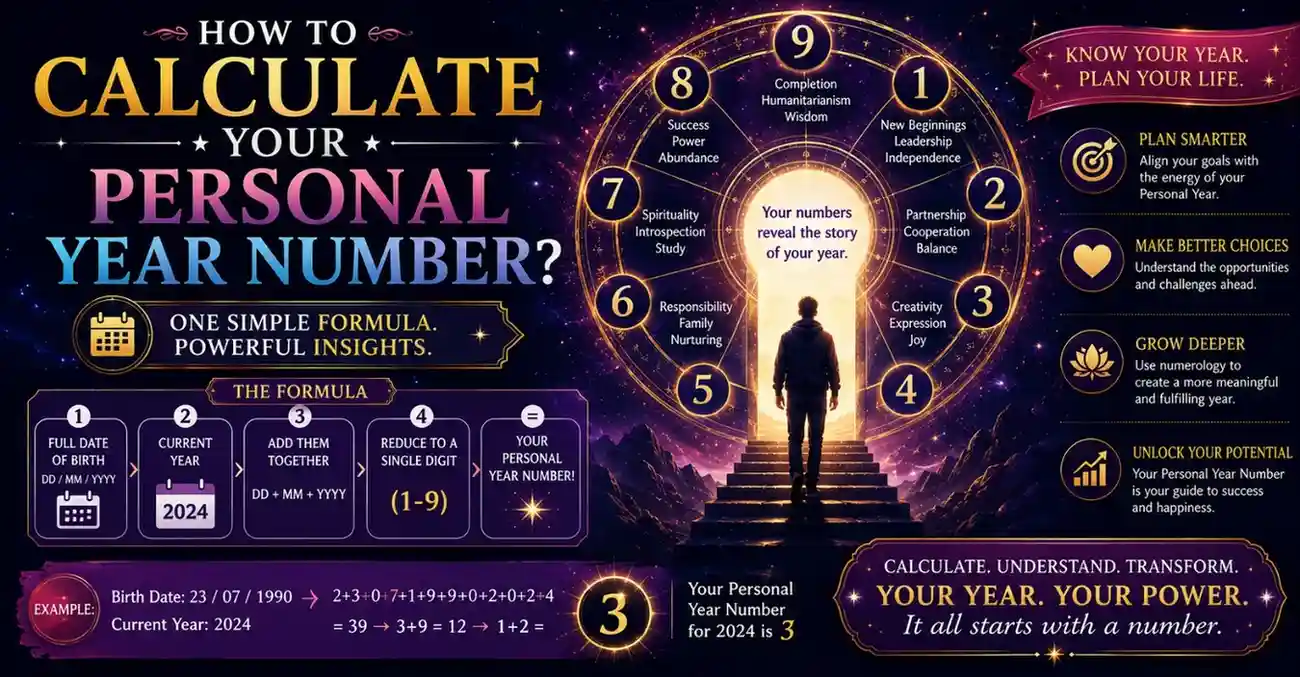
If you’ve ever felt like some years hand you fresh starts on a silver platter while others seem built for quiet reflection or sudden endings, numerology has an explanation — and a formula. It’s called your Personal Year Number, and it’s one of the most practical, immediately useful tools in the entire numerology system. Unlike your Life Path Number, which stays fixed for your entire life, your Personal Year Number changes every twelve months, moving you through a repeating nine-year cycle of growth, challenge, and renewal.
As a numerologist, this is the calculation I get asked about more than almost any other — and for good reason. Once you know your Personal Year Number, you stop swimming against the current of the year and start moving with it. You’ll understand why 2024 felt like a bulldozer clearing the way for something new, or why last year felt like wading through mud no matter how hard you tried. This guide will walk you through exactly how to calculate your Personal Year Number, explain the two competing methods numerologists use (and which one to trust), show you worked examples, and break down what each number from 1 through 9 — plus the master numbers 11, 22, and 33 — actually means for the year ahead.
Let’s get into it.
What Is a Personal Year Number in Numerology?
Your Personal Year Number is a single digit (or occasionally a master number) that represents the dominant energetic theme of a twelve-month period in your life. It’s calculated by combining your birth day, your birth month, and the calendar year in question, then reducing that sum down using the same digit-reduction method numerologists use for every core number in a chart.
Think of it as a weather forecast for your life. It doesn’t dictate exactly what will happen, but it tells you what conditions to expect — sunshine for planting seeds, storms for testing your foundations, or clear skies for reaping a harvest you planted years earlier. Numerologists believe these years unfold in a repeating nine-year cycle, starting with a Personal Year 1 (a fresh beginning) and ending with a Personal Year 9 (completion and release), before the cycle begins again.
This is different from your Life Path Number, which is calculated once from your full birth date and never changes. Your Life Path is your core identity — the “who you are” number. Your Personal Year is dynamic — the “what’s happening right now” number. Together, they give you both the map and the current weather conditions for your journey.
Why Your Personal Year Number Matters
Before we get into the math, it’s worth understanding why this calculation is worth your time in the first place.
Numerology operates on the premise that numbers carry vibrational qualities, and that these vibrations influence the timing of opportunities, challenges, relationships, and personal growth. When you know which number you’re currently living through, you gain a kind of situational awareness that’s genuinely useful:
- You stop forcing action during years meant for rest or reflection.
- You recognize windows of opportunity instead of letting them pass unnoticed.
- You understand why relationships, career moves, or big decisions feel easier or harder than usual.
- You can plan major life events — weddings, business launches, moves — with better timing.
- You gain language and context for emotional patterns that might otherwise feel confusing or random.
This isn’t about fatalism or believing a number controls your destiny. It’s about pattern recognition — the same reason a farmer checks the season before planting, or a sailor checks the tide before setting out. The number doesn’t write your story, but it does tell you what kind of chapter you’re in.
The Step-by-Step Method: How to Calculate Your Personal Year Number
Here is the core formula, broken into clear, repeatable steps. Grab a pen and your birth date — you’ll be able to calculate this in under a minute.
Step 1: Write Down Your Birth Month and Birth Day
You only need your month and day of birth for this calculation — not your birth year. Your birth year is already “baked into” your Life Path Number; for your Personal Year, the current calendar year takes its place.
For example, if you were born on March 14, you would work with:
- Month: 3 (March)
- Day: 14
Step 2: Reduce Your Birth Month and Birth Day to Single Digits (With One Exception)
Reduce each number by adding its digits together until you reach a single digit, 1 through 9.
Using our example:
- Month: 3 (already a single digit, no reduction needed)
- Day: 14 → 1 + 4 = 5
The master number exception: In numerology, the numbers 11, 22, and 33 are considered “master numbers” and are traditionally not reduced further, because they’re believed to carry amplified spiritual significance. So if your birth day is 11, 22, or 29 (which reduces to 11), or your birth month is November (11), many numerologists will preserve that master number rather than collapsing it to 2 or 4. We’ll cover this nuance more in the Master Numbers section below.
Step 3: Reduce the Current Calendar Year to a Single Digit
Take the four-digit year you want to calculate for and add its digits together until you reach a single digit.
For 2026, for example: 2 + 0 + 2 + 6 = 10 → 1 + 0 = 1
So 2026 is what numerologists call a “1 Universal Year” — a year of new beginnings for the collective, layered underneath everyone’s individual Personal Year energy.
Step 4: Add the Reduced Month, Day, and Year Together
Now combine your three reduced numbers:
Month (3) + Day (5) + Year (1) = 9
Step 5: Reduce the Final Total to a Single Digit (Unless It’s a Master Number)
If your total from Step 4 is already a single digit, you’re done. If it’s a double-digit number, reduce it one more time by adding its digits together — unless that number is 11, 22, or 33.
In our example, the total is already 9, so no further reduction is needed. This person’s Personal Year Number for 2026 is 9 — a year of completion, release, and closing chapters.
The Formula at a Glance
Reduced Birth Month + Reduced Birth Day + Reduced Calendar Year = (reduce again if needed) = Your Personal Year Number
A Second Worked Example
Let’s calculate a full example from scratch so you can see the process applied to a different birth date.
Say you were born on September 28, and you want your Personal Year Number for 2027.
- Birth month: September = 9 (already single digit)
- Birth day: 28 → 2 + 8 = 10 → 1 + 0 = 1
- Calendar year: 2027 → 2 + 0 + 2 + 7 = 11. Since this reduces further under most methods (unless you’re preserving it as a master year), 1 + 1 = 2
- Add them together: 9 + 1 + 2 = 12
- Reduce again: 1 + 2 = 3
This person’s Personal Year Number for 2027 is 3 — a year favoring creativity, self-expression, and social expansion.
An Alternative Calculation Method You’ll See Online
You may notice that some numerology sites and calculators present the formula slightly differently — adding the unreduced birth day and month together first, and only reducing at the very end, alongside the year. Both approaches are widely used and, in the vast majority of cases, produce the identical result. For example, some calculators add the number of birth date, birth month and the year for which you would like a reading, then reduce the sum to a single digit (1 to 9) or until a master number 11, 22 or 33.
Many calculators simply add the full birth date and the calendar year together in one pass, then reduce the entire sum to a single digit or master number at the very end. The difference between the two approaches only matters at the margins — specifically around whether a master number appears briefly mid-calculation and gets preserved or “flattened.” If you want to be thorough, you can calculate it both ways; in almost every case, you’ll land on the same final digit. When in doubt, most professional numerologists preserve master numbers (11, 22, 33) at every stage of the calculation rather than reducing them prematurely, since collapsing them too early can erase meaningful nuance in your reading.
Do You Use Your Birthday or January 1st? The Two Schools of Thought
This is where numerologists genuinely disagree, and it’s worth understanding both camps so you can decide which resonates with you.
Method 1: The Calendar Year Approach
The majority of modern numerologists calculate your Personal Year using the standard calendar year — January 1st through December 31st. Under this method, your Personal Year Number changes on New Year’s Day, in sync with the Universal Year Number, and stays consistent through the following December. This is the method used in most published forecasts, calculators, and numerology books, largely because it’s simpler to communicate and aligns with how most people already think about “this year” versus “next year.”
Method 2: The Birthday-to-Birthday Approach
A smaller but respected group of numerologists argue that your personal energetic year actually begins on your birthday, not on January 1st — similar to the concept of a “Solar Return” in astrology. Under this method, if your birthday is in July, your Personal Year 5 (for example) would run from this July through next July, not from January to December.
Numerologists who favor the calendar-year method often note that the energy of a Personal Year tends to build gradually, intensify around the birthday, and then peak later in the year — which is why some practitioners describe a “cusp” transition period surrounding the birthday even when using the January-to-December model. In practice, many numerologists suggest testing both methods against your own lived experience over a year or two to see which one lines up more accurately with the real shifts and turning points in your life. There’s no universally “correct” answer here — only the version that proves itself true through your own observation.
Understanding the Nine-Year Cycle
Once you know how to calculate a single Personal Year, it helps to zoom out and see the whole picture. Numerology treats your life as a series of repeating nine-year cycles, each one building on the last like chapters in a book. You don’t jump randomly between numbers — you move sequentially, year by year, from 1 through 9, and then the cycle begins again at 1.
This means your Personal Year 1 this decade will feel thematically similar to your Personal Year 1 nine years ago — but you’ll meet it with more wisdom, more resources, and a different life context. The cycle repeats, but you don’t repeat with it; you spiral upward.
Here’s the full arc, from opening to closing:
Personal Year 1: New Beginnings
This is the seed-planting year. Doors that have been stuck for years suddenly swing open. It favors starting new projects, relationships, jobs, or creative ventures — but it can also bring a restless, impatient energy, and sometimes an unexpected sense of loneliness as you step into unfamiliar territory. Whatever you initiate now sets the tone for the next eight years, so this is a year to act with intention rather than impulsiveness.
Personal Year 2: Cooperation and Patience
After the burst of energy in Year 1, Year 2 slows things down considerably. This is a year for partnership, diplomacy, and emotional depth — but also one that tests patience, boundaries, and your ability to compromise without losing yourself. Relationships (romantic, business, and family) tend to take center stage, for better or worse.
Personal Year 3: Expression and Expansion
Year 3 lifts the mood. Creativity, communication, socializing, and self-expression are highlighted, making this an excellent year for writing, public speaking, art, or simply putting yourself out there more. The shadow side is scattered focus — Year 3 can tempt you to spread your energy too thin across too many projects or people.
Personal Year 4: Structure and Hard Work
This is the foundation-building year. Year 4 favors discipline, routine, financial planning, and long-term structure over short-term excitement. It can feel restrictive or even tedious compared to the year before it, but the effort invested now typically pays off for years to come. Skipping this year’s lessons tends to create problems that resurface later in the cycle.
Personal Year 5: Change and Freedom
Year 5 is the wildcard of the cycle — a year of unexpected change, travel, and freedom-seeking energy. Plans made in Year 4 often get disrupted or accelerated here. This year rewards flexibility and punishes rigidity; those who resist change tend to have it forced upon them anyway.
Personal Year 6: Responsibility and Relationships
Year 6 draws attention back to home, family, and responsibility — sometimes including caretaking duties, marriage, home purchases, or the birth of children. It’s a nurturing, service-oriented year, but it can also bring a heavy sense of obligation if boundaries aren’t maintained.
Personal Year 7: Reflection and Inner Growth
Often described by numerologists as the most misunderstood year in the cycle, Year 7 turns your attention inward. External progress may slow or even seem to stall, but this is deliberate — this is a year built for study, spiritual growth, rest, and introspection rather than outward achievement. Numerologists frequently note that trying to force major external action during a 7 year tends to backfire, while embracing its quieter rhythm can produce lasting personal insight.
Personal Year 8: Power and Achievement
Year 8 is associated with material reward, recognition, career advancement, and financial gain — essentially, the harvest of everything planted in the previous seven years. It’s considered one of the most powerful years in the cycle for business, leadership, and tangible results, though it can also bring intense demands on your time and energy.
Personal Year 9: Completion and Release
The final year of the cycle is about endings — closing chapters, letting go of what no longer serves you, and clearing space for the new 1 Year ahead. This can manifest as literal endings (relationships, jobs, living situations) or simply a strong internal pull to release old patterns. Resisting the theme of release during a 9 Year tends to create unnecessary friction; leaning into it prepares you for a much smoother new beginning.
Master Numbers: 11, 22, and 33 in Your Personal Year
Occasionally, your calculation will land on 11, 22, or 33 before final reduction. In numerology, these are called master numbers, and they’re traditionally treated as more intense, higher-voltage versions of their reduced counterparts:
- 11 carries the amplified qualities of 2 (intuition, sensitivity, partnership) with an added spiritual intensity — often described as illuminating but demanding.
- 22 carries the amplified qualities of 4 (structure, discipline) combined with the vision to build something on a much larger scale — sometimes called “the Master Builder.”
- 33 carries the amplified qualities of 6 (nurturing, responsibility) with a heightened, almost selfless devotion to service or teaching others.
Not every numerologist agrees on when to preserve a master number versus reducing it fully. Some practitioners keep 11, 22, or 33 intact any time they appear at any stage of the calculation — birth month, birth day, calendar year, or final total. Others only preserve the master number if it appears in the final sum. If your calculation produces a master number, it’s worth exploring both interpretations (the master number itself, and its reduced single-digit form) to see which description feels more accurate to your experience of the year.
Calculating Your Personal Month and Personal Day Numbers
Once you know your Personal Year Number, you can zoom in further to get a monthly — and even daily — forecast. This is a natural next step for anyone who wants more granular timing insight.
Personal Month Number
To find your Personal Month Number, simply add the calendar month number to your Personal Year Number, then reduce to a single digit if needed.
For example, if your Personal Year Number is 9 and you want to know your Personal Month for June (month 6):
9 + 6 = 15 → 1 + 5 = 6
June would be a Personal Month 6 for this person — a month emphasizing home, relationships, and responsibility, layered on top of that year’s broader theme of completion.
Personal Day Number
To go even further, add the day of the month to your Personal Month Number, reducing as usual. This gives you a day-by-day sense of momentum, useful for timing important conversations, launches, or decisions with more precision.
Common Mistakes to Avoid When Calculating Your Personal Year Number
Even a simple formula can go wrong if a few key rules get overlooked. Here are the mistakes I see most often:
Including your birth year in the calculation.
Your Personal Year formula uses your birth month, birth day, and the current calendar year — not the year you were born. Confusing these two produces a meaningless result.
Reducing too early or inconsistently.
Decide whether you’re reducing your birth month and day individually before adding, or adding everything first and reducing once at the end. Either method is valid, but switching between them mid-calculation can produce different (and confusing) results.
Flattening master numbers without realizing it.
If your birth day, birth month, or year total lands on 11, 22, or 33, pause before reducing further. Many numerologists intentionally preserve these numbers rather than collapsing them automatically.
Assuming the transition happens on January 1st when your practice uses birthday-to-birthday.
If you’ve chosen to follow the birthday-based method, remember your Personal Year Number shifts on your birthday, not on New Year’s Eve — mixing the two systems will throw off your monthly and daily calculations too.
Treating the number as a fixed prediction rather than a theme.
A Personal Year Number describes an energetic climate, not a guaranteed script of events. Two people in the same Personal Year will experience its themes very differently depending on their broader chart, choices, and circumstances.
How to Use Your Personal Year Number in Real Life
Knowing your number is only half the value — the real benefit comes from applying it. Here’s how experienced numerology practitioners typically recommend working with this information:
- Align major decisions with the right year. Save aggressive career pivots, business launches, or big financial risks for years 1, 5, or 8, when momentum and opportunity tend to be strongest.
- Use reflective years intentionally. Instead of fighting the slower pace of a Year 7, use it for study, therapy, journaling, or spiritual practice — the growth still counts, even if it’s invisible from the outside.
- Watch for repeating patterns. Look back at your last 7, 8, or 9 year (nine years ago) and notice the parallels with what’s unfolding now. Numerology cycles rhyme, even when circumstances differ.
- Combine it with your Life Path Number. Your Personal Year interacts with your core Life Path energy — a Life Path 1 experiencing a Personal Year 9 will process endings differently than a Life Path 6 would.
- Track your Personal Month and Day for finer timing. Use the monthly and daily layers when you need to time something specific, like a proposal, interview, or important conversation.
Where This System Comes From
The concept of the Personal Year cycle traces back to the broader tradition of Pythagorean numerology, named after the ancient Greek mathematician Pythagoras, who is widely credited with the idea that numbers underlie the structure of the universe and carry meaning beyond simple quantity. Modern numerologists built on this foundation over the past century, formalizing the nine-year cycle framework and the reduction techniques still used today. You’ll also encounter Chaldean numerology, an older system with different letter-to-number correspondences and a slightly different approach to master numbers — but the core mechanics of calculating a Personal Year Number remain largely consistent across both schools, since the calculation relies on dates rather than names or letters.
Understanding this lineage matters for one practical reason: if you ever see two calculators disagree on your Personal Year Number, the discrepancy usually traces back to a difference in method (calendar year versus birthday-to-birthday, or how master numbers are handled) rather than a difference in the underlying tradition. Knowing the “why” behind the math makes it much easier to troubleshoot inconsistencies instead of assuming the calculation itself is unreliable.
A Quick Reference Table for the Nine-Year Cycle
Because the themes of each Personal Year can be a lot to hold in your head at once, it helps to have a condensed reference you can return to whenever you recalculate your number for a new year:
| Personal Year | Core Theme | Best Used For |
|---|---|---|
| 1 | New beginnings | Starting projects, relationships, or ventures |
| 2 | Cooperation | Partnership, patience, emotional depth |
| 3 | Self-expression | Creativity, communication, socializing |
| 4 | Structure | Discipline, routine, financial planning |
| 5 | Change | Travel, flexibility, embracing the unexpected |
| 6 | Responsibility | Family, home, caretaking, commitment |
| 7 | Reflection | Study, rest, spiritual and inner growth |
| 8 | Achievement | Career advancement, financial reward |
| 9 | Completion | Letting go, closing chapters, clearing space |
Keep this table handy as you move through the calculation steps above — once you know your number, you can jump straight to the row that matches your current year and get an immediate sense of its dominant energy before diving into the fuller description elsewhere in this guide.
Frequently Asked Questions About Personal Year Numbers
Does the Personal Year Number change every year?
Yes. It shifts every year, moving sequentially through the nine-year cycle (or resetting to 1 after a 9 Year), either on January 1st or your birthday depending on which method you follow.
Can two people have the same Personal Year Number?
Absolutely — and very commonly. Since the calculation only depends on your birth month, birth day, and the current year, many people around the world will share the same Personal Year Number in any given year, though its effects will play out differently based on their broader numerology chart.
Is a Personal Year 9 always negative?
No. While Year 9 involves endings and release, it’s often described as one of the most liberating years in the cycle, because it clears space for the fresh start that follows in Year 1. Endings, in numerology, are simply the necessary companion to new beginnings.
Which method should I trust — calendar year or birthday-to-birthday?
Both are used by credible, experienced numerologists. Since there’s no universal consensus, the most reliable approach is to test both methods against your own life over a year or two and see which one more accurately reflects your lived experience.
Do I need my birth year for this calculation?
No — that’s one of the most common points of confusion. Your Personal Year Number uses your birth month, birth day, and the current (or target) calendar year, not your birth year.
Final Thoughts
Your Personal Year Number is one of the simplest calculations in all of numerology, and also one of the most immediately practical. In just a few additions, you can uncover the underlying theme guiding your next twelve months — whether that’s a bold new beginning, a demanding year of structure, or a gentle season of release. The formula itself takes less than a minute to work through, but the awareness it offers can shape how you approach decisions, relationships, and timing all year long.
As with all numerology, treat this number as a compass rather than a cage. It tells you the general direction of the current, not the exact shape of every wave. Calculate your number, sit with its themes, compare it against your own lived experience, and let it inform — rather than dictate — the choices you make this year.
My Today’s Horoscope delivers carefully researched articles, accurate daily horoscopes, expert spiritual guidance, in-depth zodiac compatibility insights, birthday horoscopes, numerology interpretations, tarot readings, and practical astrology tools for everyone—from curious beginners to seasoned astrology enthusiasts. (See our Site Index to quickly find what we have to offer)